

Sensex Slips 330 Points, Nifty Snaps 4-Day Winning Streak To End At 23,329 As IT Stocks Drag
September 22, 2026 | by NammaStockMarket
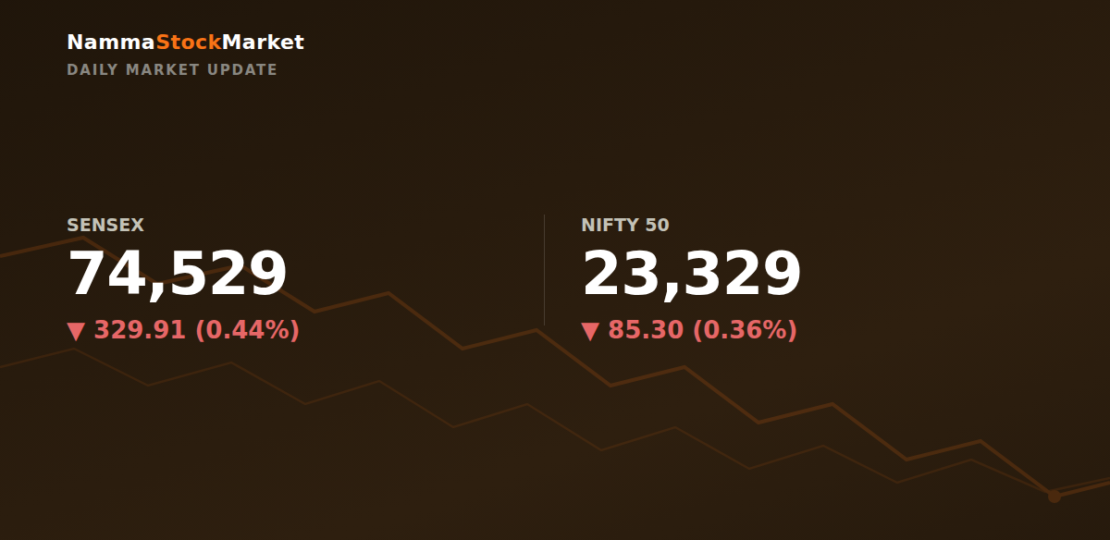
The Indian stock market gave up its winning streak today. The BSE Sensex fell 329.91 points, or 0.44%, to close at 74,529.08, while the NSE Nifty 50 dropped 85.30 points, or 0.36%, to end at 23,329.00. This breaks Nifty’s four-day rally and comes even though global cues overnight were actually quite good, with Wall Street’s Nasdaq hitting a fresh record high. The big reason Dalal Street couldn’t join that party was IT stocks, which were sold off heavily through the day, along with some profit booking in banking and FMCG names. On the brighter side, cooling crude oil prices gave the rupee some relief and kept realty and metal stocks in the green.
If you’re someone who checks your portfolio every evening, today was one of those mixed, slightly frustrating days: nothing dramatic happened, but if you’re holding IT stocks or largecap FMCG names like Nestle and Tata Consumer, you probably saw red. If you’re into realty or metals, you likely ended the day in the green. Let’s break down exactly what happened and why.
Market At A Glance
| Index | Close | Points Change | % Change |
|---|---|---|---|
| BSE Sensex | 74,529.08 | ▼ 329.91 | ▼ 0.44% |
| NSE Nifty 50 | 23,329.00 | ▼ 85.30 | ▼ 0.36% |
| Bank Nifty | 56,215.55 | ▼ 255.10 | ▼ 0.45% |
| Nifty Midcap 100 | 61,898.35 | ▼ 114.75 | ▼ 0.19% |
| Nifty Smallcap 100 | 19,807.20 | ▼ 54.30 | ▼ 0.27% |
| India VIX | 10.93 | ▼ 0.32 | ▼ 2.93% |
Note: India VIX (a measure of how much volatility, or ups and downs, traders expect in the market over the next 30 days) actually fell today even though the headline indices were down — more on why that happened below.
Why The Market Moved
Here’s the thing that probably confused a few people today: global cues were genuinely good. Overnight in the US, the Nasdaq closed at a record high, its first since June, on the back of a massive rally in tech and semiconductor stocks. Meta Platforms jumped over 11%, Intel jumped 12%, and AMD rose close to 10% and crossed a $1 trillion (that’s trillion, with a T) market value for the first time ever. The S&P 500 was up 1.5% and the Dow Jones added 0.7%. Normally, when American tech does well overnight, Indian IT stocks open higher too, because a lot of our IT companies get their revenue from exactly these kinds of US tech and enterprise clients.
But today, the opposite happened. Indian IT stocks — HCL Technologies, Tech Mahindra, Infosys, and others — were sold off through the session and ended up being the single worst-performing sector, down 0.86%. Part of the reason is that Indian IT has been under pressure for a while now on demand worries (basically, worries that US and European companies are cutting back on the IT spending that Indian outsourcing firms depend on), and foreign investors have been steadily selling this sector. A good Nasdaq night wasn’t enough to change that mood. There was also some pressure from today being an F&O expiry day — that’s the day derivative contracts (futures and options, which are essentially bets on where a stock or index will go, with a fixed expiry date) settle for the month, and this often brings extra volatility as traders close out or roll over their positions.
The other big story of the day was oil. Brent crude (the international benchmark used to price oil, quoted in US dollars per barrel) fell more than 2% to close near $98 a barrel, its fifth straight day of declines. This matters a lot for India because we import close to 85% of the crude oil we use. When oil gets expensive, our oil import bill goes up, which puts pressure on the rupee and pushes up inflation, since fuel costs eventually feed into the price of almost everything — transport, manufacturing, plastics, and so on. So when oil cools off like it did today, it’s actually good news for the Indian economy, even if it didn’t fully show up in the index numbers because of the IT-led selling. The oil fall came after reports that Iran might reopen the Strait of Hormuz — a narrow sea route through which a huge chunk of the world’s oil supply passes — if the US lifts its naval blockade on Iranian ports. This is part of an ongoing conflict in the region that has kept oil prices elevated and volatile since around August this year, so any sign of things cooling down brings quick relief to oil prices.
Which Sectors Held Up, And Which Didn’t
It was a real mixed bag sector-wise today. Realty and metals bucked the overall weak trend and closed higher, while IT, consumer durables, and FMCG dragged the market down.
| Sector | % Change |
|---|---|
| Media | ▲ 1.00% |
| Realty | ▲ 0.90% |
| Metal | ▲ 0.14% |
| Auto | ▼ 0.24% |
| Energy | ▼ 0.24% |
| Pharma | ▼ 0.41% |
| Financial Services | ▼ 0.42% |
| FMCG | ▼ 0.53% |
| Consumer Durables | ▼ 0.64% |
| IT | ▼ 0.86% |
Realty stocks like Sobha, Anant Raj, and DLF led the gainers list for a second straight session, continuing a run that’s been driven by hopes of festive season demand and steady home loan rates. Metal stocks also managed small gains, helped by some stability in global commodity prices. On the other side, IT was clearly the sector to avoid today, and if you’re holding a chunky IT allocation in your demat account (the account that holds your shares in electronic form, same as your trading account is what you use to actually place buy and sell orders), today probably wasn’t fun to watch. FMCG names also had a rough day, weighed down by weakness in heavyweights like Nestle India and Tata Consumer Products.
Today’s Top Movers
Coal India was the standout gainer of the day, jumping over 3% on continued strength in the energy and mining space. Here’s the full list of today’s top 5 gainers and losers in the Nifty:
| Stock | % Change |
|---|---|
| Coal India | ▲ 3.21% |
| Eternal (Zomato) | ▲ 1.82% |
| InterGlobe Aviation (IndiGo) | ▲ 1.80% |
| Titan Company | ▲ 1.09% |
| Dr. Reddy’s Laboratories | ▲ 0.64% |
| Stock | % Change |
|---|---|
| Tata Consumer Products | ▼ 1.65% |
| Nestle India | ▼ 1.52% |
| Bajaj Finserv | ▼ 1.43% |
| Bajaj Finance | ▼ 1.22% |
| Grasim Industries | ▼ 1.19% |
Notice how three of the five losers today — Tata Consumer, Nestle, and to some extent Grasim — are consumption-linked names. That tracks with the FMCG and consumer durables weakness we saw sector-wide. Bajaj Finance and Bajaj Finserv, the two Bajaj group financial stocks that tend to move together since Bajaj Finserv holds a big stake in Bajaj Finance, both fell in tandem too. On the gainers’ side, travel and aviation stock IndiGo continues its good run, helped by easing crude oil prices, since fuel is one of the biggest costs for any airline — cheaper oil directly helps their profit margins.
What FIIs and DIIs Were Doing
If you follow market news even a little, you’ll keep hearing the terms FII and DII. FII stands for Foreign Institutional Investor — basically big foreign funds and institutions that invest in Indian shares from outside the country. DII stands for Domestic Institutional Investor — Indian mutual funds, insurance companies like LIC, and other big domestic players. Tracking what these two big groups are doing with their money is one of the best ways to understand the mood behind a market move, since retail investors like you and me are a much smaller piece of the daily trading volume compared to these institutions.
Today’s official FII/DII cash market figures for September 22 were not out at the time of writing — this data usually gets released by the exchanges after market hours and is confirmed the next morning, so we’ll have a clearer picture tomorrow. Here’s what the last five trading days looked like:
| Date | FII Net (₹ Crore) | DII Net (₹ Crore) |
|---|---|---|
| 21 Sep 2026 | ▼ 576 | ▲ 2,797 |
| 18 Sep 2026 | ▲ 600 | ▲ 1,020 |
| 17 Sep 2026 | ▼ 3,209 | ▲ 3,618 |
| 16 Sep 2026 | ▼ 2,033 | ▲ 3,908 |
| 15 Sep 2026 | ▼ 2,978 | ▲ 2,686 |
The pattern here has been pretty consistent through September: FIIs have been net sellers on most days, pulling money out of Indian equities, while DIIs have been buying steadily and cushioning the market from a sharper fall. This is a trend worth watching if you invest through a mutual fund SIP (Systematic Investment Plan, where you invest a fixed amount every month rather than a lump sum) — it means domestic money, a good chunk of which comes from retail investors just like you putting money into SIPs every month, is currently the market’s main support system while foreign money stays cautious.
Oil, The Rupee, And Global Cues
We touched on crude oil already, but let’s connect the dots properly. Brent crude closed near $98 a barrel today, down about 2%, extending a five-day losing streak. This came on reports that Iran could reopen the Strait of Hormuz if the US eases its naval blockade on Iranian ports — a potential de-escalation in a conflict that has kept oil markets on edge since August. Lower oil prices are good news for India in a very direct way: cheaper crude means a smaller oil import bill (India imports roughly 85% of its crude needs), which takes some pressure off the rupee and helps keep a lid on inflation.
That relief showed up clearly in the currency market today. The rupee strengthened by about 22 paise against the US dollar, closing near ₹95.59, compared to yesterday’s close of ₹95.81. A stronger rupee is generally good news if you’re someone who travels abroad, studies overseas, or buys imported goods, since your rupees now buy a little more. It’s a mixed bag for IT and pharma exporters though, since a stronger rupee means their dollar earnings convert into slightly fewer rupees.
On the global front, the mood was actually upbeat. Besides the Nasdaq’s record close, there were also positive signals from preliminary US-China trade talks covering trade, investment, and AI, with a bigger meeting expected later this week that could extend a trade truce currently set to expire in November. US President Trump also signalled some openness to talks with Iranian leadership, which is part of what’s driving the optimism around oil supply easing up. US 10-year Treasury yields (a benchmark interest rate that affects how expensive it is for governments and companies to borrow globally) eased too, which is usually taken as a positive sign for emerging markets like India, since lower US yields make it relatively more attractive for foreign money to flow into markets like ours.
What To Watch Tomorrow
Nifty has key support around the 23,200 to 23,300 zone — that’s the level traders will watch closely to see if the recent selling continues or if buyers step back in. A sustained move below this zone could open the door to further weakness, while a bounce back above 23,400 would suggest today was just a one-off pause rather than a full trend change. Keep an eye on how IT stocks behave over the next couple of sessions — if the Nasdaq strength eventually filters through to Indian IT sentiment, that could be the sector to watch for a reversal. Also worth tracking: whether crude oil’s slide continues, since that directly affects how the rupee and inflation-sensitive stocks behave. Any fresh headlines on the Iran situation and the Strait of Hormuz could quickly swing oil prices either way, so this remains one of the biggest wildcards for the Indian market right now. On the results and events front, keep watching for FII/DII numbers tomorrow morning to confirm today’s institutional flow pattern, and stay alert to any RBI commentary on inflation given how closely it’s tied to the oil and rupee picture. As always, this is informational and not investment advice — do your own research or speak to a financial advisor before making any trading decisions.
RELATED POSTS
View all

Sensex Jumps 564 Points, Nifty Reclaims 23,400 As Cooling Crude Oil Lifts Sentiment
September 21, 2026 | by NammaStockMarket
Sensex, Nifty Fall Over 1% as Crude Oil Surges; IT Stocks Buck the Trend
September 15, 2026 | by NammaStockMarket
Nifty Ends Higher At 23,346 As Smallcaps Jump 1.7%, But TCS Crash Drags Sensex Into The Red
September 18, 2026 | by NammaStockMarket