

Sensex Gains 299 Points, Nifty Ends Above 23,400 As Crude Oil Drops Below $100; Metal Stocks Jump 2.4%, IT Slips
September 23, 2026 | by NammaStockMarket
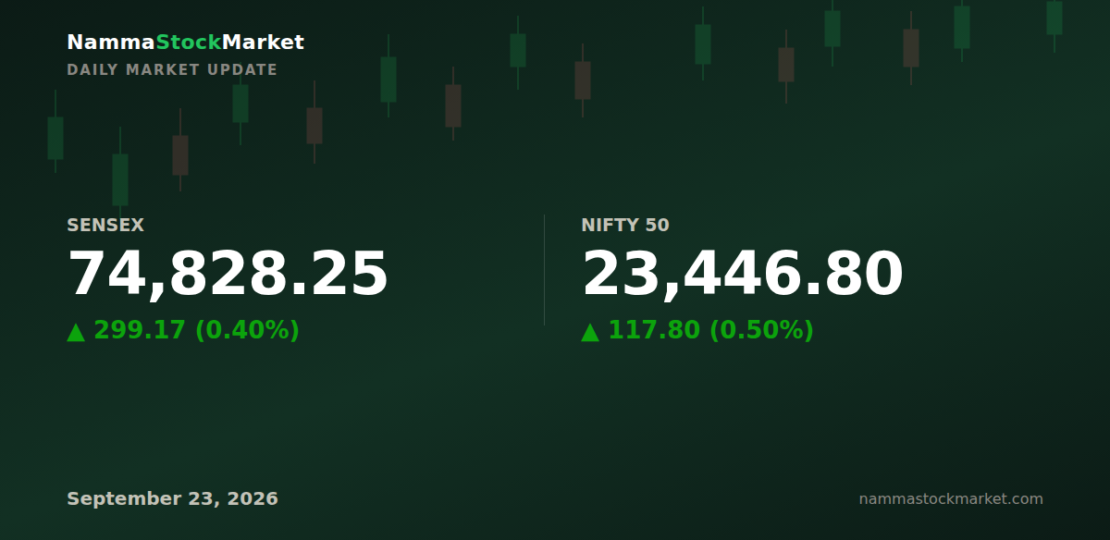
The Indian stock market closed higher on Wednesday, September 23, 2026, and if you were holding metal or FMCG stocks, you’d have had a genuinely good day. The BSE Sensex climbed 299.17 points, or 0.40%, to end at 74,828.25, while the NSE Nifty 50 added 117.80 points, or 0.50%, to close at 23,446.80. This was the second gain in three sessions, coming right after Tuesday’s IT-led slip, and it was mostly a story of cooling crude oil prices and easing tension in the Middle East giving investors a reason to buy again.
Two big things pushed the market up today. First, Brent crude oil fell below the $100 a barrel mark for the first time in about two weeks, which is genuinely good news for a country like India that imports most of its oil. Second, there were fresh signs of the US and Iran talking things out diplomatically, plus Saudi Arabia restarting a key pipeline, both of which calmed fears of an oil supply shock. That combination lifted sentiment across the board, even though IT stocks continued to be the odd ones out, dragged down by weak commentary on US tech spending and a stronger-for-longer view on the dollar hurting the sector’s earnings outlook.
Market At A Glance
| Index | Close | Points Change | % Change |
|---|---|---|---|
| BSE Sensex | 74,828.25 | ▲ 299.17 | ▲ 0.40% |
| NSE Nifty 50 | 23,446.80 | ▲ 117.80 | ▲ 0.50% |
| Bank Nifty | 56,548.90 | ▲ 333.35 | ▲ 0.59% |
| Nifty Midcap 100 | — | — | ▲ 0.69% |
| Nifty Smallcap 100 | — | — | ▲ 0.88% |
| India VIX | 10.29 | ▼ 0.70 | ▼ 6.41% |
Note: exact closing levels for Nifty Midcap 100 and Nifty Smallcap 100 were not available from the sources checked at the time of publishing — only their day’s percentage move is shown above.
Why The Market Moved
If you’re newer to investing, you might wonder why crude oil prices moving in far-away markets should matter to your portfolio here in India. Here’s the simple version: India buys close to 85% of the oil it needs from other countries, so when oil gets expensive, India has to pay more dollars for it. That widens what’s called the “import bill” — basically the country’s total shopping bill in dollars — and a bigger import bill puts pressure on the rupee, because more dollars are flowing out than coming in. A weaker rupee, in turn, makes everything from petrol to imported electronics costlier, which feeds into inflation. So when Brent crude fell to $98.26 a barrel today, down about 1.02%, it wasn’t just an oil story — it was read by the market as slightly less pressure on India’s import bill, the rupee and inflation, and that’s a big part of why banks, autos and consumer-facing stocks all found buyers today.
The other thing worth understanding is India VIX, which is sometimes called the market’s “fear gauge.” It measures how much swing traders expect in the Nifty over the next 30 days — a high VIX means people expect a rough, volatile ride, and a falling VIX means the market is getting calmer. Today, India VIX dropped sharply, down 6.41% to 10.29, which is a fairly low level. That tells you options traders were pricing in less turbulence after the oil-driven anxiety of the past couple of weeks eased off. A calmer VIX usually goes hand in hand with a steadier, broad-based rally, which is roughly what we saw today.
Which Sectors Held Up, And Which Didn’t
| Sector | % Change |
|---|---|
| Metal | ▲ 2.40% |
| FMCG | ▲ 1.32% |
| Realty | ▲ 1.10% |
| Pharma | ▲ 0.90% |
| Consumer Durables | ▲ 0.63% |
| Financial Services (Banks/NBFCs) | ▲ 0.58% |
| Auto | ▲ 0.26% |
| Energy | ▲ 0.09% |
| IT | ▼ 0.87% |
Metal stocks were the star of the show today, up a strong 2.40%, with Tata Steel, Hindalco and JSW Steel all in the top gainers list. Part of this is the usual story of lower crude and softer input costs helping metal companies’ margins, and part of it is China-related demand chatter that’s been doing the rounds this week. FMCG had a good day too, up 1.32%, as investors rotated into safer, steady-earnings consumer names, and realty and pharma weren’t far behind. If you’re holding banking or NBFC stocks (grouped here as Financial Services), you had a quiet but positive day, up 0.58%, largely on the back of Bajaj Finance’s strong showing. The one sore spot, as has been the pattern this week, was IT — down 0.87%, with HCL Tech, Infosys and TCS all ending in the red. If you’re holding IT stocks, today wasn’t a great day, and this has now been a recurring theme through the second half of September as the sector deals with a stronger dollar and cautious client spending commentary out of the US.
Today’s Top Movers
Bajaj Finance led the gainers’ chart today, up 3.41%, followed closely by Hindalco Industries and Tata Steel, both up over 3%. Apollo Hospitals and JSW Steel rounded out the top five, both comfortably in the green. This list tells you today’s rally wasn’t just about one sector — you had a large NBFC, two metal names and a hospital chain all doing well together, which is usually a healthy sign for the broader market rather than a narrow, one-sector pump.
| Stock | % Change |
|---|---|
| Bajaj Finance | ▲ 3.41% |
| Hindalco Industries | ▲ 3.17% |
| Tata Steel | ▲ 3.16% |
| Apollo Hospitals Enterprise | ▲ 2.64% |
| JSW Steel | ▲ 2.43% |
On the losing side, it was almost entirely an IT and largecap story. HCL Technologies was the biggest loser among Nifty stocks, down 1.08%, with Titan, Infosys, Coal India and TCS also ending lower. Titan’s presence here is a bit different from the IT names — it’s more to do with some profit-booking in consumer durables after a recent run-up, rather than any sector-wide worry.
| Stock | % Change |
|---|---|
| HCL Technologies | ▼ 1.08% |
| Titan Company | ▼ 0.98% |
| Infosys | ▼ 0.86% |
| Coal India | ▼ 0.81% |
| Tata Consultancy Services | ▼ 0.73% |
What FIIs and DIIs Were Doing
You’ll often see the terms FII and DII in market reports, so here’s a quick explainer if you’re not familiar with them. FIIs, or Foreign Institutional Investors, are big foreign funds and institutions that invest in Indian shares from outside the country. DIIs, or Domestic Institutional Investors, are Indian institutions like mutual funds, insurance companies (think LIC) and pension funds that invest money raised largely from Indian retail investors — including the money that flows in every month through your SIP if you invest in mutual funds. Watching what these two big groups are doing on any given day tells you a lot about the underlying mood in the market, beyond just the index numbers.
Today’s official FII/DII cash-market figures for September 23 hadn’t been released at the time of writing — this data typically comes out after market hours, usually late evening or the next morning. Here’s what we have for the last five trading days for which figures are available, with dates clearly marked:
| Date | FII Net (₹ Crore) | DII Net (₹ Crore) |
|---|---|---|
| 22 Sep 2026 | ▼ 3,810 crore sold | ▲ 4,120 crore bought |
| 21 Sep 2026 | ▼ 576 crore sold | ▲ 2,797 crore bought |
| 18 Sep 2026 | ▲ 600 crore bought | ▲ 1,020 crore bought |
| 17 Sep 2026 | ▼ 3,209 crore sold | ▲ 3,618 crore bought |
| 16 Sep 2026 | ▼ 2,033 crore sold | ▲ 3,908 crore bought |
The pattern here has been fairly consistent through September: FIIs have been net sellers on most days, pulling money out of Indian equities, while DIIs have been steady net buyers, absorbing a good chunk of that selling. This is sometimes called DIIs “cushioning” the market against FII outflows, and it’s one of the big reasons Indian indices haven’t fallen as sharply as they might have during bouts of global uncertainty. The one exception in this stretch was September 18, when FIIs turned net buyers too, alongside DIIs, which is part of why that session saw broader gains across midcaps and smallcaps.
Oil, The Rupee, And Global Cues
Brent crude, the global benchmark for oil prices, settled at $98.26 a barrel today, down about 1.02%, and importantly, below the $100 mark for the first time in roughly two weeks. Brent is always quoted in US dollars since it’s a globally traded commodity, but what really matters for you as an Indian investor is what it means for the rupee and for inflation here at home. Cheaper crude means India spends fewer dollars filling up its oil import bill, which eases pressure on the rupee and gives the Reserve Bank of India (RBI) a bit more breathing room on the inflation front — a genuinely welcome development after weeks of oil-driven nervousness tied to Middle East tensions.
On the currency front, the rupee was more or less flat against the dollar, with USD/INR at 95.613, up marginally by about 0.01%. That’s a fairly stable reading, and it suggests the recent worst of the rupee pressure — which had built up on fears of a prolonged Middle East conflict pushing oil higher — may be easing, at least for now. Global cues were mixed overnight, with US markets ending largely flat to slightly lower, but Indian markets shrugged that off and focused instead on the more India-specific positive of falling oil prices.
What To Watch Tomorrow
Keep an eye on crude oil prices over the next few sessions — if Brent stays below $100 and the US-Iran diplomatic conversation keeps making progress, that’s a tailwind that could keep supporting banks, autos and consumer stocks. IT remains the sector to watch on the other side; unless there’s a clear signal of US tech spending picking back up or the dollar cooling off, the sector may continue to lag the broader market. Also worth tracking is whether FIIs turn net buyers again after a run of selling — a shift there, alongside the steady DII support we’ve seen through September, could give the rally more legs. As always, this is general market information to help you understand the day’s moves, not investment advice, so make your own calls based on your own goals and risk appetite.
RELATED POSTS
View all

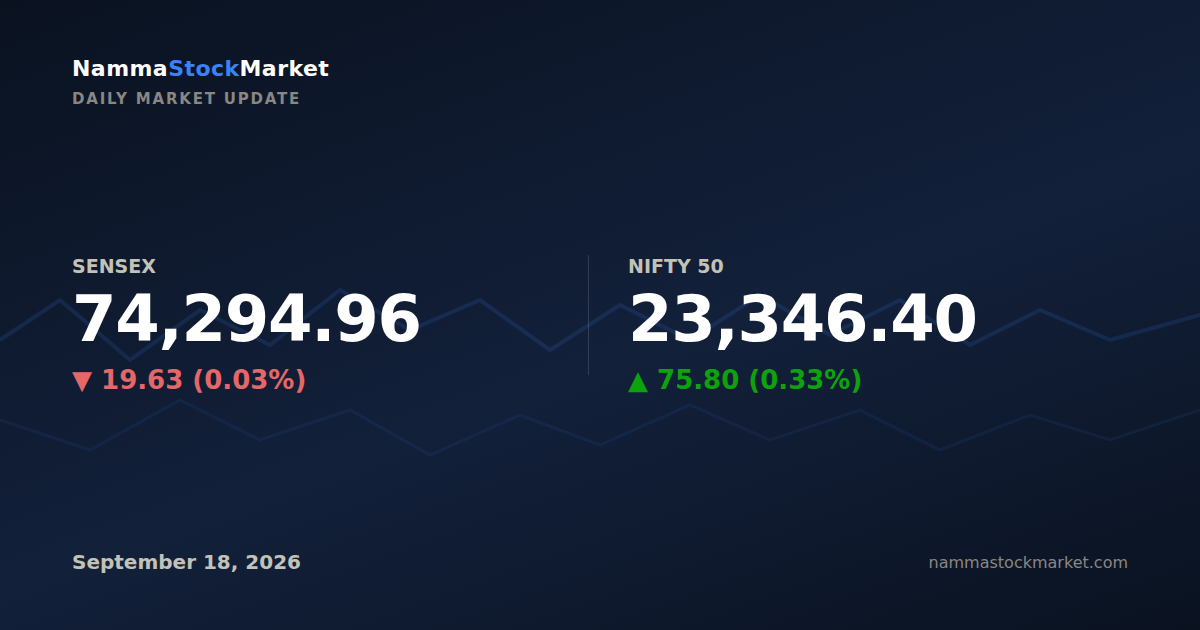
Nifty Ends Higher At 23,346 As Smallcaps Jump 1.7%, But TCS Crash Drags Sensex Into The Red
September 18, 2026 | by NammaStockMarket
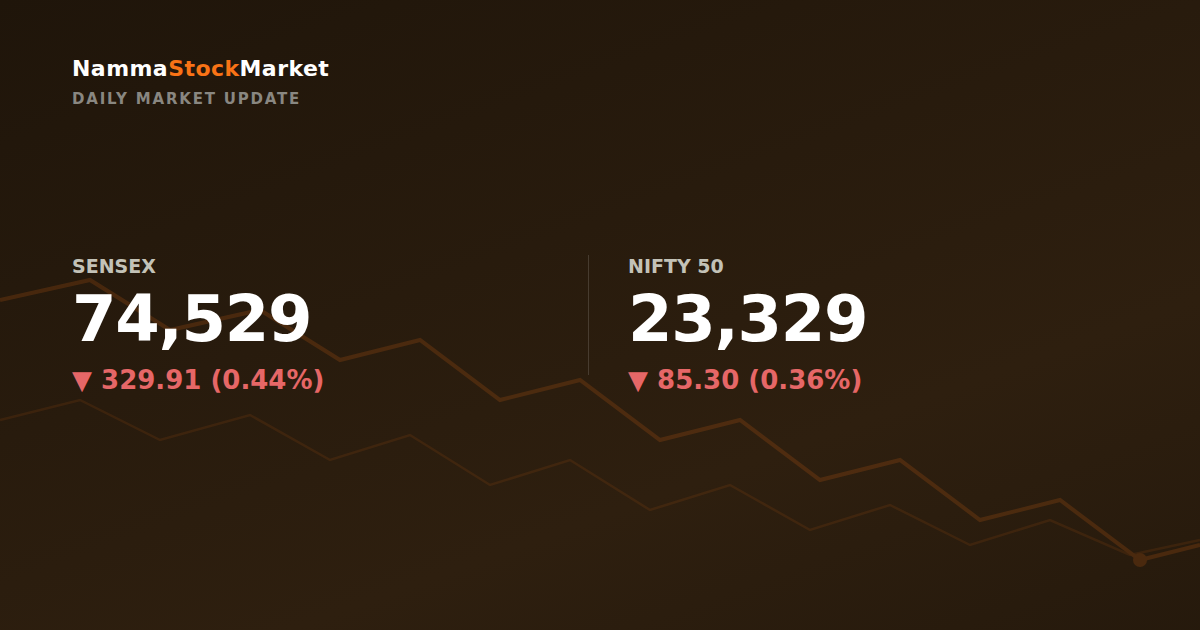
Sensex Slips 330 Points, Nifty Snaps 4-Day Winning Streak To End At 23,329 As IT Stocks Drag
September 22, 2026 | by NammaStockMarket
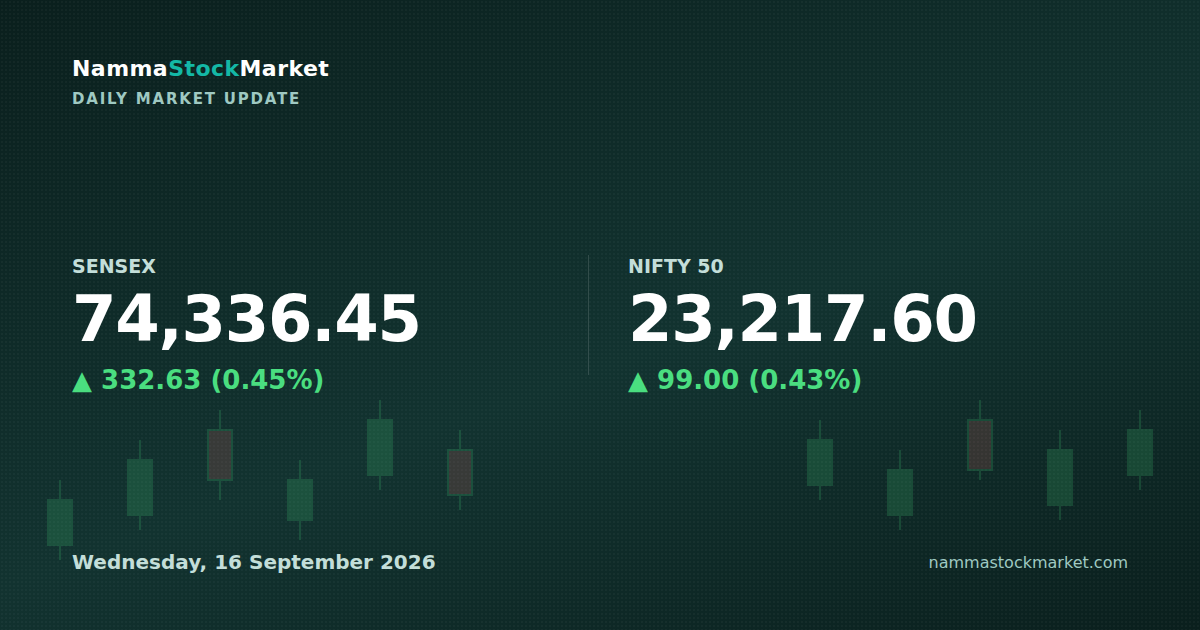
Sensex Jumps 333 Points, Nifty Reclaims 23,200 As UPI Fee Move Lifts Banks; IT Stocks Buck The Trend
September 16, 2026 | by NammaStockMarket