

Sensex Crashes 1,045 Points, Nifty Below 22,250 As RBI Rate Hike And $104 Oil Spook Indian Stock Market
October 8, 2026 | by NammaStockMarket
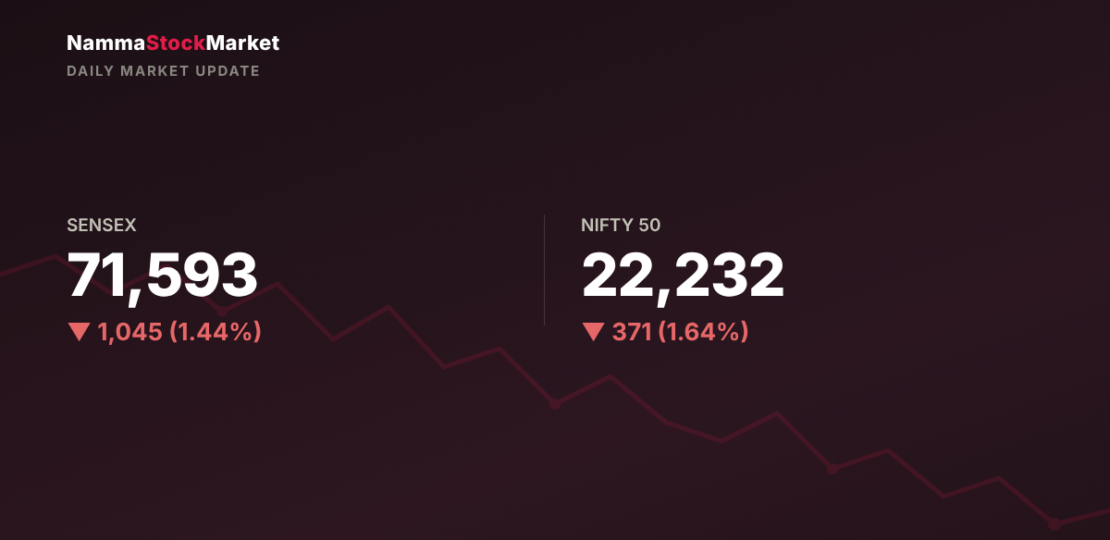
It was a rough Thursday for anyone tracking their demat account (that’s the account where your shares sit, by the way, as opposed to your trading account which is used to buy and sell). The BSE Sensex — the 30-stock index run by the Bombay Stock Exchange — crashed 1,045.46 points, or 1.44%, to close at 71,593.24, its lowest level in close to 32 months. The NSE Nifty 50, the 50-stock index run by the National Stock Exchange, fell even harder in percentage terms, dropping 371.25 points, or 1.64%, to settle at 22,231.80, a fresh low for 2026. If you were holding anything other than IT stocks today, your portfolio probably had a red day.
Two things combined to spook the Indian stock market today. One, the Reserve Bank of India raised its repo rate — the rate at which it lends to banks, and the single biggest lever it has over how expensive your home loan or car loan gets — by 25 basis points to 5.50% on Wednesday. That’s its first hike in nearly four years. Two, Brent crude oil jumped close to 4% to above $104 a barrel on fresh tensions in the Middle East, including reports of attacks on ships near the Strait of Hormuz, the narrow sea route through which a huge chunk of the world’s oil passes. Throw in foreign investors selling for a ninth straight session, and you get one of the worst sessions Dalal Street — the informal name for India’s stock market, after the street in Mumbai where the BSE is located — has seen in weeks.
The selling wasn’t limited to a few sectors either. Of the 50 stocks in the Nifty, only 3 closed higher. The other 47 ended in the red. That kind of one-sided, broad-based selling is what traders mean when they say the mood on D-Street turned “risk-off” — everyone was looking to get out, not get in.
Market At A Glance
| Index | Close | Points Change | % Change |
|---|---|---|---|
| BSE Sensex | 71,593.24 | ▼ 1,045.46 | ▼ 1.44% |
| NSE Nifty 50 | 22,231.80 | ▼ 371.25 | ▼ 1.64% |
| Nifty Bank | ~54,515 | ▼ ~540 | ▼ 0.98% |
| Nifty Midcap 100 | — | — | ▼ 2.53% |
| Nifty Smallcap 100 | — | — | ▼ 2.34% |
| India VIX | 15.33 | — | ▲ 10%+ |
Nifty Bank figure is based on late-session trade (around 3:49 pm) as the exact official closing print wasn’t separately published; Midcap 100 and Smallcap 100 points-change and closing levels weren’t available from today’s reports, only the percentage fall. India VIX, the market’s “fear gauge,” is shown as a rise, not a fall, since it moves opposite to the market — a jump here means traders are expecting more volatility ahead.
Why The Market Moved
Let’s break down the RBI’s rate hike first, because it matters more than most people realise. The repo rate is the interest rate the RBI charges banks when they borrow money overnight. When the RBI raises it, banks’ own cost of funds goes up, and they usually pass that on — your home loan EMI, car loan EMI and business loans all tend to get a bit more expensive. The RBI’s MPC (Monetary Policy Committee, the six-member panel that decides this) voted unanimously to hike rates because retail inflation has been running above its 4% comfort zone for three months straight — it was at 4.82% in August. RBI Governor Sanjay Malhotra also changed the central bank’s stance to “calibrated tightening” and said plainly that rate cuts are off the table for now — the next move, in his words, “can only be a rate hike or a pause.” That’s a clearly hawkish signal, and markets don’t love hawkish signals, because higher rates make it costlier for companies to borrow and grow, and they make safer instruments like fixed deposits relatively more attractive compared to stocks.
Now, why does crude oil matter so much for India specifically? India imports more than 80% of the crude oil it uses — we simply don’t produce enough domestically. So when Brent crude (the global benchmark price for oil) jumps, India’s oil import bill goes up, and that has a knock-on effect on two things you’ll hear a lot about: the rupee and inflation. A bigger oil import bill means more dollars flowing out of the country to pay for that oil, which weakens the rupee. A weaker rupee then makes everything we import — not just oil — more expensive, which feeds back into inflation. It’s a loop, and it’s exactly the loop that was playing out today: oil up, rupee under pressure, and the RBI already worried enough about inflation to raise rates. If you’re newer to investing, this is the connection to remember: a Middle East conflict thousands of kilometres away can still show up in your portfolio and your fuel bill at the same time.
Which Sectors Held Up, And Which Didn’t
Every single sectoral index on the NSE ended in the red today — that’s how broad the selling was. Nifty Metal was the worst-hit, down 3.55%, as global growth worries and the stronger dollar weighed on metal prices. Nifty Realty followed at -3.16% — realty (real estate) stocks are especially sensitive to interest rates since most home buyers borrow to buy, so a rate hike hits this sector hard. Nifty Oil & Gas fell 2.52%, which might seem odd given crude prices rose, but remember: Indian oil marketing companies actually lose money when crude gets more expensive and they can’t fully pass on the cost to consumers at the pump.
| Sector (Nifty Index) | % Change |
|---|---|
| Nifty Metal | ▼ 3.55% |
| Nifty Realty | ▼ 3.16% |
| Nifty Oil & Gas | ▼ 2.52% |
| Nifty Auto | ▼ 2%+ |
| Nifty Pharma | ▼ 2%+ |
| Nifty FMCG | ▼ 2%+ |
| Nifty Media | ▼ 2%+ |
| Nifty Infrastructure | ▼ 2%+ |
| Nifty Bank | ▼ ~1% |
| Nifty IT | ▲ Flat to mildly positive |
IT was the only pocket that more or less held its ground today — Infosys and HCL Technologies actually closed higher, while TCS was down just 0.21% ahead of its results. Every other sectoral index ended in the red, several of them down 2% or more.
The one sector that genuinely shrugged off the gloom was IT. Infosys and HCL Technologies both closed higher, and TCS (Tata Consultancy Services) was down just 0.21% as investors held their positions ahead of its results. IT stocks tend to do relatively better when the rupee weakens, because a big chunk of their revenue comes in dollars — a weaker rupee means those dollar earnings convert into more rupees. So in a strange way, the same rupee weakness that hurt everyone else today gave IT investors a small cushion.
Today’s Top Movers
The gainers list today is about as short as it gets — only three Nifty 50 stocks closed in positive territory, all from the IT and banking space.
| Stock | Close (₹) | % Change |
|---|---|---|
| Infosys | 997.00 | ▲ 0.50% |
| Tech Mahindra | 1,496.20 | ▲ 0.34% |
| Axis Bank | 1,245.00 | ▲ 0.20% |
Just 3 of the 50 Nifty stocks closed in the green today — that’s how one-sided the selling was. There’s no 4th or 5th gainer to list because, quite simply, there wasn’t one.
On the losing side, Adani Enterprises led the fall, down more than 5%, with metal major JSW Steel and FMCG (fast-moving consumer goods — the everyday products like soap, biscuits and cigarettes you buy repeatedly) giant ITC also among the hardest hit.
| Stock | Close (₹) | % Change |
|---|---|---|
| Adani Enterprises | 2,596.00 | ▼ 5.36% |
| JSW Steel | 1,175.20 | ▼ 4.46% |
| ITC | 255.00 | ▼ 4.03% |
| Max Healthcare | 871.70 | ▼ 4.00% |
| InterGlobe Aviation (IndiGo) | 4,813.10 | ▼ 3.55% |
Fintech and payments names were also hit hard, even outside the Nifty 50 — Paytm fell 5.2%, One MobiKwik 4.5% and Pine Labs 4.4%, on reports that new merchant fees on UPI payments could be delayed, which the market read as bad news for their revenue.
What FIIs and DIIs Were Doing
You’ll see these two terms in every market report, so here’s the quick version: FIIs are Foreign Institutional Investors (also sometimes called FPIs, Foreign Portfolio Investors) — big global funds investing money into Indian stocks from outside the country. DIIs are Domestic Institutional Investors — Indian mutual funds, insurance companies and similar big local investors, a lot of whose money ultimately comes from your own SIPs (Systematic Investment Plans, the monthly mutual fund investments millions of Indians do). When you hear “FII selling pressured the market,” it means foreign funds pulled money out of Indian equities that day.
| Date | FII Net (₹ Crore) | DII Net (₹ Crore) |
|---|---|---|
| 1 Oct 2026 | ▼ 9,484.20 | ▲ 10,041.80 |
| 5 Oct 2026 | ▼ 4,699.10 | ▲ 5,181.60 |
| 6 Oct 2026 | ▼ 2,961.30 | ▲ 5,088.90 |
| 7 Oct 2026 | ▼ 6,121.40 | ▲ 4,596.60 |
Today’s (8 October) FII/DII cash-segment figures hadn’t been published by the exchanges at the time of writing — they usually come out post-market, late evening or the next morning. We’ll have Thursday’s number for you in tomorrow’s update. A ▼ on the FII column means net selling; a ▲ on the DII column means net buying.
Notice the pattern here: FIIs have been net sellers on every single one of the last four trading days we have data for, pulling out a combined ₹23,266 crore in the cash segment (cash segment just means regular buying and selling of shares, as opposed to the derivatives or F&O market). DIIs, on the other hand, have been steady net buyers the whole time, putting in roughly ₹24,909 crore over the same stretch. This is a pattern Indian market watchers talk about a lot these days — DIIs, powered by the relentless flow of SIP money from retail investors, have increasingly been the force cushioning the market whenever FIIs turn sellers. Today’s selloff would likely have been even sharper without that domestic support.
Oil, The Rupee, And Global Cues
Brent crude jumped nearly 4% today to trade above $104 a barrel, its highest level in a while, as worries deepened over supply disruptions around the Strait of Hormuz and wider tensions in the Middle East. This has been a slow-building story through 2026 — oil has spent much of the year hovering stubbornly above $100 a barrel because of this same conflict, and today’s spike pushed it to a fresh high for the move.
The rupee had a choppy day. It actually opened a touch stronger against the dollar in the morning — traders pointed to likely RBI intervention — but lost ground as the session wore on, slipping past the 97-per-dollar mark by the afternoon, its weakest level in a while. A strong US dollar globally, the surge in crude prices, and continued FII outflows all added pressure. Wednesday’s close was around ₹96.75 to the dollar, so today’s move represents a meaningful slide in a single session.
On global cues: US markets (Dow, Nasdaq) ended lower on Wednesday night, and US futures were pointing to a weak open too, which didn’t help sentiment when Indian markets opened on Thursday. Asian markets were broadly lower as well. US bond yields have also been rising, which tends to pull foreign money away from markets like India and back toward the US — another reason FIIs have been selling here. None of this happens in isolation — a rough night on Wall Street and rising US yields tend to show up as selling pressure on Nifty and Sensex the very next morning, and that’s roughly what played out today.
What To Watch Tomorrow
The biggest near-term trigger is earnings season kicking off — TCS reports its September-quarter results soon, and given how IT was the lone bright spot today, how that print lands could set the tone for the whole sector over the next few days. Keep an eye on whether other large private banks and IT majors follow with strong numbers, since September-quarter earnings are what investors will use to judge whether the current selloff is overdone or justified.
On the technical side, chart analysts are watching whether the Nifty holds support near the 21,950 level; a break below that could invite further selling, while a bounce back above 22,350–22,400 would suggest today’s fall was more of a sharp, one-off reaction than the start of a longer slide. With India VIX (the volatility index that measures how much swing traders expect in the market over the next 30 days) up over 10% today, expect bigger-than-usual intraday swings in the sessions ahead — if you trade in F&O (futures and options), tighter stop-losses and smaller position sizes are usually the sensible approach when VIX jumps like this, though that’s a decision only you and your own risk appetite can make.
Globally, watch crude oil and the Strait of Hormuz situation closely — any sign of de-escalation could bring oil down quickly and give Indian markets some relief, while a further escalation could mean more pain, especially for the rupee and for sectors like oil marketing, aviation and autos that are sensitive to fuel costs. And after a 25-bps hike with a clearly hawkish tone, markets will also be parsing every RBI official’s comment over the coming days for hints on whether December brings a pause or another increase.
This article is for informational purposes to help you understand today’s market movement. It is not investment advice — please do your own research or consult a financial advisor before making any investment decisions.
RELATED POSTS
View all

Sensex Gains 299 Points, Nifty Ends Above 23,400 As Crude Oil Drops Below $100; Metal Stocks Jump 2.4%, IT Slips
September 23, 2026 | by NammaStockMarket
Sensex Jumps 685 Points, Nifty Closes Above 22,750 As Markets Rally Ahead Of RBI Rate Decision
October 6, 2026 | by NammaStockMarket
Sensex Jumps 333 Points, Nifty Reclaims 23,200 As UPI Fee Move Lifts Banks; IT Stocks Buck The Trend
September 16, 2026 | by NammaStockMarket