

Sensex Falls 460 Points, Nifty Below 22,700 As Crude Oil Jumps Past $112 On Middle East Tensions
October 22, 2026 | by NammaStockMarket
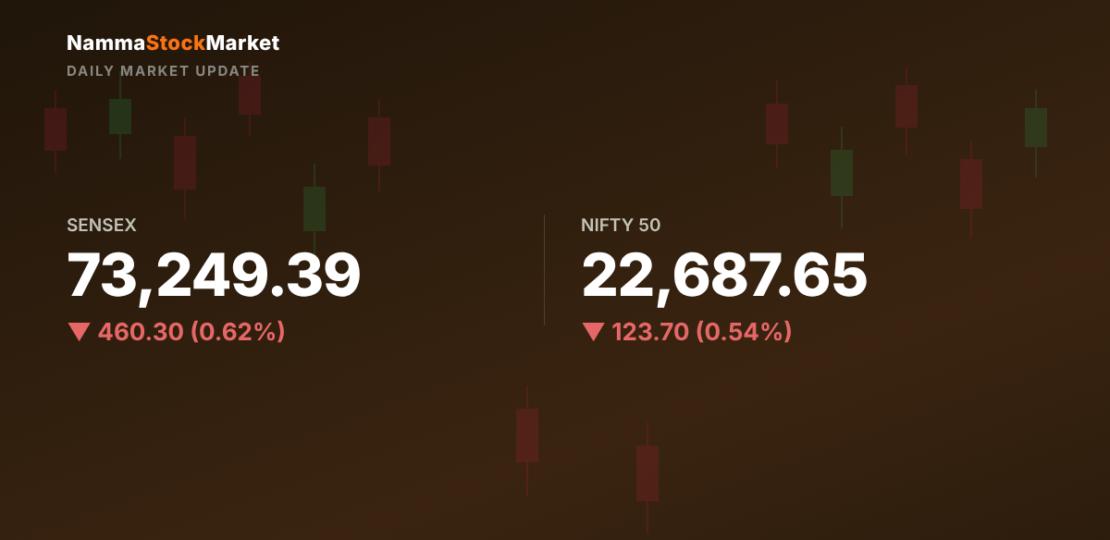
If you were holding banking, FMCG or IT stocks today, you probably didn’t enjoy checking your portfolio this evening. The Indian stock market fell for the third session in a row on Thursday, with the BSE Sensex (the Bombay Stock Exchange’s benchmark index of 30 large companies) closing 460.30 points lower at 73,249.39, a fall of 0.62%. The NSE Nifty 50 (the National Stock Exchange’s index of the top 50 companies) slipped 123.70 points to settle at 22,687.65, down 0.54%. The one word behind almost everything that happened in the Indian share market today is oil. Brent crude, the global benchmark for crude oil prices, jumped nearly 3% to around $112.5 a barrel after a drone attack on a Saudi Aramco oilfield raised fears that the conflict in West Asia is widening. When oil gets this expensive, it hits India hard because we import most of what we use, and that fear showed up everywhere today, from the rupee to banking stocks to your mutual fund SIP’s one-day return.
Here’s a quick snapshot of how the major indices closed today.
| Index | Close | Points Change | % Change |
|---|---|---|---|
| BSE Sensex | 73,249.39 | ▼ 460.30 | ▼ 0.62% |
| NSE Nifty 50 | 22,687.65 | ▼ 123.70 | ▼ 0.54% |
| Bank Nifty | 54,925.70 | ▼ 51.20 | ▼ 0.09% |
| Nifty Midcap 100 | 57,063.95 | ▼ 504.80 | ▼ 0.88% |
| Nifty Smallcap 100 | 18,275.90 | ▼ 211.40 | ▼ 1.14% |
| India VIX | 15.81 | ▲ 0.13 | ▲ 0.83% |
Only Bank Nifty, which tracks the biggest bank stocks on the NSE, managed to stay almost flat, down just 0.09%, making it the most resilient index of the day. Everything else fell harder, with the broader market, meaning midcap and smallcap stocks, taking a bigger hit than the main indices, which is usually a sign that investors were in a “sell first, ask questions later” mood. India VIX, which is often called the fear index because it measures how much volatility traders expect in the market over the next 30 days, inched up to 15.81. That’s not a scary level by itself, but it did move in the direction you’d expect on a day like this.
Why The Market Moved
The simplest way to think about today is this: crude oil got more expensive, and that’s bad news for India in a few different ways at once. First, India buys about 85% of its oil from other countries, so when the price per barrel goes up, our oil import bill goes up too. That means more dollars flowing out of the country, which puts pressure on the rupee. A weaker rupee makes imports even costlier, and because fuel feeds into transport and manufacturing costs, it can nudge inflation higher down the line. Higher inflation worries, in turn, make investors nervous about whether the RBI (Reserve Bank of India) will need to hold off on cutting its repo rate at the next MPC (Monetary Policy Committee) meeting, which would have kept borrowing cheaper for companies and for you. None of this has actually happened yet, but markets react to fear of what might happen just as much as to what has happened, and that’s what you saw today.
Which Sectors Held Up, And Which Didn’t
| Sector Index | % Change Today |
|---|---|
| Nifty Pharma | ▲ 0.3% |
| Nifty PSU Bank | ▲ 0.2% |
| Bank Nifty | ▼ 0.09% |
| Nifty Metal | ▼ 0.8% |
| Nifty Auto | ▼ 1.0% |
| Nifty Energy | ▼ 1.1% |
| Nifty FMCG | ▼ 1.2% |
| Nifty IT | ▼ 1.4% |
| Nifty Media | ▼ 2.2% |
Nifty Media was the worst-hit sector today, falling over 2%, followed closely by Nifty IT, which fell around 1.4% as rate-sensitive and global-facing software exporters came under pressure along with weak cues from US markets overnight. FMCG and energy stocks also had a tough day, down over 1% each, as rising crude costs raised worries about input costs for packaged goods companies. Auto and metal stocks fell too, though by a smaller margin. On the brighter side, Pharma and PSU Bank stocks managed small gains, bucking the overall trend, likely because they’re seen as more defensive bets when the broader mood turns cautious. If your mutual fund SIP leans towards pharma or PSU banks, today was a quieter day for you than for most other investors.
Today’s Top Movers
Among individual stocks, Bajaj Finance was the standout gainer in the Nifty 50 today, while Nestle India had the roughest day among the losers.
| Stock (Nifty 50) | Close Price | % Change |
|---|---|---|
| Bajaj Finance | ₹942.10 | ▲ 1.74% |
| Cipla | ₹1,330.90 | ▲ 1.29% |
| UltraTech Cement | ₹10,958.00 | ▲ 1.00% |
| ICICI Bank | — | ▲ 0.79% |
| Bajaj Auto | — | ▲ 0.77% |
| Stock (Nifty 50) | Close Price | % Change |
|---|---|---|
| Nestle India | ₹1,189.90 | ▼ 2.78% |
| Reliance Industries | — | ▼ 2.59% |
| Eternal | ₹304.45 | ▼ 2.53% |
| Tata Motors (PV) | — | ▼ 2.30% |
| HDFC Life Insurance | ₹528.35 | ▼ 2.09% |
Bajaj Finance gained nearly 1.75% on the back of strong buying interest, while Cipla and UltraTech Cement also found support from investors looking for safer bets outside the sectors that were under pressure. On the losing side, Nestle India fell the hardest, down close to 2.8%, as FMCG stocks broadly struggled with the rising input cost worries mentioned earlier. Reliance Industries, Eternal, Tata Motors and HDFC Life Insurance rounded out the top losers, each falling more than 2%, and together with Nestle, these five stocks explain a big chunk of today’s fall in the Nifty 50.
What FIIs and DIIs Were Doing
You’ll often see FII and DII numbers mentioned in Indian market news, and if you’re newer to investing, here’s what they mean in simple terms. FII stands for Foreign Institutional Investor, basically big foreign funds and banks that invest in Indian stocks. DII stands for Domestic Institutional Investor, which covers Indian mutual funds, insurance companies like LIC, and other local institutions. When FIIs are net sellers and DIIs are net buyers on the same day, DII buying is often said to “cushion” the market, since it stops FII selling from dragging prices down even further.
Today’s provisional FII and DII cash market figures aren’t out yet. They usually come out the next morning, so we’ll know tomorrow how big institutional investors played today’s session. Here’s how the last few trading days looked, based on the most recent data available.
| Date | FII Net (₹ Crore) | DII Net (₹ Crore) |
|---|---|---|
| 21 Oct 2026 | ▲ 1,022.32 | ▲ 1,614.32 |
| 19 Oct 2026 | ▼ 1,148.64 | ▲ 3,201.19 |
| 16 Oct 2026 | ▲ 1,165.92 | ▼ 3,661.28 |
| 15 Oct 2026 | ▼ 5,285.37 | ▲ 3,319.39 |
| 14 Oct 2026 | ▼ 1,857.44 | ▲ 2,670.44 |
Note: Provisional FII/DII cash-market figures for 22 October 2026 had not been released at the time of publishing. They typically come out the following morning.
You can see DIIs have been net buyers on four of the last five days shown here, even on days when FIIs pulled money out, like on October 15 and October 19. That’s the cushioning effect in action, and it’s one reason Indian markets haven’t fallen as sharply as some of the oil-driven moves might suggest they should.
Oil, The Rupee, And Global Cues
Brent crude rose close to 3% to around $112.5 a barrel today, its highest level in a while, after reports of a drone attack on a Saudi Aramco oilfield stoked fears that tensions in West Asia could escalate further and disrupt oil supply. For India, this isn’t just a number on a chart. Nearly everything from the diesel that moves your groceries to the plastic in your phone’s packaging has some crude oil cost baked into it, so a sustained rise here eventually shows up in prices you pay.
The rupee weakened about 30 paise against the US dollar to close near ₹94.81, ending an eight-session winning streak. The main reasons were the costlier oil import bill and increased dollar demand from importers trying to lock in rates before crude gets even pricier. Earlier in the week, the rupee had found support from foreign investor inflows tied to the Jio Platforms IPO and from RBI intervention in the currency market, but today those supports weren’t enough to offset the oil-driven pressure. A weaker rupee matters to you even if you’ve never touched the forex market, because it makes imported goods costlier and can add to inflation over time.
Global cues weren’t particularly encouraging either. Asian markets were broadly weaker today, and US markets, where the Dow and Nasdaq serve as the key benchmarks, had given mixed signals overnight as investors there also digest the same crude oil spike and what it could mean for US Fed policy. When sentiment turns cautious on Wall Street or in Asia, it tends to spill over into GIFT Nifty, which trades before our market opens and often sets the tone for how Nifty and Sensex will open the next day.
What To Watch Tomorrow
The biggest thing to track from here is whether the Saudi Aramco situation and the wider West Asia tensions escalate further or start cooling off, since that will decide whether crude stays elevated or eases back. If oil prices keep climbing, expect more pressure on the rupee, on FMCG and energy stocks, and on overall market sentiment. Keep an eye on tomorrow’s FII/DII numbers too, since today’s late selling means we’ll want to see if foreign investors turned more cautious or if domestic funds kept up their buying. Quarterly earnings season is also underway, so stock-specific moves tied to individual company results could continue alongside the broader macro story. None of this is a call to buy or sell anything, just a sense of what’s likely to drive the headlines over the next day or two, so you can make sense of whatever your portfolio does tomorrow.
RELATED POSTS
View all

Sensex Slips 143 Points, Nifty Falls To 22,811 As Crude Oil Crosses $110 — IT Stocks Buck The Trend
October 21, 2026 | by NammaStockMarket
Sensex Gains 299 Points, Nifty Ends Above 23,400 As Crude Oil Drops Below $100; Metal Stocks Jump 2.4%, IT Slips
September 23, 2026 | by NammaStockMarket
Sensex Slips 330 Points, Nifty Snaps 4-Day Winning Streak To End At 23,329 As IT Stocks Drag
September 22, 2026 | by NammaStockMarket