

Sensex Surges 905 Points, Nifty Nears 23,000 As Banks, FMCG Rally After Fed Holds Rates
October 29, 2026 | by NammaStockMarket
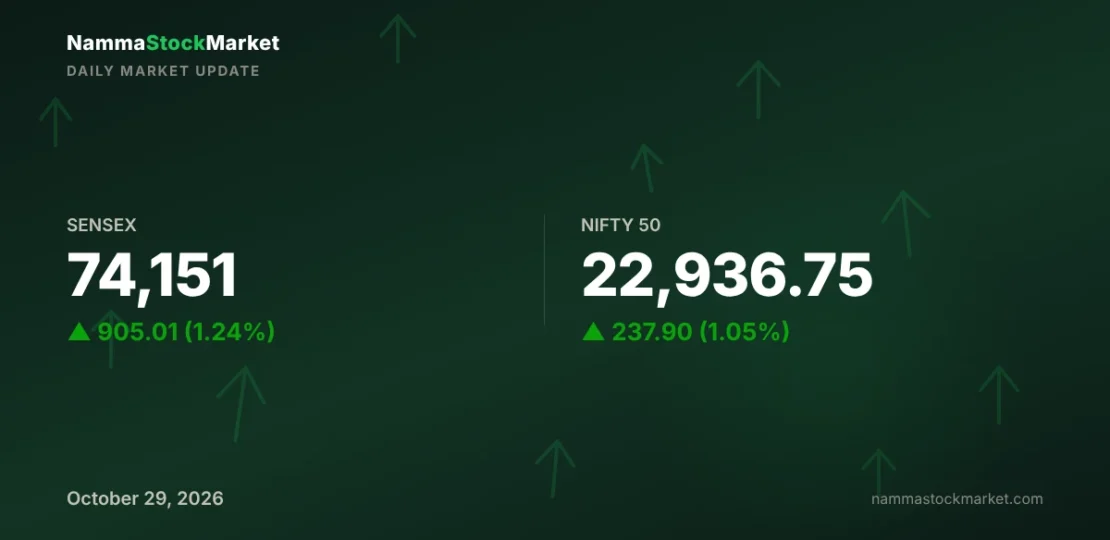
The Indian stock market just gave everyone a reason to smile today. After two straight days of losses, the BSE Sensex and the NSE Nifty 50 bounced back hard on Thursday, October 29, with the Sensex jumping 905 points and the Nifty climbing back above the 22,900 mark. If you were watching your portfolio with a bit of worry this week, today’s recovery was the kind of session that resets the mood — banks, FMCG (fast-moving consumer goods, the everyday products companies like Hindustan Unilever and ITC make) and realty stocks did the heavy lifting, while the US Federal Reserve holding interest rates steady gave global investors one less thing to worry about.
Both the Sensex (on the BSE, or Bombay Stock Exchange) and the Nifty 50 (on the NSE, or National Stock Exchange) had opened on a shaky note, with the Nifty even slipping to an intraday low near 22,657 in the morning. But the mood flipped through the day, and by the closing bell the Sensex had closed at 74,151.04, up 905.01 points or 1.24%, while the Nifty 50 ended at 22,936.75, up 237.90 points or 1.05%. It was the kind of V-shaped recovery that traders love to see, and it came on the back of genuinely broad buying — this wasn’t just two or three heavyweight stocks pulling the index up.
Market At A Glance
| Index | Close | Points Change | % Change |
|---|---|---|---|
| BSE Sensex | 74,151.04 | ▲ 905.01 | ▲ 1.24% |
| NSE Nifty 50 | 22,936.75 | ▲ 237.90 | ▲ 1.05% |
| Nifty Bank | 54,910.00 | ▲ 642.00 | ▲ 1.18% |
| Nifty Midcap 100 | 57,842.00 | ▲ 567.00 | ▲ 0.99% |
| Nifty Smallcap 100 | — | — | ▲ 0.95% |
| India VIX | 15.13 | ▼ 1.12 | ▼ 6.85% |
Note: An exact closing level for the Nifty Smallcap 100 wasn’t available from our sources at publish time, so only the day’s percentage move is shown for that row.
Why The Market Moved
There were really three things driving today’s rally, and if you’re newer to investing, it’s worth understanding why each one matters for your money.
First, the US Federal Reserve — America’s central bank, which sets interest rates for the US economy — decided to hold its key rate steady at 3.75-4%, with policymakers voting 10-2. Why should an Indian investor care what the Fed does? Because when US rates stay steady instead of rising, foreign investors (called FIIs, or Foreign Institutional Investors — big overseas funds that buy and sell Indian shares) feel more comfortable putting money into markets like India instead of parking it safely in US bonds. That eases pressure on the rupee and on our markets in general.
Second, crude oil prices cooled off a bit. Brent crude (the global benchmark for oil prices, always quoted in US dollars per barrel since it’s traded internationally) fell about 1.18% to around $113.96 a barrel, as hopes of renewed US-Iran diplomatic talks eased some supply worries. Now, you might wonder why a barrel of oil priced in dollars matters so much to your Nifty portfolio. Here’s the simple version: India imports almost 85% of the crude oil it uses. When oil prices are high, India’s import bill shoots up, which puts pressure on the rupee (since we need more dollars to pay for that oil) and adds to inflation at home through higher fuel and transport costs. So even a small cooling in crude is read as good news for Indian stocks, especially for FMCG and auto companies that are sensitive to input costs.
Third, and this is the part that should make your evening a little brighter if you hold banking or FMCG stocks — there was genuinely broad buying across banks (both private and PSU, or public sector undertaking, banks), real estate (realty) names, and consumer goods companies, plus solid participation from mid-cap and small-cap stocks too. That broad-based nature of the rally, rather than it being driven by just one or two large stocks, is usually a healthier sign for the market.
India VIX, often called the market’s “fear gauge” because it measures how much volatility (ups and downs) traders expect in the near term, fell sharply too — down 6.85% to 15.13 from Wednesday’s close of 16.25. A falling VIX usually means traders are feeling calmer and expecting a smoother ride ahead, at least for now.
Which Sectors Held Up, And Which Didn’t
| Sector | % Change |
|---|---|
| Nifty Realty | ▲ 2.75% |
| Nifty FMCG | ▲ 2.34% |
| Nifty PSU Bank | ▲ 2.20% |
| Nifty Private Bank | ▲ 1.98% |
| Nifty Media | ▲ 1.20% |
| Nifty IT | ▲ 1.00% |
| Nifty Metal | ▲ 0.66% |
| Nifty Pharma | ▲ 0.48% |
| Nifty Auto | ▼ 0.24% |
Realty stocks were today’s biggest winners, up 2.75%, with buying picking up sharply in the last hour of trade as investors bet on steady housing demand heading into the festive season. FMCG wasn’t far behind at 2.34%, helped by names like Hindustan Unilever, as investors rotated into steady, defensive businesses that do well regardless of what’s happening with interest rates or oil. Both PSU banks and private banks had a strong day too, with Kotak Mahindra Bank among the standout individual gainers — when banks rally together like this, it usually reflects relief on the interest-rate front plus hopes of healthy credit growth.
On the other side, Nifty Auto was the only sector in the red, down 0.24%. If you’re holding auto stocks, today wasn’t your day — weak Q2 (July-September quarter) earnings commentary from a couple of two-wheeler makers weighed on sentiment, and a few component makers also flagged softer demand guidance for the coming months. IT stocks managed a modest 1% gain, recovering a bit after a rough couple of sessions tied to a disappointing earnings report from a major US tech company that had spooked global IT sentiment.
Today’s Top Movers
Top 5 Gainers
| Stock | % Change |
|---|---|
| Adani Ports & SEZ | ▲ 6.17% |
| Adani Enterprises | ▲ 5.69% |
| Kotak Mahindra Bank | ▲ 4.32% |
| Power Grid Corporation | ▲ 4.22% |
| Eternal | ▲ 2.45% |
Adani Ports and Special Economic Zone led the gainers’ list, up a sharp 6.17% after the company posted an 18% jump in its September-quarter net profit and raised its full-year operating profit guidance — exactly the kind of earnings surprise that gets a stock re-rated in a single session. Adani Enterprises rode the same wave of Adani group buying to close 5.69% higher. Kotak Mahindra Bank and Power Grid Corporation both gained over 4%, reflecting the broader banking and power-sector strength, while food delivery and quick-commerce major Eternal added 2.45% on continued investor interest in the consumption space.
Top 5 Losers
| Stock | % Change |
|---|---|
| Trent | ▼ 1.68% |
| Maruti Suzuki | ▼ 1.11% |
| SBI Life Insurance | ▼ 1.06% |
| Bajaj Auto | ▼ 0.97% |
| Hindalco Industries | ▼ 0.83% |
Retail major Trent topped the losers’ list, down 1.68%, as some investors booked profits after the stock’s strong run over the past few months. Maruti Suzuki slipped 1.11% and SBI Life Insurance fell 1.06%, while two-wheeler maker Bajaj Auto and metals producer Hindalco Industries rounded out the laggards with declines under 1%. None of today’s losses were dramatic — this was a day where the gainers simply ran away with the show.
What FIIs and DIIs Were Doing
You’ll often see us mention FII and DII numbers in these daily updates, so here’s a quick refresher if you’re new to this: FIIs (Foreign Institutional Investors) are big overseas funds — think pension funds, hedge funds and sovereign wealth funds from abroad — that invest in Indian shares. DIIs (Domestic Institutional Investors) are the Indian equivalent: mutual funds, insurance companies like LIC, and other large domestic money managers, much of it fuelled by the SIPs (Systematic Investment Plans — the monthly mutual fund investments many retail investors make) that ordinary Indian investors put in every month. Tracking what these two big groups are doing in the cash market (plain buying and selling of shares, as opposed to F&O, or futures and options, which are derivative contracts) gives you a sense of who’s driving the market.
Today’s (October 29) FII/DII cash-market figures weren’t released by the exchanges at the time of publishing this article — that data usually comes out in the evening. Here are the most recent sessions we do have, with dates clearly marked:
| Date | FII Net (Cash) | DII Net (Cash) |
|---|---|---|
| 28 Oct 2026 | ▲ ₹872 crore | ▲ ₹643 crore |
| 27 Oct 2026 | ▲ ₹4,240 crore | ▼ ₹1,250 crore |
| 26 Oct 2026 | ▼ ₹1,463 crore | ▲ ₹2,610 crore |
| 23 Oct 2026 | ▲ ₹888 crore | ▲ ₹3,235 crore |
| 22 Oct 2026 | ▼ ₹3,459 crore | ▲ ₹2,891 crore |
The pattern over the past couple of weeks is a familiar one for anyone who follows this market closely: DIIs have been the steady hand, buying on most days and cushioning the market even when FIIs turned net sellers, like on October 26 and October 22. This is largely thanks to the consistent flow of money coming in through mutual fund SIPs every month, which gives DIIs firepower to buy even when foreign investors get nervous. On October 27 and October 28, FIIs themselves turned net buyers again, which is often an encouraging sign that global money is starting to see value in Indian stocks after a period of caution.
Oil, The Rupee, And Global Cues
Brent crude eased about 1.18% to settle near $113.96 a barrel, pulling back after a stronger session on Wednesday. The move lower came on hopes that renewed US-Iran diplomatic efforts — reports suggested a fresh outreach to revive peace talks — could cool tensions in the Middle East. But the fall was limited because supply risks haven’t gone away: Houthi rebels claimed a missile strike on one of Saudi Arabia’s largest oil refineries, and the Saudi-led coalition said it intercepted a separate ballistic missile. Mixed US inventory data added to the uncertainty, with crude stockpiles falling (which usually supports prices) but gasoline stockpiles rising (which usually weighs on them).
Even though Brent is still trading above $113 a barrel — a genuinely elevated level — any cooling matters a lot for India. Remember, we import most of our oil, so every dollar move in Brent crude eventually shows up either in India’s oil import bill, in pressure on the rupee, or at the fuel pump. A cheaper barrel today is a small bit of breathing room on all three fronts.
The rupee itself had a fairly uneventful day against the US dollar, closing at 95.26 per dollar compared with Wednesday’s close of 95.22 — a marginal weakening of about 4 paise. The currency did touch a two-week low of around 95.37 during the afternoon before recovering some ground, with traders pointing to likely RBI (Reserve Bank of India) intervention capping further losses, alongside easing oil prices helping the rupee claw back as the day went on. Globally, Asian markets were mixed, with Japan’s Nikkei up over 1% while South Korea’s Kosdaq fell more than 2.7%, so India’s strong, broad-based rally stood out against a fairly directionless backdrop in the rest of Asia.
What To Watch Tomorrow
A few things are worth keeping an eye on as we head into Friday’s session. US personal consumption expenditure (PCE) inflation data — the Fed’s preferred inflation gauge — is due out and could move global sentiment depending on which way it surprises, so expect some volatility around that print. On the earnings front, Q2 (July-September) results season is still in full swing, and how individual companies guide for the rest of the year will keep driving single-stock moves the way we saw with Adani Ports and Birlasoft today. Keep an eye on the auto sector too — it was today’s lone laggard, and if more companies follow with soft demand commentary, that weakness could persist. On the crude oil front, any concrete update on US-Iran talks, or further developments around the reported Houthi strike on Saudi oil infrastructure, could swing prices meaningfully in either direction, with knock-on effects for the rupee. And with India VIX down sharply today, it’s worth watching whether that calm holds or whether volatility creeps back in once the Fed’s inflation data lands.
This is general market information to help you understand what moved and why — it isn’t a buy or sell recommendation for any stock or sector, so do your own research or speak with a qualified advisor before making any investment decisions in your demat and trading account.
RELATED POSTS
View all

Sensex Jumps 333 Points, Nifty Reclaims 23,200 As UPI Fee Move Lifts Banks; IT Stocks Buck The Trend
September 16, 2026 | by NammaStockMarket
Sensex Rallies 483 Points, Nifty Back Above 22,750 as Metal and Pharma Stocks Lead the Rebound
October 26, 2026 | by NammaStockMarket
Sensex Jumps 564 Points, Nifty Reclaims 23,400 As Cooling Crude Oil Lifts Sentiment
September 21, 2026 | by NammaStockMarket