

Sensex, Nifty Hit 8-Month Closing Highs After Diwali Break as PSU Banks Jump 3.7%, IT Stocks Drag
November 9, 2026 | by NammaStockMarket
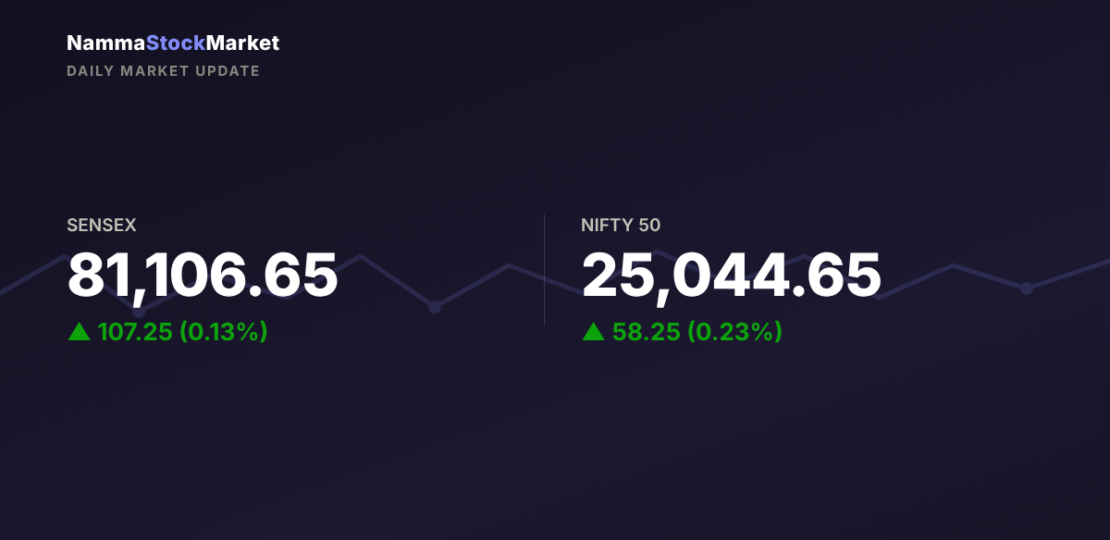
The Indian stock market opened the new Samvat year on a quiet but positive note today. The BSE Sensex closed at 81,106.65, up 107.25 points or 0.13%, while the NSE Nifty 50 ended at 25,044.65, up 58.25 points or 0.23%, crossing the psychologically important 25,000 mark. Both indices actually closed at their highest levels in about eight months, even though today’s gain itself was small. If you were watching your portfolio today, it was a fairly calm session — nothing like the sharp 10%-plus rally markets have seen over the last two weeks, but a steady one. The big story within the market was PSU (public sector undertaking) bank stocks, which shot up nearly 3.7%, while IT stocks were the one sore spot, falling over 1.2% and acting as a drag on the broader index.
This was the first full trading session after the one-hour Diwali Muhurat session held on Sunday, and the market basically took a breather after its recent run-up. A lot of today’s story was about profit booking — when a stock or the market has gone up a lot, some investors sell to lock in their gains, which can cool things down even on an otherwise positive day. That’s roughly what happened here: strong buying in banking and pharma stocks was enough to offset profit-taking in technology and metal names, keeping both indices in the green but just barely.
Market At A Glance
| Index | Close | Points Change | % Change |
|---|---|---|---|
| BSE Sensex | 81,106.65 | ▲ 107.25 | ▲ 0.13% |
| NSE Nifty 50 | 25,044.65 | ▲ 58.25 | ▲ 0.23% |
| Bank Nifty | 59,741.25 | ▲ ~889.2* | ▲ 1.51% |
| Nifty Midcap 100 | 61,022.55 | ▲ ~333.7* | ▲ 0.55% |
| Nifty Smallcap 100 | 19,185.05 | ▲ ~19.1* | ▲ 0.10% |
| India VIX | 17.36 | ▼ 1.07 | ▼ 5.80% |
*Point-changes for Bank Nifty, Nifty Midcap 100 and Nifty Smallcap 100 are calculated from the percentage move reported by exchanges, since exact previous-close figures for these three weren’t separately published in today’s wrap-ups. India VIX, the Nifty volatility or “fear” index, isn’t a price index, so it has no ₹ or points-on-rupee value — it’s just quoted in index points.
Why The Market Moved
Three big things were working in the market’s favour today, and all three connect back to your wallet in some way even if they don’t look like it at first.
First, crude oil prices fell sharply. Brent crude — the global benchmark for oil prices, quoted in US dollars per barrel — slipped to around $97.5 a barrel, down about 0.8% on the day and nearly 20% lower over the past week. The reason: US President Trump said over the weekend that further American strikes on Iran look unlikely while diplomatic talks continue, which eased fears of a bigger Middle East conflict disrupting oil supply. Why should you care about oil prices if you don’t drive a car? Because India imports close to 85% of the crude oil it uses. When oil gets cheaper, India’s oil import bill — the total amount the country pays to buy crude from abroad — comes down, which is good news for the rupee and helps keep a lid on inflation. Cheaper oil is one of the best things that can happen to the Indian economy, and the market knows it.
Second, foreign investors have been on a buying spree. FIIs (Foreign Institutional Investors — big foreign funds like pension funds, hedge funds and sovereign wealth funds that invest in Indian stocks) bought more than $4 billion worth of Indian shares last week alone, based on the flow data below. That kind of buying genuinely moves the market, because FIIs trade in large volumes through the cash segment on NSE and BSE.
Third, there’s been a bit of a shift away from expensive AI-linked technology stocks globally, with some of that money rotating into other sectors and other markets like India. That connects directly to why IT was today’s weakest sector — more on that below.
Which Sectors Held Up, And Which Didn’t
| Sector | % Change |
|---|---|
| PSU Bank | ▲ 3.73% |
| Pharma | ▲ 1.65% |
| Consumer Durables | ▲ 0.90% |
| Realty | ▲ 0.77% |
| Financial Services | ▲ 0.75% |
| Private Bank | ▲ 0.70% |
| Media | ▲ 0.50% |
| Auto | ▲ 0.30% |
| FMCG | ▼ 0.15% |
| Metal | ▼ 0.46% |
| IT | ▼ 1.22% |
Based on NSE sectoral indices as reported in today’s closing wrap-ups. Energy and Defence sectoral moves weren’t separately reported today, so they’re left out above.
PSU Bank stocks were clearly the stars of the day, rallying 3.73% as a group. Pharma also had a strong session, up 1.65%, while Consumer Durables, Realty, Financial Services and Private Banks all posted solid gains between 0.7% and 0.9%. On the other side, IT was the weakest sector by some distance, down 1.22%, as global worries about whether all the money being poured into AI data centres will actually pay off kept hitting technology stocks everywhere, not just in India. Metal stocks also slipped 0.46% and FMCG (fast-moving consumer goods — the everyday products like soap, biscuits and shampoo) dipped a mild 0.15%. If you’re holding IT stocks like HCLTech in your portfolio, today wasn’t a great day, but if you had exposure to PSU banks or pharma, you’d have had reason to smile.
Today’s Top Movers
Here’s a look at the Nifty 50 stocks that moved the most today, on both sides.
Top Gainers
| Stock | Price (₹) | % Change |
|---|---|---|
| State Bank of India (SBIN) | 1,042.00 | ▲ 2.56% |
| Trent | 3,119.20 | ▲ 2.02% |
| Nestle India | 1,297.80 | ▲ 1.91% |
| NTPC | 328.75 | ▲ 1.87% |
| Larsen & Toubro (L&T) | 4,185.00 | ▲ 1.82% |
Top Losers
| Stock | Price (₹) | % Change |
|---|---|---|
| Tata Steel | 184.85 | ▼ 2.81% |
| HCLTech | 1,407.00 | ▼ 2.43% |
| UltraTech Cement | 12,275.00 | ▼ 1.79% |
| ITC | 278.80 | ▼ 1.64% |
| Bajaj Finance | 1,064.85 | ▼ 1.56% |
State Bank of India led the gainers’ pack, climbing 2.56%, well in sync with the broader PSU bank rally. Trent and Nestle India also had a strong day. On the losing side, Tata Steel fell the hardest among large-caps, down 2.81%, with HCLTech not far behind as part of the broader IT sell-off. Market breadth — basically a count of how many stocks rose versus how many fell across the exchange — leaned negative today even though the headline indices closed higher, with more stocks declining than advancing on the NSE. That’s a reminder that a positive Sensex or Nifty close doesn’t always mean every stock in your portfolio had a good day.
What FIIs and DIIs Were Doing
If you follow market news even a little, you’ve probably seen the terms FII and DII thrown around a lot, so here’s a quick refresher. FIIs are Foreign Institutional Investors — large foreign funds investing in Indian markets from outside the country. DIIs are Domestic Institutional Investors — Indian mutual funds, insurance companies like LIC, and pension funds investing money raised domestically, including from your own SIP (Systematic Investment Plan) contributions if you invest in mutual funds every month. Tracking what these two big groups are doing with their money each day is one of the most reliable ways to gauge the mood of the market.
| Date | FII Net (₹ Crore) | DII Net (₹ Crore) |
|---|---|---|
| 08-Nov-2026 (Diwali Muhurat session) | ▼ ₹0.20 cr | ▼ ₹700.30 cr |
| 06-Nov-2026 | ▲ ₹13,749.80 cr | ▼ ₹5,968.70 cr |
| 05-Nov-2026 | ▲ ₹14,974.70 cr | ▼ ₹10,444.50 cr |
| 04-Nov-2026 | ▲ ₹7,284.00 cr | ▼ ₹3,712.20 cr |
| 03-Nov-2026 | ▲ ₹6,836.80 cr | ▼ ₹3,678.80 cr |
Cash segment, provisional figures as reported by NSE/BSE. 09-Nov-2026’s own FII/DII numbers hadn’t been released at the time of writing — exchanges usually post them with a one-day lag, and with markets shut tomorrow for Diwali Balipratipada, today’s figures will likely show up only when trading resumes on 11-Nov-2026. 07-Nov-2026 was a Saturday (no trading), and 08-Nov-2026 was the special one-hour Diwali Muhurat session, which is why that day’s volumes look tiny compared to a normal trading day.
The pattern over the past week has been pretty clear: FIIs have been net buyers in a big way, pumping in nearly ₹43,000 crore combined over just four sessions from November 3 to November 6, while DIIs have been net sellers over the same stretch, pulling out close to ₹23,800 crore. This is a classic case of DIIs cushioning the market rather than chasing it — domestic mutual funds often book some profits and sell into a rally that foreign money is driving hard, partly to keep cash ready for client redemptions and partly because fund managers get more cautious once valuations run up quickly. If you have a demat account and trading account and have been checking your portfolio daily, you’ll have noticed stocks you hold climbing steadily even on DII selling days — that’s FII buying doing the heavy lifting.
Oil, The Rupee, And Global Cues
We touched on crude oil above, but let’s talk about the rupee specifically, since USD/INR — how many rupees it takes to buy one US dollar — affects everything from your next foreign holiday to the price of imported goods. The rupee closed at 93.93 against the dollar today, up 5 paise from Friday’s close of 93.98 (a lower USD/INR number means the rupee has strengthened). During the day it even touched a six-month high of 93.70 intraday. The rupee has been helped by the same three factors driving the stock market: falling crude oil (which means India needs fewer dollars to pay its oil import bill), strong FII inflows (foreign money coming in means more dollars being converted into rupees), and a softer US Dollar Index, which slipped to around 101.8. On the flip side, there was some dollar buying by state-run banks ahead of tomorrow’s market holiday, which capped the rupee’s gains a bit.
On the global cues front, Wall Street and other global markets are keeping a close eye on the US Federal Reserve, or Fed — America’s central bank, roughly equivalent to our RBI (Reserve Bank of India). A stronger-than-expected US jobs report has pushed up the odds of a Fed rate hike in December to around 81%, up from about 71% just a week ago, according to market pricing. Higher US interest rates can sometimes pull money away from emerging markets like India and back into the US, so this is worth watching, though for now Indian markets seem more focused on the positive local story of falling oil prices and strong foreign buying.
What To Watch Tomorrow
Here’s the thing — there’s no “tomorrow” trading session in the usual sense. Indian stock markets, both NSE and BSE, will be shut on Tuesday, November 10, for Diwali Balipratipada, and trading resumes only on Wednesday, November 11. So today’s FII/DII cash figures, along with any fresh reaction to global events, will likely only show up once the market reopens on Wednesday.
A few things are worth keeping an eye on when trading resumes: US CPI (Consumer Price Index, a key inflation reading) data is due out on November 10, which could move global sentiment and, in turn, Indian markets when they reopen. Closer to home, India’s own October CPI inflation print is scheduled for Thursday, November 12 — a soft number would support hopes of the RBI staying accommodative with its repo rate (the rate at which RBI lends to banks, which influences loan and FD interest rates across the economy), while a hot number could spook bond markets a little. On the sector front, IT stocks look like the ones most exposed to further global jitters around AI spending, while PSU banks and pharma look relatively well-placed if the current buying trend continues. None of this is a buy or sell recommendation — just context for what the market will be watching. As always, if you’re a long-term investor running SIPs, days like today are a reminder that markets move in both directions, and staying invested through the ups and downs tends to work out better than trying to time every single session.
RELATED POSTS
View all

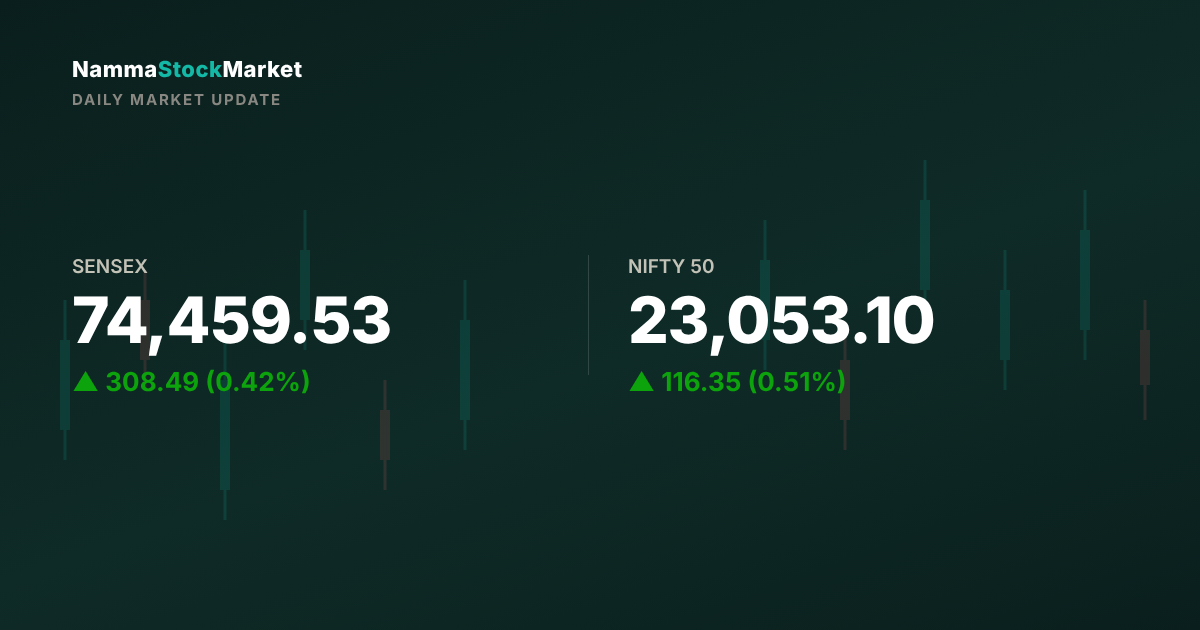
Sensex Jumps 308 Points, Nifty Reclaims 23,000 As IT And Pharma Stocks Rally; Broader Market Sinks On Middle East Oil Worries
October 30, 2026 | by NammaStockMarket
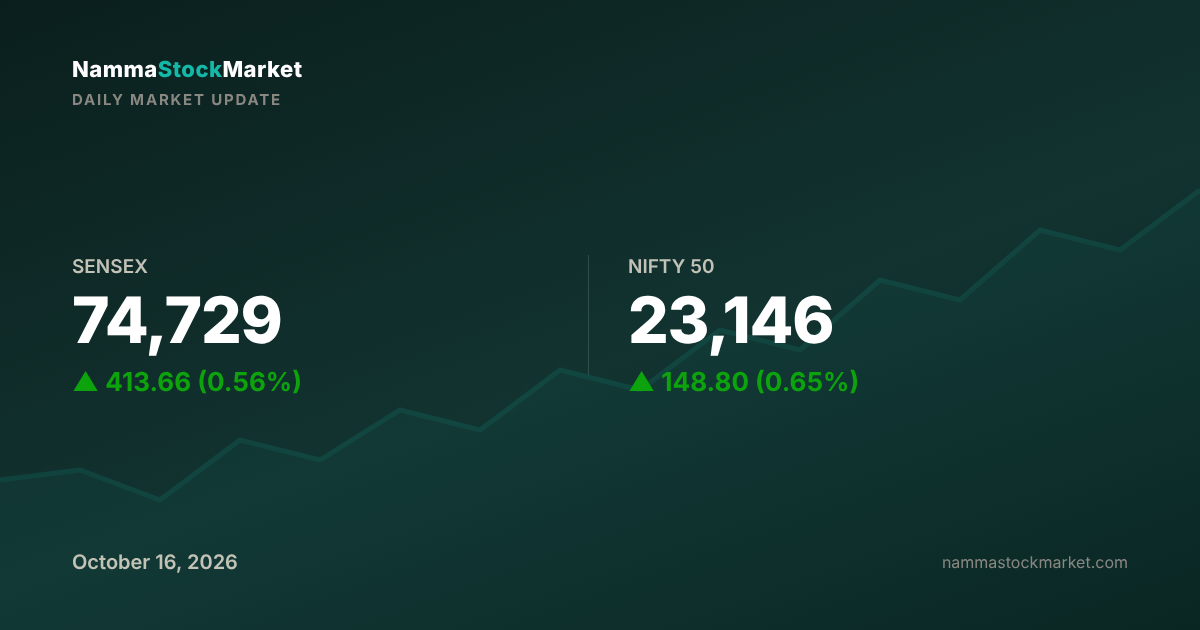
Sensex Jumps 414 Points, Nifty Tops 23,100 As Tech Mahindra Leads IT Rally
October 16, 2026 | by NammaStockMarket
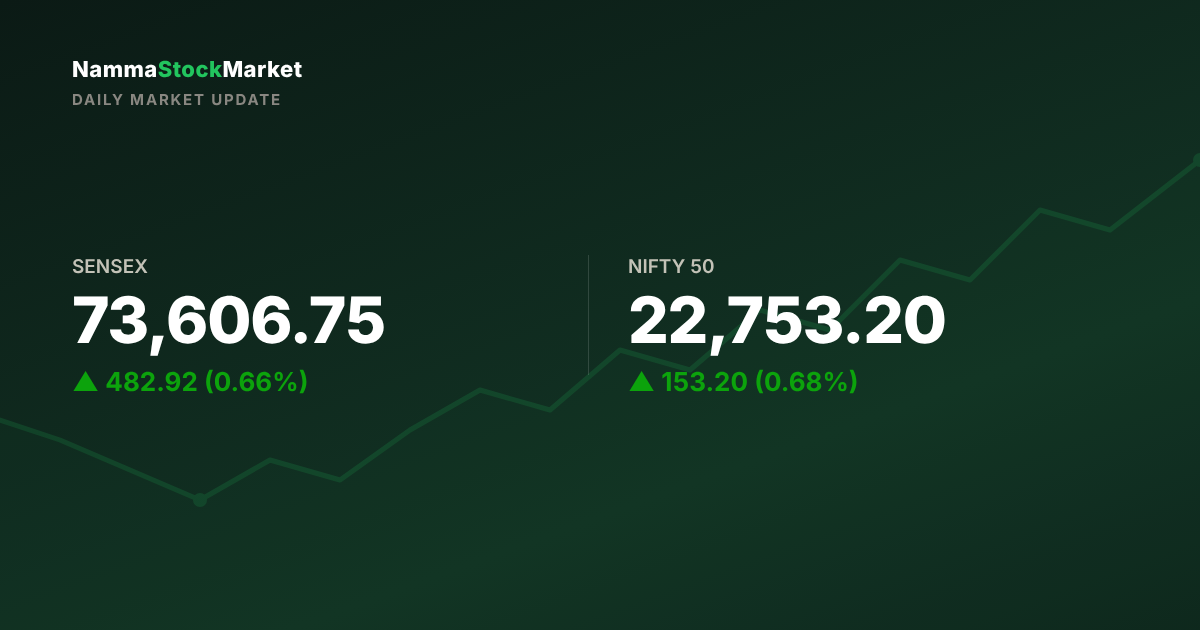
Sensex Rallies 483 Points, Nifty Back Above 22,750 as Metal and Pharma Stocks Lead the Rebound
October 26, 2026 | by NammaStockMarket