

Sensex Surges 512 Points, Nifty Nears 25,300 As FMCG & Bank Stocks Shrug Off Global AI Sell-Off
November 16, 2026 | by NammaStockMarket
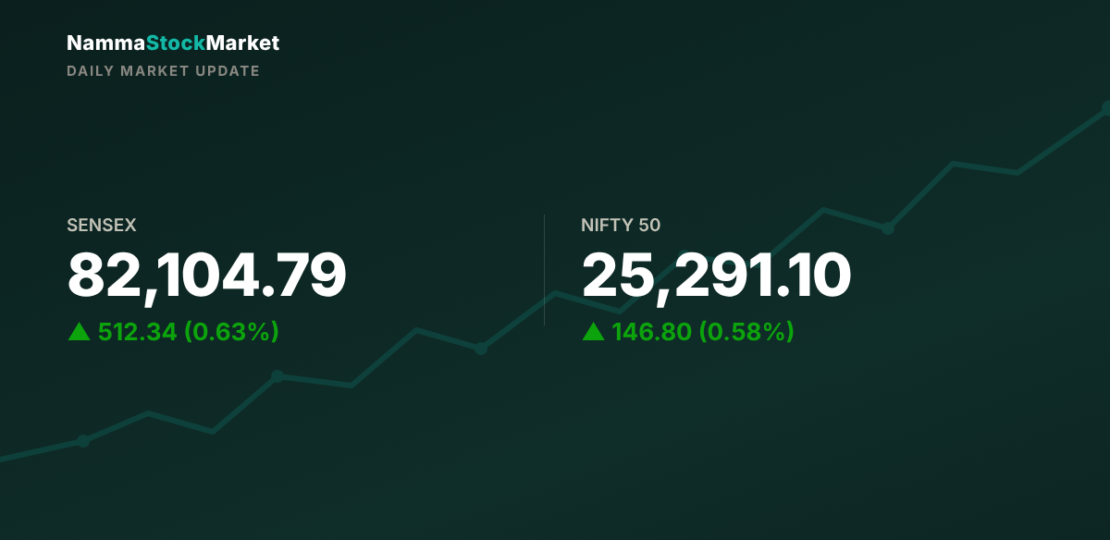
If you checked your portfolio this evening, you probably smiled a little. The Indian stock market closed well in the green today, with the BSE Sensex jumping 512 points and the NSE Nifty 50 closing just short of the 25,300 mark. This happened on a day when Wall Street had actually closed lower on Friday after a scare in AI-related stocks like Nvidia, and other Asian markets like Japan’s Nikkei and South Korea’s Kospi were also under pressure. So why did the Indian share market go up when the global mood was shaky? Two big reasons: foreign investors kept buying Indian stocks in huge numbers through November, and crude oil prices slipped further, which is always good news for a country like India that imports most of its oil. Banks and FMCG (fast-moving consumer goods, basically the everyday products you buy like soap, biscuits and tea) stocks did the heavy lifting today, while IT, auto, metal and pharma stocks lagged behind.
Market At A Glance
Here’s how the major indices closed today. If you’re new to this, the Sensex (short for Sensitive Index) is the benchmark of the Bombay Stock Exchange, or BSE, tracking 30 of India’s biggest companies. The Nifty 50 is the equivalent benchmark on the National Stock Exchange, or NSE, tracking the top 50 companies. Nifty Bank, also called Bank Nifty, tracks the biggest bank stocks and is hugely popular with F&O (futures and options) traders.
| Index | Close | Points Change | % Change |
|---|---|---|---|
| BSE Sensex | 82,104.79 | ▲ 512.34 | ▲ 0.63% |
| NSE Nifty 50 | 25,291.10 | ▲ 146.80 | ▲ 0.58% |
| Nifty Bank | 61,575.90 | ▲ 541.80 | ▲ 0.89% |
| Nifty Midcap 100 | Not confirmed* | — | ▼ 0.51% |
| Nifty Smallcap 100 | Not confirmed* | — | ▼ 1.10% |
*Nifty Midcap 100 and Nifty Smallcap 100 fell 0.51% and 1.10% respectively today, confirmed across multiple sources — but we could not independently confirm their exact closing index levels in time for publishing, so only the percentage change is shown. India VIX, the market’s “fear gauge” that measures expected volatility, was trading calmly around the 15.5 level in the morning session; a confirmed closing figure for VIX was not available at the time of writing.
Why The Market Moved
The simplest way to think about today is this: global money had a reason to feel nervous, and a reason to feel hopeful, and India ended up on the right side of both. The nervous part came from the US, where the Nasdaq and tech-heavy stocks like Nvidia fell on Friday after reports around Nvidia’s leadership and jitters ahead of its upcoming earnings and a big AI company’s expected stock market debut. When something like this happens, it’s common to see “global cues” turn risk-off, meaning investors everywhere pull back a bit from stocks seen as expensive or overheated. Since India has much lower exposure to these crowded AI trades compared to the US or countries like Japan and South Korea, some of that global money found its way into safer, steadier Indian sectors like FMCG, banks and hospitals instead.
The hopeful part came from crude oil. Brent crude, the global benchmark that is always priced in US dollars per barrel, slipped to around $95.40 a barrel today, helped by expectations that the world will have more oil than it needs in the next few months, plus signs that oil tankers moving through the Strait of Hormuz (the narrow sea route near Iran that a lot of the world’s oil passes through) were getting back to normal levels. This mattered even though Iran had reportedly struck a US base in Bahrain over the weekend — investors stayed calm because they’re still hoping for a negotiated solution rather than a bigger conflict. For India, cheaper crude is a genuinely big deal: we import more than 80% of our oil, so every dollar crude falls makes our oil import bill smaller, puts less pressure on the rupee, and helps keep inflation in check. That’s why you’ll often see Indian markets cheer when oil drops, even if the reason behind the drop has nothing to do with India directly.
Which Sectors Held Up, And Which Didn’t
FMCG was today’s star performer by a distance, up close to 1.9%, as investors rotated into stable, everyday-consumption names like ITC, Tata Consumer Products and Nestle India. Banks (Financial Services) added another 0.57%, with heavyweights like HDFC Bank and Kotak Mahindra Bank doing well, and Bank Nifty itself gained a strong 0.89%. Hospital and healthcare names also had a terrific day riding on strong earnings. On the other side, IT barely moved, staying almost flat, while Auto, Realty, Metal and Pharma all ended lower, with Pharma the worst hit, down about 1.5%.
| Sector (Nifty Index) | % Change |
|---|---|
| FMCG | ▲ 1.87% |
| Financial Services | ▲ 0.57% |
| Consumer Durables | ▲ 0.38% |
| IT | ▲ 0.03% |
| Energy | ▼ 0.33% |
| Auto | ▼ 1.29% |
| Realty | ▼ 1.34% |
| Metal | ▼ 1.50% |
| Pharma | ▼ 1.53% |
If you’re holding FMCG or bank stocks, today was a good day for your portfolio. If you’re sitting on auto or metal stocks, today probably stung a bit — Tata Motors’ passenger vehicle business alone dragged the whole auto pack down after the company trimmed its profit margin guidance for Jaguar Land Rover, its UK luxury car business, to 2-3% from an earlier 4% for the coming financial year. That’s a meaningful cut, and brokerages were quick to lower their price targets on the stock after the news.
Today’s Top Movers
Max Healthcare was the single best-performing stock among the big names today, jumping over 6.6% after its September-quarter results showed a clear recovery in operating margins — a sign the hospital chain’s expansion plans are starting to pay off. Other hospital stocks like Fortis Healthcare and Aster DM also rallied hard on similar optimism around the healthcare space, while a smaller hospital operator, KIMS, jumped after signing a 10-year operations and management deal with another medical institute. ITC and Tata Consumer Products also had a strong day as FMCG stocks came back into favour.
| Stock | Close (₹) | % Change |
|---|---|---|
| Max Healthcare Institute | 1,009.90 | ▲ 6.63% |
| Tata Consumer Products | 1,117.50 | ▲ 3.57% |
| ITC | 295.10 | ▲ 3.54% |
| Apollo Hospitals | 8,771.00 | ▲ 2.87% |
| Nestle India | 1,297.00 | ▲ 2.68% |
On the losing side, Tata Motors’ passenger vehicle stock had a rough day, falling nearly 8.7% after that JLR margin guidance cut mentioned above. Tata Steel, Maruti Suzuki, Hindalco and Coal India rounded out the weak names, as metal and auto stocks broadly stayed under pressure through the session.
| Stock | Close (₹) | % Change |
|---|---|---|
| Tata Motors Passenger Vehicles | 262.40 | ▼ 8.70% |
| Tata Steel | 182.26 | ▼ 2.37% |
| Maruti Suzuki | 12,571.00 | ▼ 2.20% |
| Hindalco Industries | 923.30 | ▼ 2.15% |
| Coal India | 397.50 | ▼ 1.49% |
What FIIs And DIIs Were Doing
You’ve probably seen the terms FII and DII thrown around a lot if you follow market news, so here’s a quick explainer. FII stands for Foreign Institutional Investor — big foreign funds, pension funds and investment houses based outside India that buy and sell Indian stocks. You’ll also sometimes see the term FPI (Foreign Portfolio Investor), which is used almost interchangeably with FII these days. DII stands for Domestic Institutional Investor — Indian mutual funds, insurance companies like LIC, and similar big local investors. When FIIs buy heavily, it’s usually a strong vote of confidence in India from the rest of the world, and that’s exactly what’s been happening this month.
November 2026 has actually been an extraordinary month for FII buying. Foreign investors net-bought roughly ₹84,290 crore worth of Indian stocks in the cash segment between November 2 and November 13 alone — among the strongest months of FII buying on record. This comes right after FIIs had been net sellers for the previous two months, so the turnaround has been sharp. Interestingly, DIIs — essentially your mutual fund SIP (Systematic Investment Plan) money and insurance money — have been net sellers over the same stretch, booking some profits even as foreign money poured in. Here are the daily cash-segment figures for the most recent sessions we could confirm (today’s official FII/DII figure is usually released by the exchanges only after market hours, so it was not yet available at the time of publishing):
| Date | FII Net (₹ Crore) | DII Net (₹ Crore) |
|---|---|---|
| 13 Nov 2026 | ▲ 5,736.60 | ▼ 2,253.60 |
| 12 Nov 2026 | ▲ 7,830.60 | ▼ 6,331.20 |
| 11 Nov 2026 | ▲ 12,563.30 | ▼ 8,434.50 |
| 09 Nov 2026 | ▲ 7,212.20 | ▼ 7,172.50 |
| 06 Nov 2026 | ▲ 13,749.80 | ▼ 5,968.70 |
Notice the pattern here — FIIs have been net buyers every single day shown above, while DIIs have been net sellers each day. This is a bit of a role reversal from what we’ve seen for much of 2026, when DIIs (helped by steady SIP inflows from retail investors like you) were often the ones holding up the market while FIIs sold. For now, foreign money is clearly in the driver’s seat, and that’s a big part of why the Nifty and Sensex have been climbing for three straight weeks.
Oil, The Rupee, And Global Cues
We touched on crude already, but let’s also talk about the rupee, because the two are closely linked. The Indian rupee strengthened today, rising 27 paise to close at 93.92 against the US dollar, helped by the same two forces driving the stock market — strong foreign fund inflows and softer crude oil prices. When FIIs bring dollars into India to buy stocks, they need to convert those dollars into rupees, which naturally supports the rupee’s value. And when crude oil is cheaper, India needs fewer dollars to pay for its oil imports, which also takes pressure off the currency. A stronger rupee is good news for anyone who travels abroad, pays for imported goods, or has debt in foreign currency, though it can be a mild headwind for IT and export-focused companies that earn in dollars.
On the global cues front, the story to watch is the AI-stock wobble in the US and other Asian markets. Nvidia’s upcoming earnings report this week, along with a high-profile AI company’s anticipated stock market listing (its IPO, or Initial Public Offering), are likely to keep global markets a little jumpy until they’re out of the way. Elevated US bond yields and expectations that major central banks, including possibly the US Federal Reserve, could raise interest rates again in December are also factors some market strategists are flagging as a reason the rally could pause or consolidate rather than run away on the upside.
What To Watch Tomorrow
A few things to keep an eye on as we head into the next session. First, whether the record pace of FII buying continues — if foreign money keeps flowing in at this rate, it could keep pushing the Nifty higher, but any slowdown could quickly change the market’s mood given how much of this rally has been FII-driven. Second, keep watching Brent crude and the rupee; a sustained move below $95 for crude would be a genuine positive, while any flare-up in Middle East tensions could reverse the recent calm quickly. Third, Nvidia’s earnings and the broader AI-stocks story out of the US could set the tone for global markets, and by extension, for Indian IT stocks and overall sentiment, over the next few sessions.
On the technical side, some analysts expect the Nifty to broadly consolidate in the 25,000-25,500 range in the near term, with positional support seen around 24,800 — useful levels to know whether you’re a short-term trader watching open interest (OI) and the put-call ratio (PCR) on F&O data, or a long-term investor just tracking your portfolio. Auto stocks remain in focus after Tata Motors’ guidance cut, while FMCG, banks and healthcare look relatively more resilient for now based on today’s price action. As always, none of this is a buy or sell recommendation — just context to help you understand where the market stands as you track your own demat and trading account holdings.
This article is for general information and understanding of today’s market moves. It is not investment advice. Please do your own research or consult a qualified financial advisor before making any investment decisions.
RELATED POSTS
View all

Sensex Jumps 384 Points, Nifty Nears 24,000 For 5th Day As Media, Metal Stocks Rally; IT Stocks Alone Drag
November 4, 2026 | by NammaStockMarket
Sensex Slips 330 Points, Nifty Snaps 4-Day Winning Streak To End At 23,329 As IT Stocks Drag
September 22, 2026 | by NammaStockMarket
Sensex Jumps 308 Points, Nifty Reclaims 23,000 As IT And Pharma Stocks Rally; Broader Market Sinks On Middle East Oil Worries
October 30, 2026 | by NammaStockMarket