

Sensex Crashes 1,247 Points, Nifty Slips Below 23,100 As Crude Oil Spikes And IRDAI Insurance Rules Hit Bank Stocks
September 24, 2026 | by NammaStockMarket
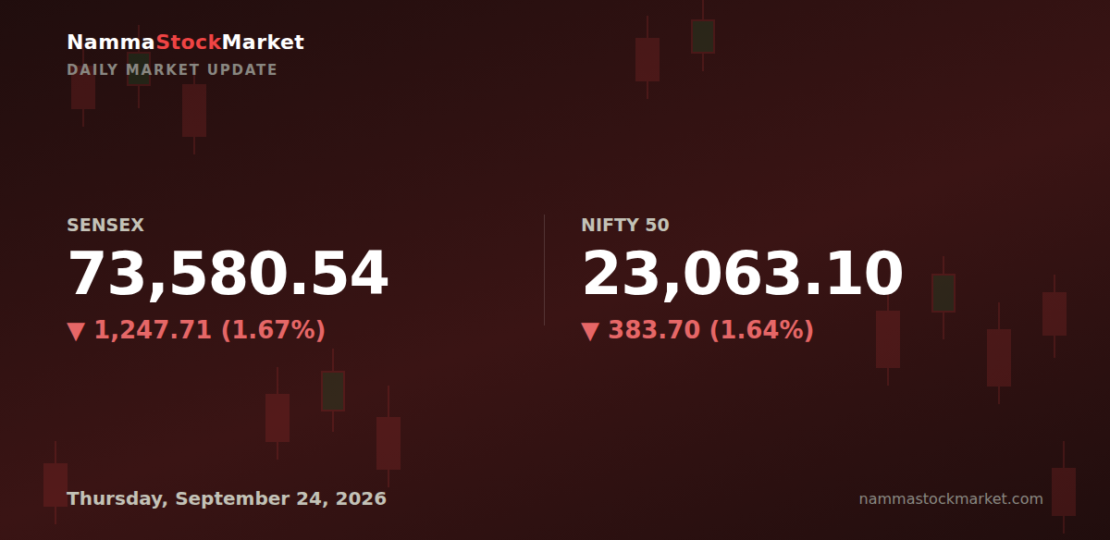
It was a rough Thursday for the Indian stock market. The BSE Sensex crashed 1,247.71 points to close at 73,580.54, down 1.67%, and the NSE Nifty 50 fell 383.70 points to end at 23,063.10, down 1.64%. This is one of the worst single-day falls in months, and if you checked your portfolio this evening, chances are almost everything in it was in the red — only three stocks in the entire Nifty 50 managed to close higher today.
Two things did most of the damage. First, crude oil prices jumped sharply after Iran’s president used his speech at the United Nations General Assembly to say the country would keep resisting US pressure, which revived fears of trouble in the Middle East and a hit to oil supply. Second, a proposal from IRDAI (the insurance regulator) to cap commissions that insurance companies pay their distributors spooked investors in insurance and banking stocks, and HDFC Life, Bajaj Finance and Axis Bank all fell between 4% and 6%. On top of this, US bond yields shot up to their highest levels in nearly two decades, which made investors everywhere, including in India, nervous about holding riskier assets like stocks.
Market At A Glance
| Index | Close | Points Change | % Change |
|---|---|---|---|
| BSE Sensex | 73,580.54 | ▼ 1,247.71 | ▼ 1.67% |
| NSE Nifty 50 | 23,063.10 | ▼ 383.70 | ▼ 1.64% |
| Bank Nifty | 55,438.50 | ▼ 1,110.40 | ▼ 1.96% |
| Nifty Midcap 100 | — | — | ▼ 2.25% |
| Nifty Smallcap 100 | — | — | ▼ 1.54% |
| India VIX | 12.69 | ▲ 2.34 | ▲ 22.64% |
Note: exact closing levels for Nifty Midcap 100 and Nifty Smallcap 100 were not available from our sources at publish time, so only the percentage fall is shown. India VIX going up is not a good sign — more on that below.
Why The Market Moved
If you’re new to investing, here’s the simple version of why oil prices thousands of kilometres away and bond yields in America end up moving your portfolio here in India. India buys most of its crude oil from other countries — we don’t produce nearly enough ourselves. So when oil prices go up, our oil import bill goes up too, which means more dollars flowing out of the country. More dollars going out puts pressure on the rupee, which weakens against the dollar (exactly what happened today, more on that below). A weaker rupee and a bigger import bill also add to inflation worries, and none of that is good news for company profits or stock prices.
Then there’s the US bond yield story. Today the US 10-year Treasury yield moved above 5.1%, its highest level since 2007, and the 30-year yield hit similar multi-decade highs. When yields on safe US government bonds rise this much, big global investors find it more attractive to sit in these bonds rather than take risk in emerging markets like India. That is a big reason why foreign investors pull money out of Indian stocks when US yields spike, and today’s selling had exactly that flavour.
On top of all this, IRDAI’s proposal to cap commissions insurance companies pay their agents and distributors hit the insurance and banking pack hard, since a chunk of their profit comes from these distribution fees. That is why HDFC Life led the losers’ table today, and why banks with large insurance arms or lending books, like Axis Bank and Bajaj Finance, also fell sharply.
Which Sectors Held Up, And Which Didn’t
There was no real green on the sector scoreboard today — every major sector index closed lower. But some fell a lot less than others, and that difference matters if you’re deciding what to do with your portfolio.
| Sector | % Change |
|---|---|
| IT | ▼ 0.44% |
| Pharma | ▼ 0.45% |
| Consumer Durables | ▼ 0.74% |
| Energy | ▼ 1.06% |
| FMCG | ▼ 1.08% |
| Realty | ▼ 1.10% |
| Auto | ▼ 1.57% |
| Metal | ▼ 1.96% |
| Financial Services | ▼ 2.39% |
IT and pharma were the least-worst performers today, down less than half a percent, and that’s not surprising — these are largely export-focused sectors that don’t have much to do with IRDAI’s insurance rules or Indian bond yields directly. Financial services was easily the worst hit, down 2.39%, dragged by the insurance-commission scare, and metal stocks fell almost 2% too on worries that a slowing global economy (that’s what high bond yields usually signal) will hurt demand for steel and other metals. If you’re holding a portfolio tilted towards IT or pharma, today was a much easier day than if you were sitting in bank or financial stocks.
Today’s Top Movers
Market breadth was extremely weak today — just three Nifty 50 stocks closed in the green, and more than 2,500 shares fell on the BSE against roughly 1,500 that rose. Here’s how the top movers looked.
| Top Gainers | % Change |
|---|---|
| Cipla | ▲ 1.16% |
| ONGC | ▲ 0.89% |
| NTPC | ▲ 0.18% |
| Top Losers | % Change |
|---|---|
| HDFC Life Insurance | ▼ 6.16% |
| Bajaj Finance | ▼ 5.87% |
| Axis Bank | ▼ 4.56% |
| Bajaj Finserv | ▼ 4.56% |
| Adani Enterprises | ▼ 3.11% |
Notice a pattern? Every single stock on the losers’ list today is either an insurer, an NBFC (non-banking finance company, like Bajaj Finance and Bajaj Finserv) or a bank — all of them tied directly to the IRDAI commission news or the broader financial-sector selloff. Cipla topping the gainers’ list makes sense too, since pharma was one of the sectors that held up best today. If you hold any of these five losers in your demat account, today’s fall was about a specific regulatory worry, not a reflection of a bad quarter or bad business — something worth remembering before you panic and sell.
What FIIs And DIIs Were Doing
You’ll often see the terms FII and DII in market reports, so here’s what they mean in plain words. FII stands for Foreign Institutional Investor (sometimes also called FPI, Foreign Portfolio Investor) — big global funds and institutions based outside India that invest in our markets. DII stands for Domestic Institutional Investor — Indian mutual funds, insurance companies and similar institutions investing money that includes what you and I put in through SIPs (systematic investment plans) every month. When FIIs sell heavily and DIIs buy, it’s usually DII money, a lot of it your own SIP contributions, that cushions the market from falling even further.
Today’s official FII/DII cash-segment numbers for September 24 weren’t out yet at the time of writing — NSE typically releases this data in the evening after markets close. Here’s how the last five trading sessions have looked:
| Date | FII Net (₹ Crore) | DII Net (₹ Crore) |
|---|---|---|
| 23 Sep 2026 | ▲ ₹1,617 crore | ▲ ₹2,341 crore |
| 22 Sep 2026 | ▼ ₹3,810 crore | ▲ ₹4,120 crore |
| 21 Sep 2026 | ▼ ₹576 crore | ▲ ₹2,797 crore |
| 18 Sep 2026 | ▲ ₹600 crore | ▲ ₹1,020 crore |
| 17 Sep 2026 | ▼ ₹3,209 crore | ▲ ₹3,618 crore |
Look at the DII column — green every single day. Domestic institutions, powered heavily by mutual fund SIP money, have been net buyers on all five of the last sessions we have data for, even on days when FIIs pulled money out. This is exactly the kind of cushioning effect that has kept Indian market crashes shallower than they might otherwise have been over the last couple of years. We’ll update this article’s numbers as soon as today’s official figures are out, but given how sharp today’s fall was, don’t be surprised if FII selling picked up again.
Oil, The Rupee, And Global Cues
Brent crude, the global benchmark for oil prices, jumped to around $105.90 a barrel today, up 2.74%, after Iran’s president used his speech at the UN General Assembly to say the country would keep resisting US pressure. That kind of talk makes traders nervous about oil supply from the Middle East, and oil prices react fast to that kind of nervousness. Remember, Brent is always priced in US dollars per barrel since it’s a globally traded commodity, but what matters for you as an Indian investor is what it does to our oil import bill and the rupee, not the dollar number itself.
And that’s exactly what happened. The rupee fell 23 paise against the dollar to close around 95.96, from Wednesday’s close of 95.73, making it one of the weaker days for the currency recently. Three things combined to pressure the rupee: costlier oil pushing up the import bill, a stronger US dollar index (which rose on bets of more Fed rate hikes after strong American economic data), and the heavy selling in Indian stocks itself, which tends to feed back into a weaker currency as some foreign money heads for the exit. On the global cues front, Wall Street had a soft session overnight too — the Dow, Nasdaq and S&P 500 all ended lower, and that muted mood carried into Asian and then Indian trading this morning.
What To Watch Tomorrow
The big overhang going into the next session is the same one that hurt the market today: where US bond yields and the US Fed’s rate-hike commentary head next. If yields stay this elevated, don’t expect FIIs to come back into Indian equities in a hurry. Keep an eye on Brent crude too — another leg up from the Iran-related tension could keep the pressure on both the rupee and inflation-sensitive sectors like autos and FMCG. On the regulatory side, watch for any clarification or walk-back from IRDAI on its commission-cap proposal, since that alone could decide whether bank and insurance stocks stabilise or fall further. India VIX shooting up more than 22% today also tells you options traders are bracing for more swings, so if you trade F&O (futures and options), expect a choppier ride than usual until some of these worries settle down. As always, none of this is a buy or sell call — just the things worth keeping on your radar before the opening bell tomorrow.
RELATED POSTS
View all

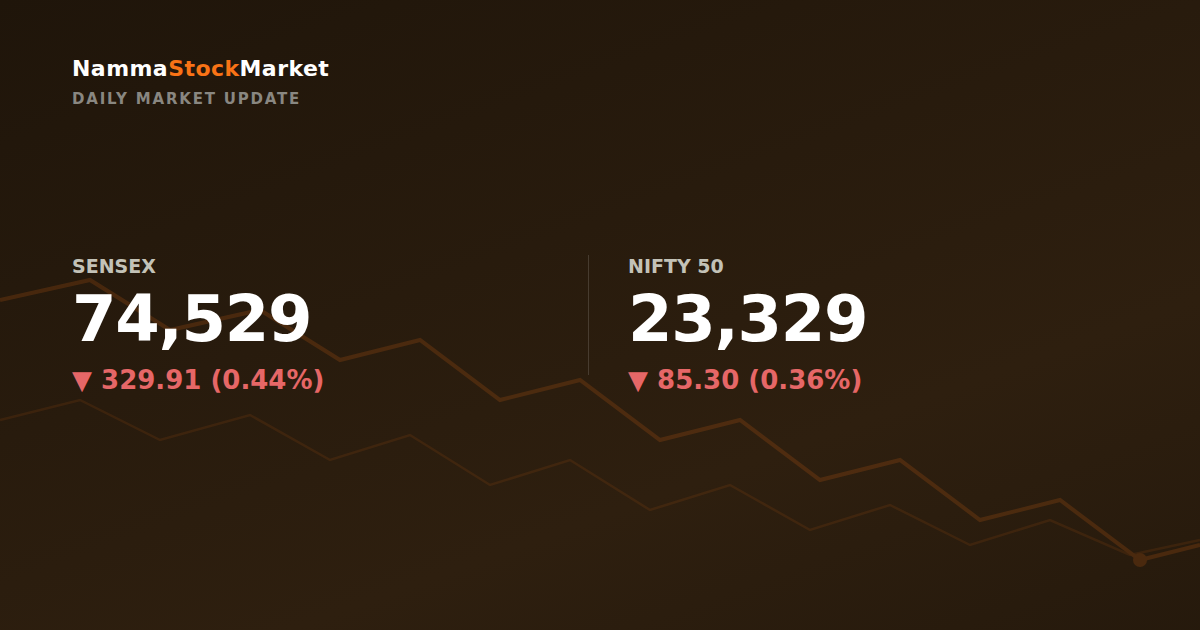
Sensex Slips 330 Points, Nifty Snaps 4-Day Winning Streak To End At 23,329 As IT Stocks Drag
September 22, 2026 | by NammaStockMarket
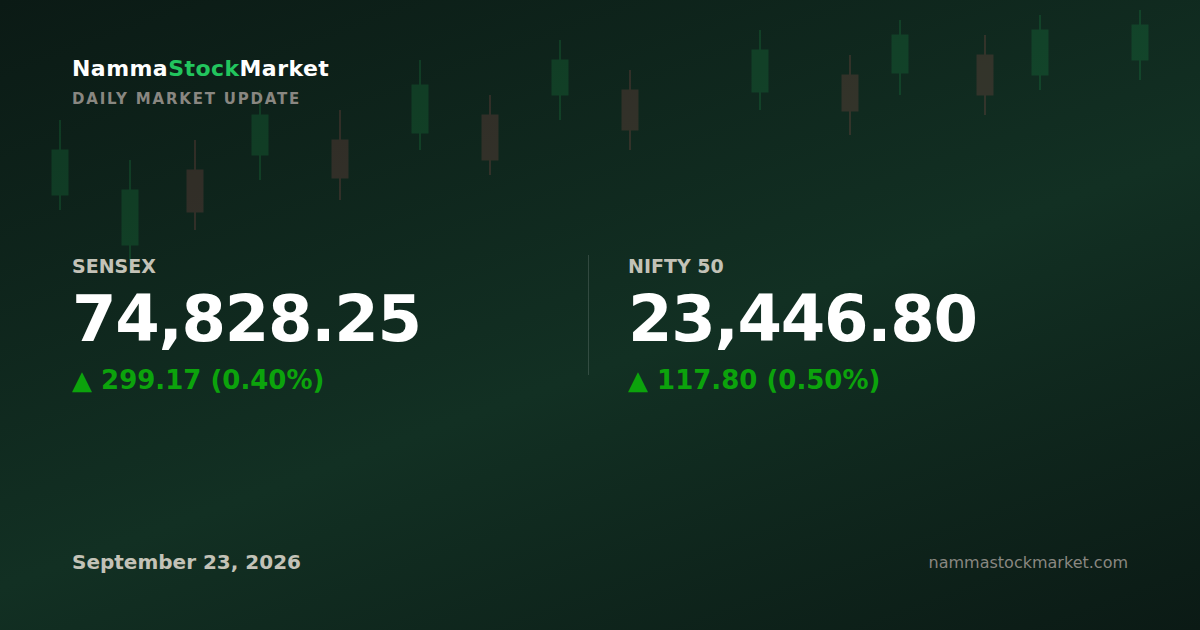
Sensex Gains 299 Points, Nifty Ends Above 23,400 As Crude Oil Drops Below $100; Metal Stocks Jump 2.4%, IT Slips
September 23, 2026 | by NammaStockMarket
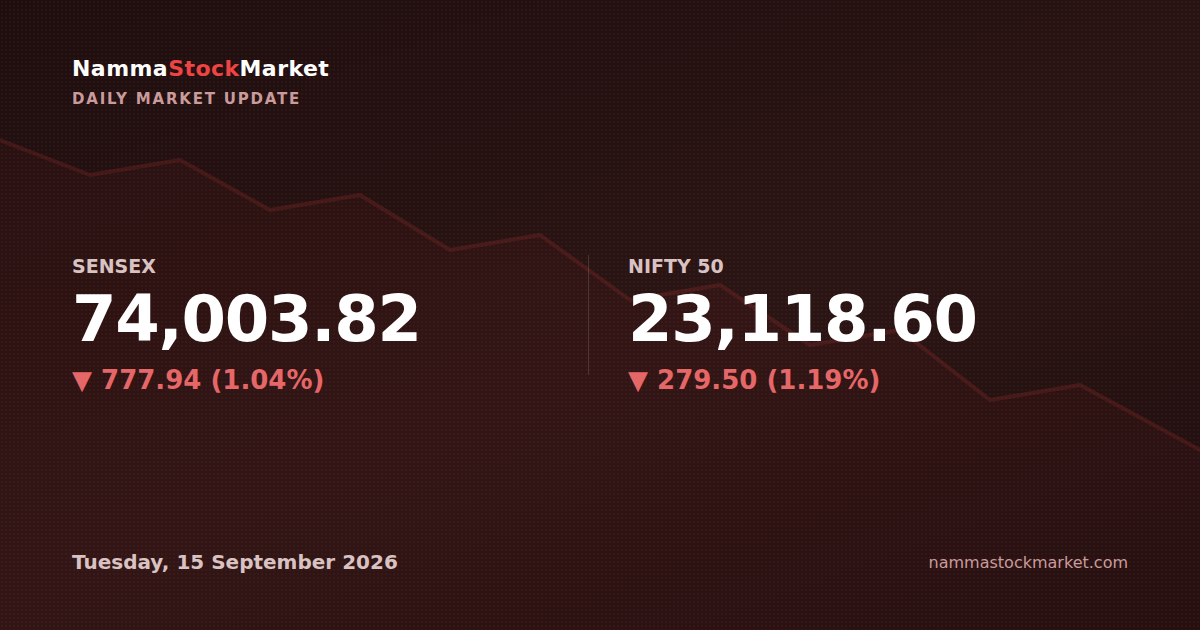
Sensex, Nifty Fall Over 1% as Crude Oil Surges; IT Stocks Buck the Trend
September 15, 2026 | by NammaStockMarket