

Sensex Ends Flat At 72,480, Nifty Slips To 22,620 As Banks, Realty Shine
September 30, 2026 | by NammaStockMarket
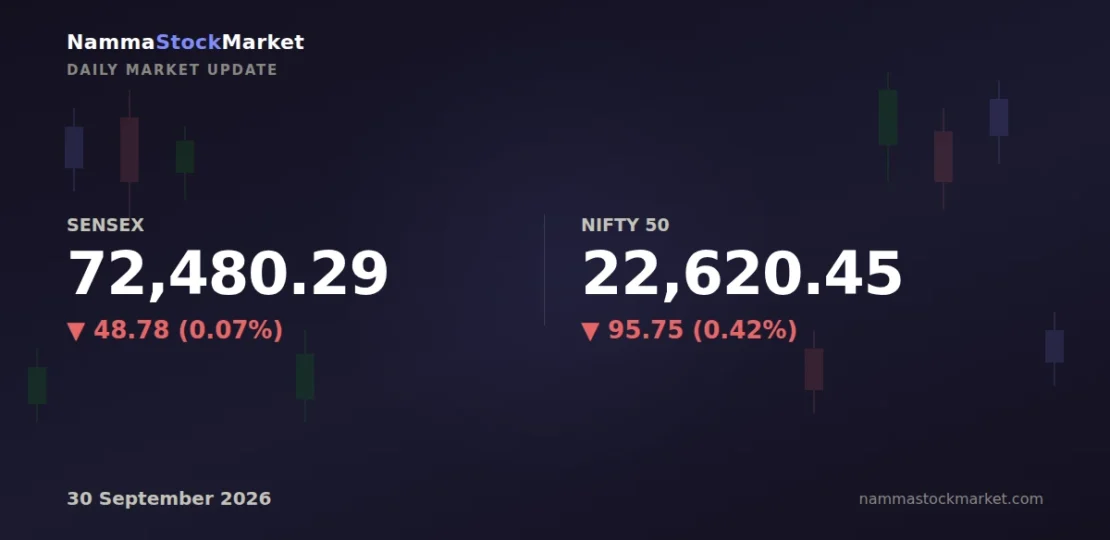
It was a choppy, give-and-take kind of Wednesday on Dalal Street. The BSE Sensex (the 30-stock index of the Bombay Stock Exchange) closed almost exactly where it started, ending at 72,480.29, down just 48.78 points or 0.07%. The NSE Nifty 50 (the 50-stock benchmark of the National Stock Exchange) had a slightly rougher day, closing at 22,620.45, down 95.75 points or 0.42%, its third straight day in the red. If you’re tracking the Indian stock market closely, today felt like two different markets rolled into one: bank and realty stocks quietly did well, while metal and pharma stocks, especially hospital shares, took a beating.
The story behind the flat headline number is really a story of pulling in two directions. On one side, you had elevated crude oil prices, a weak rupee, and foreign investors continuing to pull money out of Indian shares. On the other side, domestic investors (mutual funds and insurance companies, mainly) kept buying, and a few pockets like private banks and realty found genuine buying interest. That tug of war is why the Sensex barely moved even though the mood under the surface was fairly nervous.
Market At A Glance
| Index | Close | Change (Pts) | % Change |
|---|---|---|---|
| BSE Sensex | 72,480.29 | ▼ 48.78 | ▼ 0.07% |
| NSE Nifty 50 | 22,620.45 | ▼ 95.75 | ▼ 0.42% |
| Bank Nifty | 54,633.05 | ▲ 373.00 | ▲ 0.69% |
| Nifty Midcap 100 | n/a* | n/a* | ▼ ~flat |
| Nifty Smallcap 100 | n/a* | n/a* | ▲ ~0.2% |
| India VIX | 13.18 | ▼ 0.23 | ▼ 1.72% |
*Exact closing levels for Nifty Midcap 100 and Nifty Smallcap 100 were not available from public sources at the time of writing. Based on multiple market reports, the Midcap 100 index ended roughly flat while the Smallcap 100 index closed with a marginal gain of around 0.2%.
Why The Market Moved
If you’re newer to investing, you might wonder why things like crude oil prices or US bond yields, which sound like they have nothing to do with Indian stocks, actually move the Sensex and Nifty every single day. Here’s the simple version.
India imports close to 85% of the crude oil it uses. So when oil prices go up, India’s oil import bill goes up too, which means more dollars are going out of the country to pay for oil. More dollars going out puts pressure on the rupee (it tends to weaken), and a weaker rupee makes everything from petrol to imported electronics a bit costlier, which stokes inflation worries. That’s exactly what played out today. Brent crude (the global benchmark for oil prices, quoted in US dollars per barrel since oil is a globally dollar-priced commodity) was trading around $103 a barrel, still elevated because of ongoing tension in the Middle East and worries about Iran, even though it had eased a bit from higher levels earlier in the week. That kept the pressure on the rupee and on sectors that depend on oil, like paints, tyres, and aviation.
The other big factor was US bond yields. The US 10-year Treasury yield was hovering near 5.24%, its highest level since 2007. When US government bonds pay that kind of return with very little risk, big global investors find it less attractive to keep money in riskier markets like India, so some of that money gets pulled out. This is a big reason why FIIs (foreign institutional investors, the big foreign funds that invest in Indian shares) have been net sellers in the cash market for several sessions running.
Which Sectors Held Up, And Which Didn’t
Banks and realty were clearly the story of the day on the positive side, while metals and pharma dragged the market lower. Here’s how the major sector indices moved:
| Sector Index | Move |
|---|---|
| Nifty Realty | ▲ 1-2% |
| Nifty PSU Bank | ▲ 1-2% |
| Nifty Private Bank | ▲ 1-2% |
| Nifty Media | ▲ 1-2% |
| Bank Nifty (overall) | ▲ 0.69% |
| Nifty Metal | ▼ over 1% |
| Nifty Pharma | ▼ over 1% |
If you’re holding private bank stocks or realty stocks, today was a genuinely good day. ICICI Bank was the standout, surging around 3% on the back of strong buying, while Kotak Mahindra Bank also added more than 2%. This lifted Nifty Private Bank and Nifty PSU Bank, and pulled the overall Bank Nifty up 0.69% to close at 54,633.05, even though heavyweight HDFC Bank actually ended nearly 2% lower and worked against the index. That’s the kind of divergence that happens inside the banking pack sometimes; not every bank stock moves together even when the sector index looks green.
On the other end, if you’re holding metal or pharma stocks, today stung a bit. Both Nifty Metal and Nifty Pharma fell more than 1%, and healthcare stocks in particular had a rough session, with hospital chains like Apollo Hospitals and Max Healthcare falling sharply on profit-booking after a strong run over the past few weeks. IT stocks were a mixed bag; while the broader Nifty IT index didn’t move much, individual names like Tech Mahindra and Wipro managed decent gains even as the rest of the market stayed cautious.
Today’s Top Movers
Here are the Nifty 50 stocks that moved the most today, on both sides:
| Stock | % Change |
|---|---|
| Kotak Mahindra Bank | ▲ 2.71% |
| InterGlobe Aviation (IndiGo) | ▲ 2.30% |
| ICICI Bank | ▲ 2.28% |
| Tech Mahindra | ▲ 1.42% |
| Wipro | ▲ 1.38% |
Banking and aviation stocks led the gainers’ list. Kotak Mahindra Bank topped the charts with a gain of 2.71%, followed closely by InterGlobe Aviation, the company that runs IndiGo, which climbed 2.30%, likely helped by softer crude prices easing worries about jet fuel costs. ICICI Bank, Tech Mahindra, and Wipro rounded out the top five.
| Stock | % Change |
|---|---|
| Apollo Hospitals | ▼ 5.70% |
| Max Healthcare | ▼ 5.33% |
| Adani Enterprises | ▼ 2.92% |
| Eternal | ▼ 2.75% |
| ONGC | ▼ 2.62% |
The losers’ list was dominated by healthcare and energy-linked names. Apollo Hospitals and Max Healthcare both fell more than 5% as investors booked profits after a big rally in hospital stocks this year. Adani Enterprises, Eternal (the company formerly known as Zomato), and ONGC also featured among the day’s biggest laggards, with ONGC’s weakness a bit ironic given that high crude prices usually help oil producers, but broader profit-taking in energy names outweighed that today.
What FIIs And DIIs Were Doing
You’ll often see the terms FII and DII in market reports, so here’s a quick explainer. FIIs, or Foreign Institutional Investors (sometimes also called FPIs, Foreign Portfolio Investors), are big foreign funds and institutions that invest in Indian shares from outside the country. DIIs, or Domestic Institutional Investors, are Indian institutions doing the same thing from within, mainly mutual funds (the ones that collect your SIP, or Systematic Investment Plan, money every month) and insurance companies like LIC. Watching what these two big groups are doing tells you a lot about the real mood in the market, beyond just the index numbers.
Today’s official FII and DII cash market figures for September 30 aren’t out yet; they are usually released by the exchanges after market hours, typically late evening. Here’s what we know for the last three confirmed trading sessions:
| Date | FII (Cash) | DII (Cash) |
|---|---|---|
| September 25, 2026 | ▼ 3,693.90 crore sold | ▲ 2,838.20 crore bought |
| September 28, 2026 | ▼ 5,353.20 crore sold | ▲ 5,189.00 crore bought |
| September 29, 2026 | ▼ 9,980.22 crore sold | ▲ 6,952.70 crore bought |
The pattern here is pretty clear and it’s been the pattern for a while now: FIIs have been steady net sellers in the cash segment, and DIIs have been stepping in as buyers almost every single day to cushion that selling. On September 29 alone, FIIs sold a hefty ₹9,980 crore worth of Indian shares, the biggest single-day outflow in about four months, while DIIs bought nearly ₹6,953 crore. This is a big reason why, despite all the FII selling you keep reading about, the Sensex and Nifty haven’t fallen off a cliff; domestic money, a lot of it your own SIP contributions if you invest through mutual funds, is quietly absorbing a good chunk of that foreign selling.
Oil, The Rupee, And Global Cues
Brent crude was trading around $103 to $104 a barrel today, still elevated due to the ongoing standoff involving Iran and concerns about oil supply disruptions from the Middle East, even though there was some relief earlier in the week after reports of the Red Sea shipping routes normalising. Remember, since India buys most of its oil from abroad in dollars, every dollar increase in the price of Brent crude adds directly to the country’s import bill and, in turn, pressures the rupee.
Speaking of the rupee, the USD/INR pair (how many rupees it takes to buy one US dollar) settled around 95.97, weaker by about 3 paise compared to the previous close. The rupee’s weakness today came from a mix of factors: persistent dollar demand from state-run oil marketing companies buying dollars to pay for crude imports, continued FII outflows, and firm US bond yields making the dollar more attractive globally. The Reserve Bank of India (RBI) is believed to have stepped in through state-run banks selling dollars to prevent the rupee from breaching the 96 mark, a reminder that the central bank keeps a close watch on the currency to avoid runaway depreciation. Global cues were mixed too: Wall Street (the US market) closed modestly lower overnight as rising long-term bond yields worried investors, even as odds of a near-term US Fed rate cut eased. Closer home, Asian markets like Japan’s Nikkei were firmer, giving Indian markets a partial cushion.
What To Watch Tomorrow
A few things are worth keeping an eye on as we head into the next session. First, keep watching crude oil prices; any further escalation in Middle East tensions could push Brent higher and add more pressure on the rupee and on oil-sensitive sectors like paints, tyres, and airlines. Second, keep an eye on the FII and DII cash figures for today once they’re out later tonight; if FII selling continues at the same pace while DII buying can’t fully offset it, that’s usually a sign of more volatility ahead. Third, with September (and the September F&O series) coming to a close, some of today’s moves may have also been influenced by derivatives expiry-related positioning, so don’t read too much into single-day swings in individual stocks just yet. Banking and realty look like the more resilient pockets for now, while metal and pharma stocks, especially hospital shares after such a sharp rally this year, could see more profit-booking if global sentiment stays shaky. This is purely an observation of current trends and not investment advice; always do your own research or speak with a qualified advisor before making any trading or investment decisions.
RELATED POSTS
View all

Sensex Falls 243 Points, Nifty Ends Below 22,750 As Tata Sons Restructuring Plan Rattles Tata Group Stocks
September 29, 2026 | by NammaStockMarket
Sensex Slips 330 Points, Nifty Snaps 4-Day Winning Streak To End At 23,329 As IT Stocks Drag
September 22, 2026 | by NammaStockMarket
Sensex, Nifty Fall Over 1% as Crude Oil Surges; IT Stocks Buck the Trend
September 15, 2026 | by NammaStockMarket