

Sensex Ends Nearly Flat, Nifty Closes At 23,270 As Pharma, Realty Rally While Fed Rate Hike Hits IT And Bank Stocks
September 17, 2026 | by NammaStockMarket
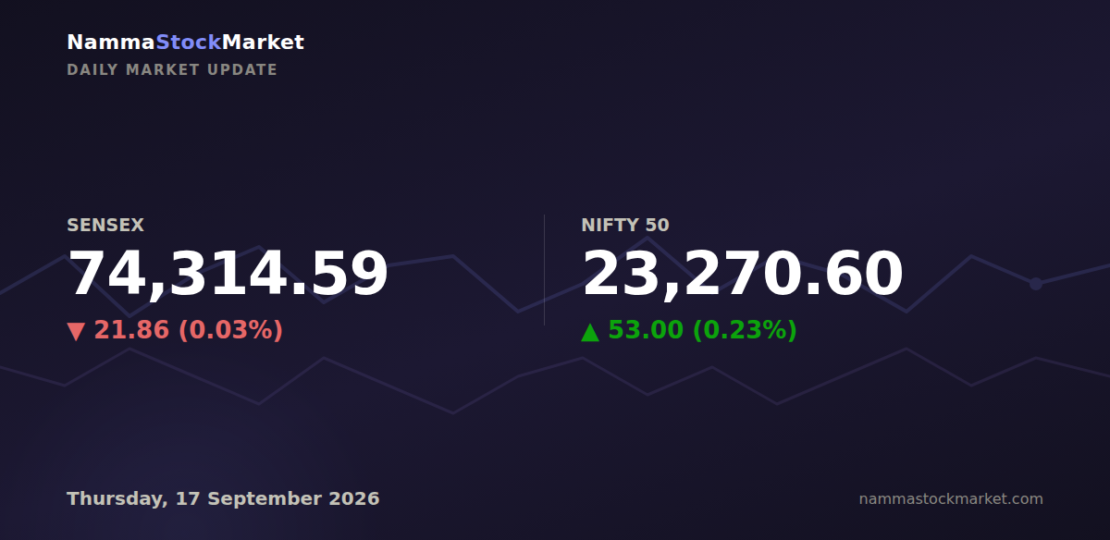
It was a quiet, almost sleepy day on Dalal Street on Thursday, and after the choppy sessions we’ve had lately, that’s not really a bad thing. The Sensex closed at 74,314.59, down just 21.86 points, while the Nifty 50 actually managed a small gain, ending 53 points higher at 23,270.60. But that flat headline number hides a real tug of war that was going on underneath. On one side, the US Federal Reserve raised interest rates overnight for the first time in this cycle, and that spooked IT stocks and banks, which are the most sensitive to expensive US money. On the other side, pharma, realty, auto and metal stocks quietly had a strong day and pulled the index back up. If you’re holding an IT-heavy or bank-heavy portfolio, today probably felt a bit disappointing. If you had some pharma or realty names sitting in there, you’d have had a much better day.
Market At A Glance
| Index | Close | Change (pts) | % Change |
|---|---|---|---|
| Sensex | 74,314.59 | ▼ 21.86 | ▼ 0.03% |
| Nifty 50 | 23,270.60 | ▲ 53.00 | ▲ 0.23% |
| Bank Nifty | ~56,056 | ▼ ~236 | ▼ 0.42% |
| Nifty Midcap 100 | — | — | ▲ 0.92% |
| Nifty Smallcap 100 | — | — | ▲ 0.76% |
| India VIX | 12.14 | ▼ ~1.03 | ▼ 7.82% |
Note: Closing levels and point changes for Nifty Midcap 100 and Nifty Smallcap 100 were not separately published as of writing — only their percentage moves were available, so those two columns are left blank for these two rows. Bank Nifty’s closing level is estimated from its previous close and today’s reported percentage move.
Why The Market Moved
The single biggest reason markets were on edge today was the US Federal Reserve. Late last night, the Fed raised its key interest rate by 0.25%, to a range of 3.75-4%, and signalled that most of its policymakers expect at least one more hike before the year is out. Now, why should a rate decision made in Washington matter to you as an Indian investor? It’s simple, really. When US interest rates go up, it becomes more attractive for big global investors to just park their money safely in US bonds instead of taking a risk on emerging markets like India. That’s one big reason why Foreign Institutional Investors, or FIIs, have been net sellers in Indian stocks for a while now — more on that in a bit. A stronger dollar also makes imports costlier for us, and since India buys almost all of its crude oil from abroad, a strong dollar directly pushes up our oil import bill. That, in turn, puts pressure on the rupee and on inflation back home.
Sectors that depend on cheap global money, like banks, and companies that earn a big chunk of their revenue from the US, like IT firms, usually get hit hardest on days like this. Higher US rates typically mean American clients tighten their technology budgets and delay projects, which hurts revenue growth for Indian IT companies that earn more than half their money from the US market. That’s exactly what played out today, with HCL Technologies, TCS, Tech Mahindra and Infosys all closing lower.
Adding to the mix, the massive NSE IPO — yes, the stock exchange itself is going public — opened for subscription today, with a price band of Rs 1,700-1,785 a share and a target of raising around Rs 22,569 crore. When an IPO this big opens, a good amount of money that would otherwise go into buying existing shares gets locked up instead in application money, which is one more reason the broader market traded in a fairly narrow range today.
Which Sectors Held Up, And Which Didn’t
| Sector (Nifty Index) | % Change |
|---|---|
| Pharma | ▲ 1.66% |
| Realty | ▲ 1.45% |
| Media | ▲ 1.19% |
| Auto | ▲ 1.00% |
| Metal | ▲ 1.00% |
| IT | ▼ 0.26% |
| Bank | ▼ 0.42% |
Pharma was the star performer today, with the Nifty Pharma index climbing 1.66%, led by Alkem Laboratories, Dr Reddy’s Laboratories and Gland Pharma. Realty wasn’t far behind, up 1.45%, and media stocks added 1.19% as well. Auto and metal stocks also had a decent outing, both gaining roughly 1%, helped by strength in Tata Motors’ passenger vehicle business and a bit of optimism around industrial demand. On the other side, IT was the weakest sector, with the BSE IT index slipping around a quarter of a percent as investors worried about what a higher-for-longer US rate environment means for tech spending. Bank Nifty also had a soft day, down around 0.4%, dragged lower by both private and PSU banks — HDFC Bank, ICICI Bank and State Bank of India all closed in the red.
Today’s Top Movers
Top Gainers (Nifty 50)
| Stock | % Change |
|---|---|
| HDFC Life Insurance | ▲ 5.05% |
| Tata Motors Passenger Vehicles | ▲ 4.49% |
| SBI Life Insurance | ▲ 4.06% |
| Dr. Reddy’s Laboratories | ▲ 3.07% |
| Bharat Electronics | ▲ 2.51% |
Top Losers (Nifty 50)
| Stock | % Change |
|---|---|
| ONGC | ▼ 1.85% |
| Titan Company | ▼ 1.38% |
| HDFC Bank | ▼ 1.18% |
| Hindustan Unilever | ▼ 1.01% |
| Coal India | ▼ 1.01% |
The insurance pack had a terrific day. HDFC Life Insurance was the top gainer on the Nifty 50, jumping just over 5%, followed closely by SBI Life Insurance, up more than 4%. Tata Motors’ passenger vehicle stock also rallied over 4% on continuing optimism about that business. Dr Reddy’s Labs and Bharat Electronics rounded out the top five gainers.
On the losing side, ONGC was the biggest drag, falling nearly 1.9% as the stock felt the pinch of a softer crude price and general weakness in the oil and gas space. Titan, HDFC Bank, Hindustan Unilever and Coal India also ended in the red, each down around 1% or a touch more. If you’re holding any of these five, today wasn’t a great day, but none of these are dramatic falls — this looked like a stock-specific, sector-rotation kind of session rather than a broad sell-off.
What FIIs And DIIs Were Doing
You’ll often hear market commentators talk about what FIIs and DIIs were doing, so here’s a quick explainer if you’re newer to investing. FIIs, or Foreign Institutional Investors, are big funds based outside India — pension funds, hedge funds and the like — who invest in Indian stocks. DIIs, or Domestic Institutional Investors, are the Indian equivalent — mutual funds, insurance companies like LIC, and other big domestic players. When FIIs are selling heavily and the market still doesn’t fall much, it’s usually because DIIs, often backed by your own SIP money, are buying and cushioning the fall.
Today’s official FII/DII figures for the cash market aren’t out yet — these numbers usually come in after market hours or the next morning, so we’ll know Thursday’s exact tally only on Friday. But looking at the last five trading days we do have clean data for, the pattern is hard to miss:
| Date | FII/FPI Net (₹ cr) | DII Net (₹ cr) |
|---|---|---|
| 16 Sep 2026 | ▼ 2,032.60 | ▲ 3,908.20 |
| 15 Sep 2026 | ▼ 2,977.90 | ▲ 2,686.00 |
| 11 Sep 2026 | ▼ 930.90 | ▲ 1,968.20 |
| 10 Sep 2026 | ▼ 438.20 | ▲ 1,025.80 |
| 9 Sep 2026 | ▼ 583.00 | ▲ 1,509.00 |
FIIs have been net sellers on every single one of these days, while DIIs have bought without a break. This is a big reason why, even with foreign money steadily leaving, the market hasn’t cracked — domestic money, a good chunk of it your own mutual fund SIPs, has been quietly absorbing the selling.
Oil, The Rupee, And Global Cues
Brent crude, the international benchmark for oil prices, closed around $103.49 a barrel today, down about 2.2%, or $2.34. That might sound like a small move, but the backdrop is anything but ordinary. Crude has been on a wild ride since early August because of the ongoing US-Israel-Iran conflict — Iranian strikes on Saudi energy facilities, the destruction of Iranian tankers, and a near-total collapse in shipping traffic through the Strait of Hormuz, the narrow waterway that a big chunk of the world’s oil passes through, have together pushed prices up roughly 25% since the war escalated. Today’s small dip came mainly because the Fed’s rate hike strengthened the dollar, and oil, which is priced in dollars, tends to soften a little whenever the dollar gets stronger, even when the supply story is still tense.
Why should you care about crude prices as an Indian investor? Because India imports close to 85% of the crude oil it uses. When oil gets expensive, our import bill balloons, which puts pressure on the rupee, since we need more dollars to pay for the same oil, and eventually shows up as costlier fuel and higher inflation at home. That’s a big part of why oil marketing companies and the rupee are watched so closely on days like this.
Speaking of the rupee, the USD/INR pair closed at 95.93 today, only marginally weaker than yesterday’s close near 95.91 — essentially flat. That stability didn’t happen entirely on its own. Reports suggest the Reserve Bank of India stepped in and sold dollars to keep the rupee from sliding further, drawing on the comfortable foreign exchange reserves it has built up. Without that support, the double pressure of expensive crude and a stronger post-Fed dollar could easily have pushed the rupee weaker.
What To Watch Tomorrow
A few things are worth keeping an eye on heading into Friday’s session. First, expect more commentary around the Fed’s rate decision and what it means for emerging markets like India — if global brokerages turn more cautious because of it, we could see some follow-through selling in IT and other rate-sensitive pockets. Second, the Strait of Hormuz situation and the broader Iran-Israel-US conflict remain the big wildcard for crude prices — any fresh escalation there could send oil sharply higher again, which is never good news for Indian markets or the rupee. Third, keep an eye on how the NSE IPO subscription shapes up over its remaining days, along with other issues like Jindal Supreme, Hero Motors and SS Retail that are already seeing strong demand — a flood of IPO money can sometimes pull liquidity away from the secondary market in the near term. And finally, watch whether banking stocks can find their footing; they’ve been the weak link for a few sessions now, and how they behave over the next couple of days will say a lot about whether this turns into a deeper correction or was just a one or two-day breather. As always, this is meant to help you understand what’s driving the market, not as a buy or sell recommendation — that decision should rest on your own goals and risk appetite, ideally with help from a qualified advisor.
RELATED POSTS
View all

Sensex Jumps 333 Points, Nifty Reclaims 23,200 As UPI Fee Move Lifts Banks; IT Stocks Buck The Trend
September 16, 2026 | by NammaStockMarket
Nifty Ends Higher At 23,346 As Smallcaps Jump 1.7%, But TCS Crash Drags Sensex Into The Red
September 18, 2026 | by NammaStockMarket
Sensex, Nifty Fall Over 1% as Crude Oil Surges; IT Stocks Buck the Trend
September 15, 2026 | by NammaStockMarket