

Sensex Sinks 571 Points, Nifty Slips Below 22,450 As Crude Oil Tops $100 And US Bond Yields Spook D-Street
October 1, 2026 | by NammaStockMarket
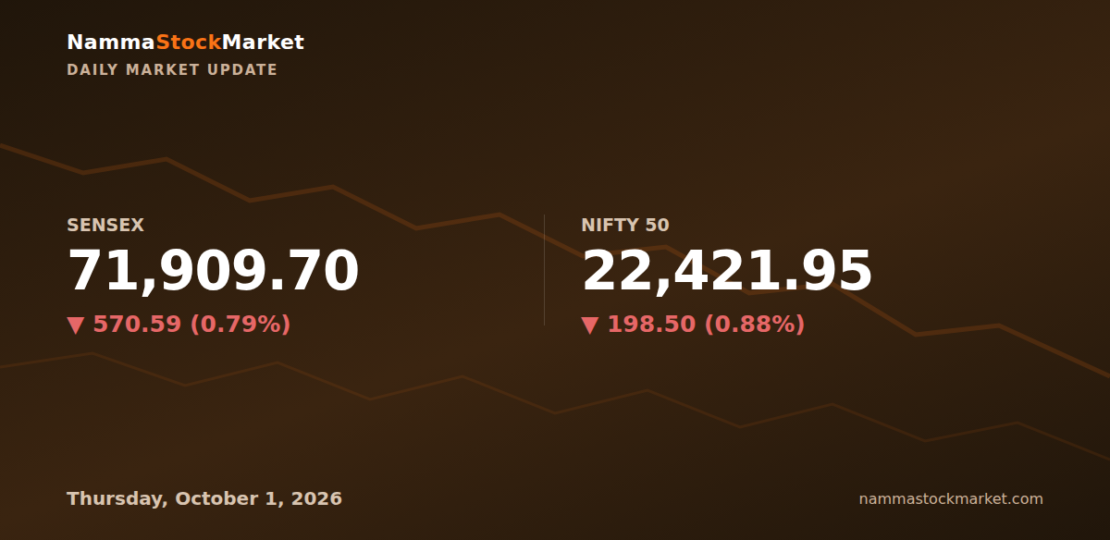
The Indian stock market fell for the fourth straight session on Thursday, and today’s fall was the sharpest of the four. The BSE Sensex (the Bombay Stock Exchange’s 30-share benchmark) closed at 71,909.70, down 570.59 points or 0.79%. The NSE Nifty 50 (the National Stock Exchange’s 50-share benchmark) ended at 22,421.95, down 198.50 points or 0.88%. Two things did most of the damage today: crude oil prices climbing back above the $100-a-barrel mark, and US bond yields shooting up to levels not seen in decades. Both might sound like faraway numbers with nothing to do with your demat account, but as you’ll see below, they hit the Indian share market and your rupee pretty directly. This was also the eighth straight weekly fall for Nifty, its longest losing streak in 25 years, so if your mutual fund SIP statement has been looking a bit sad lately, this is a big part of why.
Market At A Glance
| Index | Close | Points Chg | % Chg |
|---|---|---|---|
| BSE Sensex | 71,909.70 | ▼ 570.59 | ▼ 0.79% |
| NSE Nifty 50 | 22,421.95 | ▼ 198.50 | ▼ 0.88% |
| Bank Nifty | ~54,453 | ▼ ~180 | ▼ 0.33% |
| Nifty Midcap 100 | — | — | ▼ 1.01% |
| Nifty Smallcap 100 | — | — | ▼ 0.97% |
| India VIX | 15.69 | ▲ 2.19 | ▲ 16.31% |
Note: Bank Nifty’s exact closing tick wasn’t separately published by the time of writing, so the close above (~54,453) is worked out from its previous close of 54,633.05 and today’s reported 0.33% fall. Sensex and Nifty points and closing values are as officially reported. All index levels are in points, not rupees.
Why The Market Moved
Let’s break down why oil and US bond yields, two things that have nothing to do with Indian companies’ actual business, can knock 570 points off the Sensex in a single day.
Start with crude oil. India imports close to 85% of the crude oil it uses to make petrol, diesel and a hundred other things. When Brent crude (the global benchmark for oil prices, quoted in US dollars) gets costlier, India’s oil import bill goes up. A bigger import bill means more dollars flowing out of the country, which pressures the rupee. A weaker rupee makes everything we import more expensive, from oil to electronics, and that shows up later as inflation at your local kirana store or petrol pump. That’s the chain: costlier oil, pricier rupee pressure, worry about inflation, which the Reserve Bank of India then has to factor into its own interest rate decisions.
Now the US bond yields part. The US 10-year Treasury yield, which is basically the return you get for lending money to the US government for 10 years, has climbed close to its highest level in roughly two decades. When that yield is high, it becomes more attractive for big global funds to just park money safely in US government bonds instead of taking a risk on emerging markets like India. That’s a direct reason why FIIs, the foreign funds that invest in our market, have been selling Indian shares heavily in recent weeks. Today’s fall was broad-based too, with roughly 2,916 stocks on the NSE ending in the red against just 1,306 that closed higher, so this wasn’t just a handful of big Sensex names dragging the index down.
Which Sectors Held Up, And Which Didn’t
| Sector (Nifty Index) | % Change |
|---|---|
| IT | ▲ 2.17% |
| Telecom | ▲ 0.50% |
| PSU Bank | ▼ 0.98% |
| Oil & Gas | ▼ 1.32% |
| Realty | ▼ 1.46% |
| FMCG | ▼ 1.61% |
| Consumer Durables | ▼ 1.91% |
| Media | ▼ 2.33% |
| Metal | ▼ 2.35% |
| Auto | ▼ 3.46% |
IT was the one big bright spot today, and there’s a simple reason why: Indian IT companies like Infosys earn most of their revenue in US dollars from overseas clients, so when the rupee weakens, the same dollar revenue converts into more rupees. That’s why IT stocks often do well on days the rupee is under pressure, even as the rest of the market sells off. Telecom was the other sector to end in the green, if only just.
On the other end, Auto was the worst-hit sector by a distance, falling over 3%, after companies reported weaker-than-expected September sales numbers. Metal and Media weren’t far behind, and Consumer Durables, FMCG and Realty all lost close to 2% as well. Pharma and Energy stocks also slipped by more than 1% as the overall risk-off mood (investors avoiding anything that feels risky and rushing to safety) spread across the board.
Today’s Top Movers
Here are the five Nifty 50 stocks that gained the most, and the five that fell the hardest.
| Stock | % Change |
|---|---|
| Infosys | ▲ 4.11% |
| HDFC Life Insurance | ▲ 2.49% |
| HDFC Bank | ▲ 1.76% |
| SBI Life Insurance | ▲ 1.49% |
| Max Healthcare Institute | ▲ 1.20% |
| Stock | % Change |
|---|---|
| Bajaj Auto | ▼ 7.62% |
| Maruti Suzuki | ▼ 4.86% |
| Shriram Finance | ▼ 3.84% |
| Tata Steel | ▼ 3.42% |
| Adani Ports & SEZ | ▼ 3.36% |
Infosys led the gainers with a 4.11% jump, for the dollar-revenue reason explained above, while HDFC Bank and HDFC Life also held up well. On the losing side, Bajaj Auto was the single biggest drag on the Nifty today, tumbling 7.62% after weak September wholesale dispatch numbers. That’s a big one-day move for a large, liquid stock like Bajaj Auto, which doesn’t have the kind of tight daily circuit limit (the maximum percentage move the exchange allows a stock before trading is paused) that smaller, less liquid stocks do, so the fall played out through the full session rather than triggering a halt. Maruti Suzuki, Shriram Finance, Tata Steel and Adani Ports rounded out the top five losers.
What FIIs and DIIs Were Doing
Quick explainer if you’re newer to this: FIIs, or foreign institutional investors, are big funds based outside India (pension funds, hedge funds, sovereign wealth funds and so on) that buy and sell Indian shares. DIIs, or domestic institutional investors, are the Indian equivalents, mutual funds, insurance companies like LIC, and banks. If you invest through a mutual fund SIP every month, that money is part of what shows up as DII buying.
| Date | FII Net (₹ Crore) | DII Net (₹ Crore) |
|---|---|---|
| 30 Sep 2026 (latest available) | ▼ 10,148 (sold) | ▲ 11,272 (bought) |
On the last session for which full data is available (30 September), FIIs were net sellers of ₹10,148 crore in the cash segment, continuing a selling streak that added up to more than ₹36,000 crore of outflows for the month of September alone. DIIs, meanwhile, were net buyers of ₹11,272 crore on the same day, more than offsetting the FII selling. This has been the pattern through this whole eight-week losing streak: FIIs pulling money out on worries about US yields and a stronger dollar, and DIIs, powered partly by steady SIP inflows from retail investors like you, stepping in to cushion the fall. Today’s (1 October) FII/DII figures hadn’t been released at the time of writing, since these numbers typically come out only after market hours; we’ll have a clearer picture of today’s institutional activity tomorrow.
Oil, The Rupee, And Global Cues
Brent crude reclaimed the $100-a-barrel level today, up about 2.59% on the day, after briefly easing toward $98 earlier in the session on hopes of a ceasefire easing tensions in the Middle East. Those hopes faded as the day went on, and worries about supply disruptions pushed oil back above $100. For India, this matters a lot more than it might seem: every dollar increase in the price of Brent widens our oil import bill, a direct hit to the rupee and eventually to retail fuel prices.
The rupee itself weakened to around ₹96.10 against the US dollar, from a previous close of ₹95.83, its weakest level in about two months. The main pressure came from those elevated US bond yields again, with the 10-year US Treasury yield sitting near its highest level in decades, and hawkish comments from a US Federal Reserve official who said inflation running around 3% was still too high and hinted that more rate increases could be on the table. That combination makes the dollar more attractive to global investors and the rupee less so, which is part of the same chain reaction we talked about above. On global cues, European markets were weak too, with Germany’s DAX and the UK’s FTSE both down over half a percent, while US futures were mixed ahead of their own session, a sign that this isn’t an India-only story but a broader risk-off mood across world markets.
What To Watch Tomorrow
A few things are worth keeping an eye on as we head into the next session. First, crude oil: if Brent holds above $100, expect the pressure on the rupee and on oil marketing and paint companies to continue. Second, US bond yields and any fresh commentary from Federal Reserve officials, since that’s been the single biggest driver of FII selling lately. Third, India’s Q2 (July-September quarter) corporate earnings season is just getting underway, and early commentary points to a softer set of numbers this time around, which markets will be watching closely for clues on how companies are holding up under this pressure. Finally, keep an eye on the primary market too: nearly 100 mainboard IPOs have raised close to ₹1.13 lakh crore so far this year, and when that much money is getting soaked up by new listings, some of it inevitably comes out of existing stocks in the secondary market, which can add to the pressure we’re already seeing. If you’re tracking any of the IPOs lined up next, the grey market premium, or GMP, the unofficial premium at which shares trade before listing, is worth watching as an early sentiment indicator, though it’s not something to bet your money on by itself. As always, none of this is a buy or sell recommendation, just context to help you understand what’s moving your portfolio.
RELATED POSTS
View all

Sensex Falls 243 Points, Nifty Ends Below 22,750 As Tata Sons Restructuring Plan Rattles Tata Group Stocks
September 29, 2026 | by NammaStockMarket
Sensex Jumps 333 Points, Nifty Reclaims 23,200 As UPI Fee Move Lifts Banks; IT Stocks Buck The Trend
September 16, 2026 | by NammaStockMarket
Sensex Jumps 564 Points, Nifty Reclaims 23,400 As Cooling Crude Oil Lifts Sentiment
September 21, 2026 | by NammaStockMarket