

Sensex Jumps 1,534 Points, Nifty Nears 23,000 as Global Tech Sell-Off Makes India Look Like the Safer Bet
October 15, 2026 | by NammaStockMarket
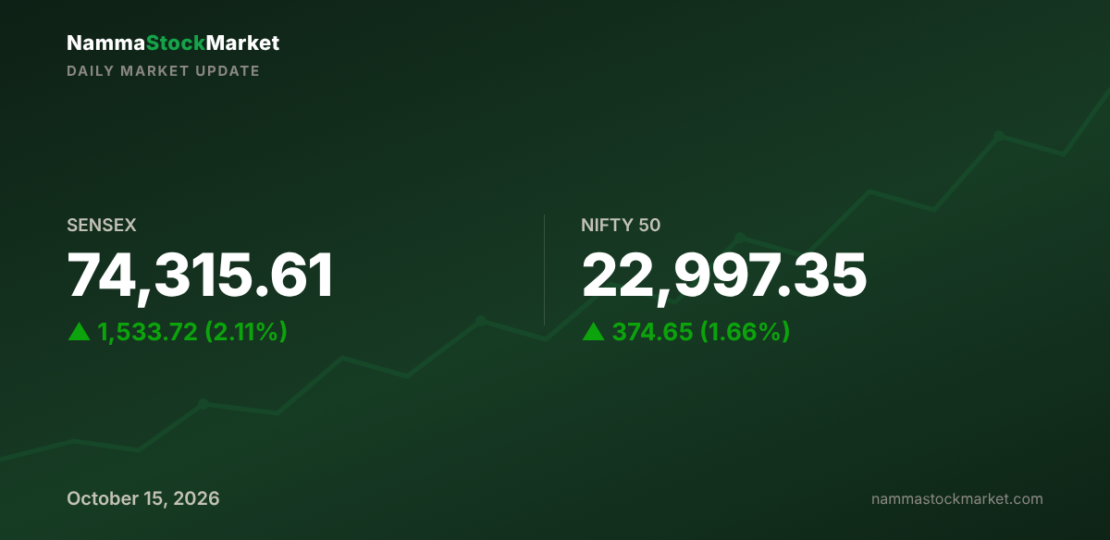
If you checked your portfolio this afternoon, you probably smiled for the first time in a few days. The Indian stock market had its best day in four months today. The BSE Sensex closed at 74,315.61, up a massive 1,533.72 points, or 2.11%. The NSE Nifty 50 ended at 22,997.35, up 374.65 points, a gain of 1.66%, just a whisker away from the psychological 23,000 mark. For readers who are new to this, NSE stands for National Stock Exchange, which runs the Nifty 50, and BSE is the Bombay Stock Exchange, home of the Sensex — these are simply India’s two big stock exchanges, and their index numbers are what everyone means when they say “market today.”
So what changed? It wasn’t great news from India. It was actually bad news from everywhere else. Stock markets across Asia got hammered today on fears that artificial intelligence (AI) stocks in the US and elsewhere have become too expensive, combined with worries about sticky inflation data in America and what that means for the US Federal Reserve’s next move on interest rates. Japan’s Nikkei fell over 5%, South Korea’s Kospi fell more than 8%, and Hong Kong’s Hang Seng was down over 1%. In that kind of panic, global money looks for a market that hasn’t joined the AI-stock party and therefore has less to lose. Today, that market was India. Big investors rotated into Indian IT, private banking and auto stocks, and the rally was broad enough across large-caps to lift both Sensex and Nifty sharply higher.
Market At A Glance
| Index | Close | Points Change | % Change |
|---|---|---|---|
| BSE Sensex | 74,315.61 | ▲ 1,533.72 | ▲ 2.11% |
| NSE Nifty 50 | 22,997.35 | ▲ 374.65 | ▲ 1.66% |
| Nifty Bank (Bank Nifty) | 55,810.50 | ▲ 494.50 | ▲ 0.89% |
| Nifty Midcap 100 | N/A | N/A | ▼ 0.36% |
| Nifty Smallcap 100 | N/A | N/A | ▼ 1.31% |
| India VIX | 14.37 | ▼ 0.26 | ▼ 1.78% |
Note: exact closing levels for Nifty Midcap 100 and Nifty Smallcap 100 were not disclosed in today’s market reports — only their percentage moves were available, so those two rows show the % change alone. India VIX figure is from late-session trade, very close to the 3:30 PM close.
Why The Market Moved
Three things worked together for Indian markets today, and all three are worth understanding simply.
First, there’s what traders call “relative appeal.” When tech and AI-linked stocks crash in the US, Japan, Korea and Taiwan, money doesn’t just disappear — it looks for a new home. India hasn’t had a big AI-stock bubble the way some of these markets have, so it suddenly looked like a safer, cheaper place to park money. That’s a big reason you saw such a sharp, one-day jump in Sensex and Nifty today, even though nothing dramatic happened in the India growth story itself.
Second, bond yields eased and the rupee stayed steady, both of which matter more to your money than they sound. When bond yields fall, it becomes cheaper for companies to borrow money, which is good for growth and profits down the line. And a stable rupee matters because India imports a huge amount of what it uses — crude oil being the biggest example. When the rupee is steady or strengthening against the dollar, it costs us less in rupee terms to buy the same imports, which eases pressure on inflation. We’ll explain the rupee move in more detail further down.
Third, there’s been talk in the market about a possible rethink of equity taxation — that’s the tax you pay on profits from stocks, known as LTCG (long-term capital gains tax, for shares held over a year) and STCG (short-term capital gains tax, for shares sold within a year). Just the hope that these taxes could be eased was enough to add a bit of extra risk appetite today, on top of everything else.
One word of caution here, though, and it’s an important one. Vinod Nair of Geojit Investments, a well-known market expert, pointed out that this rally did not have what analysts call “broad participation.” In plain language: largecap stocks like the ones in Sensex and Nifty went up a lot, but your midcap and smallcap stocks — the smaller companies many retail investors and mutual fund SIP holders own — actually fell today. PSU bank stocks (government-owned banks) were also sold off heavily. So if you’re holding a largecap-focused portfolio, today was a very good day. If you’re more invested in small and midcap funds through your SIP (systematic investment plan, where you invest a fixed amount every month into a mutual fund), today may have looked less exciting, or even slightly red, even though the headline numbers were glowing.
Which Sectors Held Up, And Which Didn’t
| Sector Index | % Change |
|---|---|
| Nifty Private Bank | ▲ 1.89% |
| Nifty IT | ▲ 1.82% |
| Nifty Financial Services | ▲ 1.67% |
| Nifty Auto | ▲ 1.67% |
| Nifty Realty | ▲ 0.72% |
| Nifty Pharma | ▲ 0.31% |
| Nifty Metal | ▲ 0.10% |
| Nifty Consumer Durables | ▼ 0.27% |
| Nifty Energy | ▼ 0.79% |
| Nifty FMCG | ▼ 1.06% |
| Nifty Media | ▼ 1.47% |
| Nifty PSU Bank | ▼ 1.55% |
Private banks and IT led the charge today, both rising close to 1.9%, followed closely by financial services and auto, each up 1.67%. If you’re holding IT stocks or IT mutual funds, today was a genuinely good day — the sector benefited directly from the “India looks safer than AI-heavy markets” story, plus a weaker dollar made IT export earnings estimates look a little rosier. Realty and pharma posted smaller, steadier gains, and metals were just about flat. On the other side, FMCG (fast-moving consumer goods — think soaps, biscuits, packaged food) fell over 1%, dragged down hard by Nestle India’s results-related crash, which we’ll get to in a moment. Media stocks and PSU banks were the weakest links, both down more than 1.4%, continuing a theme we’ve seen through much of this month where government-owned banks have lagged their private-sector peers.
Today’s Top Movers
Top Gainers
| Stock | Close Price | % Change |
|---|---|---|
| Tech Mahindra | ₹1,650.00 | ▲ 4.75% |
| ICICI Bank | ₹1,389.40 | ▲ 3.80% |
| Reliance Industries | ₹1,215.00 | ▲ 3.44% |
| Bharti Airtel | — | ▲ 3.31% |
| BSE Ltd | — | ▲ 2.70% |
Tech Mahindra topped the gainers’ list today, up nearly 4.75%, as IT stocks rode the broader rally. ICICI Bank and Reliance Industries, two of the heaviest-weighted stocks on Nifty, both jumped over 3.4%, and between them did a lot of the work in pulling the index higher. Bharti Airtel and BSE Ltd (the company that runs the Bombay Stock Exchange, not to be confused with the Sensex itself) rounded out the top five.
Top Losers
| Stock | Close Price | % Change |
|---|---|---|
| Nestle India | ₹1,275.80 | ▼ 7.76% |
| Adani Enterprises | ₹2,700.00 | ▼ 0.83% |
| Trent | ₹2,949.70 | ▼ 0.72% |
| Shriram Finance | — | ▼ 0.65% |
| Bharat Electronics | — | ▼ 0.51% |
Nestle India was the big loser of the day by a wide margin, falling nearly 7.8% on what looks like a disappointing response to its results. If you hold Nestle in your portfolio or through an FMCG-focused mutual fund, that single stock likely hurt your day’s returns more than the rest of the market’s gains helped. Adani Enterprises and Trent saw mild declines, and Shriram Finance and Bharat Electronics rounded out a fairly short losers’ list — a sign of just how one-sided today’s gains were.
What FIIs and DIIs Were Doing
You’ll often see the terms FII and DII in market reports, so here’s a quick refresher if you’re newer to this. FII stands for Foreign Institutional Investor (sometimes also called FPI, or Foreign Portfolio Investor) — these are big global funds investing in Indian stocks from outside the country. DII stands for Domestic Institutional Investor — Indian mutual funds, insurance companies like LIC, and similar big domestic players. Tracking what each group is doing with its money, in the cash segment (meaning actual buying and selling of shares, not derivatives), tells you a lot about where sentiment is headed.
| Date | FII Net (₹ Crore) | DII Net (₹ Crore) |
|---|---|---|
| 14 Oct 2026 | ▼ ₹1,857.44 | ▲ ₹2,670.44 |
| 13 Oct 2026 | ▼ ₹1,305.13 | ▲ ₹2,439.24 |
| 12 Oct 2026 | ▼ ₹1,708.48 | ▲ ₹3,045.02 |
| 09 Oct 2026 | ▼ ₹3,568.90 | ▲ ₹4,743.26 |
| 08 Oct 2026 | ▼ ₹12,943.58 | ▲ ₹10,703.11 |
Today’s (15 October) official FII/DII cash-segment figures were not out at the time of publishing — this data usually gets released by the exchanges after market hours, so we’ll have a clearer picture tomorrow. But the pattern over the last five trading days is pretty clear and worth understanding: FIIs have been net sellers every single day, pulling out anywhere from about ₹1,300 crore to a massive ₹12,943 crore on 8 October. DIIs, on the other hand, have been steady net buyers through the same stretch, cushioning the market from what could have been a much sharper fall. This is a pattern we’ve been seeing through much of October — foreign money heading out, domestic mutual funds and insurers quietly buying the dip. If you’ve put money into an Indian equity mutual fund through an SIP, this is exactly the kind of buying that’s happening with your money on days when foreign investors are nervous.
Oil, The Rupee, And Global Cues
Brent crude, the international benchmark for oil prices (always quoted in US dollars per barrel), fell more than 2% today to around $103.55 a barrel. This matters a lot for India, maybe more than people realise. India imports close to 85% of the crude oil it uses, so when oil becomes cheaper, India’s oil import bill — the total amount we spend in dollars buying crude from abroad — comes down. That’s good news for the rupee, good news for government finances, and over time, good news for inflation, since fuel costs feed into the price of almost everything else we buy. Today’s fall in crude came on a mix of easing worries about Middle East supply disruptions and a sense that oil supply will stay comfortable going forward.
The rupee had a good day too, logging its fifth straight session of gains against the US dollar, closing around ₹95.05, up about 12 paise. A few things were behind this: continued support from the Reserve Bank of India (RBI) through its forex market operations, some unwinding of bets that had been betting against the rupee, and of course, today’s softer crude oil prices. That said, the gains were capped a bit by India’s widening trade deficit (the gap between what we import and what we export) and steady dollar demand from importers, who need dollars to pay for their purchases. A stable-to-stronger rupee is one of the quieter reasons the Sensex and Nifty found support today, because it reduces one more source of worry for foreign investors thinking about putting money into India.
As for the bigger global picture: the sell-off that hit Asian markets traces back to concerns about stretched valuations in AI-related stocks in the US, plus worries about hotter-than-expected inflation data there and what it means for the US Fed’s interest rate path. When the Fed looks like it might keep US rates higher for longer, it usually makes dollar-based investments more attractive relative to emerging markets like India — but today, the sheer scale of the tech-stock panic overwhelmed that usual logic, and money flowed into India instead as a relative safe haven for this one session.
What To Watch Tomorrow
Markets don’t move in a straight line, so a few things are worth watching as we head into Friday’s session. Wipro’s Q2 results are among the big earnings reports due, part of the ongoing earnings season that’s been driving a lot of single-stock action this month — Nestle India’s sharp fall today after its own results is a reminder of how much individual results can move a stock regardless of what the broader index is doing. On the technical side, Nifty has support in the 22,900–22,950 zone and resistance around 23,050–23,150, while Sensex has support near 73,900–74,100 and resistance around 74,600–74,900 — these are simply the price zones where buying or selling has tended to show up recently, not predictions of where the market will go. Keep an eye on whether the FII selling pattern continues or starts to ease, since that’s been the main headwind even on days like today when the headline numbers look great. And globally, watch whether the AI-stock sell-off in the US and Asia stabilises or deepens — if it deepens further, India’s “safer haven” appeal could pull in more money, but if US markets snap back quickly, some of today’s gains could prove to be a one-day rotation rather than the start of a new trend. This is general market information, not investment advice — please make your own buy or sell decisions based on your own research and risk appetite, or in consultation with a financial advisor.
RELATED POSTS
View all

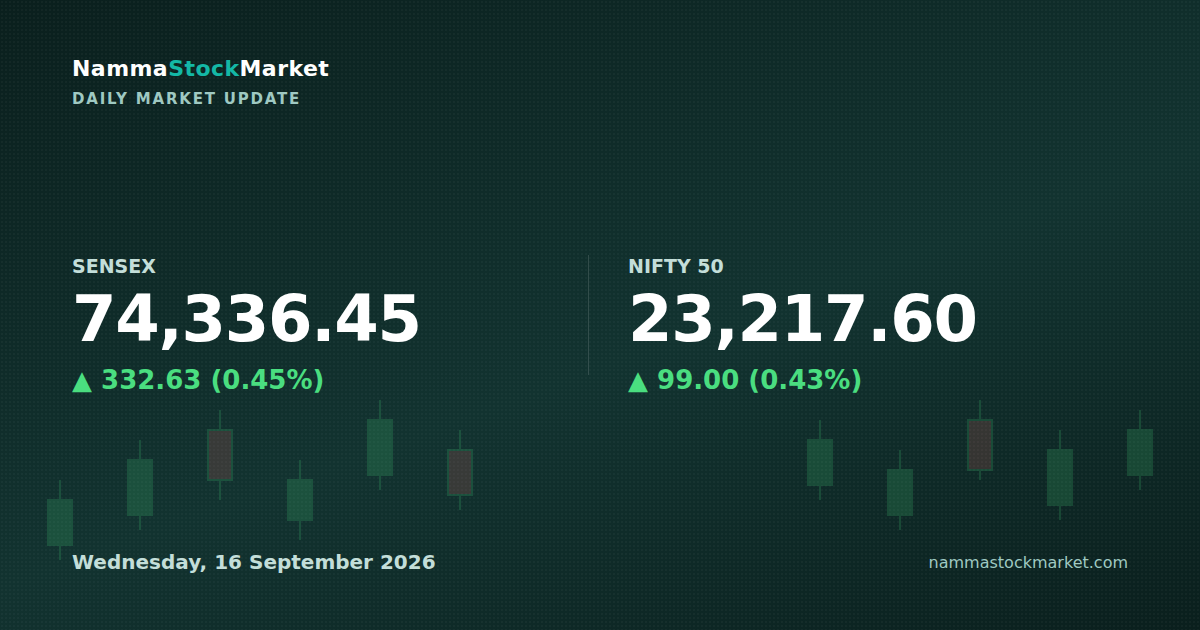
Sensex Jumps 333 Points, Nifty Reclaims 23,200 As UPI Fee Move Lifts Banks; IT Stocks Buck The Trend
September 16, 2026 | by NammaStockMarket
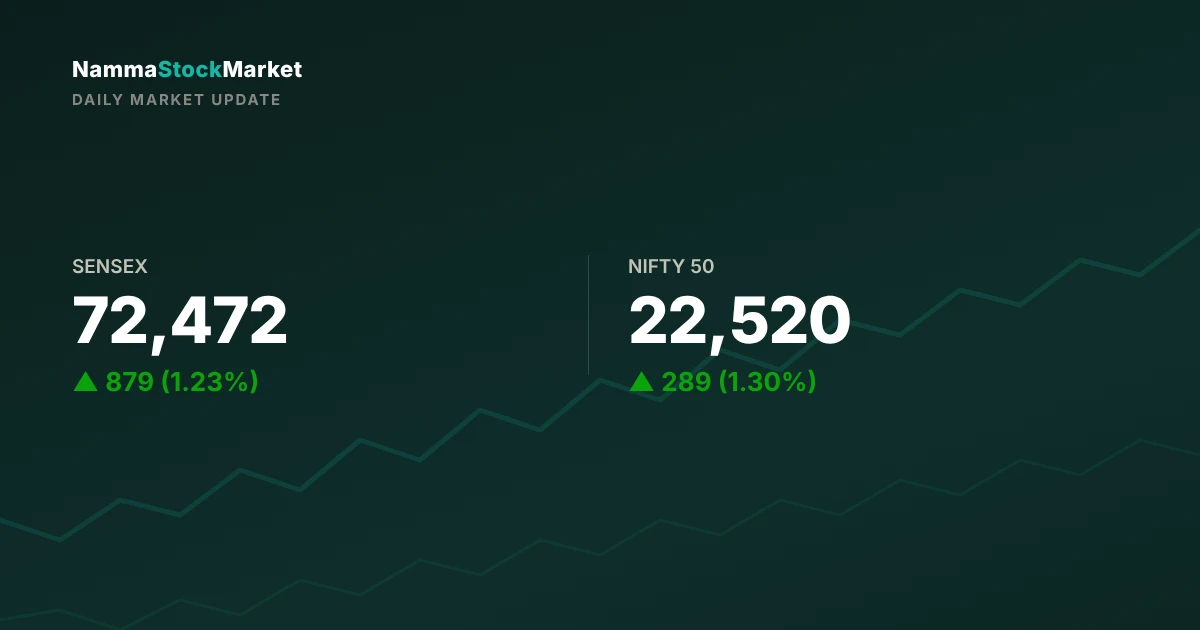
Sensex Jumps 879 Points, Nifty Reclaims 22,500: IT Stocks Lead Rebound After 8-Week Losing Run
October 9, 2026 | by NammaStockMarket
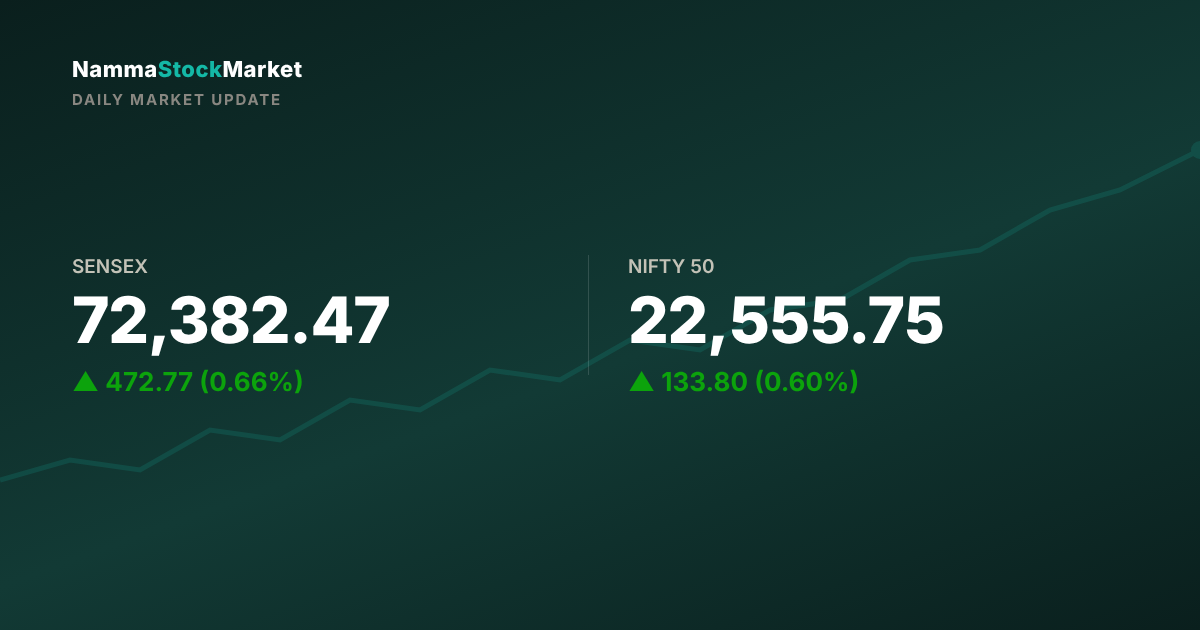
Sensex Jumps 472 Points To 72,382, Nifty Ends At 22,556 As ITC Rallies 5% And Crude Oil Eases
October 5, 2026 | by NammaStockMarket