

Sensex Slips 143 Points, Nifty Falls To 22,811 As Crude Oil Crosses $110 — IT Stocks Buck The Trend
October 21, 2026 | by NammaStockMarket
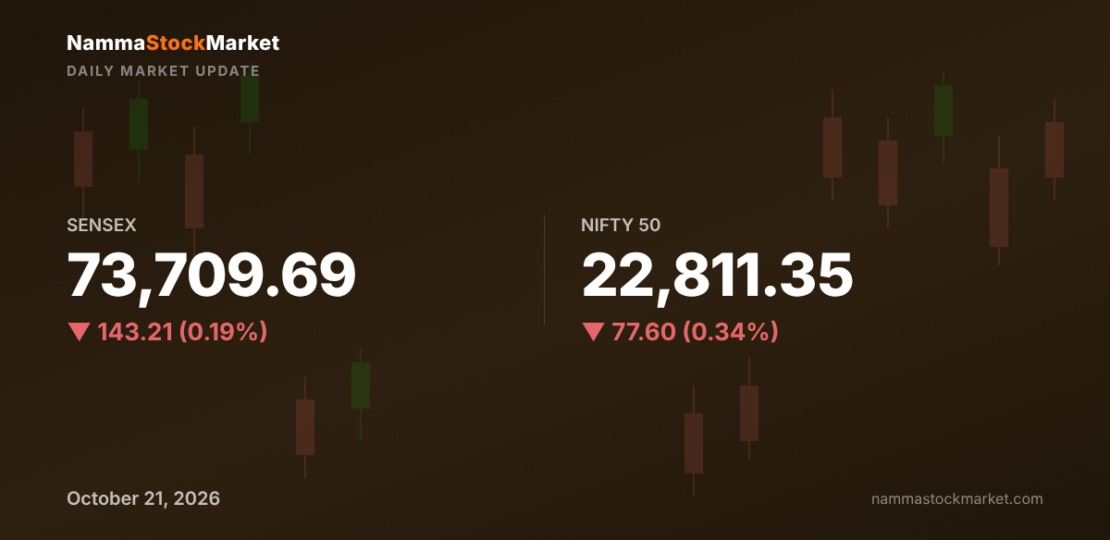
The Indian stock market closed lower for the second day in a row on Wednesday, and the reason is one that hits almost every Indian household sooner or later: oil. The BSE Sensex (the 30-share index of the Bombay Stock Exchange) ended at 73,709.69, down 143.21 points or 0.19%, while the NSE Nifty 50 (the 50-share index of the National Stock Exchange) slipped 77.60 points, or 0.34%, to settle at 22,811.35. If you only look at these closing numbers, today looks like a quiet, almost boring day. It wasn’t. The Sensex was actually up close to 800 points at one point in the morning, with Nifty touching 23,120 on hopes of a India-US trade deal and strong buying in Reliance Industries after the much-awaited Jio Platforms IPO opened. Then crude oil crossed $110 a barrel, and that early cheer evaporated fast. By the time the closing bell rang, the market had given up almost all of that gain. The one sector that refused to join the slide was IT (information technology), which jumped nearly 3% and was the only major sector to end the day in the green.
Market At A Glance
| Index | Close | Points Change | % Change |
|---|---|---|---|
| BSE Sensex | 73,709.69 | ▼ 143.21 pts | ▼ 0.19% |
| NSE Nifty 50 | 22,811.35 | ▼ 77.60 pts | ▼ 0.34% |
| Bank Nifty | 54,976.90 | ▼ 511.20 pts | ▼ 0.92% |
| Nifty Midcap 100 | — | — | ▼ 1.58% |
| Nifty Smallcap 100 | — | — | ▼ 2.37% |
| India VIX | 15.73 | ▲ 0.96 pts | ▲ 6.50% |
Note: closing index levels for Nifty Midcap 100 and Nifty Smallcap 100 were not available from our sources at the time of publishing, so only the day’s percentage move is shown for these two.
Why The Market Moved
Let’s start with the basics, because this matters for your portfolio even if you don’t track oil prices every day. Brent crude (the global benchmark for oil, priced in US dollars per barrel) jumped to around $111 a barrel today, up about 2.1% or roughly $2.28. Why does that matter to you as an Indian investor? Because India buys about 85% of the crude oil it uses from other countries. When oil gets costlier in dollar terms, India’s oil import bill goes up. A bigger import bill means Indian oil companies need more dollars to pay their suppliers, which puts pressure on the rupee. A weaker rupee, in turn, makes everything from imported goods to fuel at the pump a little more expensive, which is why investors get nervous about inflation the moment crude starts climbing. That’s the entire chain of worry in one line: costlier oil, bigger import bill, weaker rupee, inflation worry, nervous market.
Today’s spike in crude had a clear trigger. News agencies reported fresh attacks on ships in the Gulf, and there was no sign of any diplomatic breakthrough in the Iran situation — in fact, US Secretary of State Marco Rubio said a peace deal with Iran looked very difficult right now. On top of that, there were fresh worries about Saudi Arabia’s oil facilities being targeted, and data showed that US crude oil stocks had fallen by close to 4.9 million barrels in the week to October 16, which usually pushes prices up because it signals tighter supply.
You can also see the nervousness in the India VIX, which is sometimes called the market’s “fear gauge”. It simply measures how much movement, up or down, options traders expect in the Nifty over the next 30 days — a higher VIX means more fear and more expensive hedging, a lower VIX means calm. Today it jumped 6.5% to 15.73, a three-month high. That’s the market quietly telling you it expects more bumpy days ahead, not smooth ones, at least until there’s more clarity on crude and the Middle East situation.
Which Sectors Held Up, And Which Didn’t
| Sector | % Change |
|---|---|
| Nifty IT | ▲ 2.88% |
| Nifty FMCG | ▼ 0.89% |
| Nifty Private Bank | ▼ 1.16% |
| Nifty Media | ▼ 1.24% |
| Nifty Realty | ▼ 1.57% |
| Nifty Metal | ▼ 1.97% |
| Nifty Auto | ▼ 1.99% |
| Nifty Chemicals | ▼ 2.64% |
IT was the standout story of the day, up almost 3% and hitting an eight-month high for the sector. If you’re holding IT stocks like Infosys, HCL Technologies or Tech Mahindra, today was genuinely a good day for you. Most of these companies earn the bulk of their revenue in US dollars from clients abroad, so they’re seen as a bit insulated from what’s happening with crude and the rupee at home — and this earnings season has brought some genuinely upbeat numbers and improving demand commentary from IT managements, which pulled in fresh buying. On the other end, chemicals, autos and metals were the worst hit, each falling close to 2% or more. These are sectors where oil-linked input costs (think raw materials, freight, plastics) matter a lot, so a crude spike hurts their margins directly. Realty, media and private banks also slipped, mostly on plain old profit booking after a decent run over the past couple of weeks, while FMCG (fast-moving consumer goods, the everyday grocery and household-products companies) held up relatively better with a modest fall.
Today’s Top Movers
| Top Gainers (Nifty 50) | % Change |
|---|---|
| Infosys | ▲ 3.30% |
| HCL Technologies | ▲ 3.21% |
| Tech Mahindra | ▲ 3.13% |
| Tata Consultancy Services (TCS) | ▲ 2.77% |
| UltraTech Cement | ▲ 1.87% |
| Top Losers (Nifty 50) | % Change |
|---|---|
| Bajaj Finance | ▼ 3.27% |
| BSE Ltd | ▼ 2.63% |
| Eternal (Zomato) | ▼ 2.45% |
| Eicher Motors | ▼ 2.43% |
| Trent | ▼ 2.41% |
Notice how the gainers list is almost entirely IT names — that tells you how concentrated today’s bright spot really was. UltraTech Cement was the only non-IT stock to make the top five gainers, helped along by steady demand expectations. On the losers’ side, Bajaj Finance led the fall after a sharp run-up earlier this month invited profit booking, while BSE Ltd and Eternal (the company formerly known as Zomato) also cooled off from recent highs. Eicher Motors and Trent fell on a mix of profit booking and the broader worry that costlier fuel and raw materials could dent consumer spending and margins going into the festive season.
What FIIs and DIIs Were Doing
Two sets of big investors move Indian markets every day, and it helps to know the difference. FIIs, or Foreign Institutional Investors, are overseas funds and institutions investing in Indian stocks from outside the country. DIIs, or Domestic Institutional Investors, are Indian entities like mutual funds, insurance companies and pension funds — a lot of this money ultimately comes from ordinary investors like you, through mutual fund SIPs (systematic investment plans) that get deployed into the market every month regardless of whether the news that day is good or bad. As of the time of writing, the official FII/DII cash-market figures for today, October 21, had not yet been released — these numbers usually come out after market hours — so here’s how the last five trading sessions looked (note that October 20 was a trading holiday for Dussehra, so there’s no data for that date):
| Date | FII Net (₹ Crore) | DII Net (₹ Crore) |
|---|---|---|
| 19 Oct 2026 | ▼ 1,148.64 crore | ▲ 3,201.19 crore |
| 16 Oct 2026 | ▲ 1,165.92 crore | ▼ 3,661.28 crore |
| 15 Oct 2026 | ▼ 5,285.37 crore | ▲ 3,319.39 crore |
| 14 Oct 2026 | ▼ 1,857.44 crore | ▲ 2,670.44 crore |
| 13 Oct 2026 | ▼ 1,305.13 crore | ▲ 2,439.24 crore |
The pattern here is hard to miss: FIIs have been net sellers in the cash segment on four of these five days, while DIIs have been net buyers almost every single day, often by a bigger amount than the FIIs sold. This is exactly the cushioning effect you hear market commentators talk about — steady domestic buying, powered partly by your own SIP money, has been absorbing a good chunk of foreign selling and keeping the Sensex and Nifty from falling much harder than they otherwise would have.
Oil, The Rupee, And Global Cues
We’ve already covered the crude oil story above, so a quick recap: Brent crude ended near $111.07 a barrel, up about 2.1% on the day, with Middle East supply worries and falling US inventories doing the damage. The rupee, meanwhile, closed only marginally weaker against the US dollar at around 94.85, a move of roughly 0.07%. That’s a surprisingly small dent given how much crude jumped, and there’s a good reason for it: the Jio Platforms IPO has been drawing in foreign investor money this week, and when overseas investors apply for shares in a big Indian IPO, they need to convert their dollars into rupees to pay for them, which adds extra dollar supply into the market. On top of that, the Reserve Bank of India (RBI) is reported to have stepped in through state-run banks to meet oil companies’ dollar needs directly, rather than letting all that demand hit the open market and crash the rupee. Together, these two factors meant the rupee barely budged even as oil got noticeably more expensive.
On global cues, Asian markets were mixed to higher today, with Japan’s Nikkei and South Korea’s Kospi both up, while Hong Kong’s Hang Seng slipped a little. US markets continue to watch an earnings season that has mostly beaten expectations so far, and traders globally are also keeping an eye on US Fed commentary and bond yields, which have been sitting near three-year highs — all of which feeds into how much foreign money flows into or out of markets like India.
What To Watch Tomorrow
A few things are worth keeping on your radar. First, and most obviously, crude oil — if Brent holds above $110 or climbs further on continued Middle East tensions, expect the rupee and import-heavy sectors to stay under pressure. Second, the India VIX is now at a three-month high, which usually means sharper swings in either direction are more likely than usual, so don’t be surprised by bigger daily moves till it cools off. Third, the Jio Platforms IPO flow and listing-related news will likely keep influencing both the rupee and sentiment around Reliance Industries and its group companies. Fourth, October F&O (futures and options) expiry falls on October 27, and positioning around that date can add to volatility as traders roll over or square off contracts. Finally, with Q2 earnings season in full swing, more results are due this week and next, and how IT, banking and auto companies report their numbers could decide whether today’s sector trends continue or reverse. None of this is a buy or sell call — just the factors that are likely to set the tone for your portfolio over the next few sessions.
RELATED POSTS
View all

Sensex Jumps 1,109 Points To 73,034, Nifty Tops 22,700 As IT Stocks Stage Stunning Comeback
October 13, 2026 | by NammaStockMarket
Sensex Slips 330 Points, Nifty Snaps 4-Day Winning Streak To End At 23,329 As IT Stocks Drag
September 22, 2026 | by NammaStockMarket
Sensex, Nifty Fall Over 1% as Crude Oil Surges; IT Stocks Buck the Trend
September 15, 2026 | by NammaStockMarket