

Sensex Jumps 1,225 Points, Nifty Crosses 23,800 As FII Buying And Cooling Crude Spark Fourth Day Of Gains
November 3, 2026 | by NammaStockMarket
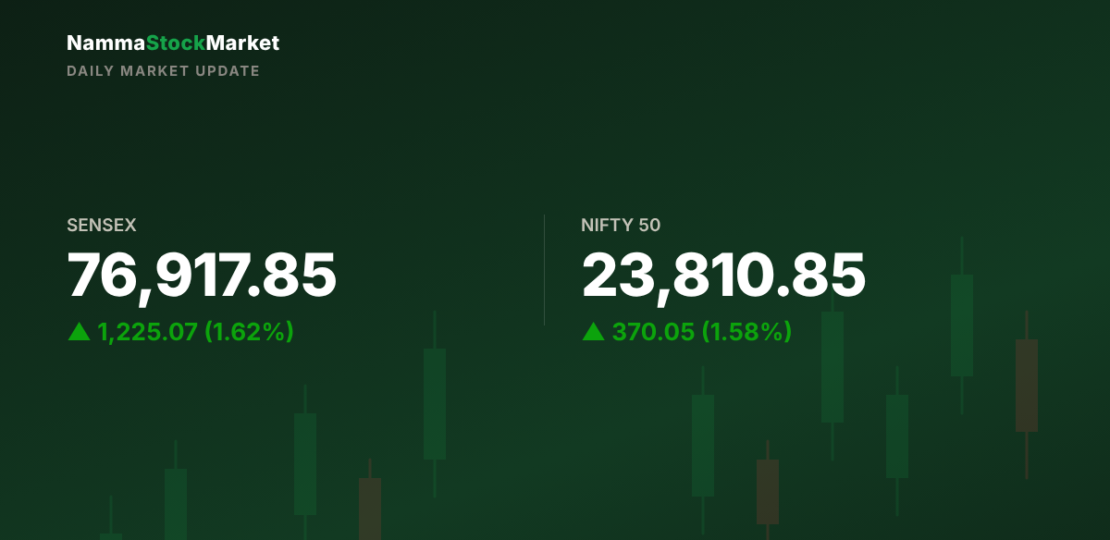
If you’ve been checking your portfolio every evening this week, today was probably the best day you’ve seen in a while. The BSE Sensex (that’s the Bombay Stock Exchange’s benchmark index) shot up 1,225.07 points, or 1.62%, to close at 76,917.85, while the NSE Nifty 50 (the National Stock Exchange’s benchmark) jumped 370.05 points, or 1.58%, to settle at 23,810.85. This is the fourth session in a row that the Indian stock market has closed higher, and together the two benchmark indices are now sitting around 5% above where they were just four trading days back. Two things did the heavy lifting today: foreign investors came back as buyers after weeks of selling, and crude oil prices cooled off sharply, which is always good news for a country like India that imports most of its oil.
Market At A Glance
| Index | Close | Change | % Change |
|---|---|---|---|
| BSE Sensex | 76,917.85 | ▲ 1,225.07 | ▲ 1.62% |
| NSE Nifty 50 | 23,810.85 | ▲ 370.05 | ▲ 1.58% |
| Bank Nifty | — | — | ▲ 0.98% |
| Nifty Midcap 100 | — | — | ▲ 1.06% |
| Nifty Smallcap 100 | — | — | ▲ 0.31% |
| India VIX | 15.64 | ▲ 0.15 | ▲ 0.97% |
Exact closing levels for Bank Nifty, Nifty Midcap 100 and Nifty Smallcap 100 were not available from exchange reports at the time of publishing — only their percentage moves were confirmed. India VIX is a volatility measure, not a price index, so there is no currency symbol against it.
With Diwali — the festival that marks the start of the new Samvat year for Indian investors — just days away on November 8 (when exchanges will hold a short, symbolic Muhurat trading session), there’s a genuine festive mood building on Dalal Street, the nickname for Mumbai’s financial district where the BSE is headquartered. FMCG stocks, which make the everyday goods you buy for festival shopping, led sector gains today. Nifty PSU Bank was the only big sector that ended in the red.
Why The Market Moved
The two biggest reasons behind today’s rally are crude oil and foreign money. Let’s take them one at a time, in plain words.
Crude oil had crashed nearly 7% on Monday on hopes that tensions involving Iran in the Middle East could ease through talks mediated by Qatar. Lower oil prices matter a lot for India because we import more than 85% of our crude, and that oil is bought and paid for in US dollars. When crude falls, India’s oil import bill shrinks, which helps the rupee, helps control inflation, and helps company profit margins across the board, from paint makers to airlines. On Tuesday, oil ticked back up a little, with Brent crude trading near $105-107 a barrel, after reports of a fresh US military strike near Iran’s Qeshm Island revived worries about the Strait of Hormuz, the narrow sea passage through which a huge chunk of the world’s oil supply travels. Even with that small bounce, Brent is still well below where it was just a few sessions ago, so Indian companies and the government are breathing a little easier on the oil front for now.
The second big driver was FIIs, or foreign institutional investors — large global funds that buy and sell Indian shares from outside the country (you’ll also hear them called FPIs, or foreign portfolio investors; the terms are used almost interchangeably in Indian market reports). After weeks of pulling money out of Indian stocks, FIIs turned net buyers on Monday, picking up about ₹3,115 crore worth of shares in the cash market, and that buying mood carried into Tuesday as well. When foreign money starts flowing back in, it tends to lift the heavyweight stocks first — banks, financials and large consumer names — which is exactly what happened today. Resilient September-quarter earnings from several companies added further confidence, with investors feeling that corporate India’s profit growth is holding up well despite all the global noise around tariffs, tech valuations and the US midterm elections.
Which Sectors Held Up, And Which Didn’t
| Sector (Nifty Index) | % Change |
|---|---|
| Nifty FMCG | ▲ 3.65% |
| Nifty Realty | ▲ 2.33% |
| Nifty Financial Services | ▲ 1.84% |
| Nifty Private Bank | ▲ 1.77% |
| Nifty Auto | ▲ 1.71% |
| Nifty Bank | ▲ 0.98% |
| Nifty Media | ▲ 0.49% |
| Nifty IT | ▲ 0.24% |
| Nifty Energy | ▼ 0.11% |
| Nifty Metal | ▼ 0.14% |
| Nifty PSU Bank | ▼ 1.27% |
FMCG — the sector that makes everyday consumer products like soaps, biscuits and packaged food — was today’s star performer, up 3.65%, as investors bet on strong festive-season demand in the run-up to Diwali. Realty stocks followed with a 2.33% gain, and banking and financial stocks did well too, with Nifty Financial Services up 1.84% and Nifty Private Bank up 1.77%, since the return of FII buying usually flows straight into bank shares first. Auto stocks gained 1.71%, continuing a strong festive sales story that’s been playing out all through October. On the weaker side, Nifty PSU Bank fell 1.27%, giving back some of its recent sharp run-up, while Metal and Energy stocks were roughly flat, down only a fraction of a percent each. IT stocks barely moved, up just 0.24%, as the sector continues to deal with worries about US technology spending and a strengthening rupee, which can eat into the dollar earnings that IT exporters bring home.
Today’s Top Movers
Top Gainers
| Stock | Close Price | % Change |
|---|---|---|
| BSE Ltd | ₹3,665.70 | ▲ 5.03% |
| Nestle India | ₹1,248.40 | ▲ 4.47% |
| Tata Consumer Products | ₹1,073.00 | ▲ 4.29% |
| Asian Paints | ₹2,437.80 | ▲ 3.99% |
| Bharti Airtel | ₹2,065.00 | ▲ 3.77% |
BSE Ltd, the company that runs the Bombay Stock Exchange itself, was today’s biggest gainer, up over 5%, as overall trading volumes across the market picked up sharply. Nestle India and Tata Consumer Products, both FMCG names, rode the sector’s festive rally to gains of over 4% each, while Asian Paints and Bharti Airtel also had a strong day. Outside the Nifty 50, Marico surged around 10% after a strong set of September-quarter results, and basmati rice maker KRBL jumped over 10% as well — a reminder that some of the sharpest moves on a day like today happen outside the big 50 names.
Top Losers
| Stock | Close Price | % Change |
|---|---|---|
| Power Grid Corporation | ₹259.55 | ▼ 3.04% |
| State Bank of India | ₹970.25 | ▼ 1.70% |
| ONGC | ₹232.17 | ▼ 1.13% |
| Infosys | ₹1,148.10 | ▼ 1.11% |
| Adani Enterprises | ₹2,593.30 | ▼ 0.84% |
On the losing side, Power Grid Corporation was the biggest drag, falling just over 3%, while SBI and ONGC also ended lower. Infosys and Adani Enterprises rounded out the list of laggards, both down close to 1%, a reminder that even on a strongly positive day, not every stock joins the party. If you’re holding IT or PSU bank stocks, today was a quieter day for you compared with the rest of the market.
What FIIs and DIIs Were Doing
If you’re newer to the market, here’s a quick explainer: FIIs (foreign institutional investors, often used interchangeably with FPIs, or foreign portfolio investors) are big funds based outside India that invest in Indian stocks, while DIIs (domestic institutional investors) are Indian players like mutual funds, insurance companies and pension funds. A good chunk of DII money ultimately comes from your own SIP (systematic investment plan) if you invest in mutual funds every month through your demat and trading account. Watching the tug-of-war between these two groups tells you a lot about where market sentiment is headed.
| Date | FII/FPI Net (₹ crore) | DII Net (₹ crore) |
|---|---|---|
| 3 November 2026 (today) | Not released yet | Not released yet |
| 2 November 2026 | ▲ 3,114.68 | ▼ 392.20 |
On Monday, the most recent day for which official NSE data was available at the time of writing, FIIs were net buyers of about ₹3,114.68 crore in the cash segment, while DIIs were net sellers of about ₹392.20 crore — a slightly unusual pattern, since DIIs have spent most of this year quietly buying while FIIs sold in bursts. Today’s (Tuesday’s) FII/DII figures had not been released by the exchanges at the time this article was published; they usually come out only after markets close for the day, so keep an eye out for them tomorrow morning. What is clear is that FIIs have now been net buyers in four of the last five sessions, a meaningful shift after a long stretch of selling, and that shift is a big part of why the market has rallied so hard over the past four trading days.
Oil, The Rupee, And Global Cues
We’ve already covered crude oil above, but here’s the rupee story in brief: the Indian rupee closed stronger at around 94.74 against the US dollar, gaining about 16 paise from Monday’s close of 94.90. A stronger rupee usually goes hand in hand with FII inflows, since foreign investors need to convert dollars into rupees to buy Indian shares, and with softer crude oil, since India needs fewer dollars to pay its import bill. Globally, it was a mixed picture. Most Asian markets actually closed lower today, with South Korea’s Kospi and Taiwan’s Taiex both down sharply on a pullback in AI-related technology stocks, while Japan’s market was shut for a local holiday. European markets like Germany’s DAX and the UK’s FTSE 100 were also slightly lower. In the US, investors turned cautious ahead of the midterm elections, with early futures trading mixed between the Dow, the S&P 500 and the Nasdaq. India managing to rally strongly even as several global markets wobbled is a sign that today’s gains were driven mostly by local factors — FII buying and falling oil — rather than a broad global risk-on mood.
What To Watch Tomorrow
Markets are now just days away from Diwali and the Muhurat trading session on November 8, and the mood on Dalal Street looks upbeat heading into it. A few things worth watching: whether FIIs keep buying or whether Monday and Tuesday turn out to be a short-lived bounce, how crude oil behaves given the still-unresolved situation around Iran, and the pace of September-quarter earnings still trickling in from India Inc. One thing that stands out is that India VIX, the market’s “fear gauge” that measures how much volatility options traders expect, actually rose slightly today even as stocks climbed — a bit unusual, and a sign that some investors are quietly buying insurance against a reversal. That’s worth keeping an eye on if you trade in F&O (futures and options), where open interest and the put-call ratio (PCR) tend to shift quickly around festival-week volatility. As always, this is general market commentary and not investment advice — do your own research, or speak with a financial advisor, before making any trading or investment decisions.
RELATED POSTS
View all

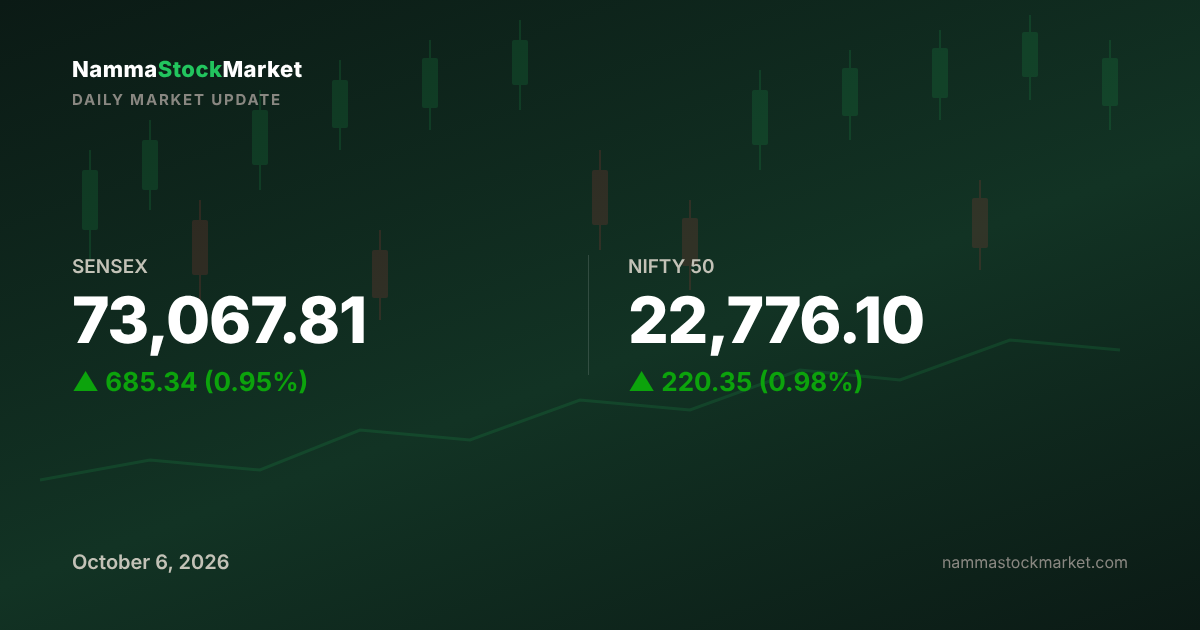
Sensex Jumps 685 Points, Nifty Closes Above 22,750 As Markets Rally Ahead Of RBI Rate Decision
October 6, 2026 | by NammaStockMarket
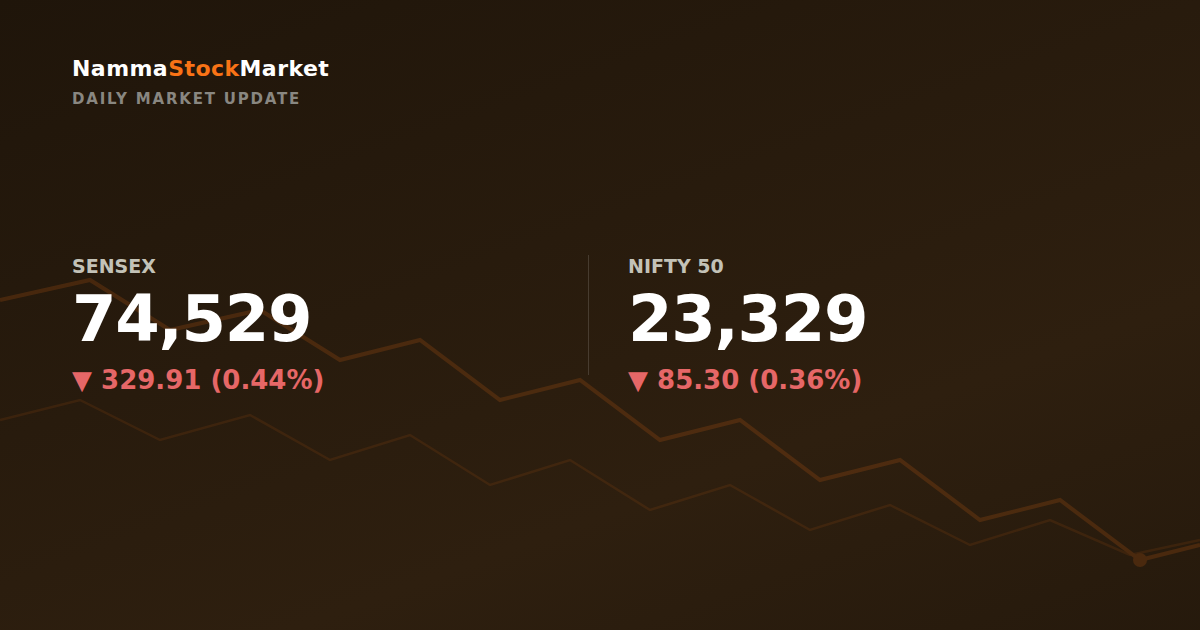
Sensex Slips 330 Points, Nifty Snaps 4-Day Winning Streak To End At 23,329 As IT Stocks Drag
September 22, 2026 | by NammaStockMarket
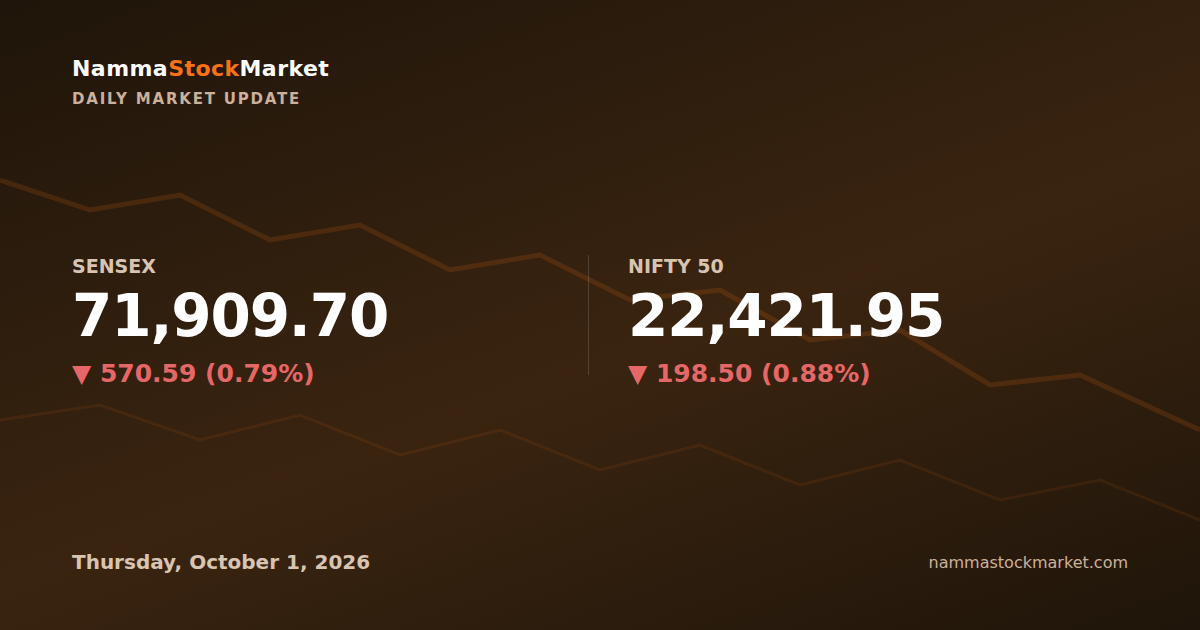
Sensex Sinks 571 Points, Nifty Slips Below 22,450 As Crude Oil Tops $100 And US Bond Yields Spook D-Street
October 1, 2026 | by NammaStockMarket