

Bank Nifty Nears Record High As Realty Stocks Rally 4.5%, But Sensex And Nifty Barely Move On November 12
November 12, 2026 | by NammaStockMarket
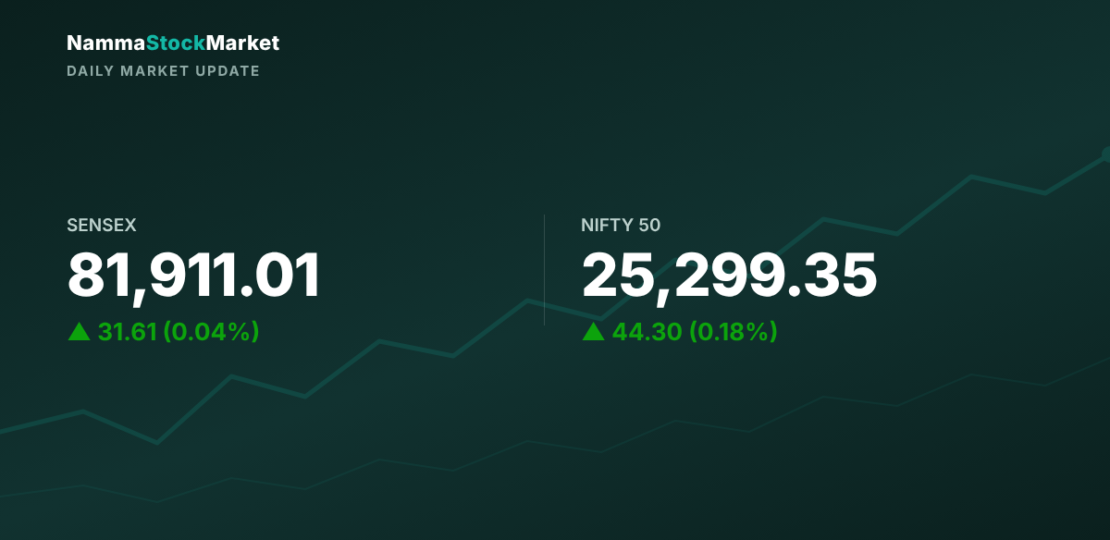
The Indian stock market had a strange sort of day on Thursday. If you only looked at the BSE Sensex and the NSE Nifty 50, you’d think almost nothing happened. The Sensex closed at 81,911.01, up just 31.61 points, or 0.04 percent. The Nifty 50 ended at 25,299.35, up 44.30 points, or 0.18 percent. That’s about as flat as a trading day gets.
But that headline number was hiding a much livelier story underneath. Bank Nifty, which tracks the big banking stocks, jumped 1.19 percent to 61,518.50 and is now sitting just a whisker away from its all-time high. Real estate stocks had a terrific day, with the Nifty Realty index surging 4.5 percent. And if you were holding small-cap or mid-cap stocks, you had a genuinely good day, because both the Nifty Midcap 100 and Nifty Smallcap 100 outperformed the main indices by a wide margin. This was the third straight session of gains for the market, even though today’s close looked almost unchanged on the surface.
The two big reasons behind today’s action were strong buying by foreign investors into banking and financial stocks, and crude oil continuing to cool off, which is always good news for a country like India that imports most of its oil. On the other side, a stronger US dollar pulled the rupee lower, and some profit booking crept into IT, FMCG and auto stocks after their recent run-up.
Market At A Glance
| Index | Close | Points Change | % Change |
|---|---|---|---|
| Sensex (BSE) | 81,911.01 | ▲ 31.61 | ▲ 0.04% |
| Nifty 50 (NSE) | 25,299.35 | ▲ 44.30 | ▲ 0.18% |
| Bank Nifty | 61,518.50 | ▲ 726.00 | ▲ 1.19% |
| Nifty Midcap 100 | 62,039.00 | ▲ ~520 | ▲ 0.85% |
| Nifty Smallcap 100 | 19,706.75 | ▲ ~218 | ▲ 1.12% |
| India VIX | 16.61 | ▼ 0.94 | ▼ 5.38% |
Note: points change for Nifty Midcap 100 and Nifty Smallcap 100 are approximate, calculated from the day’s percentage move, since exact point figures weren’t separately published by exchanges at the time of writing.
Why The Market Moved
Let’s break this down simply, because a few things were pulling the market in different directions at once.
The biggest positive was banking. India’s big banks reported a strong set of July-September quarter results this earnings season, with healthy loan and deposit growth and improving asset quality, which basically means fewer loans turning bad. When banks look this healthy, foreign institutional investors, or FIIs (these are big funds based outside India that invest in Indian shares, usually through what’s called the FPI or Foreign Portfolio Investor route), tend to put money into them. That’s exactly what happened, with heavy FII buying flowing into private banks, PSU banks and non-banking finance companies like Bajaj Finance and Shriram Finance.
The second big tailwind was crude oil. Brent crude, which is the global benchmark price for oil and is always quoted in US dollars per barrel, has fallen sharply over the past two weeks, from around $118 a barrel at the end of October to around $92 a barrel today, a drop of roughly 13 percent. Why does this matter so much for India? Because India buys more than 80 percent of the oil it needs from abroad, paying for it in dollars. When crude is expensive, India’s oil import bill balloons, which widens the trade deficit, puts pressure on the rupee, and eventually shows up as costlier petrol, diesel and LPG at home. So when oil falls this much, it’s a genuine relief for the Indian economy, and the market knows it. Today’s fall of about 1 percent, taking Brent to near $91.80 a barrel, came on hopes that tensions in the Middle East, particularly around Saudi Arabia and Iran, are easing, which reduces the risk of oil supply getting disrupted.
Working against these positives was the US dollar. Hotter-than-expected inflation data out of the US raised the odds that the American central bank, the Fed, might even raise interest rates in December instead of cutting them, which is the opposite of what markets had been hoping for. A stronger dollar makes every other currency, including the rupee, look weaker in comparison, and that’s a big reason your dollar-priced imports like oil, electronics and gold get costlier even when nothing changes on the Indian side.
Which Sectors Held Up, And Which Didn’t
This was very much a “pick your sector carefully” kind of day.
| Sector | % Change |
|---|---|
| Nifty Realty | ▲ 4.50% |
| Nifty Media | ▲ 2.46% |
| Nifty PSU Bank | ▲ 1.51% |
| Nifty Bank | ▲ 1.19% |
| Nifty Private Bank | ▲ 0.87% |
| Nifty Consumer Durables | ▲ 0.35% |
| Nifty Metal | ▼ 0.11% |
| Nifty Pharma | ▼ 0.35% |
| Nifty IT | ▼ 0.41% |
| Nifty FMCG | ▼ 0.74% |
| Nifty Energy | ▼ 0.70% |
| Nifty Auto | ▼ 1.02% |
Realty was the standout, up a sharp 4.5 percent, on the back of strong festive-season home sales data and a broader rotation of money into rate-sensitive sectors. Media and PSU banks also had a strong showing. On the other end, auto stocks were the biggest laggards, down about 1 percent, with some profit booking after a strong run this month. FMCG and IT also slipped, continuing a recent pattern where export and consumption-linked sectors have struggled to keep pace with financials and realty.
Today’s Top Movers
If you’re tracking individual stocks in your demat account, here’s where the real action was. A demat account, in case you’re new to this, is simply the account that holds your shares electronically, the same way a bank account holds your money, and it works together with your trading account, which is what you use to actually place buy and sell orders.
Insurance and NBFC (non-banking financial company) stocks dominated the gainers’ list today.
| Nifty 50 Stock | % Change |
|---|---|
| HDFC Life Insurance | ▲ 4.23% |
| Shriram Finance | ▲ 3.58% |
| Bajaj Finance | ▲ 3.36% |
| SBI Life Insurance | ▲ 2.97% |
| State Bank of India | ▲ 2.97% |
HDFC Life led the pack after strong monthly new business numbers, while Shriram Finance, Bajaj Finance and SBI Life all rode the same wave of FII buying into financials. Bajaj Finance’s rise came even as the company priced a large share sale to institutional investors, which usually weighs on a stock rather than lifting it, showing just how strong the demand for financial stocks was today.
On the losing side, it was a mixed bag of FMCG, auto and utility names.
| Nifty 50 Stock | % Change |
|---|---|
| Nestle India | ▼ 2.10% |
| Mahindra & Mahindra | ▼ 1.90% |
| Power Grid Corporation | ▼ 1.63% |
| Hindustan Unilever | ▼ 1.47% |
| Trent | ▼ 1.32% |
Nestle India led the fall after its quarterly results disappointed some investors, while Mahindra & Mahindra and Hindustan Unilever gave back some of their recent gains. Power Grid slipped on profit booking after a long rally in utility and infrastructure stocks this year.
What FIIs And DIIs Were Doing
You’ll often see FII and DII numbers quoted in market reports, so here’s a quick explainer. FIIs, or Foreign Institutional Investors (also called FPIs, Foreign Portfolio Investors), are big foreign funds, pension funds and institutions investing in Indian markets from outside the country. DIIs, or Domestic Institutional Investors, are the Indian counterparts, mainly mutual funds (the same funds that your SIP, or Systematic Investment Plan, money goes into every month), insurance companies and banks. Watching whether FIIs are buying or selling, and whether DIIs are doing the opposite, tells you a lot about where the underlying demand for Indian shares is coming from.
Today’s official FII/DII cash-segment figures for November 12 hadn’t been released at the time of writing, since this data typically comes out a day later. Here’s what we know from the most recent sessions:
| Date | FII/FPI (Cash) | DII (Cash) |
|---|---|---|
| 11 Nov 2026 | ₹12,563 crore (net buy) | ₹8,435 crore (net sell) |
| 9 Nov 2026 | ₹7,212 crore (net buy) | ₹7,173 crore (net sell) |
| 6 Nov 2026 | ₹13,750 crore (net buy) | ₹5,969 crore (net sell) |
| 5 Nov 2026 | ₹14,975 crore (net buy) | ₹10,445 crore (net sell) |
| 4 Nov 2026 | ₹7,284 crore (net buy) | ₹3,712 crore (net sell) |
The pattern here is unmistakable: FIIs have been net buyers on every one of these days, while DIIs, mainly domestic mutual funds, have been steady net sellers. This is actually a healthy sign rather than a worrying one. It usually means domestic mutual funds are booking some profits and partly rebalancing, while foreign money is flowing back into India after a rough patch earlier this year. FIIs have now pumped in roughly ₹60,000 crore into Indian equities in just the first eleven trading days of November, among their strongest months of buying in a long while. If you’re running an SIP, this kind of to-and-fro between FIIs and DIIs isn’t something you need to react to; it’s just the normal push and pull that happens every single trading day.
Oil, The Rupee, And Global Cues
We’ve already touched on crude oil above, so let’s focus on the rupee and what’s happening overseas.
The rupee ended weaker today, falling about 33 to 34 paise to close near 94.03 against the US dollar, compared to Wednesday’s close of around 93.69. The main reason, as we discussed, was a stronger US dollar after hot American inflation data pushed up US bond yields and raised bets on the Fed holding rates higher for longer, or even hiking in December. The dollar index, which measures the dollar’s strength against a basket of major currencies, moved up to around 103. A weaker rupee makes imports costlier across the board, from crude oil and edible oils to electronics and gold, which is one reason the RBI (the Reserve Bank of India) keeps a close watch on sharp currency moves and sometimes steps in to smooth out excessive volatility.
Globally, the picture was mixed. Wall Street had a strong Wednesday night, with the Dow up 0.49 percent, the S&P 500 up 1.31 percent and the Nasdaq 100 up a sharp 2.28 percent, as US investors cheered strong earnings and bets on rate cuts later in the cycle. But Asian markets didn’t follow through today, with Japan’s Nikkei down 0.99 percent, South Korea’s KOSPI down 0.61 percent, China’s Shanghai Composite down 0.68 percent and Hong Kong’s Hang Seng down a sharper 1.46 percent, all weighed down by uncertainty around a change in leadership at chipmaker Nvidia and fresh US scrutiny of the semiconductor sector. India mostly shrugged this off today, thanks to its own domestic banking and realty story, but these global cues are worth watching, since a prolonged tech sell-off abroad can eventually spill over into Indian IT stocks and overall sentiment.
What To Watch Tomorrow
A few things are worth keeping on your radar going into Friday’s session. First, keep an eye on whether Bank Nifty can actually take out its record high, now less than half a percent away; a breakout there could pull the broader market along with it. Second, watch crude oil closely: if Brent keeps sliding toward $90 or below, it’s a genuine tailwind for the rupee, inflation and the market as a whole, but any fresh escalation in the Middle East could reverse this quickly. Third, with F&O (futures and options) positioning still elevated after this month’s rally, keep half an eye on India VIX, which eased to 16.61 today; a sudden spike there often signals nervousness building up ahead of expiry-related volatility. Auto, FMCG and IT look like the sectors most exposed to further profit booking if this rotation into banks and realty continues, while PSU banks, realty and insurance names look relatively well placed if the current trend holds. As always, this is meant to help you understand what’s driving the market, not as a buy or sell recommendation, so make your own calls based on your goals and risk appetite, or speak with your financial advisor.
RELATED POSTS
View all

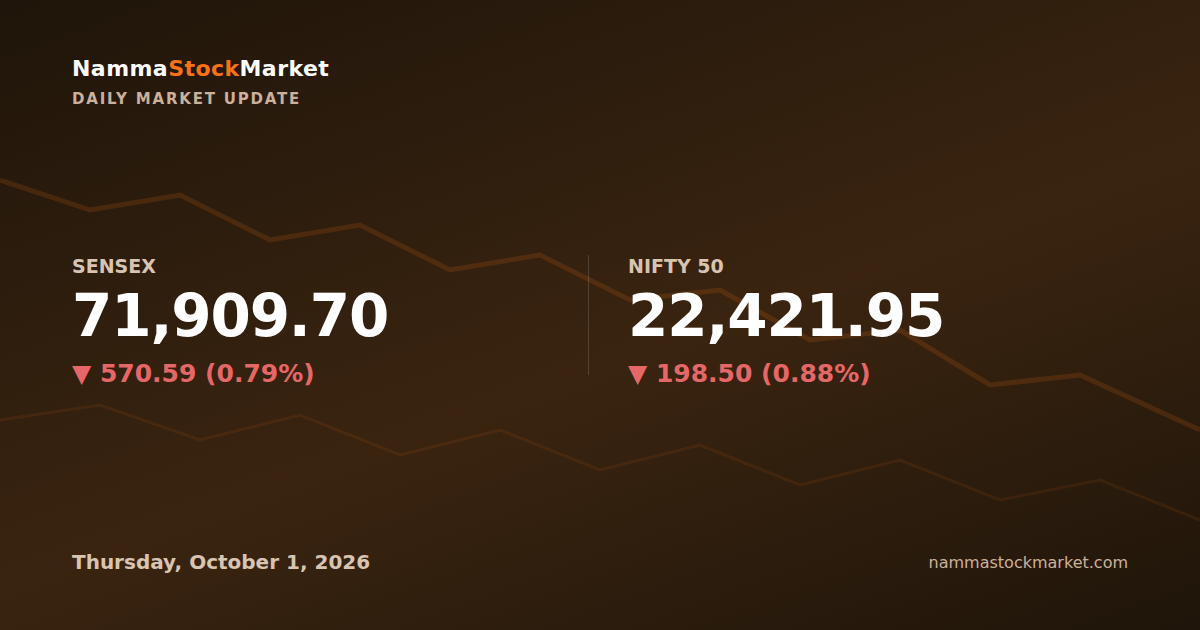
Sensex Sinks 571 Points, Nifty Slips Below 22,450 As Crude Oil Tops $100 And US Bond Yields Spook D-Street
October 1, 2026 | by NammaStockMarket
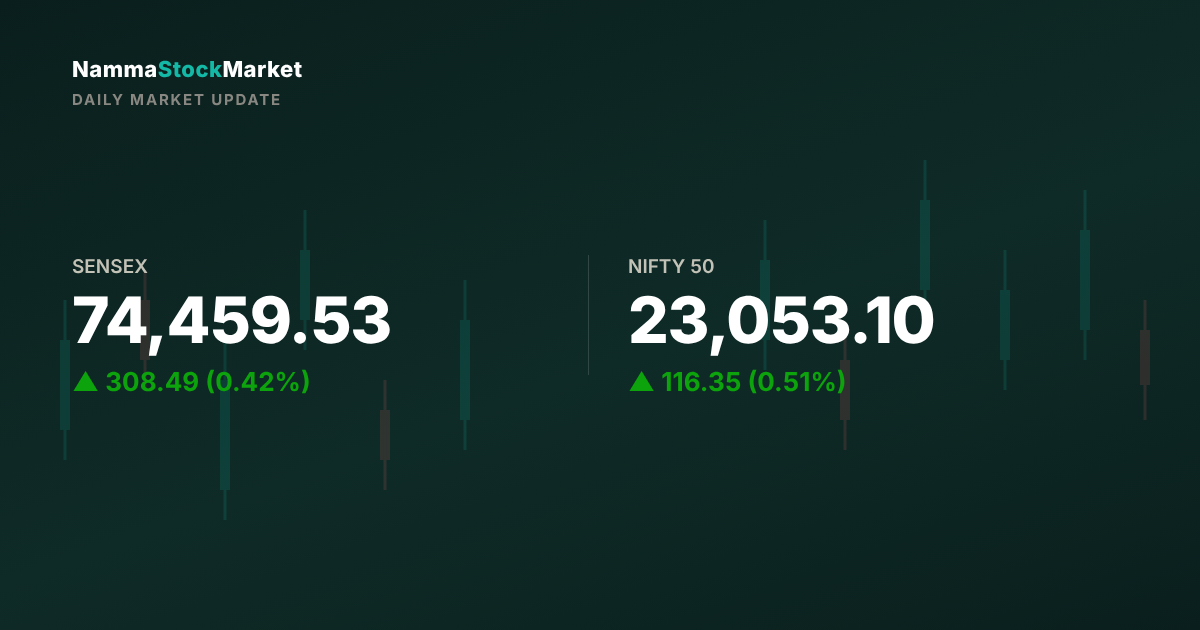
Sensex Jumps 308 Points, Nifty Reclaims 23,000 As IT And Pharma Stocks Rally; Broader Market Sinks On Middle East Oil Worries
October 30, 2026 | by NammaStockMarket
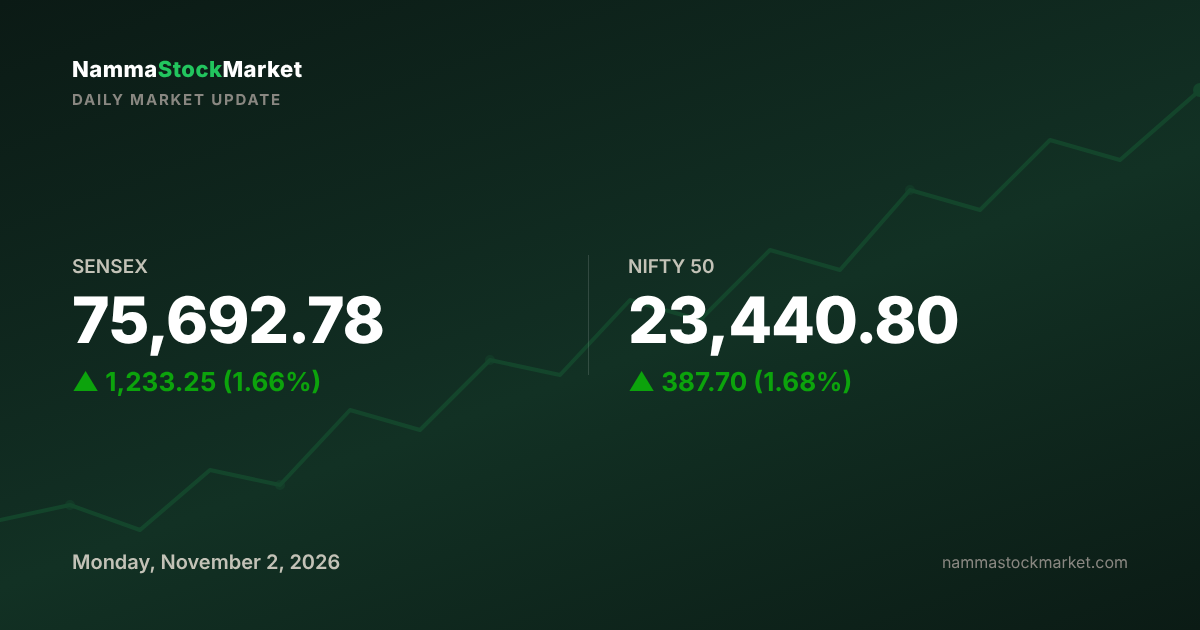
Sensex Jumps 1,233 Points, Nifty Crosses 23,440 As Reliance’s Record Profit And Cooling Oil Prices Trigger A Big Rally
November 2, 2026 | by NammaStockMarket