

Sensex Jumps 427 Points To 82,532, Nifty Ends At 25,387 As Bank Nifty Hits Record High And Crude Oil Cools
November 17, 2026 | by NammaStockMarket
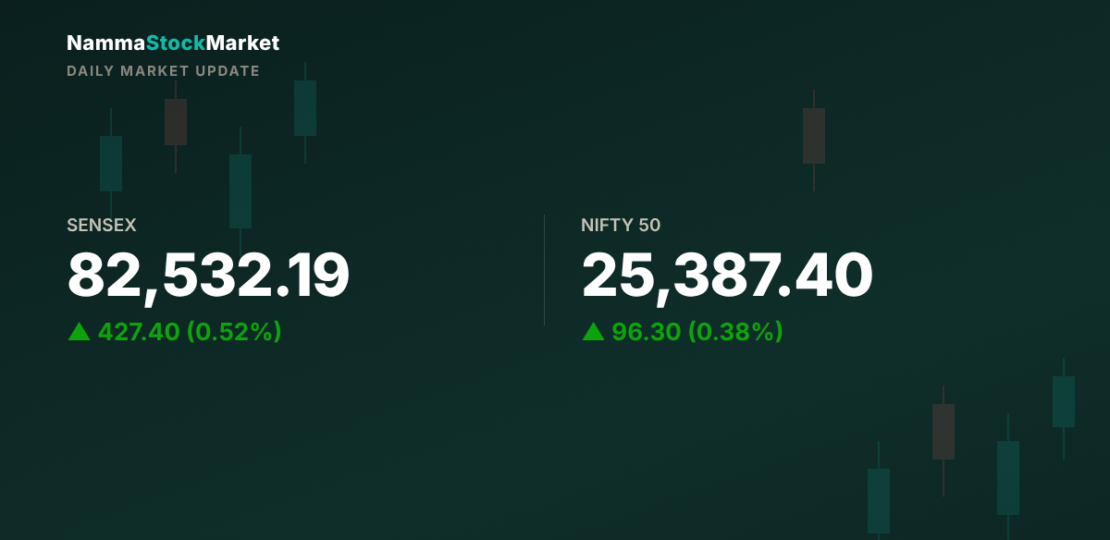
The Indian stock market extended its winning run into a second straight session on Tuesday. The BSE Sensex (the 30-share index of India’s oldest stock exchange, the Bombay Stock Exchange) closed at 82,532.19, up 427.40 points or 0.52%. The NSE Nifty 50 (the 50-stock benchmark of the National Stock Exchange, India’s biggest exchange) ended at 25,387.40, up 96.30 points or 0.38%. If you’ve been checking your demat account today — that’s the account where your shares actually sit, separate from the trading account you use to place buy and sell orders — there’s a good chance you saw some green, especially if banking stocks feature in your portfolio or in a mutual fund SIP you run every month.
Banks were the real story of the day. The Nifty Bank index, known simply as Bank Nifty, smashed through its earlier all-time high and touched a fresh record of 62,379.15 during the session, easily clearing its previous peak of 61,764.85. Heavyweight private banks such as Axis Bank, ICICI Bank and Bank of Baroda, along with public sector banks, led the charge, while HDFC Bank and Yes Bank slipped a bit as some investors booked profits after the recent run-up. The other big reason the Indian share market felt good today was crude oil, which slipped further and gave markets one more thing to cheer about, since India imports the bulk of the oil it uses and cheaper crude is almost always good news for our economy.
Market At A Glance
| Index | Close | Points Change | % Change |
|---|---|---|---|
| BSE Sensex | 82,532.19 | ▲ 427.40 | ▲ 0.52% |
| NSE Nifty 50 | 25,387.40 | ▲ 96.30 | ▲ 0.38% |
| Nifty Midcap 100 | — | — | ▲ 0.25% |
| Nifty Smallcap 100 | — | — | ▼ 0.22% |
Note: Bank Nifty’s official closing level wasn’t published by the sources we checked at the time of writing, though it did touch a fresh record high of 62,379.15 intraday (more on that below). India VIX’s reading for today also wasn’t out yet when this was written; its last confirmed close was 15.68 on 16 November. We’ve left both out of the table above rather than guess.
Why The Market Moved
Two things did most of the work today, and both are worth understanding properly instead of just skimming past the numbers.
First, crude oil. Brent crude (the international benchmark that most of India’s oil imports are priced off) slipped to around $91.70 to $92 a barrel, continuing its recent slide. Why does this matter so much for us in India? Because we buy close to 85% of our oil from other countries, paying for it in US dollars. When crude gets cheaper, our oil import bill shrinks, which is good news on two fronts — it eases pressure on the rupee (since we need fewer dollars to pay for the same oil), and it keeps a lid on inflation, because fuel costs filter into the price of almost everything, from the vegetables delivered to your home to the cab you book. That’s exactly why paint companies, tyre makers and oil marketing companies such as the ones that run your local petrol pump were among the gainers today — cheaper crude means cheaper raw material for paints and tyres, and fatter margins for fuel retailers.
Second, foreign money kept flowing into Indian shares. FIIs, or Foreign Institutional Investors (that’s the term for large foreign funds, pension funds and similar overseas investors who buy and sell Indian stocks), have been strong buyers through November, and that buying has been a big reason the Nifty and Sensex have climbed nearly 10% this month alone. A chunk of this money appears to be rotating out of expensive US technology and AI stocks and into Indian large-caps, which look relatively cheap and safe by comparison after the recent global sell-off in AI-linked names.
Which Sectors Held Up, And Which Didn’t
Banking and rate-sensitive sectors were clearly the stars of the day, while IT and FMCG lagged behind. Here’s how the major sectoral indices moved:
| Sector | % Change |
|---|---|
| Nifty PSU Bank | ▲ 1.95% |
| Nifty Realty | ▲ ~2.0% |
| Nifty Financial Services | ▲ 0.6% |
| Nifty Auto | ▲ 0.72% |
| Nifty Metal | ▲ 0.5% to 0.9% |
| Nifty Oil & Gas | ▲ 0.5% to 0.9% |
| Nifty Media | ▲ 0.5% to 0.9% |
| Nifty Private Bank | ▲ 0.5% to 0.9% |
| Nifty Infrastructure | ▲ 0.5% to 0.9% |
| Nifty FMCG | ▼ 0.3% |
| Nifty IT | ▼ 0.9% |
Public sector banks led from the front, rising close to 2%, with private banks, metals, oil & gas, media and infrastructure stocks all joining the rally. Realty stocks also had a strong day, helped by the broader risk-on mood and the hope that softer crude will keep interest rates steady. IT stocks were the one sore spot — they fell nearly 1%, dragged down by weak global cues after a rough night on Wall Street, where worries about stretched AI valuations hit technology names hard. FMCG stocks also slipped slightly, as money rotated out of defensive names and into the more cyclical sectors that were rallying.
Today’s Top Movers
Here are the five biggest gainers and losers among Nifty 50 stocks today:
Top Gainers
| Stock | Price | % Change |
|---|---|---|
| Adani Enterprises | ₹2,746.00 | ▲ 3.27% |
| Eicher Motors | ₹7,785.00 | ▲ 2.45% |
| Axis Bank | ₹1,371.50 | ▲ 2.17% |
| Mahindra & Mahindra | ₹3,407.40 | ▲ 2.05% |
| Asian Paints | ₹2,622.80 | ▲ 1.94% |
Adani Enterprises led the gainers with a gain of more than 3%, while auto major Eicher Motors and Axis Bank both added over 2%. Mahindra & Mahindra and Asian Paints rounded out the top five, both helped by the fall in crude oil, since Asian Paints uses crude-linked inputs and cheaper raw material is straightforward good news for its margins.
Top Losers
| Stock | Price | % Change |
|---|---|---|
| HCL Technologies | ₹1,358.80 | ▼ 1.86% |
| Coal India | ₹390.95 | ▼ 1.65% |
| HDFC Life | ₹594.90 | ▼ 1.59% |
| Infosys | ₹1,129.40 | ▼ 1.37% |
| Power Grid | ₹258.60 | ▼ 1.37% |
IT bellwether HCL Technologies topped the losers’ list, down close to 2%, with Infosys also in the red as the whole IT pack came under pressure. Coal India, HDFC Life and Power Grid rounded out the top five fallers, with profit-booking visible in some of the recent high-flyers.
What FIIs and DIIs Were Doing
You’ll often see FII and DII numbers mentioned in market reports, so here’s a quick explainer if you’re newer to investing. FIIs, or Foreign Institutional Investors (sometimes also called FPIs, or Foreign Portfolio Investors), are large overseas funds that invest in Indian stocks. DIIs, or Domestic Institutional Investors, are the Indian equivalent — mutual funds, insurance companies like LIC, and pension funds that invest money collected from Indian savers, including the SIP instalments many of you put in every month. Watching whether these two big groups are buying or selling helps you understand who is actually driving a rally or a fall.
Today’s official FII and DII cash-segment figures weren’t out yet at the time of writing — these numbers usually come in after markets close, from NSE’s provisional data. So here are the figures for the last five trading days we could confirm, with dates clearly marked:
| Date | FII Net (Cash) | DII Net (Cash) |
|---|---|---|
| 16 Nov 2026 | ▲ ₹4,865 crore | ▼ ₹3,519 crore |
| 13 Nov 2026 | ▲ ₹5,737 crore | ▼ ₹2,254 crore |
| 12 Nov 2026 | ▲ ₹7,831 crore | ▼ ₹6,331 crore |
| 11 Nov 2026 | ▲ ₹12,563 crore | ▼ ₹8,435 crore |
| 09 Nov 2026 | ▲ ₹7,212 crore | ▼ ₹7,173 crore |
The pattern here is a familiar one this month: FIIs have been net buyers on every one of these days, while DIIs have mostly been net sellers, likely booking some profits and rebalancing after the market’s sharp run-up. In other words, foreign money has been pushing this rally, while domestic institutions have been the ones quietly taking some chips off the table. That’s worth keeping an eye on, because if FII buying ever pauses, DII selling alone could start to weigh on the market.
Oil, The Rupee, And Global Cues
Brent crude slipped to around $91.70 to $92.76 a barrel through the day, even though tensions in West Asia (the Middle East) haven’t fully gone away. The reason prices fell anyway is supply, not demand — the International Energy Agency expects a global oil supply surplus of around 2 million barrels a day in the current quarter, as Middle Eastern exports recover and oil shipments through the Strait of Hormuz, a key chokepoint for global oil trade, get back to close to pre-war levels. US Vice President JD Vance also signalled that Washington wants to avoid a prolonged conflict with Iran, which eased some of the geopolitical risk premium that had been built into oil prices.
The rupee, helped by this fall in crude and by all that FII money coming in, pushed on to a fresh seven-month high today, trading in the 93.60 to 93.70 band against the US dollar, up roughly 30 paise from Monday’s close of 93.94. A stronger rupee is a genuinely good thing for anyone planning foreign travel or paying for a child’s education abroad, and it also means imported goods, including crude oil itself, cost us a little less in rupee terms. The one small headwind was a slightly firmer US dollar index, which capped how much further the rupee could run; some analysts flagged that rising US Treasury yields could limit further appreciation from here.
On global cues, Wall Street had a rough Monday night, with the Nasdaq Composite down about 2.49%, the S&P 500 down around 1.91%, and the Dow Jones Industrial Average down 1.41%, all weighed down by worries over stretched valuations in AI-related stocks and tighter US restrictions on chip exports to China. Asian markets, including Japan’s Nikkei and South Korea’s Kospi, also fell, tracking Wall Street lower. Despite all that, the Indian stock market shrugged off the weak global mood and closed firmly higher — a sign that, for now at least, India is being treated as a relatively safer place to park money compared to pricier global technology stocks.
What To Watch Tomorrow
A few things are worth keeping on your radar as we head into Wednesday’s session. Nvidia, the bellwether for the whole global AI trade, reported its results after Tuesday’s US market close; how Wall Street reacts to that print overnight will likely set the tone for GIFT Nifty (the Singapore-listed Nifty futures contract that gives an early signal on how Indian markets might open) and, in turn, for our own market tomorrow morning. Keep an eye on whether FIIs keep buying at the same pace, since that flow has been the single biggest driver of this rally. Crude oil’s direction matters too — if the expected supply surplus keeps pushing prices down, that’s a tailwind for India, but any flare-up in West Asia could reverse the move quickly. Markets will also be watching for fresh signals on the US Federal Reserve’s next rate decision in December, since that shapes how much foreign money keeps flowing into emerging markets like India. Closer to home, the Q2 earnings season is still rolling on, with more companies due to report in the coming days, and banking stocks, after today’s record-breaking run, will be worth watching for any signs of profit-booking. This is general market information to help you follow along, not investment advice or a buy or sell recommendation — always do your own homework or speak to a qualified advisor before acting on any of it.
RELATED POSTS
View all

Sensex Jumps 1,233 Points, Nifty Crosses 23,440 As Reliance’s Record Profit And Cooling Oil Prices Trigger A Big Rally
November 2, 2026 | by NammaStockMarket
Sensex Falls 460 Points, Nifty Below 22,700 As Crude Oil Jumps Past $112 On Middle East Tensions
October 22, 2026 | by NammaStockMarket
Sensex Jumps 1,109 Points To 73,034, Nifty Tops 22,700 As IT Stocks Stage Stunning Comeback
October 13, 2026 | by NammaStockMarket