

Sensex Jumps Over 1,000 Points, Nifty Back Above 25,500 As Auto Stocks Roar — Maruti Surges 7%
November 19, 2026 | by NammaStockMarket
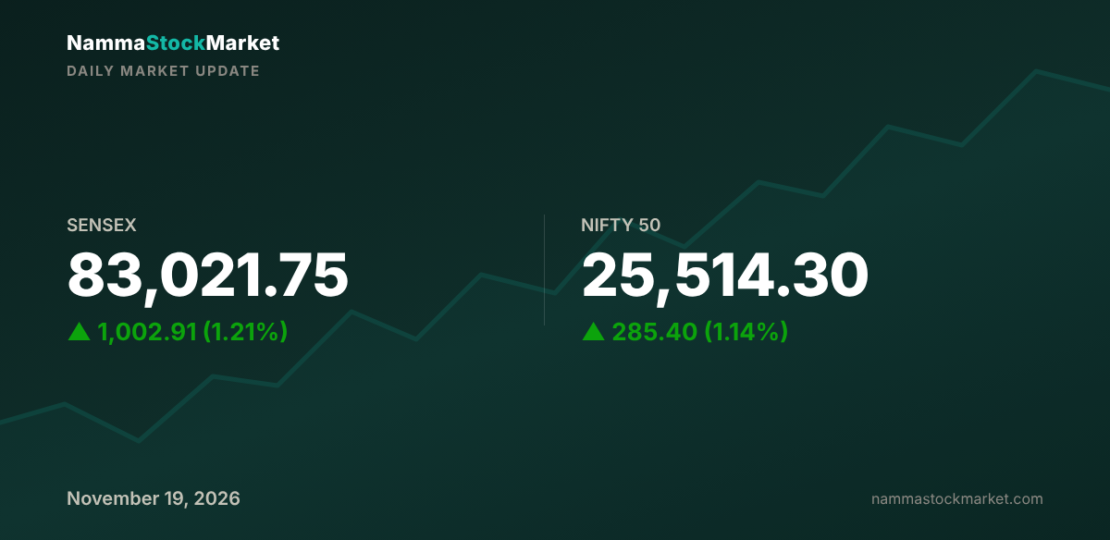
Today was a good day to be holding auto stocks. The BSE Sensex and the NSE Nifty 50 — the two main gauges of the Indian stock market, run by the Bombay Stock Exchange (BSE) and the National Stock Exchange (NSE) — closed sharply higher on Thursday, with the Sensex climbing over 1,000 points and the Nifty jumping back above the 25,500 mark. If you check your portfolio tonight and see a lot of green in auto, FMCG and banking names, that’s exactly where the buying happened today. The rally came down to two things: a sharp fall in metal prices like copper and aluminium that made life a lot easier for auto companies, and a drop in crude oil prices, which is good news for India’s oil import bill. IT stocks were the one sore spot in an otherwise strong day, falling on fresh worries about more US interest rate hikes.
Market At A Glance
| Index | Close | Points Chg | % Chg |
|---|---|---|---|
| BSE Sensex | 83,021.75 | ▲ 1,002.91 | ▲ 1.21% |
| NSE Nifty 50 | 25,514.30 | ▲ 285.40 | ▲ 1.14% |
| Nifty Bank | 63,063.00 | ▲ 1,023.25 | ▲ 1.65% |
| Nifty Midcap 100 | 61,620.00 | ▲ 636.28 | ▲ 1.05% |
| Nifty Smallcap 100 | 19,461.10 | ▲ 128.84 | ▲ 0.67% |
| India VIX | 15.90 | ▲ 0.33 | ▲ 2.12% |
All figures are closing values for Thursday. India VIX, which measures how nervous or calm options traders are feeling about the market, actually rose a little even on a day the market rallied hard — a small sign that not everyone is fully convinced this rally has legs yet.
Why The Market Moved
The day didn’t start out looking anything like this. In early trade, the Nifty actually slipped below the 25,150 level. The reason: minutes from the US Federal Reserve’s last policy meeting, released overnight, showed that most Fed officials are leaning towards more interest rate hikes, with some even open to a bigger, 50 basis point hike in December. When the US Fed signals higher rates ahead, it tends to make global investors a little nervous about putting money into riskier markets like India, because higher US rates pull money back towards the dollar and US government bonds, which suddenly look more attractive.
But through the day, the mood flipped completely. Heavy buying came into auto, banking and FMCG (fast-moving consumer goods — basically the everyday stuff you buy, like soap, biscuits and shampoo) stocks, and that was enough to drag both the Sensex and the Nifty well into positive territory by the closing bell, up over 1% each.
A big reason behind the auto rally: the prices of copper and aluminium, two metals that go into making cars, bikes and ACs, have been falling. That’s a direct saving on raw material costs for auto companies, and the market rewarded them for it in a big way. Maruti Suzuki, the country’s biggest carmaker, had its best single day in around 15 months, jumping more than 7%.
Which Sectors Held Up, And Which Didn’t
Here’s how the major sectors stacked up today, from best performer to worst:
| Sector (Nifty Index) | % Change |
|---|---|
| Auto | ▲ 4.40% |
| Consumer Durables | ▲ 3.64% |
| PSU Bank | ▲ 2.28% |
| FMCG | ▲ 2.08% |
| Private Bank | ▲ 1.39% |
| Energy | ▲ 1.14% |
| Metal | ▲ 0.64% |
| Pharma | ▲ 0.62% |
| Realty | ▲ 0.45% |
| Media | ▼ 0.06% |
| IT | ▼ 1.10% |
Auto was clearly the star of the day, up over 4%, while consumer durables — companies that make ACs, fans and other home appliances — also had a strong day for the same reason: air-conditioner makers use a lot of copper in their coils, so cheaper copper is a direct cost benefit. PSU banks and FMCG also had a solid day. On the other end, IT was the only major sector that closed in the red, down about 1.1%, as the hawkish Fed commentary made IT stocks — which earn a big chunk of their revenue in dollars from US clients — look a little less attractive for now. Media stocks were roughly flat, down just marginally.
Today’s Top Movers
Among the Nifty 50 names, auto stocks dominated the gainers’ list, while IT stocks made up most of the losers’ list — a clean reflection of the sector story above.
Top Gainers
| Stock | Close (₹) | % Change |
|---|---|---|
| Maruti Suzuki India | 13,554.00 | ▲ 7.30% |
| Mahindra & Mahindra | 3,515.60 | ▲ 4.66% |
| Eicher Motors | 8,056.00 | ▲ 4.62% |
| Hindustan Unilever | 2,067.70 | ▲ 3.75% |
| Tata Motors Passenger Vehicles | 262.00 | ▲ 3.74% |
Top Losers
| Stock | Close (₹) | % Change |
|---|---|---|
| Infosys | 1,091.90 | ▼ 1.52% |
| Tech Mahindra | 1,725.00 | ▼ 1.43% |
| Tata Consultancy Services | 2,345.80 | ▼ 1.42% |
| HCLTech | 1,328.40 | ▼ 1.21% |
| Apollo Hospitals Enterprise | 8,730.50 | ▼ 1.03% |
Maruti Suzuki’s jump of over 7% was the standout move of the day, by some accounts its best session in more than a year. Elsewhere in the broader market, away from the Nifty 50, two fintech names — Paytm and Mobikwik — had a rough day, both falling around 8%, on reports that a proposed 0.4% discount rate UPI apps would charge merchants on larger payments could be delayed yet again, which would mean more uncertainty for their payments business. If you’re holding either of those in your demat account, today was a day to just watch and not react.
What FIIs And DIIs Were Doing
If you’ve read market reports before, you’ve probably seen the terms FII and DII thrown around a lot, so here’s a quick refresher. FIIs, or Foreign Institutional Investors, are big funds based outside India — pension funds, hedge funds and the like — that buy and sell Indian stocks from abroad. DIIs, or Domestic Institutional Investors, are the Indian equivalent — mutual funds, insurance companies like LIC, and so on. When your mutual fund SIP money goes into the market every month, it flows in through DIIs.
Today’s (19 November) FII and DII cash market figures weren’t out yet at the time of writing — the exchanges usually release this data late in the evening, well after the closing bell. So here’s the pattern over the last five trading sessions instead, clearly dated, and it’s worth a close look because it’s a bit different from what you usually hear:
| Date | FII Net (₹ Crore) | DII Net (₹ Crore) |
|---|---|---|
| 18 Nov 2026 | ▲ 5,866.78 | ▼ 3,159.90 |
| 17 Nov 2026 | ▲ 4,195.38 | ▲ 196.93 |
| 16 Nov 2026 | ▲ 4,864.68 | ▼ 3,519.05 |
| 13 Nov 2026 | ▲ 5,736.55 | ▼ 2,253.58 |
| 12 Nov 2026 | ▲ 7,830.60 | ▼ 6,331.17 |
Normally the story you hear is “FIIs sold, but DIIs cushioned the fall.” This time it’s almost the opposite. FIIs have been big net buyers in the cash market for five straight sessions, pumping in anywhere from about ₹4,195 crore to ₹7,830 crore a day, while DIIs have mostly been net sellers, likely booking some profits after the market’s recent run-up. That’s a sign foreign investors are turning more constructive on India right now, even as domestic funds pause to lock in some gains along the way.
Oil, The Rupee, And Global Cues
Brent crude, the global benchmark for oil prices (always quoted in US dollars per barrel, since it’s traded globally), fell over 2% today to around $89.76 a barrel. The drop is tied to easing fears over the US-Iran standoff — reports suggesting the US may be holding back from further military action eased worries about oil supplies from the Middle East getting disrupted.
Why should you, as an Indian investor, care about a US-dollar oil price? Because India imports more than 80% of the crude oil it uses. When oil prices fall, India’s oil import bill — the money that flows out of the country every month to buy oil — comes down too. That’s good for the rupee, good for inflation at home, and good for companies that use oil and oil-linked products as raw material, which is part of why the market cheered today.
Speaking of the rupee, it firmed up to around ₹93.29 against the US dollar during the day’s trade, helped along by the fall in crude and by all that FII buying we just talked about. A stronger rupee is a bit of a mixed bag — it’s good news if you’re planning foreign travel or have a child studying abroad, but it’s a slight headwind for IT and other export-focused companies that earn in dollars and then convert that back into rupees, which is one more reason IT stocks underperformed today.
What To Watch Tomorrow
A few things worth keeping an eye on. First, retail inflation for October came in at 6.09%, above the RBI’s upper comfort band of 6%, and some economists now expect the RBI’s Monetary Policy Committee (MPC) — the group that decides the repo rate, which is the rate at which the RBI lends to banks and which eventually affects your home loan and FD rates — to raise rates by 25 basis points when it meets from December 2 to 4. That’s a story that could start playing out in bond and banking stocks over the next couple of weeks.
Second, options market data (that’s the F&O, or futures and options, segment) shows traders see 26,000 as a tough resistance level for the Nifty right now, with support sitting around the 25,000 to 25,500 zone. So don’t be surprised if the index spends a few sessions digesting this rally in that range rather than running away immediately. The put-call ratio (PCR, a simple way to gauge whether options traders are leaning bullish or bearish — a PCR above 1 generally means more puts are being written than calls, which is read as a mildly bullish-to-neutral sign) is sitting at 1.20 for the near-term weekly expiry.
Third, keep an eye on global cues — specifically how the US-Iran situation develops, since that’s been swinging crude oil prices around sharply, and any fresh escalation could just as quickly reverse today’s relief. IT investors in particular will want to watch what comes next from the US Fed, since another round of hawkish signals could keep the pressure on IT stocks and, by extension, the rupee-sensitive trade.
None of this is a buy or sell recommendation — just the things that are likely to move the needle over the next few sessions, so you know what to watch for in your own portfolio.
RELATED POSTS
View all

Sensex Jumps 879 Points, Nifty Reclaims 22,500: IT Stocks Lead Rebound After 8-Week Losing Run
October 9, 2026 | by NammaStockMarket
Sensex Jumps 773 Points, Nifty Reclaims 25,255 As Bank Nifty Nears Record High After Diwali Break
November 11, 2026 | by NammaStockMarket
Sensex Jumps 1,233 Points, Nifty Crosses 23,440 As Reliance’s Record Profit And Cooling Oil Prices Trigger A Big Rally
November 2, 2026 | by NammaStockMarket