

Sensex Jumps 773 Points, Nifty Reclaims 25,255 As Bank Nifty Nears Record High After Diwali Break
November 11, 2026 | by NammaStockMarket
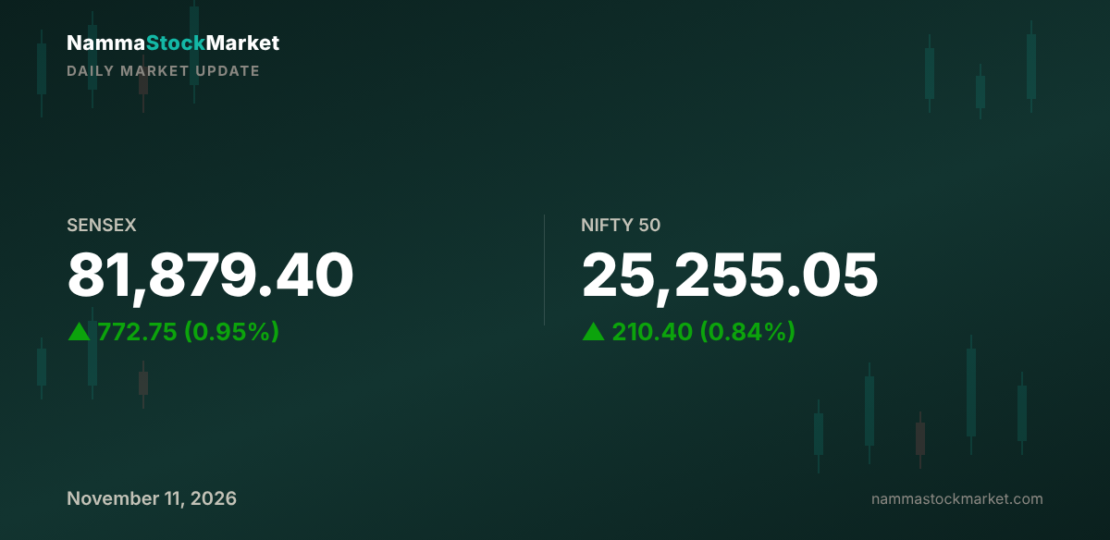
The Indian stock market picked up right where it left off before the Diwali break, and picked up in style. The BSE Sensex closed up 772.75 points, or 0.95%, at 81,879.40, while the NSE Nifty 50 ended 210.40 points higher, a gain of 0.84%, to settle at 25,255.05. Markets were shut on Tuesday for Diwali-Balipratipada, so this was the first trading day in two sessions, and the mood was clearly upbeat. If you were waiting for banking stocks to come back into favour, today was your day — Bank Nifty came within touching distance of its all-time high, and PSU banks were the stars of the show.
Two things drove the rally. First, crude oil prices cooled off sharply, touching a two-month low, which is always good news for a country like India that imports most of its oil. Second, foreign investors kept pouring money into Indian shares, with November turning into the best month for foreign buying since September 2024. Put those two together and you get exactly the kind of day Dalal Street had today — banks, autos and PSU names leading, while IT and pharma lagged a bit.
Market At A Glance
Here’s how the main indices closed today. If you’re new to investing, Sensex is the benchmark index of the BSE (Bombay Stock Exchange), tracking 30 of India’s biggest companies, while Nifty 50 is the flagship index of the NSE (National Stock Exchange), tracking the top 50. Bank Nifty tracks the biggest bank stocks, and India VIX is often called the market’s “fear gauge” — it tells you how much volatility traders expect in the next 30 days.
| Index | Close | Points Change | % Change |
|---|---|---|---|
| BSE Sensex | 81,879.40 | ▲ 772.75 | ▲ 0.95% |
| NSE Nifty 50 | 25,255.05 | ▲ 210.40 | ▲ 0.84% |
| Bank Nifty | ~60,793* | ▲ ~1,051* | ▲ 1.76% |
| Nifty Midcap 100 | 61,519.10 | ▲ 496.55 | ▲ 0.81% |
| Nifty Smallcap 100 | 19,489.35 | ▲ 304.30 | ▲ 1.59% |
| India VIX | 17.56 | ▲ 0.14 | ▲ 0.80% |
Note: Bank Nifty’s exact closing tick wasn’t separately published by exchanges at the time of writing; the closing level above (marked with an asterisk) is calculated from its previous close of 59,741.25 and the day’s confirmed 1.76% gain.
Why The Market Moved
If you’ve ever wondered why a report about crude oil prices shows up in every Indian stock market update, here’s the simple answer: India buys about 85% of the oil it uses from other countries, in US dollars. When oil gets expensive, India has to spend more dollars to buy the same amount of oil. That widens what’s called the “import bill,” puts pressure on the rupee, and eventually shows up as higher fuel and transport costs at home, which feeds into inflation. So when Brent crude (that’s the international oil benchmark, priced in US dollars per barrel) falls, as it did this week to a two-month low near $89 a barrel on fading fears of a bigger US-Iran conflict, it’s actually one of the best pieces of news the Indian market can get. Lower oil means a healthier import bill, less pressure on the rupee, and more room for the Reserve Bank of India (RBI) to think about supporting growth rather than fighting inflation.
The second big driver was foreign money. FIIs, or Foreign Institutional Investors (think global funds based outside India investing in Indian stocks), have bought a net ₹53,739 crore worth of Indian shares in just the first nine trading days of November — the strongest monthly buying in more than a year. A lot of that money has been rotating out of expensive AI and technology stocks in the US and Asia and into markets like India that looked cheap after two rough months of selling in September and October. That inflow directly lifted largecap banks and financials, which is why Bank Nifty did so well today.
There was a mild headwind too. Wall Street fell overnight after hotter-than-expected US inflation (CPI) data pushed American bond yields up, which raised the odds of the US Federal Reserve (the Fed, America’s central bank) staying cautious on rate cuts in December. That’s usually a negative for emerging markets like India, since higher US yields can pull some foreign money back to the US. But today, the oil and FII story was strong enough to override that worry, at least for one session.
Which Sectors Held Up, And Which Didn’t
Banking led from the front today, and by a wide margin. PSU banks — State Bank of India, Bank of Baroda, Punjab National Bank and others — jumped the most, with the Nifty PSU Bank index up nearly 3%. Private banks like HDFC Bank and Axis Bank weren’t far behind. Auto stocks also had a strong session, helped by festive-season demand and a couple of standout earnings reports. On the other side, IT, pharma and realty stocks lost a little ground, dragged down partly by a stronger rupee (which cuts into the dollar revenues of IT exporters) and some profit-booking after recent gains.
| Sector | % Change |
|---|---|
| Nifty PSU Bank | ▲ 2.94% |
| Nifty Auto | ▲ 2.14% |
| Nifty Private Bank | ▲ 1.14% |
| Nifty FMCG | ▲ 1.13% |
| Nifty Oil & Gas | ▲ 1.03% |
| Nifty Realty | ▼ 0.42% |
| Nifty Pharma | ▼ 0.41% |
| Nifty IT | ▼ 0.53% |
Today’s Top Movers
Mahindra & Mahindra was the single biggest gainer in the Nifty 50 today, adding 5.3%, while InterGlobe Aviation (the company that runs IndiGo) wasn’t too far behind with a 4.33% jump. Retail major Trent and metals heavyweight Tata Steel also had a good day. If you’re holding any of these names, today was a good day for your portfolio.
| Top Gainers (Nifty 50) | % Change |
|---|---|
| Mahindra & Mahindra | ▲ 5.30% |
| InterGlobe Aviation (IndiGo) | ▲ 4.33% |
| Trent | ▲ 3.32% |
| Tata Steel | ▲ 2.40% |
| Power Grid Corporation | ▲ 2.25% |
On the losing side, Adani Ports was the biggest drag, down close to 2%, while a few IT and FMCG names like Tech Mahindra, HCL Technologies and Nestle India also slipped. None of these are dramatic falls — more a case of money rotating out of yesterday’s winners and into today’s banking and auto rally.
| Top Losers (Nifty 50) | % Change |
|---|---|
| Adani Ports & SEZ | ▼ 1.84% |
| ICICI Bank | ▼ 1.10% |
| Tech Mahindra | ▼ 0.91% |
| HCL Technologies | ▼ 0.85% |
| Nestle India | ▼ 0.76% |
What FIIs and DIIs Were Doing
You’ll often see FII and DII numbers in every market report, so here’s a quick explainer if you’re newer to this. FIIs are foreign funds and institutions investing in Indian markets from outside the country, while DIIs, or Domestic Institutional Investors, are Indian entities like mutual funds, insurance companies (think LIC) and banks investing on behalf of Indian savers, including your own SIP (Systematic Investment Plan) money if you invest in equity mutual funds.
Today’s exact FII/DII cash-segment figures for November 11 weren’t out at the time of writing — these numbers typically get released by the exchanges after market hours and are reported the next morning. So here’s the most recent data available, covering the last few sessions. Note that Saturday, November 8 was a special “Muhurat trading” session held for Diwali (a short, symbolic trading hour that Indian exchanges hold every year on this occasion), which is why that day’s volumes look unusually small.
| Date | FII Net (Cash) | DII Net (Cash) |
|---|---|---|
| November 4, 2026 | ▲ ₹7,284 crore | ▼ ₹3,712 crore |
| November 5, 2026 | ▲ ₹14,975 crore | ▼ ₹10,445 crore |
| November 6, 2026 | ▲ ₹13,750 crore | ▼ ₹5,969 crore |
| November 8, 2026 (Muhurat) | ▼ ₹0.25 crore | ▼ ₹700 crore |
| November 9, 2026 | ▲ ₹7,212 crore | ▼ ₹7,173 crore |
The pattern over the past week has been clear: FIIs have been net buyers almost every single day, while DIIs have been net sellers, likely booking some profits and rebalancing after a strong run. This is actually a healthy dynamic — it shows DIIs have had the cushion to sell into FII buying without the market cracking, which suggests decent underlying demand from both sides even though their flows are pointed in opposite directions right now.
Oil, The Rupee, And Global Cues
Brent crude, the international benchmark that Indian oil companies effectively pay based on, slipped to around $90-91 a barrel today, continuing its retreat from a two-month low of $89.16 touched on Tuesday. The fall has been driven by easing fears of a wider US-Iran conflict, after comments from US President Trump suggested tensions may not escalate further. For India, cheaper crude is close to an unambiguous positive — it eases the oil import bill, takes pressure off the rupee, and gives the RBI more breathing room on inflation.
Speaking of the rupee: it closed today a touch stronger, trading around ₹93.68 to the US dollar, compared to Monday’s close of ₹93.93 (markets were shut Tuesday for the holiday). That’s a gain of roughly 25 paise, helped along by the same two factors driving the stock market — softer crude and strong FII inflows. A stronger rupee is a mixed bag: good for anyone importing goods or paying for a foreign holiday or education in dollars, but a slight negative for IT and pharma companies that earn a big chunk of their revenue in dollars, since each dollar now converts into fewer rupees.
On the global front, Asian markets had a mixed-to-positive day, with Japan’s Nikkei and South Korea’s Kospi both rallying over 1% on a rebound in AI and tech-linked shares, while Hong Kong’s Hang Seng slipped. Wall Street itself had a soft session overnight, with the Dow, S&P 500 and Nasdaq all in the red after that hotter-than-expected US inflation print. Markets are now watching whether the Fed turns more cautious on rate cuts at its December meeting — a more hawkish Fed tends to be a headwind for emerging markets like India since it can pull foreign money back towards the US.
What To Watch Tomorrow
A few things are worth keeping an eye on. Bank Nifty is sitting just under 1% away from its all-time high of 61,764.85, touched back in February — a breakout above that level could trigger fresh momentum buying in banking stocks, while a failure to clear it could see some profit-booking kick in. The ongoing Q2 FY27 earnings season is still in full swing, with well over a hundred companies due to report results in the days ahead, so stock-specific volatility is likely to stay elevated. Keep an eye on crude oil prices too — any fresh escalation in the US-Iran situation could reverse this week’s drop quickly, and that would hit the rupee and sentiment together. Finally, with India VIX ticking up slightly to 17.56, a bit of caution has crept back in even on a day when the market rallied hard, so don’t be surprised by some give-and-back-and-forth in the sessions ahead. This is market information for you to stay informed, not investment advice — always do your own research or speak to a qualified advisor before making any buy or sell decisions in your demat account.
RELATED POSTS
View all

Sensex Sheds 548 Points, Nifty Below 22,400 As Banking, FMCG Stocks Drag; Rupee Posts Best Day In 6 Months On RBI Measures
October 12, 2026 | by NammaStockMarket
Sensex Surges 905 Points, Nifty Nears 23,000 As Banks, FMCG Rally After Fed Holds Rates
October 29, 2026 | by NammaStockMarket
Sensex Zooms 1,718 Points, Nifty Reclaims 25,000 On Dhanteras As Indian Market Shrugs Off Global Tech Crash
November 6, 2026 | by NammaStockMarket