

Sensex Sheds 548 Points, Nifty Below 22,400 As Banking, FMCG Stocks Drag; Rupee Posts Best Day In 6 Months On RBI Measures
October 12, 2026 | by NammaStockMarket
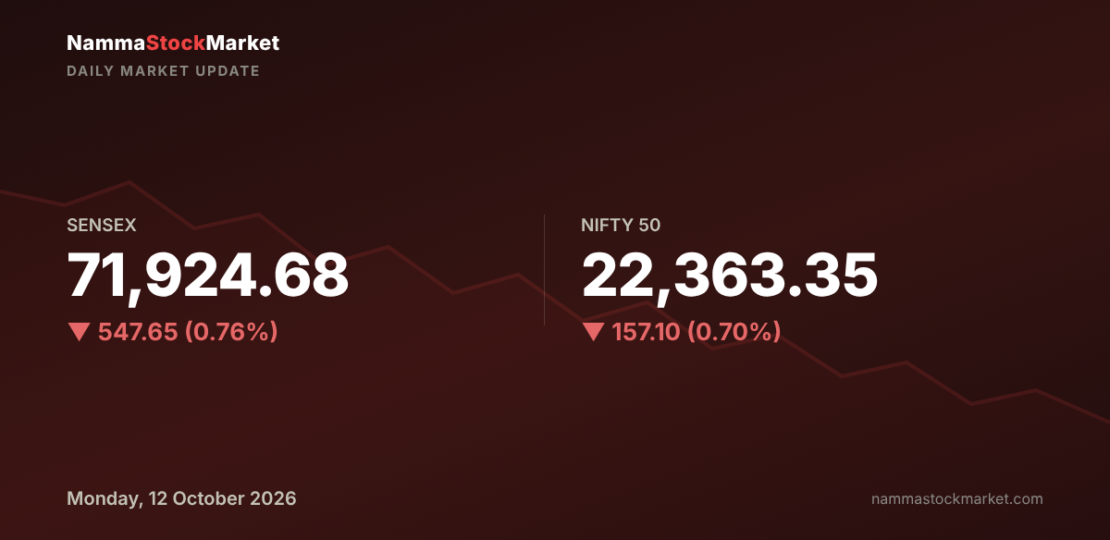
The Indian stock market had a rough start to the week. The BSE Sensex closed down 547.65 points, or 0.76%, at 71,924.68, and the NSE Nifty 50 ended 157.10 points, or 0.70%, lower at 22,363.35, slipping below the psychologically important 22,400 mark. If you were watching your portfolio today, you probably noticed banking and FMCG (fast-moving consumer goods, the everyday products like soap, biscuits and tea that companies like ITC and Hindustan Unilever make) stocks dragging the index down, while auto and media stocks quietly had a good day. The one bright spot that will matter if you’re holding mutual fund SIPs (systematic investment plans) in small and midcap schemes: the Nifty Smallcap 100 actually gained 1.42% today, so not every part of the market had a bad Monday.
Two big things shaped today’s session. First, the Reserve Bank of India (RBI) stepped in over the weekend with a set of measures to defend the rupee, which had been sliding towards the 97-per-dollar mark. That sent the rupee up 96 paise against the US dollar, its sharpest single-day jump in more than six months, but the same measures also tightened liquidity for banks, which is a big reason Bank Nifty and PSU Bank stocks fell. Second, crude oil prices stayed elevated through the day on fresh Houthi attacks near Saudi Arabia, keeping worries alive about India’s oil import bill and inflation, even though the rupee’s recovery provided some cushion.
Market At A Glance
| Index | Close | Change (Pts) | % Change |
|---|---|---|---|
| BSE Sensex | 71,924.68 | ▼ 547.65 | ▼ 0.76% |
| NSE Nifty 50 | 22,363.35 | ▼ 157.10 | ▼ 0.70% |
| Bank Nifty | 54,918.00 | ▼ 338.65 | ▼ 0.61% |
| Nifty Midcap 100 | 58,834.55 | ▲ 47.06 | ▲ 0.08% |
| Nifty Smallcap 100 | 19,425.80 | ▲ 270.81 | ▲ 1.42% |
| India VIX | 15.23 | ▼ 0.87 | ▼ 6.05% |
All indices above are shown with their closing values on the National Stock Exchange (NSE), except Sensex, which trades on the Bombay Stock Exchange (BSE). India VIX is a volatility index, not a price index, so it doesn’t move in “points” the way Sensex or Nifty do.
Why The Market Moved
If you’re new to tracking the Indian share market, here’s the simple version of what happened today. The RBI announced a package of steps on Saturday aimed at stopping the rupee from falling further. This included opening a special dollar window so that oil marketing companies (the government-run firms that import crude and sell petrol and diesel) can get dollars more easily, instead of competing for them in the open market. The RBI also made it costlier to take large speculative bets on the rupee by tightening rules on foreign exchange derivatives, and it told banks to keep a bigger chunk of their cash reserve ratio (CRR, the portion of deposits banks must park with the RBI) on a daily basis rather than just on average, starting 16 October.
Here’s why this matters for your money even if you don’t trade currencies. A weaker rupee makes everything India imports, especially crude oil, more expensive in rupee terms, and that feeds into inflation, which eventually affects interest rates, your loan EMIs and company profit margins. So when the RBI acts to support the rupee, it’s trying to protect the broader economy, not just the currency market. The flip side is that tighter cash with banks, which is what the new CRR rule and a planned ₹25,000 crore bond sale on 13 October mean, leaves banks with less room to lend freely in the short term. That’s a big part of why Bank Nifty and PSU Bank stocks underperformed today, even as the rupee rallied.
On top of this, India VIX (the India Volatility Index, often called the market’s “fear gauge” because it reflects how much swing traders expect in Nifty over the next month) jumped 6.05% to 15.23. A rising VIX usually means more nervousness in the system, and today it rose even though the broader market was only down a bit, which tells you options traders were bracing for more volatility. In the futures and options (F&O) segment, the put-call ratio (PCR, a ratio of outstanding put options to call options that traders use to gauge sentiment) slipped to around 0.61, a sign that more market participants were positioned for a continued down move or hedging against one.
Which Sectors Held Up, And Which Didn’t
| Sector Index | % Change |
|---|---|
| Nifty Media | ▲ 4.60% |
| Nifty Auto | ▲ 0.90% |
| Nifty Realty | ▲ 0.76% |
| Nifty Pharma | ▲ 0.45% |
| Nifty Energy | ▲ 0.20% |
| Nifty Consumer Durables | ▼ 0.09% |
| Nifty Metal | ▼ 0.41% |
| Nifty Financial Services | ▼ 0.41% |
| Nifty IT | ▼ 0.79% |
| Nifty PSU Bank | ▼ 1.31% |
| Nifty FMCG | ▼ 1.67% |
Nifty Media was the standout, up 4.60%, as investors rotated into the sector on stock-specific buying. Auto held up well too, up 0.90%, with Bajaj Auto and Tata Motors Passenger Vehicles leading the charge even on a weak day for the broader market, which tells you this wasn’t a case of auto stocks just drifting up with the tide. Realty, pharma and energy also closed in the green, giving defensive and rate-sensitive investors something to hold on to.
On the other side, Nifty FMCG had the toughest day, down 1.67%, weighed down heavily by ITC’s near 3% fall. If you hold FMCG stocks for their usual “safe, steady” reputation, today was a reminder that even defensive sectors aren’t immune on a day when a heavyweight stock like ITC drops sharply. PSU Bank stocks fell 1.31% and IT dropped 0.79%, both hurt by the liquidity-tightening measures and, for IT, by continued caution around US demand and the ongoing earnings season. Private banks and financial services stocks were also softer, down around 0.4%, as the CRR change and the upcoming bond sale made investors a little more cautious on the sector as a whole.
Today’s Top Movers
Top Gainers (Nifty 50)
| Stock | % Change |
|---|---|
| Dr. Reddy’s Laboratories | ▲ 2.71% |
| Bajaj Auto | ▲ 2.62% |
| Tata Motors Passenger Vehicles | ▲ 1.63% |
| Bharat Electronics (BEL) | ▲ 1.56% |
| BSE Ltd | ▲ 1.31% |
Dr. Reddy’s Laboratories and Bajaj Auto led the gainers, both up more than 2.6%, while defence PSU Bharat Electronics (BEL) also found buyers, continuing its run as a favourite among investors tracking India’s defence manufacturing push. BSE Ltd, the stock exchange operator, added 1.31% even on a day when the broader market was under pressure.
Top Losers (Nifty 50)
| Stock | % Change |
|---|---|
| Apollo Hospitals Enterprise | ▼ 3.15% |
| ITC Ltd | ▼ 3.05% |
| Tech Mahindra | ▼ 2.85% |
| Larsen & Toubro (L&T) | ▼ 2.05% |
| Max Healthcare Institute | ▼ 2.02% |
Apollo Hospitals and ITC were the biggest drags, both down over 3%, with Tech Mahindra close behind as IT stocks stayed weak. Larsen & Toubro and Max Healthcare rounded out the top five losers. If you hold any of these stocks in your demat account, today’s fall was broad enough that it’s worth checking whether it was stock-specific news or simply the sector-wide pressure described above before deciding what to do next.
What FIIs and DIIs Were Doing
Two big groups of investors move the Indian market every day: FIIs (foreign institutional investors, sometimes also called FPIs or foreign portfolio investors) who bring in money from outside India, and DIIs (domestic institutional investors), mainly Indian mutual funds and insurance companies investing money collected through SIPs, insurance premiums and the like. When you hear that “FIIs sold” or “DIIs bought,” it means their net activity in the cash market that day, not every single trade.
| Date | FII/FPI Net (Cash) | DII Net (Cash) |
|---|---|---|
| 09 Oct 2026 (Fri) | ▼ ₹3,568.90 cr | ▲ ₹4,743.26 cr |
| 08 Oct 2026 (Thu) | ▼ ₹12,943.58 cr | ▲ ₹10,703.11 cr |
| 07 Oct 2026 (Wed) | ▼ ₹6,121.37 cr | ▲ ₹4,596.57 cr |
| 06 Oct 2026 (Tue) | ▼ ₹2,961.30 cr | ▲ ₹5,088.92 cr |
| 05 Oct 2026 (Mon) | ▼ ₹4,699.14 cr | ▲ ₹5,181.62 cr |
Today’s (12 October) FII/DII cash figures hadn’t been published by NSE and BSE at the time of writing — these numbers come out after market hours, usually late evening or the next morning. The table above shows the last five trading sessions for which confirmed, dated figures are available.
The pattern over the past five sessions is clear: FIIs have been net sellers every single day, pulling out a combined ₹30,294 crore, while DIIs have been net buyers on each of those days, putting in almost exactly as much, about ₹30,313 crore. This is a pattern that’s played out through much of this year — DIIs, backed by steady mutual fund SIP inflows from retail investors like you, have been quietly absorbing FII selling and keeping the market from falling even harder. Separately, data cited by market trackers shows FPIs have pulled out close to ₹44,166 crore from Indian equities so far in October, underlining just how persistent the foreign selling has been this month.
Oil, The Rupee, And Global Cues
Brent crude, the global benchmark that Indian refiners largely price off, climbed to around $105.7 a barrel, up close to 1% on the day. The move was driven by Houthi attacks near Saudi Arabia’s King Khalid International Airport in Riyadh and a drone strike on a tanker near Oman’s Sohar anchorage over the weekend, both of which raised the risk premium on Middle East crude supply. Prices were capped from rising further by reports of a possible US-brokered pause between Russia and Ukraine on strikes against energy infrastructure, along with expectations that Russian diesel exports could ease a global fuel shortage.
Here’s why this matters if you’re not an oil trader: India imports close to 85% of the crude oil it uses, so every dollar increase in the price of Brent crude adds directly to India’s oil import bill, which in turn puts pressure on the rupee and stokes inflation. That’s exactly the loop the RBI was trying to break into this weekend. The rupee ended up gaining 96 paise to close at ₹95.75 against the US dollar, a sharp reversal from Friday’s close of ₹96.71, as the RBI’s dollar-window and derivative-tightening measures worked to calm the panic that had been building. Bloomberg reported that the RBI appears to be drawing a defence line close to the 97-per-dollar level, stepping up intervention to prevent the currency from weakening past that point.
Global cues were mixed. Asian markets mostly struggled, with South Korea’s Kospi falling a sharp 3.79% and Japan’s Nikkei and Taiwan’s weighted index both slipping marginally, while Hong Kong’s Hang Seng and Singapore’s Straits Times managed small gains. Back home, 10-year government bond yields rose through the session, adding to the cautious mood around rate-sensitive sectors like banking and real estate, even as Nifty Realty itself still closed higher on stock-specific buying.
What To Watch Tomorrow
The RBI’s planned ₹25,000 crore open-market sale of government bonds on 13 October will be an important test of how much the central bank’s liquidity-tightening measures are actually biting, and it’s worth watching bond yields and Bank Nifty closely around that event. The September-quarter (Q2 FY27) earnings season is in full swing, so expect stock-specific volatility to continue as more companies report results through the week. Keep an eye on whether the rupee can hold its gains near ₹95.75-96, since a reversal back towards 97 would likely revive the same pressure on bank liquidity and sentiment that weighed on the market today. On the commodities side, any fresh escalation in Middle East tensions could push Brent crude higher again, which would be a headwind for the rupee and for inflation-sensitive sectors like FMCG and auto. Markets will stay shut on 20 October for Dussehra, so there’s a shortened week to watch out for closer to that date. None of this is investment advice — it’s simply what the data and the news flow suggest is worth tracking if you’re following your portfolio closely this week.
RELATED POSTS
View all

Sensex Falls 243 Points, Nifty Ends Below 22,750 As Tata Sons Restructuring Plan Rattles Tata Group Stocks
September 29, 2026 | by NammaStockMarket
Sensex Jumps 879 Points, Nifty Reclaims 22,500: IT Stocks Lead Rebound After 8-Week Losing Run
October 9, 2026 | by NammaStockMarket
Sensex Ends Flat At 72,480, Nifty Slips To 22,620 As Banks, Realty Shine
September 30, 2026 | by NammaStockMarket