

Sensex Zooms 1,718 Points, Nifty Reclaims 25,000 On Dhanteras As Indian Market Shrugs Off Global Tech Crash
November 6, 2026 | by NammaStockMarket
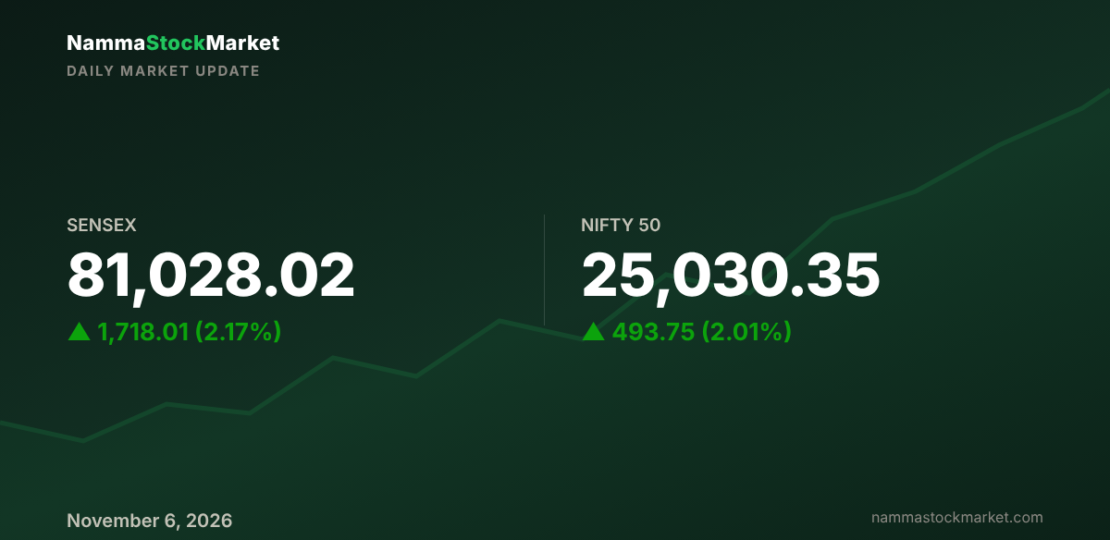
If you were watching your portfolio today, you probably ended Dhanteras in a very good mood. The Indian stock market just had one of its best days in years, and it came on a day when, by every normal rule, it should have fallen hard instead. The BSE Sensex (the 30-stock index of the Bombay Stock Exchange) jumped 1,718.01 points, or 2.17%, to close at 81,028.02. The NSE Nifty 50 (the 50-stock benchmark of the National Stock Exchange) rose 493.75 points, or 2.01%, to settle at 25,030.35, finally back above the psychologically important 25,000 mark. This was the seventh straight session of gains for both indices, and this week turned out to be the best week for the Indian stock market in roughly six years, with the Sensex up about 8.8% and the Nifty up about 8.6% over the last five trading days.
Here’s what makes today’s rally stand out. Overnight, Wall Street had a genuinely scary session: the Nasdaq Composite fell 5.5%, the S&P 500 dropped 4.4%, and the Dow Jones lost around 1,833 points, or 3.4%, wiping out roughly $2.5 trillion in value in a single day. The selling spread into Asia on Friday morning, with South Korea’s Kospi crashing more than 8% (triggering a circuit breaker, which is an automatic trading halt used to calm panic selling) and Japan’s Nikkei falling around 5-6%. Given that kind of global cues, you’d expect Dalal Street to fall too. Instead, Indian stocks opened flat, dipped briefly, and then powered higher through the day, which tells you something important: foreign money is choosing India right now, even as it runs away from US technology stocks.
Market At A Glance
| Index | Close | Points Change | % Change |
|---|---|---|---|
| BSE Sensex | 81,028.02 | ▲ 1,718.01 | ▲ 2.17% |
| NSE Nifty 50 | 25,030.35 | ▲ 493.75 | ▲ 2.01% |
| Bank Nifty | NA* | NA* | ▲ 2.27% |
| Nifty Midcap 100 | 60,606.65 | ▼ 14.25 | ▼ 0.02% |
| Nifty Smallcap 100 | 18,975.05 | ▼ 157.40 | ▼ 0.82% |
| India VIX | 17.46 | ▲ 1.88 | ▲ 12.07% |
*Bank Nifty’s exact closing level wasn’t available from public sources at the time of publishing this article, though the index was clearly up 2.27% on the day, led by private banks.
Why The Market Moved
The simple story is this: global investors who have been pouring money into AI-related stocks in the US got spooked overnight. Weak results from chipmaker Qualcomm, worries about whether all the money being spent on AI data centres will actually pay off, and talk of possible stricter US regulation on AI companies after the midterm elections all combined to trigger a sharp sell-off in US tech stocks. That kind of shock usually spreads everywhere, because big global funds often sell everything when they’re nervous, including stocks in India.
But this time, something different happened. Because Indian IT and tech stocks have much less direct exposure to the AI infrastructure story compared to US tech giants, foreign institutional investors, or FIIs (big overseas funds that invest in Indian shares, also sometimes called FPIs, or foreign portfolio investors) saw India as a safer place to park money while the AI trade cooled off elsewhere. On Thursday alone, FIIs net bought ₹14,974.68 crore worth of Indian shares in the cash segment, their biggest single-day net purchase in almost six years. That kind of buying doesn’t just lift a few stocks, it lifts the whole market.
There were also a couple of helpful local factors. Mahindra & Mahindra posted strong July-September quarter (Q2 FY27) results, with consolidated net profit jumping around 25% year-on-year, and that gave the auto and banking-heavy index extra fuel. And crude oil, after dropping below $100 a barrel earlier in the week, only recovered modestly, which kept a lid on worries about India’s oil import bill. Since India imports most of its crude, cheaper oil is normally good news for the rupee and for inflation, and that combination of easing oil fears plus strong FII buying is really what powered today’s rally despite the ugly global cues.
Which Sectors Held Up, And Which Didn’t
| Sector Index | % Change |
|---|---|
| Nifty Financial Services | ▲ 2.57% |
| Nifty Bank | ▲ 2.27% |
| Nifty Pharma | ▲ 1.21% |
| Nifty Auto | ▲ 0.76% |
| Nifty FMCG | ▲ 0.67% |
| Nifty Metal | ▲ 0.66% |
| Nifty PSU Bank | ▲ 0.60% |
| Nifty IT | ▲ 0.43% |
| Nifty Realty | ▲ 0.09% |
| Nifty Energy | ▼ 0.05% |
| Nifty Media | ▼ 1.52% |
Ten of the twelve major Nifty sectoral indices closed in the green today, which shows just how broad-based this rally was. Financial Services and Bank Nifty led the charge, both up more than 2%, as heavyweight private lenders like ICICI Bank and HDFC Bank rallied hard. If you’re holding banking or NBFC (non-banking financial company) stocks, today was a great day for you. Pharma and Auto also had a strong session, with M&M’s results giving the auto pack a lift. The one clear loser was Nifty Media, down 1.52%, and Nifty Energy slipped marginally too. IT managed to stay in the green, up 0.43%, even with the AI-linked gloom in the US, because Indian IT companies don’t carry the same AI infrastructure exposure that hurt their American peers.
Today’s Top Movers
| Top Gainers (Nifty 50) | % Change |
|---|---|
| Mahindra & Mahindra | ▲ 5.11% |
| ICICI Bank | ▲ 4.75% |
| HDFC Life Insurance | ▲ 3.95% |
| HDFC Bank | ▲ 3.72% |
| Titan Company | ▲ 3.42% |
| Top Losers (Nifty 50) | % Change |
|---|---|
| Tata Motors (PV) | ▼ 0.58% |
| Eicher Motors | ▼ 0.56% |
| Shriram Finance | ▼ 0.30% |
| Grasim Industries | ▼ 0.02% |
Mahindra & Mahindra topped the gainers’ list after its strong quarterly numbers, while ICICI Bank, HDFC Life Insurance, HDFC Bank and Titan Company all added more than 3% each. What really tells you how one-sided today’s rally was, though, is the losers’ side: only four stocks in the entire Nifty 50 basket ended the day in the red, and even the worst of them, Tata Motors’ passenger vehicle business, fell by less than 1%. That’s an unusually clean sweep for the bulls. Away from the Nifty 50, though, the picture wasn’t quite as rosy. Several midcap and smallcap names like Astral, Apar Industries, and TD Power Systems fell sharply, between 5% and 13%, even as their indices overall were only mildly lower. This is a good reminder that a strong headline number doesn’t mean every stock in your demat account (the electronic account that holds your shares, the same place your mutual fund SIP units often sit too) went up today.
What FIIs And DIIs Were Doing
You’ll often see us, and most financial news, talk about FIIs and DIIs, so here’s a quick refresher. FIIs are foreign institutional investors, big overseas funds and banks that buy and sell Indian shares. DIIs are domestic institutional investors, meaning Indian mutual funds, insurance companies like LIC, and pension funds that invest money collected largely through SIPs (systematic investment plans, the monthly instalment way most Indians invest in mutual funds) and insurance premiums. Watching what these two big groups of buyers and sellers are doing tells you a lot about where the real money is flowing.
| Date | FII Net (Cash) | DII Net (Cash) |
|---|---|---|
| 05-Nov-2026 | ▲ ₹14,974.70 cr | ▼ ₹10,444.50 cr |
| 04-Nov-2026 | ▲ ₹7,284.00 cr | ▼ ₹3,712.20 cr |
| 03-Nov-2026 | ▲ ₹6,836.80 cr | ▼ ₹3,678.80 cr |
| 02-Nov-2026 | ▲ ₹3,114.70 cr | ▼ ₹392.20 cr |
| 30-Oct-2026 | ▲ ₹3,599.00 cr | ▼ ₹818.00 cr |
Today’s (6 November) FII/DII cash-segment figures hadn’t been released by the exchanges at the time of publishing this article, since this data is usually compiled and put out after markets close for the day. The table above shows the five most recent confirmed sessions.
The pattern over the last week is clear: FIIs have been aggressive net buyers every single day, while DIIs have been net sellers, likely booking some profit after the market’s own sharp run-up and perhaps rebalancing portfolios ahead of Diwali. In simple terms, foreign money has been doing the heavy lifting on this rally, and domestic funds have been the ones quietly taking some chips off the table. That’s a bit of a role reversal from what we’ve seen for much of the last couple of years, when DIIs were usually the ones cushioning FII selling during global shocks.
Oil, The Rupee, And Global Cues
Brent crude, the global benchmark for oil prices that is always quoted in US dollars per barrel since it’s an internationally dollar-priced commodity, rose 1.73% to around $99.99 a barrel today, while US crude (WTI) rose 1.26% to close near $91.66. The reason oil is climbing isn’t demand, it’s fear: there have been fresh attacks on oil tankers in the Arabian Gulf, and shipping traffic through the Strait of Hormuz, one of the world’s most important oil routes, has reportedly dropped to under 60% of its usual levels because ships are avoiding the area. Even so, oil is still down roughly 12% for the week overall, after a sharp drop earlier following the US midterm elections, which had raised hopes that Middle East tensions might ease.
Why should you, as an Indian investor, care about a barrel of oil sitting in a ship near the Gulf? Because India imports close to 85% of the crude oil it uses. When oil prices rise, India’s oil import bill goes up, which widens the current account deficit, puts pressure on the rupee, and eventually can show up as higher fuel and transport costs at home, pushing up inflation. That’s why, even on a day when Sensex and Nifty are celebrating, a sustained jump in crude is something to watch closely.
Interestingly, the rupee still managed to strengthen today, gaining 52 paise against the US dollar to close at 93.89, compared to Thursday’s close of 94.41. A weaker US dollar overall, plus the strong FII inflows into Indian stocks, helped the rupee hold its ground even with oil ticking higher. Global cues, meanwhile, remain shaky: the brutal sell-off on Wall Street and the rout in AI-linked Nasdaq and Dow stocks, along with sharp falls across Asian markets like Korea’s Kospi and Japan’s Nikkei, show that the AI-stock story in the US is going through a genuine wobble. For now, Indian markets are reading this as an opportunity rather than a threat, since money leaving expensive US tech stocks has to go somewhere, and India looks like a reasonably attractive, reasonably priced destination.
What To Watch Tomorrow
Markets will be shut this Saturday as usual, but there’s a special one-hour Diwali Muhurat trading session lined up for Sunday, 8 November, a symbolic session that many traders use to place small, auspicious trades to mark the new financial year in the Hindu calendar, rather than a normal trading day. Beyond that, a few things are worth keeping an eye on. First, whether crude oil keeps climbing: if the attacks near the Strait of Hormuz continue or get worse, oil could push higher, which would start to worry currency and inflation watchers. Second, whether FIIs keep up this pace of buying, because a single very strong week doesn’t guarantee the trend continues, especially if US markets stabilise and some of that money decides to go back to buying the AI dip. Third, keep watching the broader market: today’s rally was led by large banks and financials, while midcap and smallcap stocks actually lagged and a chunk of individual names in those spaces fell quite sharply. If you hold more aggressive, smaller stocks, your portfolio’s day likely looked quite different from the headline numbers.
None of this is a buy or sell recommendation, just context for what’s driving the market right now and what might move it next. As always, keep an eye on your own goals and risk appetite rather than just chasing the day’s big green numbers, especially heading into a long festive weekend when volumes and conviction can both thin out.
RELATED POSTS
View all

Sensex Sheds 548 Points, Nifty Below 22,400 As Banking, FMCG Stocks Drag; Rupee Posts Best Day In 6 Months On RBI Measures
October 12, 2026 | by NammaStockMarket
Sensex Slips 330 Points, Nifty Snaps 4-Day Winning Streak To End At 23,329 As IT Stocks Drag
September 22, 2026 | by NammaStockMarket
Sensex Crashes 876 Points, Nifty Below 22,900 As Bank Earnings Disappoint And Crude Stays Hot
October 19, 2026 | by NammaStockMarket