

Sensex Crashes 876 Points, Nifty Below 22,900 As Bank Earnings Disappoint And Crude Stays Hot
October 19, 2026 | by NammaStockMarket
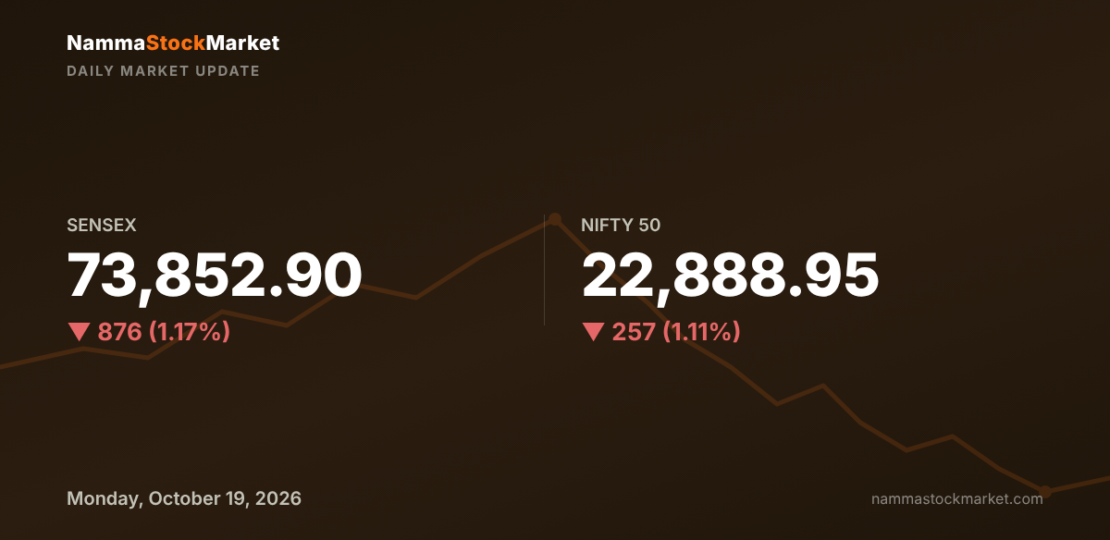
The Indian stock market had a rough Monday. The BSE Sensex closed at 73,852.90, down 876.37 points or 1.17%, and the NSE Nifty 50 ended at 22,888.95, down 257.20 points or 1.11%. If you were watching your portfolio today, you probably saw a sea of red, with only one pocket of green holding up the show. The index had actually opened higher, in continuation of last week’s strength, but selling in private banks and IT stocks pulled it down through the day and it closed near the lows. Two things did most of the damage: disappointing September-quarter results from private sector banks, and crude oil staying stubbornly high because of tension near the Strait of Hormuz, which always makes Indian investors nervous because of what it means for our oil import bill and the rupee.
Market At A Glance
Here’s how the main indices closed today. The NSE (National Stock Exchange) runs the Nifty 50, and the BSE (Bombay Stock Exchange) runs the Sensex — these are the two benchmark indices that everyone tracks to know how the Indian stock market, or Indian share market, did on any given day.
| Index | Close | Points Chg | % Chg |
|---|---|---|---|
| BSE Sensex | 73,852.90 | ▼ 876.37 | ▼ 1.17% |
| NSE Nifty 50 | 22,888.95 | ▼ 257.20 | ▼ 1.11% |
| Bank Nifty | 55,488.10 | ▼ 355.90 | ▼ 0.64% |
| Nifty Midcap 100 | — | — | ▼ 1.09% |
| Nifty Smallcap 100 | — | — | ▼ 1.01% |
| India VIX | 14.77 | ▲ 0.71 | ▲ 5.05% |
Note: exact closing levels for Nifty Midcap 100 and Nifty Smallcap 100 weren’t available at the time of writing, so only the percentage moves are shown above.
Why The Market Moved
If you’re new to the market, you might wonder why a bank’s quarterly results from thousands of kilometres away or an oil tanker incident in the Middle East should move your mutual fund SIP’s value. Here’s the simple version.
Private banks make up a huge chunk of the Nifty and Sensex, so when their numbers disappoint, the whole index feels it. Axis Bank’s results came in below what analysts expected, even though profit did grow, and the stock fell more than 4% — the single biggest drag on the Nifty today. HDFC Bank’s profit was up 4.7% year-on-year to ₹19,510 crore, which sounds healthy, but it was still a touch below what the market was hoping for, and that was enough to spook investors into selling.
Then there’s crude oil. Brent crude (the global benchmark, priced in US dollars per barrel) slipped today after the US waived some sanctions on Russian oil, which raised hopes of more supply reaching the market. But it’s still trading close to $110 a barrel, which is elevated, mainly because of continuing tension in the Strait of Hormuz — a narrow sea passage that a huge share of the world’s oil physically passes through. When oil stays this expensive, India feels it directly: we import most of our crude, so a higher oil price means a bigger import bill, more pressure on the rupee, and eventually it can feed into inflation at home. That’s why Indian markets react to an oil story the way they do, even when the news itself is thousands of miles away.
On top of that, foreign investors (FIIs) have been net sellers of Indian equities through most of October, which keeps pulling money out of the market, and today was also a weekly options expiry day in the derivatives (F&O) segment, which tends to add extra volatility in the final hour of trade as traders square off their positions. Put all of it together and you get a session that opened in the green and still ended down more than 1%.
The weakness wasn’t limited to blue chips either. On the NSE, only 846 stocks advanced against 2,717 that declined, which tells you this was a genuinely broad-based fall and not just a handful of large stocks dragging the index down. As many as 169 stocks hit fresh 52-week lows today, against just 70 that hit 52-week highs, and the overall market value of all BSE-listed companies fell by about ₹5.54 lakh crore in a single session, from ₹473.47 lakh crore to ₹467.93 lakh crore.
Which Sectors Held Up, And Which Didn’t
| Sector | % Change |
|---|---|
| Nifty PSU Bank | ▲ 2.46% |
| Nifty Metal | ▼ 0.55% |
| Nifty Energy | ▼ 0.60% |
| Nifty Pharma | ▼ 0.65% |
| Nifty Auto | ▼ 0.69% |
| Nifty Consumer Durables | ▼ 1.12% |
| Nifty Realty | ▼ 1.20% |
| Nifty IT | ▼ 1.28% |
| Nifty FMCG | ▼ 1.44% |
| Nifty Financial Services | ▼ 1.58% |
| Nifty Private Bank | ▼ 1.85% |
Public sector bank stocks were the one bright spot today, with the Nifty PSU Bank index bucking the trend completely to close up 2.46% while almost everything else was in the red — State Bank of India was among the day’s gainers even as its private-sector peers struggled. On the other end, it was private banks and financial services stocks that took the hardest hit, down close to 1.6-1.9%, directly because of the muted earnings reaction we talked about above. IT stocks also gave up ground, down 1.28%, mostly on profit-booking after the sector had a strong run last week — if you’ve been riding the IT rally, today was a day to just sit tight rather than panic. Defensive sectors like metal, energy, pharma and auto held up comparatively better, each down less than 1%, which is often how it goes on a broad sell-off day: money doesn’t leave the market entirely, it just rotates into relatively safer pockets.
Today’s Top Movers
Among individual stocks, JSW Steel led the gainers, helped along by the relatively resilient metals pack, while ONGC and State Bank of India also closed well in the green. Adani Ports & SEZ also ended the day higher, up more than 1%, bucking the broader trend.
| Stock | % Change |
|---|---|
| JSW Steel | ▲ 2.06% |
| ONGC | ▲ 1.35% |
| State Bank of India | ▲ 1.15% |
| Adani Ports & SEZ | ▲ >1.0% |
On the losing side, Axis Bank was easily the worst-hit Nifty stock today after its results missed expectations, down over 4%. Tata Motors’ passenger vehicle business, UltraTech Cement (which also reported its September-quarter numbers today), Infosys and Bajaj Finance rounded out the list of the day’s biggest laggards.
| Stock | % Change |
|---|---|
| Axis Bank | ▼ 4.19% |
| Tata Motors (PV) | ▼ 3.09% |
| UltraTech Cement | ▼ 2.90% |
| Infosys | ▼ 2.63% |
| Bajaj Finance | ▼ 2.63% |
What FIIs and DIIs Were Doing
You’ll often see the terms FII and DII in market reports, so here’s a quick explainer. FIIs are Foreign Institutional Investors — big foreign funds and institutions that invest in Indian stocks from outside the country. DIIs are Domestic Institutional Investors — Indian mutual funds, insurance companies like LIC, and other local institutions that invest money collected from retail investors, including the SIPs (systematic investment plans) that lakhs of Indians run every month. Watching the push and pull between these two groups tells you a lot about who’s supporting the market and who’s pulling money out.
Today’s official FII/DII cash-segment figures for October 19 weren’t out at the time of writing — this data is usually released after market hours, so it’ll be available only after the trading day closes. Here’s what we do have, the last five sessions with dates clearly marked:
| Date | FII Net (₹ Crore) | DII Net (₹ Crore) |
|---|---|---|
| 16 Oct 2026 | ▲ ₹1,165.92 cr (bought) | ▼ ₹3,661.28 cr (sold) |
| 15 Oct 2026 | ▼ ₹5,285.37 cr (sold) | ▲ ₹3,319.39 cr (bought) |
| 14 Oct 2026 | ▼ ₹1,857.44 cr (sold) | ▲ ₹2,670.44 cr (bought) |
| 13 Oct 2026 | ▼ ₹1,305.13 cr (sold) | ▲ ₹2,439.24 cr (bought) |
| 12 Oct 2026 | ▼ ₹1,708.48 cr (sold) | ▲ ₹3,045.02 cr (bought) |
The pattern over the last week has been fairly clear: FIIs have been net sellers on most days, while DIIs have mostly been stepping in to buy, cushioning the market from a sharper fall. In fact, FII selling for the month of October so far adds up to roughly ₹52,100 crore — a sizeable number — and it’s one of the quieter reasons behind the market’s recent weakness. If you hold mutual funds through an SIP, this DII buying is partly your own money and other retail investors’ money working to support the market during bouts of foreign selling, which is one of the reasons advisors keep telling people not to stop their SIPs when the market falls.
Oil, The Rupee, And Global Cues
Brent crude eased a little today to trade around $110 a barrel, down about 1.2% on the day, after the US waived some Russia-related sanctions, which raised hopes that more Russian oil could reach the global market and ease supply worries. But crude is still elevated compared to where it was a few weeks ago, largely because of an escalation near the Strait of Hormuz, including a reported tanker incident involving a naval mine. For India, which imports roughly 85% of its crude oil needs, every dollar on the oil price matters — it widens our import bill, puts pressure on the rupee since we have to pay for that oil in dollars, and can eventually show up as higher fuel and transport costs at home.
The rupee itself was little changed against the US dollar today, trading close to the ₹94.95-95 mark, having recovered a bit over the past week on the back of strong RBI-related inflows. A stable rupee is a small silver lining in an otherwise weak session — it means at least one source of imported inflation pressure isn’t getting worse for now.
Global cues were mixed-to-weak heading into today’s session and that didn’t help sentiment either. The Nasdaq had fallen over 2% in the US on Friday, and in Asia, Japan’s Nikkei dropped around 1.6-0.7% and South Korea’s Kospi was down too, though Hong Kong’s Hang Seng and China’s Shanghai Composite managed small gains. European markets fell further during the day, with Germany’s DAX and France’s CAC 40 both down more than 1%. When global markets are this jittery all at once, it usually shows up in India too, since a chunk of the money in our market comes from the same global funds that are reacting to the same news everywhere.
What To Watch Tomorrow
The September-quarter earnings season is in full swing, and that’s going to keep driving stock-specific and sector moves for the next couple of weeks — keep an eye on results from the companies in your own portfolio rather than just the headline index. On the technical side, Nifty has immediate support around the 22,800 level and resistance near 23,000; a break below support could invite more selling, while a bounce back above 23,000 would be the first sign that today’s fall was just a one-day blip. Bank Nifty has support at 55,200 and resistance at 55,700. Crude oil and the Strait of Hormuz situation remain the big wildcard to track — any further escalation there could keep oil prices high and add more pressure on the rupee and on import-heavy sectors. On the global side, markets will be watching US inflation data, bond yields, and what the US Fed signals about interest rates at its next meeting, since that shapes how much money flows into emerging markets like India. None of this is a buy or sell call — just the things worth keeping half an eye on if you’re tracking your portfolio this week.
RELATED POSTS
View all

Sensex Jumps 472 Points To 72,382, Nifty Ends At 22,556 As ITC Rallies 5% And Crude Oil Eases
October 5, 2026 | by NammaStockMarket
Sensex Sinks 571 Points, Nifty Slips Below 22,450 As Crude Oil Tops $100 And US Bond Yields Spook D-Street
October 1, 2026 | by NammaStockMarket
Sensex Jumps 685 Points, Nifty Closes Above 22,750 As Markets Rally Ahead Of RBI Rate Decision
October 6, 2026 | by NammaStockMarket