

Sensex Soars 1,502 Points, Nifty Hits Record Closing High Of 25,819 As FIIs Go On Buying Spree And Oil Prices Cool Off
November 25, 2026 | by NammaStockMarket
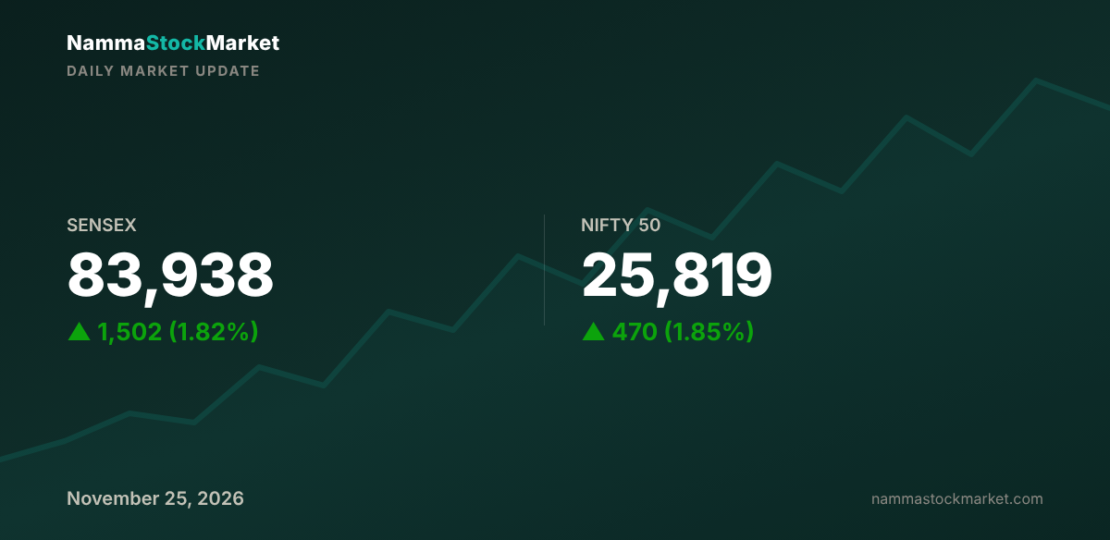
The Indian stock market had its best day in weeks today. The BSE Sensex rocketed 1,502.29 points, or 1.82%, to close at 83,938.28, while the NSE Nifty 50 jumped 469.60 points, or 1.85%, to settle at 25,819.25 — a fresh record closing high for the Nifty. If you logged into your demat account this evening, chances are almost everything in your portfolio was sitting in green, with banks and FMCG (fast-moving consumer goods, basically the everyday products companies like Hindustan Unilever and Nestle make) doing the heavy lifting. Two big things drove the rally: foreign investors kept pouring money into Indian stocks for yet another session, and crude oil prices stayed soft, which is always good news for a country like India that imports most of its oil.
This was also the first full trading day after Tuesday’s market holiday for Guru Nanak Jayanti (also called Guruparb), and the bounce more than made up for Monday’s weak session, when global worries around AI stocks and a stronger US dollar had knocked Dalal Street around. Today, the mood flipped completely. The Sensex opened at 83,436.89 and at one point touched an intraday high of 84,498.21, while the Nifty opened at 25,658.35 and touched a high of 25,951.65 — just shy of the psychologically important 26,000 mark. Both indices gave up some of those gains in the afternoon as traders booked profits, but still closed well above where they started.
Market At A Glance
| Index | Close | Points Change | % Change |
|---|---|---|---|
| BSE Sensex | 83,938.28 | ▲ 1,502.29 | ▲ 1.82% |
| NSE Nifty 50 | 25,819.25 | ▲ 469.60 | ▲ 1.85% |
| Nifty Bank | 63,703.25 | ▲ ~1,122 | ▲ 1.79% |
| Nifty Midcap 100 | 61,584.75 | ▲ 181.55 | ▲ 0.30% |
| Nifty Smallcap 100 | 19,229.35 | ▼ 85.05 | ▼ 0.44% |
| India VIX | 17.69 | ▼ 0.01 | ▼ 0.06% |
Note: Bank Nifty’s points change above is an approximate figure worked out from the reported 1.79% move, since an exact point figure was not published alongside the percentage change. Nifty Midcap 100 and Nifty Smallcap 100 figures are from NSE’s broader market indices.
Why The Market Moved
If you’re newer to investing, here’s the simple version of what happened today, and why two things that sound totally unrelated to the Indian stock market — oil prices in the Middle East and US inflation data — actually move your portfolio.
Start with oil. India buys most of its crude oil from other countries, so when oil becomes cheaper, India’s total import bill shrinks. That’s good for the rupee (because we need fewer dollars to pay for the same oil) and it’s good for inflation (because transport and fuel costs feed into the price of almost everything). Brent crude, the global oil benchmark priced in US dollars, has fallen roughly 22% from its late-October peak of more than $117 a barrel, and was trading around $91 a barrel today, broadly flat on the day but still way below where it was a month ago. Analysts pointed to an emerging global oversupply of crude and some cooling in the geopolitical risk premium around the Strait of Hormuz, the narrow waterway through which a big chunk of the world’s oil passes, as tensions between the US and Iran show some signs of easing. Lower oil also eases pressure on the Reserve Bank of India (RBI), which has been watching inflation closely — October’s retail inflation print came in at 6.09%, and cheaper crude reduces the odds of the RBI’s Monetary Policy Committee (MPC) needing to hike the repo rate (the rate at which RBI lends to banks, which eventually decides your home loan and FD rates) in its December meeting.
Then there’s the foreign money angle. FIIs (foreign institutional investors, basically big overseas funds) have been net buyers of Indian stocks on every single full trading day this November, taking the month’s total inflow past the ₹1 lakh crore mark (1 lakh crore = ₹1,00,00,00,00,000, or roughly $13-14 billion). That kind of sustained foreign buying pushes up demand for the rupee as these funds convert dollars into rupees to buy Indian shares, which is a big reason the rupee touched a fresh seven-month high today, trading around ₹92.40-92.50 to the US dollar and gaining nearly 50-70 paise on the day. A stronger rupee is a quiet tailwind for the whole market because it makes imports cheaper and tends to calm inflation worries further.
Globally, there was a bit of a tug of war too. Wall Street’s Nasdaq has been on a tear thanks to a big Nvidia-led rally in AI stocks, and some of that “risk-on” money seems to be rotating into other markets, including India, as investors look past the pricey AI trade. At the same time, everyone is a little cautious ahead of the US Fed’s favourite inflation gauge, the PCE (Personal Consumption Expenditure) data, due out in the US on Wednesday. A hot PCE print could revive expectations of the US Fed staying hawkish on rates, which usually makes the dollar stronger and foreign money a bit more cautious on emerging markets like India — so don’t be surprised if that headline moves our market again tomorrow.
Which Sectors Held Up, And Which Didn’t
It was a broad rally, but a few pockets did noticeably better than the rest. FMCG stocks were the standout, up nearly 3.8%, as cooling palm oil and crude prices improved the profit margin outlook for companies that make everyday products like soaps, shampoos, and packaged food. Pharma and healthcare names also had a strong day, and private banks and the broader financial services space rallied hard too — HDFC Bank alone was the most heavily traded stock on the exchange today. If you’re holding banking or FMCG stocks, today was a very good day for you.
On the other side, media stocks had a rough session, and metals fell as the AI-linked copper trade unwound and worries about weak demand from China weighed on the group. If you’re invested in metal or media stocks, you’ll have seen red today even as the rest of the market partied. Smallcap stocks, interestingly, barely budged and actually closed slightly lower even as the big blue-chip names surged — a sign that today’s rally was concentrated mostly in large caps rather than being a market-wide move.
| Sector | % Change |
|---|---|
| Nifty FMCG | ▲ 3.79% |
| Nifty Pharma | ▲ 2.38% |
| Nifty Private Bank | ▲ 2.21% |
| Nifty Financial Services | ▲ 2.17% |
| Nifty Healthcare | ▲ 2.13% |
| Nifty Bank | ▲ 1.79% |
| Nifty Auto | ▲ 1.16% |
| Nifty IT | ▲ 1.12% |
| Nifty Oil & Gas | ▲ 0.99% |
| Nifty PSU Bank | ▲ 0.37% |
| Nifty Consumer Durables | ▼ 0.13% |
| Nifty Chemicals | ▼ 0.66% |
| Nifty Metal | ▼ 2.04% |
| Nifty Media | ▼ 4.44% |
Sector data wasn’t available for realty, defence, and manufacturing indices at the time of writing, so those have been left out of the table above.
Today’s Top Movers
Hindustan Unilever (HUL) was the star of the Nifty 50 today, soaring over 6% on strong demand for FMCG names. Tata Consumer Products and HDFC Life Insurance weren’t far behind, both surging more than 4.5%, while Nestle India and InterGlobe Aviation (the company that runs IndiGo) also had a strong session.
| Stock | % Change |
|---|---|
| Hindustan Unilever | ▲ 6.08% |
| Tata Consumer Products | ▲ 4.66% |
| HDFC Life Insurance | ▲ 4.58% |
| Nestle India | ▲ 4.03% |
| InterGlobe Aviation (IndiGo) | ▲ 3.57% |
On the losing side, metal stocks dominated the list of laggards. Tata Steel led the fall, down over 2%, while Hindalco Industries and JSW Steel also slipped as global metal prices stayed weak. Max Healthcare Institute and Shriram Finance rounded out today’s top losers, even though their respective sectors (healthcare and financial services) were broadly positive — a reminder that individual stocks don’t always move with their sector.
| Stock | % Change |
|---|---|
| Tata Steel | ▼ 2.27% |
| Max Healthcare Institute | ▼ 1.22% |
| Hindalco Industries | ▼ 1.17% |
| JSW Steel | ▼ 0.72% |
| Shriram Finance | ▼ 0.60% |
What FIIs and DIIs Were Doing
You’ll hear the terms FII and DII thrown around a lot in Indian market news, so here’s a quick explainer if you’re new to this: FIIs (foreign institutional investors, sometimes also called FPIs or foreign portfolio investors) are big funds based outside India that buy and sell Indian stocks, while DIIs (domestic institutional investors) are Indian entities like mutual funds, insurance companies (think LIC) and pension funds doing the same thing with money raised largely through your SIPs (systematic investment plans, the monthly mutual fund contributions many retail investors make) and insurance premiums. Tracking who’s buying and who’s selling each day gives you a sense of where the big money is flowing.
Today’s official FII/DII cash-market numbers for November 25 were not out at the time of writing — NSE and depositories typically release the final figures only after market hours, usually by late evening. So here are the last five trading sessions for which confirmed numbers are available (cash segment, net figures):
| Date | FII Net (Cash, Rs crore) | DII Net (Cash, Rs crore) |
|---|---|---|
| Tue, 17 Nov 2026 | ▲ Rs 4,195 crore | ▲ Rs 197 crore |
| Wed, 18 Nov 2026 | ▲ Rs 5,867 crore | ▼ Rs 3,160 crore |
| Thu, 19 Nov 2026 | ▲ Rs 7,411 crore | ▼ Rs 1,357 crore |
| Fri, 20 Nov 2026 | ▲ Rs 10,308 crore | ▼ Rs 4,860 crore |
| Mon, 23 Nov 2026 | ▲ Rs 5,673 crore | ▼ Rs 2,760 crore |
The pattern over the past couple of weeks has been pretty consistent: FIIs have been big, steady net buyers, while DIIs have mostly been net sellers, likely booking some profits and rebalancing after the market’s strong run through November. That’s actually a healthy sign — DII selling into FII buying usually means domestic funds are taking some money off the table rather than chasing the rally, which can cushion the market if foreign flows ever reverse suddenly. Markets have gained close to 10% in November before this week’s pullback, so some give-and-take between these two big pools of money is normal.
Oil, The Rupee, And Global Cues
Brent crude (the international oil benchmark, always quoted in US dollars per barrel since oil is a globally dollar-priced commodity) was hovering around $91.38-91.46 a barrel today, roughly flat on the day but still about 22% below its late-October peak of over $117 a barrel. The drop over the past month has been driven by worries about a global supply surplus (producers pumping out more oil than the world currently needs) and easing geopolitical risk around the Strait of Hormuz as US-Iran tensions show tentative signs of cooling, even though the situation remains unresolved and analysts caution a fall below $80 isn’t their base case yet.
For India, cheaper oil isn’t just a number on a chart — it directly affects your life. India imports the vast majority of its crude oil needs, so every dollar drop in Brent reduces the country’s oil import bill, which in turn eases pressure on the rupee and gives the RBI more breathing room on inflation and interest rates. That’s exactly what played out today: the rupee touched a fresh seven-month high against the US dollar, trading in the 92.40-92.50 zone and gaining roughly 50-70 paise, helped along by the steady FII inflows mentioned earlier, the softer oil bill, and some short-covering by traders who had bet on rupee weakness and were forced to buy back rupees as the currency rallied. The RBI has also reportedly been running a special dollar-selling window for public sector oil marketing companies (Indian Oil, BPCL and HPCL) since October, which has helped smooth out some of the immediate dollar demand from those importers.
What To Watch Tomorrow
The big global trigger to watch is the US PCE inflation data, due out on Wednesday US time (which lands early Thursday morning in India). A hotter-than-expected number could revive worries about the US Federal Reserve staying hawkish on interest rates, which tends to strengthen the dollar and cool off the kind of foreign buying that powered today’s rally. On the domestic front, keep an eye on whether FIIs keep up their buying streak, and whether banks and FMCG can hold on to today’s gains or see some profit booking, especially with the November derivatives (F&O, or futures and options) expiry roughly a week away — open interest (OI, the total number of outstanding derivative contracts) and the put-call ratio (PCR, a popular gauge of whether traders are leaning bullish or bearish) are both worth tracking as expiry approaches if you trade F&O. Metal and media stocks look like the more exposed pockets of the market after today’s fall, while banking and FMCG look relatively more resilient for now, though as always, this is general market information and not a buy or sell recommendation — please do your own research or speak to a financial advisor before making any investment decisions.
RELATED POSTS
View all

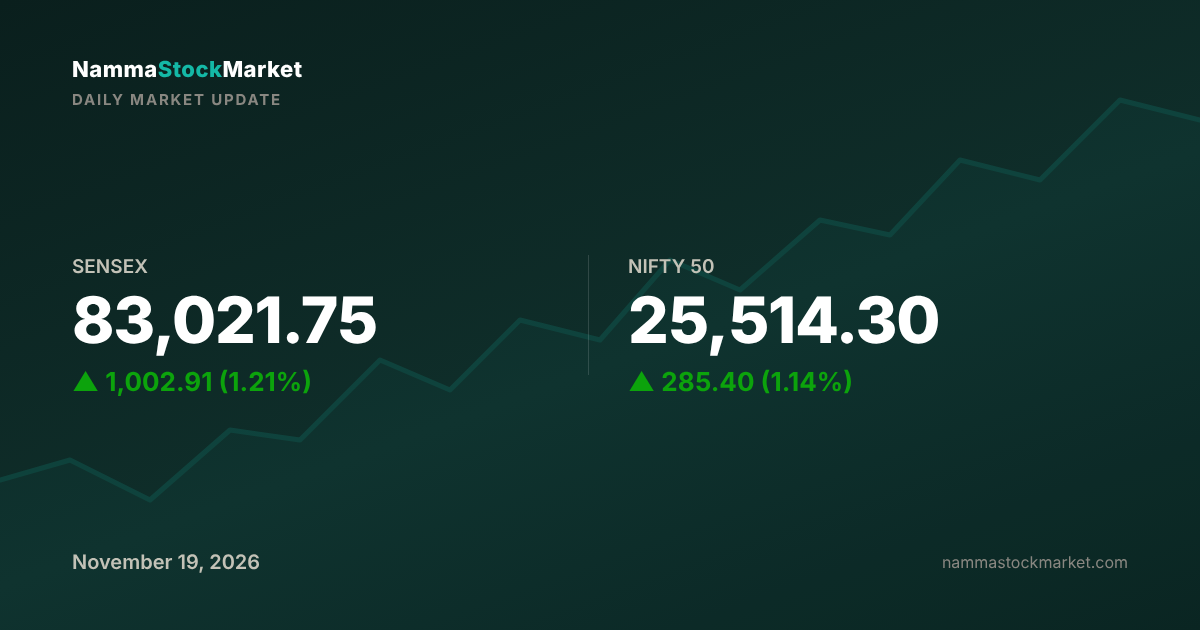
Sensex Jumps Over 1,000 Points, Nifty Back Above 25,500 As Auto Stocks Roar — Maruti Surges 7%
November 19, 2026 | by NammaStockMarket
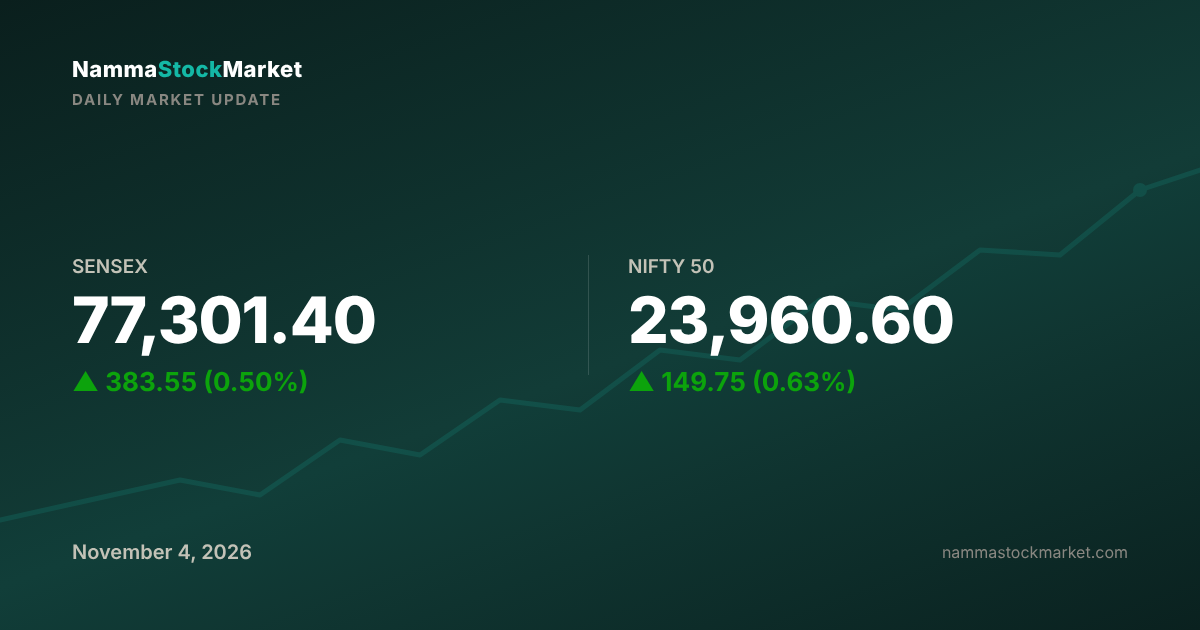
Sensex Jumps 384 Points, Nifty Nears 24,000 For 5th Day As Media, Metal Stocks Rally; IT Stocks Alone Drag
November 4, 2026 | by NammaStockMarket
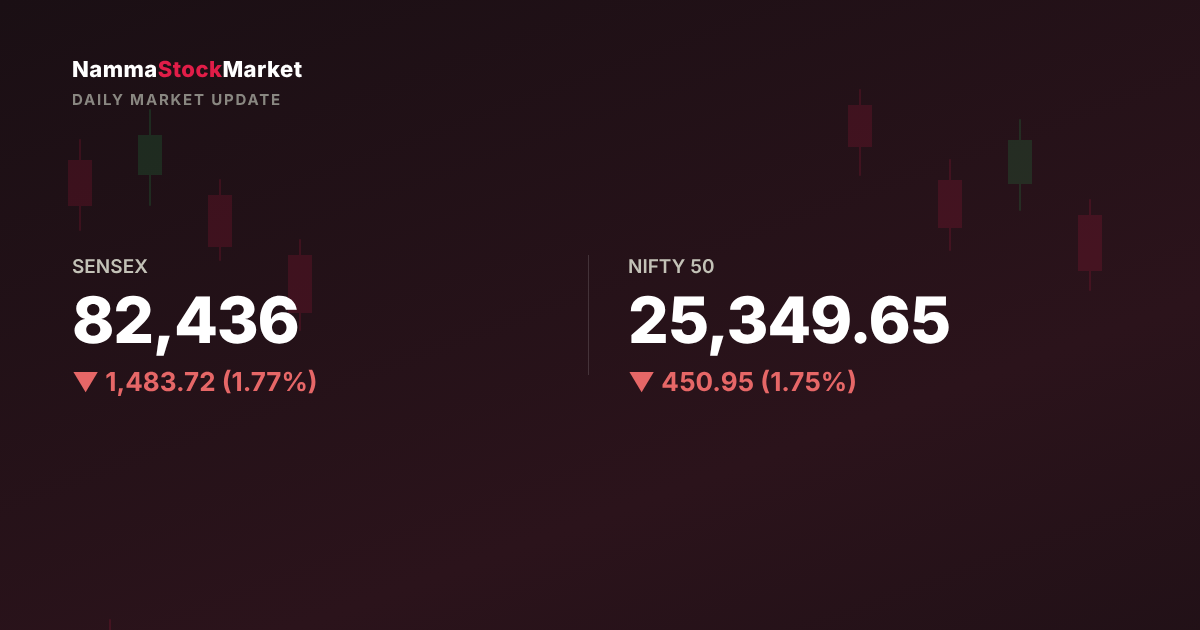
Sensex Crashes 1,484 Points, Nifty Falls Below 25,350 As Bank, Metal Stocks Lead Sell-Off
November 23, 2026 | by NammaStockMarket