

Sensex Crashes 1,484 Points, Nifty Falls Below 25,350 As Bank, Metal Stocks Lead Sell-Off
November 23, 2026 | by NammaStockMarket
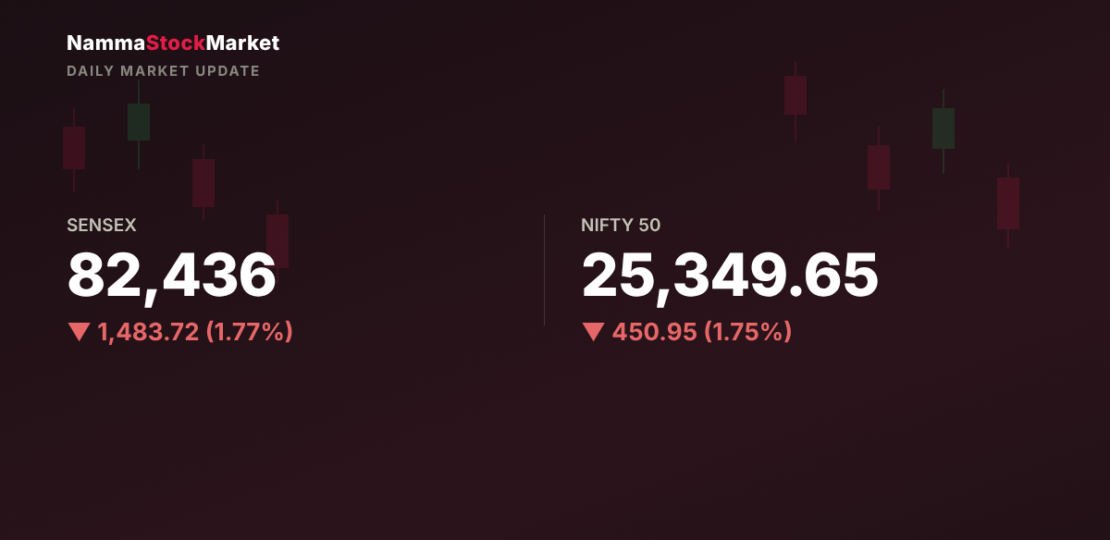
It was a rough Monday for the Indian stock market. The BSE Sensex crashed 1,483.72 points, or 1.77%, to close at 82,435.99, and the NSE Nifty 50 fell 450.95 points, or 1.75%, to end at 25,349.65. If you were watching your portfolio today, you probably felt it — this was the sharpest one-day fall in weeks, and it wiped out almost all of the gains the market had made since last Wednesday. The big reason: a heavy sell-off in bank and metal stocks, with Bank Nifty alone crashing 3.17%. There was also some stock-specific drama — Tata Steel tumbled 8.48% after announcing a large, complicated deal to buy a stake in APL Apollo Tubes — and a wobble in global markets after US tech stocks had a terrible Friday.
Here’s the twist, though: the day didn’t start out bad at all. Nifty actually opened near 25,929, not far from its highest level since February, with GIFT Nifty (the index that tracks how Nifty is likely to open, based on overnight trade in Singapore) pointing to a strong start. But that early optimism faded fast as the session went on, and by the time the closing bell rang, banks and metals had dragged the whole market down. The only real bright spot was IT, which bucked the trend and closed higher.
Market At A Glance
| Index | Close | Points Change | % Change |
|---|---|---|---|
| Sensex (BSE) | 82,435.99 | ▼ 1,483.72 | ▼ 1.77% |
| Nifty 50 (NSE) | 25,349.65 | ▼ 450.95 | ▼ 1.75% |
| Bank Nifty | 62,585.35 | ▼ 2,049.85 | ▼ 3.17% |
| Nifty Midcap 100 | 61,401.75 | ▼ ~627 | ▼ 1.01% |
| Nifty Smallcap 100 | 19,307.35 | ▼ ~139 | ▼ 0.70% |
| India VIX | 18.02 | ▲ 0.70 | ▲ 4.04% |
Points-change figures for Nifty Midcap 100 and Nifty Smallcap 100 are approximate, worked out from the day’s percentage move, as exact point figures weren’t published by our sources. All other figures are as reported at market close.
Why The Market Moved
So why did a day that opened on a high note end up this red? A few things came together at once.
First, there was straightforward profit booking. The Sensex and Nifty have rallied hard through November — more than 11% in just about four weeks — and after a run like that, a lot of big investors simply decide to lock in gains rather than chase the rally further. That kind of selling tends to hit hardest in the stocks and sectors that ran up the most, and banks had been one of the biggest drivers of the recent rally. When the profit booking started, it hit them hardest too.
Second, banks had their own specific problem. Private banks like Axis Bank, HDFC Bank and ICICI Bank all fell more than 3%, and PSU (public sector undertaking, meaning government-owned) banks fell even harder, with the Nifty PSU Bank index down 3.25%. Part of this was just the broader profit-booking mood, but there’s also a sense among traders that after such a strong run, bank valuations (how expensive a stock is compared to its earnings) had become a bit stretched, leaving less room for further gains in the near term.
Third, and this is a big one if you hold any metal stocks, Tata Steel announced it will take an initial 26.38% stake in APL Apollo Tubes for close to ₹15,511 crore — a deal large enough that it also triggers a mandatory open offer (where the acquirer has to offer to buy more shares from public shareholders) for another 26%. As part of the same arrangement, APL Apollo will buy some of Tata Steel’s tubes and colour-coated steel businesses for up to ₹28,000 crore. Big, complicated corporate deals like this often spook the market in the short term because investors worry about funding, valuations and whether the companies involved are taking on too much at once. Tata Steel stock fell 8.48% on the news, and it dragged the whole metals pack down with it — Nifty Metal was the worst-performing sector today, down 3.68%.
Finally, there was a global angle too. US markets had a brutal Friday, with the Nasdaq down more than 5% and the S&P 500 down nearly 4%, as investors grew nervous about how expensive AI-related stocks have become. That kind of mood doesn’t stay contained to Wall Street — it spreads to Asian markets too, and India wasn’t spared, even though our IT stocks actually did well today (more on that below). South Korea’s Kospi fell more than 3%, adding to the gloomy mood across the region. On top of all this, today was also the monthly F&O (futures and options, the derivatives segment where traders bet on future price moves) expiry, which got pushed up to Monday because markets are shut tomorrow for Guru Nanak Jayanti. Expiry days are often more volatile than usual, as traders unwind or roll over their positions, and India VIX (a measure of how much volatility traders expect in the days ahead, often called the market’s “fear gauge”) jumped 4.04% to 18.02, confirming that nerves were a bit more frayed than usual.
Which Sectors Held Up, And Which Didn’t
If you’re the kind of investor who tracks sector-wise mutual funds or has picked individual stocks in specific themes, here’s how your corner of the market likely did today.
| Sector (Nifty Index) | Close | % Change |
|---|---|---|
| IT | 31,850.80 | ▲ 1.69% |
| Consumer Durables | — | ▲ 0.59% |
| Realty | — | ▲ 0.31% |
| Pharma | — | ▼ 0.35% |
| Media | — | ▼ 0.37% |
| FMCG | — | ▼ 0.46% |
| Auto | — | ▼ 1.03% |
| Energy | — | ▼ 1.78% |
| Financial Services | — | ▼ 2.49% |
| Bank (Bank Nifty) | 62,585.35 | ▼ 3.17% |
| Private Bank | 30,659.85 | ▼ 3.19% |
| PSU Bank | 9,559.65 | ▼ 3.25% |
| Metal | 11,819.25 | ▼ 3.68% |
IT was really the only sector that had a good day, up 1.69%, and it’s not hard to see why if you flip the Friday story around: the same AI-valuation worries that hurt Nasdaq tech stocks actually helped Indian IT, because traditional IT services firms like TCS, Tech Mahindra and HCL Technologies are seen as less exposed to that kind of AI-bubble risk, and some investors rotated money into them as a safer bet. Consumer durables and realty also managed small gains. On the other end, it was a bloodbath for anything connected to banking and metals — Bank Nifty, Private Bank, PSU Bank and Metal were all down more than 3%, and Financial Services as a whole fell 2.49%. If your SIP (systematic investment plan, where you invest a fixed amount regularly into a mutual fund) is in a banking or PSU-focused fund, today was not a fun day to check your portfolio — but one bad session after a strong month-long rally isn’t something to panic about on its own.
Today’s Top Movers
TCS led the gainers’ list today, rising 3.24% to end at ₹2,460, helped along by the broader rotation into IT stocks. Shriram Finance, Tech Mahindra, HCL Technologies and Titan Company rounded out the top five gainers.
| Stock | Price (₹) | % Change |
|---|---|---|
| Tata Consultancy Services (TCS) | 2,460.00 | ▲ 3.24% |
| Shriram Finance | 995.90 | ▲ 2.25% |
| Tech Mahindra | 1,777.50 | ▲ 2.10% |
| HCL Technologies | 1,364.30 | ▲ 1.64% |
| Titan Company | — | ▲ 1.36% |
On the losing side, Tata Steel was by far the worst hit, down 8.48% on the APL Apollo deal news — that’s a huge single-day move for a large, well-tracked stock like this, and it tells you how much the market disliked the uncertainty around the deal’s structure and funding. Axis Bank, HDFC Bank, Hindalco Industries and ICICI Bank made up the rest of the top five losers, all falling more than 3%.
| Stock | Price (₹) | % Change |
|---|---|---|
| Tata Steel | 163.00 | ▼ 8.48% |
| Axis Bank | 1,388.60 | ▼ 3.70% |
| HDFC Bank | 817.80 | ▼ 3.48% |
| Hindalco Industries | 900.45 | ▼ 3.14% |
| ICICI Bank | 1,585.50 | ▼ 3.14% |
What FIIs And DIIs Were Doing
If you’re newer to the market, you’ll often see the letters FII and DII thrown around in market reports, so here’s a quick explanation. FIIs (Foreign Institutional Investors, sometimes also called FPIs, or Foreign Portfolio Investors) are big funds and institutions based outside India that buy and sell Indian stocks. DIIs (Domestic Institutional Investors) are Indian institutions doing the same thing — mainly mutual funds, insurance companies like LIC, and pension funds, which is where a lot of your own SIP money actually ends up getting invested. Tracking what these two big groups are doing with their money, in the cash segment (meaning regular stock buying and selling, as opposed to F&O), is one of the best ways to understand who’s driving a rally or a sell-off.
Today’s official FII/DII cash-segment figures for the 23rd weren’t out at the time of writing — NSE usually publishes provisional numbers only after market hours, typically by late evening. But the pattern over the last several trading sessions tells its own story.
| Date | FII/FPI Net (₹ crore) | DII Net (₹ crore) |
|---|---|---|
| 20-Nov-2026 (Fri) | ▲ ₹10,308 crore bought | ▼ ₹4,860 crore sold |
| 19-Nov-2026 (Thu) | ▲ ₹7,411 crore bought | ▼ ₹1,357 crore sold |
| 18-Nov-2026 (Wed) | ▲ ₹5,867 crore bought | ▼ ₹3,160 crore sold |
| 17-Nov-2026 (Tue) | ▲ ₹4,195 crore bought | ▲ ₹197 crore bought |
| 16-Nov-2026 (Mon) | ▲ ₹4,865 crore bought | ▼ ₹3,519 crore sold |
FIIs have been net buyers for five straight sessions through Friday, pumping in more than ₹32,000 crore over that stretch alone, and November’s total FPI inflow has already crossed a record ₹1.3 lakh crore (one lakh crore equals ten thousand crore, or ₹1,000,000,000,000). DIIs, meanwhile, have mostly been net sellers over the same period, which is a pattern you’ll often see — domestic funds booking some profit and taking a bit of money off the table even as foreign money keeps flowing in, rather than both groups buying or selling in lockstep. It’s this strong FII buying that’s been driving a lot of the month’s rally, and it’s also a big reason the rupee has been relatively strong recently — which brings us to the currency and oil picture.
Oil, The Rupee, And Global Cues
The rupee (India’s currency, traded against the US dollar as USD/INR) closed at ₹92.91 to the dollar today, down 24 paise, or about 0.26%, from Friday’s close of ₹92.67. That snapped a five-session winning streak that had taken the rupee to its strongest level in more than seven months. Two things pulled it lower today: strong dollar demand from large Indian companies — including, traders said, two large conglomerates buying dollars for import payments or other needs — and the fact that a falling stock market gives the rupee less support, since a sell-off in Indian equities means less foreign money flowing in to buy rupees. Still, with FIIs having pumped in so much this month, analysts reckon the rupee has decent support not too far below current levels, and the RBI (Reserve Bank of India, India’s central bank) may use this period of relative strength to quietly rebuild its foreign exchange reserves.
Brent crude (the international benchmark for crude oil, priced in US dollars per barrel, unlike Indian fuel prices which you see in rupees per litre) was trading around $89 to $90 a barrel through the day, little changed to mildly lower. There were two opposite forces at play: on one side, reports of a Houthi-claimed attack on a Saudi Arabian oil refinery and further shipping attacks near the Gulf and the Strait of Hormuz added a bit of a risk premium; on the other side, expectations of ample supply heading into the OPEC+ (the group of oil-producing countries, plus allies like Russia, that coordinates output levels) meeting on November 29 kept a lid on prices. Why should you, as an Indian investor, care about a number quoted in dollars for oil sitting in the Middle East? Because India imports the vast majority of the crude oil it uses, and that import bill is paid in dollars. When oil prices rise, India’s oil import bill goes up, which pressures the rupee and stokes inflation worries; when oil eases, as it has over the past couple of weeks, it’s genuinely good news for India’s trade balance and, indirectly, for the rupee too.
What To Watch Tomorrow
Tomorrow, Tuesday, November 24, the Indian stock market is shut for Guru Nanak Jayanti, so there’s no trading session to watch. The next session is Wednesday, and here’s what’s likely to set the tone when markets reopen.
On the technical front, Nifty has support (a price level where buying has tended to step in and slow a fall) around 25,200 to 25,230; a break below that could open the door toward 25,050. On the upside, resistance (a level where selling has tended to cap a rise) sits around 25,470 to 25,500, and a sustained move above that would ease some of today’s pressure. Bank Nifty’s support is placed around 62,000, with resistance near 63,000. Globally, keep an eye on how US markets behave when they reopen after Friday’s sharp AI-led fall, since that sentiment tends to flow through to GIFT Nifty and our own opening trade. Closer to home, whether FIIs continue their buying streak once today’s figures are out, and whether the rupee can hold above the 93 mark, will both matter for how the broader mood develops. As always, this is informational context on what’s being watched — not a recommendation to buy or sell anything, so do your own homework, or speak to a qualified advisor, before acting on any of it.
RELATED POSTS
View all

Sensex, Nifty End Flat As Banks Slide But Pharma, Realty, Media Shine; Tata Consumer Jumps 6.78%
October 27, 2026 | by NammaStockMarket
Nifty Ends Higher At 23,346 As Smallcaps Jump 1.7%, But TCS Crash Drags Sensex Into The Red
September 18, 2026 | by NammaStockMarket
Sensex Sheds 548 Points, Nifty Below 22,400 As Banking, FMCG Stocks Drag; Rupee Posts Best Day In 6 Months On RBI Measures
October 12, 2026 | by NammaStockMarket