

Nifty Next Week: 12 Things to Check After 7 Falls (28 Sep-2 Oct)
September 27, 2026 | by NammaStockMarket
Seven weeks in a row. That is how long the NSE Nifty 50 and BSE Sensex have now fallen, week after week, and it is the longest weekly losing run for Indian markets since 2020 – a trend we flagged in last week’s preview too. So if you are trying to plan for Nifty next week, you are not alone – a lot of readers are asking the same question this weekend: will the Indian stock market finally turn around, or is there more pain coming before Monday’s open?
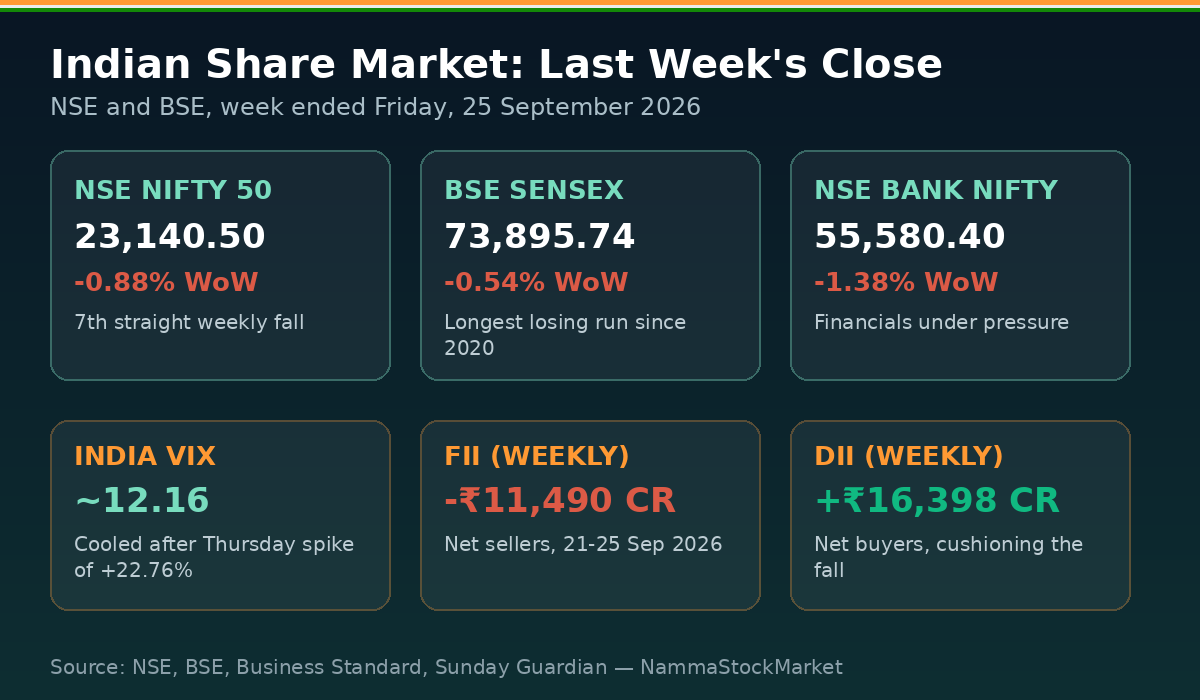
Let’s see what actually happened last week first. On Friday, 25 September 2026, the NSE Nifty 50 closed at 23,140.50, up 77.40 points, and the BSE Sensex ended at 73,895.74, up 315.20 points. That Friday bounce felt good, but it was not enough to save the week – Nifty still finished about 0.88% lower and Sensex about 0.54% lower versus the previous Friday, according to Business Standard and other market reports. Elevated crude oil prices, rising US bond yields and steady FII selling kept pressure on the Indian share market through the week, even as domestic institutions kept buying the dip. We covered Friday’s full recovery in detail here.
Now we move into a short, four-day trading week on NSE and BSE (28 September to 2 October 2026), with a market holiday, a weekly F&O expiry, fresh IPOs and an RBI bond auction all packed in. Here are the 12 things worth checking before you place your first trade on Monday.
1. Nifty next week: levels after the 7-week losing streak
Simple point first: know where the market stands. NSE Nifty 50 closed the week at 23,140.50 and BSE Sensex at 73,895.74. Both indices have now fallen for seven straight weeks, and Nifty is down close to 5.8% over that stretch. That is useful context – a market that has fallen this much, this consistently, tends to see sharp bounces on any good news, so don’t be surprised by volatile swings either way next week.
| Index | Friday Close (25 Sep 2026) | Weekly Change |
|---|---|---|
| NSE Nifty 50 | 23,140.50 | -0.88% (7th weekly fall) |
| BSE Sensex | 73,895.74 | -0.54% |
| NSE Bank Nifty | 55,580.40 | -1.38% |
| India VIX | ~12.16 | Cooled off after a Thursday spike |
2. Support and resistance: the levels to watch on Nifty and Bank Nifty
Simple point: support is the level where buyers usually step in, and resistance is where sellers usually show up. For NSE Nifty 50, immediate support is around 23,000-23,050, and immediate resistance sits near 23,400-23,500. A close below 23,000 could open the door to 22,800-22,600, while reclaiming 23,400-23,500 would be the first sign that the seven-week slide is pausing. On NSE Bank Nifty, support is near 55,000-55,300, with resistance at 56,000-56,200. Keep an eye on this through the week rather than reacting to a single day’s move.
3. NSE and BSE holiday: markets shut on Friday, 2 October
This is an easy one to miss. NSE and BSE will be closed on Friday, 2 October 2026, for Gandhi Jayanti. That means the coming week has only four trading sessions – Monday to Thursday – instead of the usual five. A shorter week often means slightly lower volumes and can add a bit of extra swing to prices, especially in F&O positions, since traders square off before the long weekend. If you’re planning to buy or sell, factor in that Thursday, 1 October, is effectively your last trading day of the week.
4. F&O expiry moves to Tuesday this week
F&O simply means futures and options, the derivative contracts many traders use instead of buying shares directly. The weekly F&O expiry for Nifty, Bank Nifty and stock derivatives falls on Tuesday, 29 September 2026 this week. Expiry day usually brings higher intraday volatility and unusual price moves in stocks with heavy open interest (OI, the total number of outstanding contracts). If you trade options, keep a closer watch on the put-call ratio (PCR) and OI build-up around the 23,000 and 23,500 strikes on Nifty going into Tuesday.
5. FII selling vs DII buying: who is winning the tug of war
FII stands for Foreign Institutional Investors (also called FPIs, or Foreign Portfolio Investors) and DII stands for Domestic Institutional Investors, mainly Indian mutual funds and insurance companies. Last week, FIIs were net sellers of about ₹11,490 crore in the cash market, while DIIs stepped in as net buyers of about ₹16,398 crore, which is a big reason the market did not fall further. For the month of September so far, FIIs have sold roughly ₹18,531 crore while DIIs have bought around ₹52,617 crore (see our daily pre-market FII DII data report for the day-by-day break-up). This tug of war between FII selling and DII buying is one of the biggest things to track for Nifty next week – if FII selling slows down even a little, the market could see a sharp relief rally.
6. India VIX: the market’s fear gauge is cooling down
India VIX tells you how much volatility traders expect in the next 30 days – higher VIX means more nervousness. It spiked sharply on Thursday, jumping over 22% to touch around 12.70, before cooling off about 4% on Friday to close near 12.16. That is still a fairly low VIX in absolute terms, so there isn’t panic in the market, but a sudden VIX spike like Thursday’s is worth watching for early next week – it usually means someone is buying protection against a bigger move.
7. Rupee vs US dollar: ₹ under mild pressure
The rupee (₹) closed near ₹95.81 per US dollar on Friday. A weaker rupee usually helps IT and pharma exporters (they earn in dollars) but makes imports like crude oil costlier for India, which can add to inflation worries. Keep half an eye on the ₹ vs dollar move next week, especially around the RBI’s bond sale and any global dollar strength.
8. Crude oil and global bond yields: the cues from outside India
Brent crude eased to around US$102.86 a barrel on Friday, down about 2.2% from earlier in the week when it had touched near US$105, but it is still elevated and remains a key risk for the Indian share market since India imports most of its oil. On the global cues side, US Treasury bond yields are at their highest since 2007, and that has been a major reason for the FII selling we’ve seen from Indian markets. Also track GIFT Nifty (the Nifty futures traded in Gujarat’s GIFT City) before Monday’s open – it’s usually the first real hint of how NSE and BSE will start the day, along with overnight moves in the Dow, Nasdaq and other Asian markets.
9. Sector trends: what to watch on NSE and BSE this week
Friday’s recovery was led by Nifty Consumer Durables (+0.95%), Realty (+0.92%) and Auto (+0.89%), with Financial Services and FMCG also in the green. IT (-0.17%) and Pharma (-0.10%) were the laggards. Among individual stocks, Coal India, ITC and Eternal were among last week’s gainers, while Bharti Airtel, Trent and Infosys were among the sharper decliners. If the FII-selling pressure eases, rate-sensitive sectors like Bank Nifty and Realty tend to bounce first – worth watching if you hold positions there.
10. IPOs next week: mainboard and SME issues to track
There’s plenty happening on the IPO front. Two mainboard IPOs open this week: SRIT India (price band ₹123-130, lot size 115 shares) and Shah Investor’s Home (price band ₹159-167), both opening 28 September and closing 30 September. Nityas Gems & Jewellery (price band ₹70-75, lot size 200 shares) opens 30 September. Meanwhile, allotment for four IPOs that closed last week – Orient Cables (₹258-272), AceVector (₹30-32), German Green Steel and Power (₹132-139) and Runwal Enterprises (₹290-305) – is expected around 30 September, ahead of their listing. Several SME IPOs on NSE Emerge and BSE SME are also in the pipeline. Remember, IPO allotment is not guaranteed even if you apply, and IPO GMP (grey market premium) is an unofficial, unregulated indicator – don’t treat it as a promise of listing gains.
| IPO | Type | Price Band (₹) | Open | Close |
|---|---|---|---|---|
| SRIT India | Mainboard | ₹123-130 | 28 Sep | 30 Sep |
| Shah Investor’s Home | Mainboard | ₹159-167 | 28 Sep | 30 Sep |
| Nityas Gems & Jewellery | Mainboard | ₹70-75 | 30 Sep | 5 Oct |
| Orient Cables, AceVector, German Green Steel, Runwal Enterprises | Mainboard (allotment week) | Various | Closed | Allotment ~30 Sep |
11. F&O ban list: stocks under trading restriction
A stock lands in the F&O ban list when its open interest crosses 95% of the market-wide position limit (MWPL) – it means no new derivative positions can be built, only squaring off existing ones. As of Friday, Kaynes Technology India, LIC Housing Finance, Steel Authority of India (SAIL) and Manappuram Finance were in the ban list. This list changes daily, so if you trade F&O, check the NSE India ban list every morning before placing fresh positions in these or other stocks.
12. RBI bond sale, SIP investors and demat account safety
The RBI has a bond sale (G-Sec auction) scheduled on Monday, 28 September, worth about ₹25,000 crore, aimed at managing excess liquidity in the banking system – this can have a small effect on short-term interest rates. Separately, if you invest through a mutual fund SIP (Systematic Investment Plan), a seven-week fall like this one is exactly the kind of period SIPs are built for – you buy more units when prices are lower, which can average out your cost over time. And a quick safety reminder: never share your demat account or trading account login, OTP or PIN with anyone claiming to offer “guaranteed returns” – SEBI has repeatedly warned about such frauds targeting retail investors.
Quick checklist for Monday morning
- Check GIFT Nifty and global cues (Dow, Nasdaq, Asian markets) before 9:15 AM IST
- Note that NSE and BSE trading hours remain 9:15 AM to 3:30 PM, Monday to Thursday this week
- Watch Nifty’s 23,000 support and 23,400-23,500 resistance zone
- Track FII/DII cash market data, usually out by evening
- Remember: no trading on Friday, 2 October (Gandhi Jayanti)
- If applying for SRIT India or Shah Investor’s Home IPO, apply before the 30 September close
- Check the NSE F&O ban list before opening new derivative positions
Frequently Asked Questions
What time does NSE and BSE open on Monday?
NSE and BSE open at 9:15 AM IST and close at 3:30 PM IST, Monday to Friday. This week, since Friday, 2 October is a market holiday, trading happens only Monday to Thursday.
Is there a market holiday next week on NSE and BSE?
Yes. NSE and BSE will remain closed on Friday, 2 October 2026, for Gandhi Jayanti. It’s one of the trading holidays announced by NSE India and BSE India every year.
Which sectors should I watch in the Indian share market next week?
Based on last week’s trend, Realty, Auto, Consumer Durables and Financial Services showed strength, while IT and Pharma lagged. Bank Nifty is worth watching closely given its steeper weekly fall and the Tuesday F&O expiry.
Why do FII and DII flows matter for Nifty next week?
FIIs (foreign investors) and DIIs (domestic mutual funds and insurers) are the biggest buyers and sellers in the Indian stock market. When FIIs sell heavily and DIIs buy just as much, the market tends to stay range-bound; if that balance shifts, Nifty and Sensex can move sharply in either direction.
What is IPO GMP and should I rely on it?
IPO GMP (grey market premium) is an unofficial price at which IPO shares trade before listing. It gives a rough sense of demand but is not regulated by SEBI and can change quickly, so it should never be the only reason to apply for an IPO.
That’s the full picture for the week ahead. Markets have had a tough seven weeks, but between the RBI’s bond sale, a shortened trading week, fresh IPOs and the ongoing FII-DII tussle, there’s a lot that could shift sentiment on NSE and BSE. We’ll be back with our daily pre-market reports and a fresh look at Nifty next week once this week wraps up – follow NammaStockMarket so you don’t miss any of it.
This article is for learning and information only. It is not investment advice. Please do your own research or talk to a SEBI registered advisor before you invest.
RELATED POSTS
View all


Nifty Sensex Next Week: 12 Must-Check Things After 6 Falls (21-25 Sep)
September 20, 2026 | by NammaStockMarket