

Sensex Crashes 1,124 Points, Nifty Slips Below 22,800 As Brent Crude Tops $107 On Iran Standoff
September 28, 2026 | by NammaStockMarket
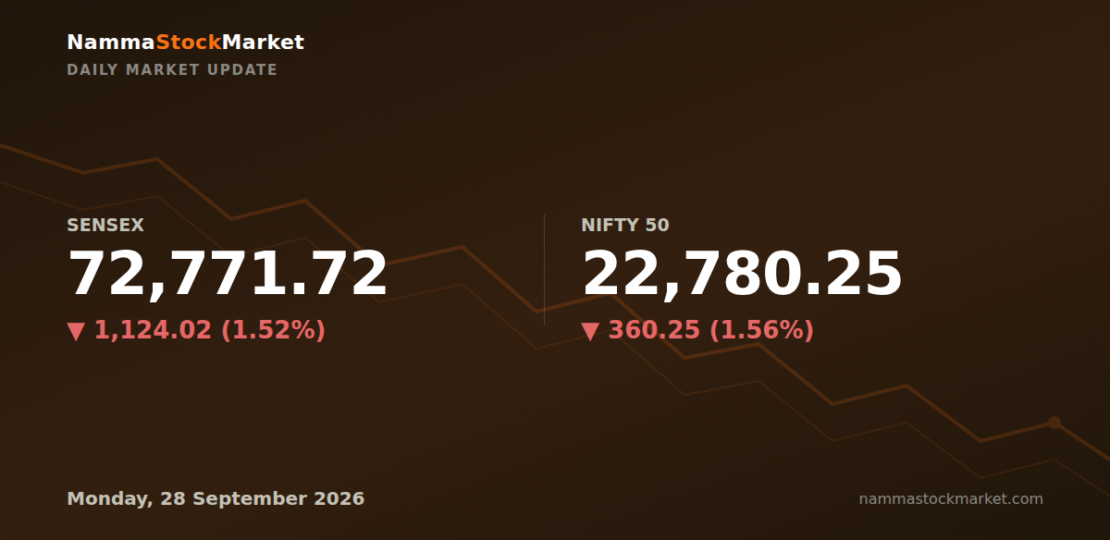
The Indian stock market had a rough Monday. The BSE Sensex crashed 1,124 points to close at 72,771.72, and the NSE Nifty 50 fell 360 points to settle at 22,780.25, its lowest close in six months. If you were tracking your portfolio today, you already know it wasn’t pretty — almost every stock on the board was red, with only 3 out of the 50 Nifty stocks managing to close higher. The big reason behind today’s fall is crude oil. Brent crude, the global benchmark for oil prices, jumped past $107 a barrel after former President Trump rejected an Iran proposal to reopen the Strait of Hormuz, a narrow sea route through which almost a fifth of the world’s oil normally travels. Add to that a weak rupee and heavy selling by foreign investors, and you get one of the sharper single-day falls the Indian share market has seen in recent months.
Market At A Glance
Here’s how the main indices closed today. The BSE Sensex is the benchmark index of the Bombay Stock Exchange (BSE), tracking 30 of India’s largest companies, while the NSE Nifty 50 does the same job for the National Stock Exchange (NSE) with 50 large companies. Bank Nifty tracks the biggest banking stocks, and the Midcap 100 and Smallcap 100 indices track mid-sized and smaller companies respectively.
| Index | Close | Change (Pts) | % Change |
|---|---|---|---|
| BSE Sensex | 72,771.72 | ▼ 1,124.02 | ▼ 1.52% |
| NSE Nifty 50 | 22,780.25 | ▼ 360.25 | ▼ 1.56% |
| Nifty Bank | 54,471.65 | ▼ 1,108.75 | ▼ 1.99% |
| Nifty Midcap 100 | — | — | ▼ 1.70% |
| Nifty Smallcap 100 | — | — | ▼ 1.80% |
| India VIX | 13.63 | ▲ 1.47 | ▲ 12.09% |
Note: exact closing levels for Nifty Midcap 100 and Nifty Smallcap 100 were not available at the time of publishing; the percentage falls above (1.70% and 1.80%) are confirmed from multiple market reports.
Why The Market Moved
The story today is almost entirely about oil. India buys nearly 85% of the crude oil it needs from other countries, so when oil prices go up, it directly hits what’s called India’s “oil import bill” — simply put, the total amount of dollars India has to pay to buy oil from abroad. A bigger oil import bill means more dollars flowing out of the country, which weakens the rupee. A weaker rupee makes everything we import costlier, and that includes fuel at the pump, which eventually shows up as inflation in your monthly budget.
Today’s trigger was geopolitical, not economic. Iran had offered to reopen the Strait of Hormuz — the sea corridor between Iran and Oman through which a huge chunk of the world’s oil ships pass — in exchange for the US releasing frozen funds and easing sanctions. Trump turned the offer down over the weekend, and that spooked oil traders, who worry supply through the strait could stay disrupted for longer. Higher oil prices, in turn, raise fears that the RBI (Reserve Bank of India) may find it harder to cut interest rates at its next MPC (Monetary Policy Committee) meeting, since costlier fuel can push inflation higher. That’s why you saw banking and rate-sensitive stocks fall hard today alongside oil marketing and aviation-linked names.
Which Sectors Held Up, And Which Didn’t
Every single sectoral index on the NSE ended in the red today, but some sectors held up far better than others. IT stocks were the least hurt, down just about a quarter of a percent, largely because IT companies earn most of their revenue in dollars, so a weaker rupee actually helps their earnings a bit when converted back to rupees. Pharma too was relatively resilient. On the other end, PSU Bank stocks were hammered, down over 3%, as investors worried that state-run banks would feel the pinch of any rate-hike worries more than private ones. Realty (real estate) and energy stocks also fell sharply, since both are sensitive to interest rates and input costs respectively.
| Sector | % Change |
|---|---|
| IT | ▼ 0.26% |
| Consumer Durables | ▼ 0.30% |
| Pharma | ▼ 0.89% |
| FMCG | ▼ 1.47% |
| Auto | ▼ 1.64% |
| Financial Services | ▼ 1.69% |
| Metal | ▼ 1.78% |
| Telecom | ▼ 2.00% |
| Energy / Oil & Gas | ▼ 2.00% |
| Realty | ▼ 2.12% |
| PSU Bank | ▼ 3.24% |
Today’s Top Movers
On a day when almost the entire market was in the red, pharma major Dr Reddy’s Laboratories stood out as the top gainer, helped by hopes around its US generic drug pipeline. IT bellwether Infosys and HDFC Life Insurance were the only other two Nifty 50 stocks that managed to close higher — that’s how one-sided today’s session was.
| Stock | % Change |
|---|---|
| Dr Reddy’s Laboratories | ▲ 1.67% |
| Infosys | ▲ 0.30% |
| HDFC Life Insurance | ▲ 0.11% |
On the losing side, auto and infrastructure names bore the brunt. Tata Motors’ passenger vehicle business, Adani Enterprises, Jio Financial Services, Power Grid Corporation and Larsen & Toubro (L&T) were among the worst hit, each falling close to 3%. If you’re holding auto, infra or power stocks, today was a day best forgotten; if you were in IT or pharma, the damage was far smaller.
| Stock | % Change |
|---|---|
| Tata Motors (PV) | ▼ 3.00% |
| Adani Enterprises | ▼ 2.93% |
| Jio Financial Services | ▼ 2.86% |
| Power Grid Corporation | ▼ 2.84% |
| Larsen & Toubro | ▼ 2.83% |
What FIIs and DIIs Were Doing
You’ll often see the terms FII and DII in market reports. FII stands for Foreign Institutional Investor — big foreign funds that invest in Indian stocks — and DII stands for Domestic Institutional Investor, which covers Indian mutual funds, insurance companies like LIC, and similar large local investors. Tracking their daily buying and selling in the cash segment tells you who is driving the market’s mood.
Today’s official FII/DII cash figures for 28 September were not out at the time of publishing this article — these numbers are usually released after market hours and confirmed the next trading day. Here’s what we know from the last five sessions:
| Date | FII Net (₹ Crore) | DII Net (₹ Crore) |
|---|---|---|
| Fri, 25 Sep 2026 | ▼ 3,694 | ▲ 2,838 |
| Thu, 24 Sep 2026 | ▼ 5,027 | ▲ 4,301 |
| Wed, 23 Sep 2026 | ▲ 1,617 | ▲ 2,341 |
| Tue, 22 Sep 2026 | ▼ 3,810 | ▲ 4,120 |
| Mon, 21 Sep 2026 | ▼ 576 | ▲ 2,797 |
The pattern over the last few sessions is clear: FIIs have been net sellers on four of the last five days, pulling money out of Indian equities, while DIIs have been steady net buyers throughout, cushioning the market from a much sharper fall. This is a trend you’ll see often in the Indian stock market — when foreign money exits, domestic mutual funds (powered largely by your SIP, or Systematic Investment Plan, contributions) often step in and buy the dip. Given today’s sharp fall and the risk-off mood globally, don’t be surprised if tomorrow’s data shows FIIs selling even more heavily.
Oil, The Rupee, And Global Cues
Brent crude, which is priced in US dollars per barrel like most oil globally, jumped more than 3% today to trade above $107 a barrel, edging close to $108 during Asian trading hours. As explained earlier, this is squarely down to the US-Iran standoff over the Strait of Hormuz. For India, a $107 Brent is a meaningful jump from levels closer to $95-100 that the market had gotten used to recently, and every extra dollar on the oil barrel adds real pressure on the rupee and the country’s current account (the gap between what India earns from exports and what it spends on imports).
The rupee felt that pressure directly, falling 28 paise to close at 96.03 against the US dollar, after opening weak at 95.89. Apart from costlier oil, the rupee was also weighed down by the same FII selling we talked about above, plus a general risk-off mood across Asian currencies. Global cues weren’t supportive either — with crude spiking and geopolitical tension elevated, US markets (the Dow and Nasdaq) were also seen as cautious in early trade, which typically doesn’t help sentiment in the Indian share market the next session.
What To Watch Tomorrow
The single biggest thing to track from here is oil. If the US and Iran show any sign of talks resuming over the Strait of Hormuz, Brent crude could cool off quickly and take some pressure off the Sensex and Nifty. If tensions escalate instead, expect more of the same — a weaker rupee, nervous banking and realty stocks, and continued FII selling. Keep an eye on the India VIX too; at 13.63, up over 12% today, it’s still well below levels that would signal panic, but a sustained rise from here usually means more volatile sessions ahead in F&O (futures and options) expiry-driven moves. IT and pharma, which held up relatively well today because of their dollar-earning nature, are worth watching to see if they can keep acting as a cushion if oil-driven selling continues. As always, this is what the data and the day’s cues suggest — not a recommendation to buy or sell anything, so make your own call based on your own goals and risk appetite.
RELATED POSTS
View all

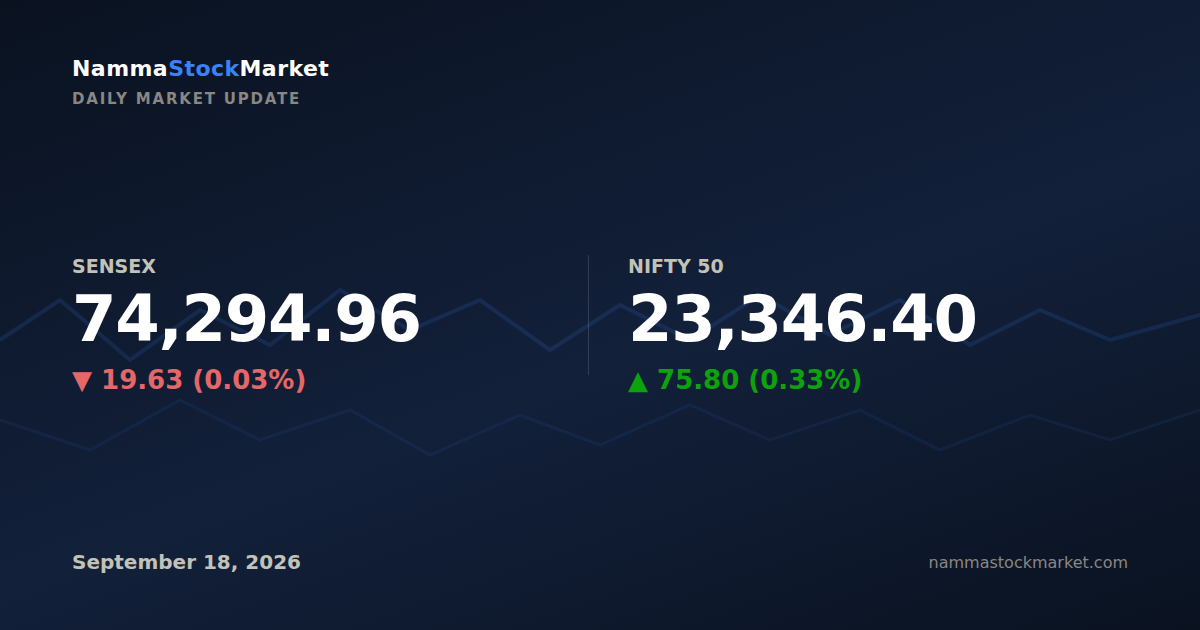
Nifty Ends Higher At 23,346 As Smallcaps Jump 1.7%, But TCS Crash Drags Sensex Into The Red
September 18, 2026 | by NammaStockMarket
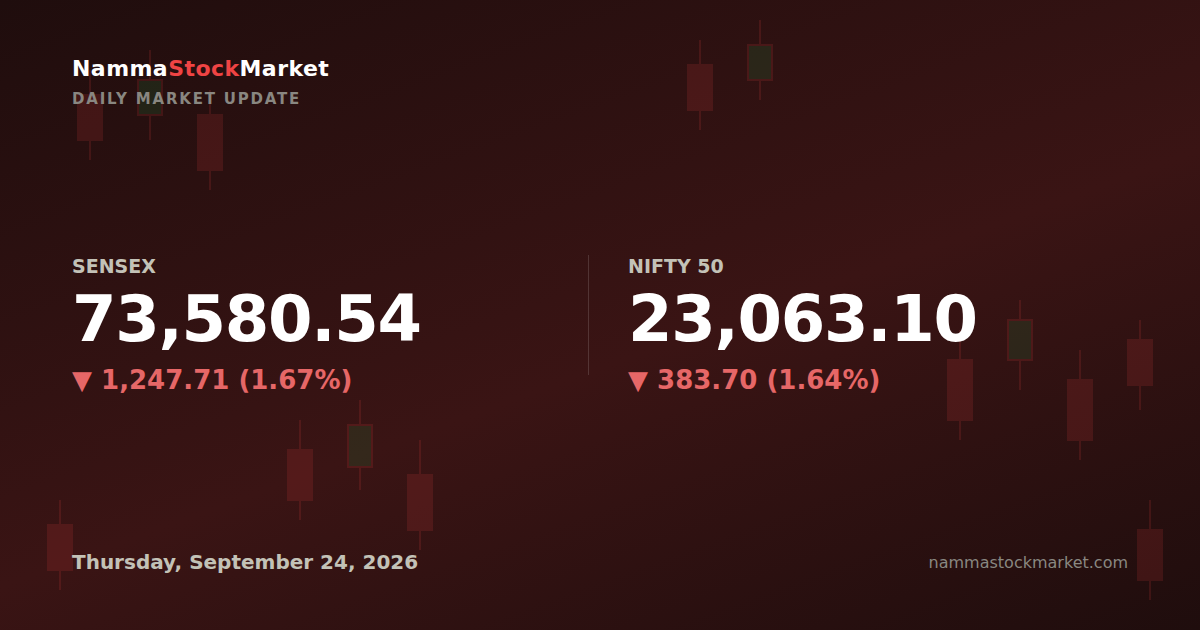
Sensex Crashes 1,247 Points, Nifty Slips Below 23,100 As Crude Oil Spikes And IRDAI Insurance Rules Hit Bank Stocks
September 24, 2026 | by NammaStockMarket
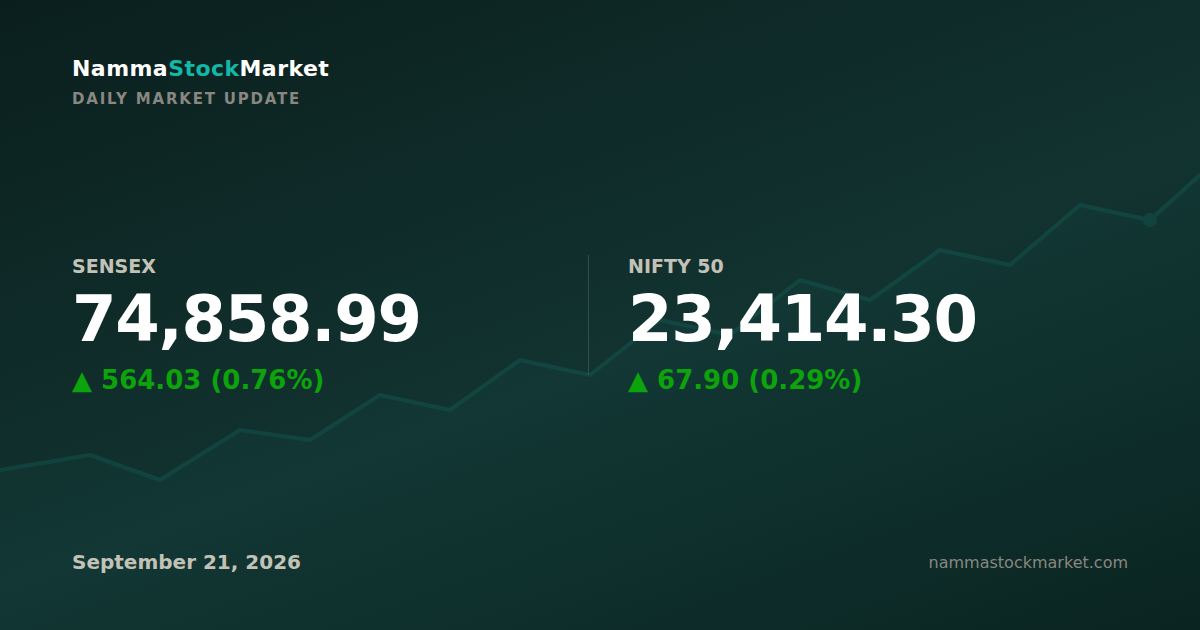
Sensex Jumps 564 Points, Nifty Reclaims 23,400 As Cooling Crude Oil Lifts Sentiment
September 21, 2026 | by NammaStockMarket