

Sensex Falls 353 Points, Nifty Slips Below 22,700 As Oil Spike And IT Selloff Overshadow Jio’s Blockbuster Debut
October 28, 2026 | by NammaStockMarket
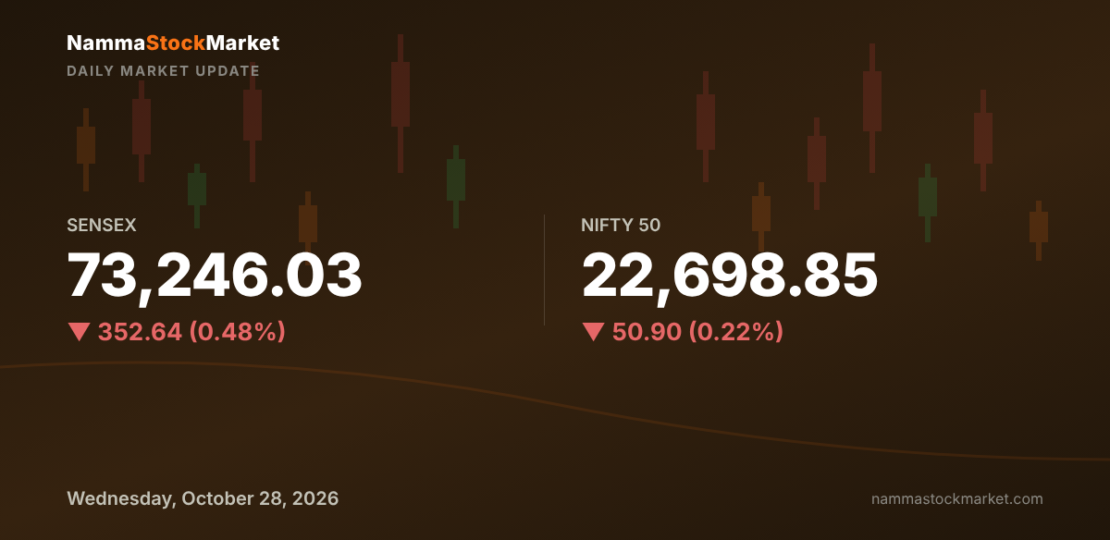
It was a choppy Wednesday on Dalal Street. The BSE Sensex ended 352.64 points, or 0.48%, lower at 73,246.03, while the NSE Nifty 50 slipped 50.90 points, or 0.22%, to close at 22,698.85. Both indices had fallen much harder in the morning, with the Sensex down over 600 points and the Nifty briefly below 22,500, before buying in auto and bank stocks helped claw back some of the losses by the closing bell. Two things drove the day: crude oil jumped close to $116 a barrel after a reported missile strike on a Saudi Arabia refinery, and IT stocks like Infosys fell hard on worries about US tech spending. The one bright spot was Jio Platforms, which made a blockbuster debut on the exchanges after India’s biggest-ever IPO, though even that wasn’t enough to pull the broader market into the green.
Market At A Glance
Here is how the main indices on the NSE (National Stock Exchange) and BSE (Bombay Stock Exchange) closed today. If you’re new to these terms, NSE and BSE are India’s two big stock exchanges, and the Sensex and Nifty are the two most-watched index “scorecards” of how our market is doing overall.
| Index | Close | Pts Change | % Change |
|---|---|---|---|
| BSE Sensex | 73,246.03 | ▼ 352.64 | ▼ 0.48% |
| NSE Nifty 50 | 22,698.85 | ▼ 50.90 | ▼ 0.22% |
| Nifty Bank (Bank Nifty) | 54,267.40 | ▲ 292.65 | ▲ 0.54% |
| Nifty Midcap 100 | — | — | ▲ 0.43% |
| Nifty Smallcap 100 | — | — | ▲ 0.90% |
| India VIX | 16.20 | ▼ 0.16 | ▼ 1.0% |
Note: Closing index levels for Nifty Midcap 100 and Nifty Smallcap 100 were not available from the sources checked at the time of publishing, so only their percentage moves are shown. Bank Nifty’s point change is calculated from its reported percentage move.
Why The Market Moved
If you’re wondering why the market fell even though nothing dramatic happened in India itself today, the answer lies mostly outside our borders. Brent crude oil, which is the global benchmark price for oil, jumped close to $116 a barrel after reports that Yemen’s Houthi rebels fired a missile at Saudi Arabia’s Ras Tanura refinery, one of the biggest oil refineries in the world. Saudi Arabia hasn’t confirmed the attack, but just the fear of it was enough to spook oil traders, coming on top of an Iran-related conflict that has now dragged on for eight months with no peace deal in sight.
Now, you might ask, why should a missile strike near Saudi Arabia affect your portfolio sitting in Mumbai or Bengaluru? Here’s the simple answer: India buys most of its oil from abroad. When crude oil gets costlier, our oil import bill goes up, which means we need more dollars to pay for the same amount of oil. That extra dollar demand puts pressure on the rupee, which in turn makes everything we import a little more expensive, and that can eventually show up as inflation at the petrol pump and in your monthly budget. This is exactly why you’ll hear market watchers get nervous whenever crude oil climbs, even when the news is happening thousands of kilometres away.
The second big drag today was the IT sector. Infosys, HCL Tech and other IT majors get a big chunk of their revenue from the US, so investors are naturally sensitive to anything that signals US companies might tighten their technology budgets. Adding to the nervousness, the US Federal Reserve’s rate decision was due late tonight by Indian time, and the market doesn’t like making big bets right before an event like that. If you’re holding IT stocks in your portfolio, today was a rough day; if you were out of IT and into autos or banks instead, you were sitting a lot more comfortably.
Which Sectors Held Up, And Which Didn’t
Auto stocks were the star performers today, while IT and oil-and-gas names were the biggest drag. Here’s the sector scorecard:
| Sector | % Change |
|---|---|
| Nifty Auto | ▲ 1.45% |
| Nifty Bank / Financial Services | ▲ 0.54% |
| Nifty FMCG | ▼ 0.56% |
| Nifty IT | ▼ 1.98% |
| Nifty Oil & Gas / Energy | ▼ 2.27% |
Auto stocks gained on the back of strong festive-season demand expectations and a set of encouraging quarterly results from companies like TVS Motor. Bank Nifty, which tracks India’s biggest banks, also ended in the green even though the broader market was weak, with lenders like IndusInd Bank and Canara Bank finding buyers. On the other end, Nifty Oil & Gas fell the hardest as rising crude oil prices hurt the profit outlook for oil marketing and refining companies, and IT stocks extended their recent slide on US-demand worries. FMCG also had a quiet, slightly negative day, with no fresh triggers to excite buyers.
Today’s Top Movers
Here’s a look at the biggest individual movers across the Nifty 50 and Nifty 100 universe today.
Top 5 Gainers
| Stock | % Change |
|---|---|
| Voltas | ▲ 6.90% |
| Patanjali Foods | ▲ 6.20% |
| Biocon | ▲ 5.50% |
| Apollo Hospitals | ▲ 4.43% |
| Larsen & Toubro | ▲ 3.72% |
Voltas led the gainers’ chart after strong demand expectations for cooling products and air conditioners, while Patanjali Foods and Biocon rallied on stock-specific buying. In the Nifty 50 pack itself, Apollo Hospitals and Larsen & Toubro were the standout gainers, both helped along by upbeat business updates. If you’re holding any of these names, today was a day worth smiling about.
Top 5 Losers
| Stock | % Change |
|---|---|
| Steel Authority of India (SAIL) | ▼ 5.40% |
| Pidilite Industries | ▼ 4.20% |
| Bajaj Holdings & Investment | ▼ 4.00% |
| Infosys | ▼ 3.43% |
| Reliance Industries | ▼ 3.19% |
On the losing side, Steel Authority of India (SAIL) and Pidilite Industries saw the sharpest falls, along with Bajaj Holdings & Investment. Among the heavyweights, Infosys and Reliance Industries both ended more than 3% lower. Infosys fell on the same US-tech-spending worries dragging down the rest of the IT pack, while Reliance’s fall was a bit more unusual: some analysts think a section of investors who were holding Reliance partly to get exposure to its digital arm, Jio Platforms, decided to sell Reliance and buy the newly-listed Jio shares directly instead, now that Jio trades on its own.
What FIIs And DIIs Were Doing
You’ll often hear market reports talk about “FII” and “DII” activity, and if you’re newer to investing, here’s what that means in plain words. FIIs, or Foreign Institutional Investors, are big foreign funds and institutions that invest in Indian shares from outside the country. DIIs, or Domestic Institutional Investors, are Indian institutions like mutual funds, insurance companies and pension funds that invest money collected from investors like you, including through mutual fund SIPs (the monthly investment plans most retail investors use). Watching whether FIIs are buying or selling, and whether DIIs are stepping in to balance that out, tells you a lot about the underlying mood in the market.
| Date | FII Net (₹ Cr) | DII Net (₹ Cr) |
|---|---|---|
| 27 Oct 2026 | ▲ 4,240 | ▼ 1,250 |
| 26 Oct 2026 | ▼ 1,463 | ▲ 2,610 |
| 23 Oct 2026 | ▲ 888 | ▲ 3,235 |
| 22 Oct 2026 | ▼ 3,459 | ▲ 2,891 |
| 21 Oct 2026 | ▲ 1,022 | ▲ 1,614 |
Today’s (28 October) FII/DII cash-segment figures were not yet released at the time of publishing, as these numbers typically come out after market hours. The table above shows the most recent five trading sessions with provisional cash-segment data available.
The pattern over the last few sessions has been fairly telling: DIIs have been net buyers on four of the last five trading days, even stepping in with over ₹3,200 crore of buying on October 23 when FIIs were only mild buyers. This is a classic case of DIIs cushioning the market whenever FIIs turn cautious or start booking profits, something that has become a familiar script in Indian markets over the last couple of years thanks to the steady flow of money coming in through mutual fund SIPs every month. On a day like today, with crude oil spiking and global cues uncertain, that domestic cushion matters a lot more than usual.
Oil, The Rupee, And Global Cues
Brent crude, the international oil benchmark that is always quoted in US dollars per barrel because oil is a globally dollar-priced commodity, traded close to $115-116 a barrel today, up roughly 1.5-2% on the day. The spike came after the Houthi claim of a missile strike on Saudi Arabia’s giant Ras Tanura refinery, which can process around 550,000 barrels of oil a day. Saudi Arabia hasn’t officially confirmed the strike, but oil traders took no chances given that the broader Iran-linked conflict in the region has now stretched past eight months with no resolution in sight, and Iran has said it won’t even discuss its nuclear programme until the US eases sanctions on its oil exports.
For India, this matters a great deal because we import close to 85% of the crude oil we use. Costlier oil means a bigger oil import bill, which widens our trade deficit and current account deficit, and that pressure usually shows up on the rupee. True to form, the rupee weakened today, trading near 95.22 against the US dollar compared with its previous close of around 95.12, as importers needed more dollars to pay for pricier oil. A weaker rupee is a double-edged sword: it’s good news if you’re an IT or pharma exporter earning in dollars, but it’s bad news for anyone importing oil, electronics or gold, and it can nudge up prices across the economy over time.
On the global cues front, all eyes were on the US Federal Reserve, which was scheduled to announce its rate decision late tonight by Indian time. Most economists expect the Fed to hold rates steady for now, with some simply waiting to see whether it signals another hike in December. Asian markets were mixed through the day, and that uncertainty ahead of the Fed decision added to the cautious, risk-off mood you saw play out in our own market, especially in sectors with heavy US exposure like IT.
The Jio Platforms Listing: The Day’s Big Story
Away from the index-level gloom, there was genuine excitement around Jio Platforms making its market debut today. Jio had raised about ₹30,213 crore through India’s largest-ever IPO, and the issue was subscribed a massive 22.19 times, at a price band of ₹1,065 to ₹1,119 per share. On listing day, the stock jumped sharply to around ₹1,417.5, making Jio Platforms the second-largest company in India by market value after its own parent, Reliance Industries. For retail investors who got an allotment, it was a day to remember. For Reliance shareholders, though, it was a mixed bag, since Reliance stock itself fell over 3% even as its subsidiary soared, as some money appears to have rotated out of the parent and straight into the newly-listed Jio shares.
What To Watch Tomorrow
The single biggest thing to watch is the US Federal Reserve’s rate decision, due late tonight by Indian time, and more importantly, its tone on what comes next in December. A hawkish Fed (one that sounds inclined to raise rates further) tends to be bad news for riskier assets like Indian equities, while a dovish tone could help calm nerves. Crude oil will also stay in focus, since any fresh headlines around the Saudi refinery situation or the broader Iran conflict could keep pushing prices around, and with it, the rupee. On the sector front, IT looks the most exposed if US rate worries persist, while autos and select banks look relatively more resilient given their recent run. None of this is a buy or sell call, just a sense of what’s likely to set the tone as we head into Thursday’s session. As always, keep an eye on your own asset allocation and investment horizon rather than reacting to any single day’s moves in your demat account.
RELATED POSTS
View all

Sensex Crashes 1,045 Points, Nifty Below 22,250 As RBI Rate Hike And $104 Oil Spook Indian Stock Market
October 8, 2026 | by NammaStockMarket
Sensex Slips 143 Points, Nifty Falls To 22,811 As Crude Oil Crosses $110 — IT Stocks Buck The Trend
October 21, 2026 | by NammaStockMarket
Sensex Ends Flat At 72,480, Nifty Slips To 22,620 As Banks, Realty Shine
September 30, 2026 | by NammaStockMarket