

Sensex Tumbles 989 Points, Nifty Ends Below 25,650 As Crude Oil Spike Past $98 Hits IT And Auto Stocks
November 27, 2026 | by NammaStockMarket
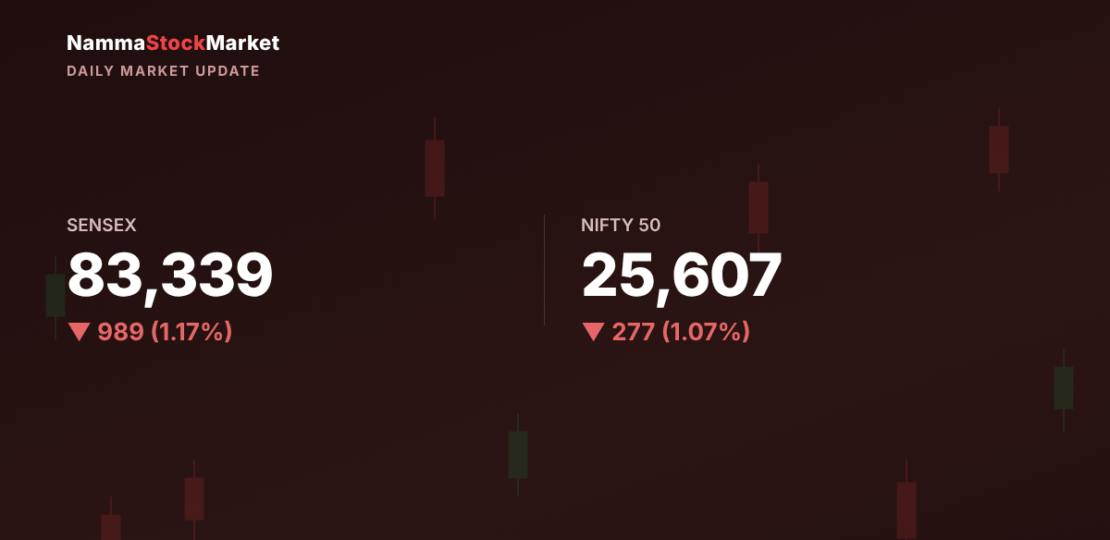
If you were watching your portfolio today, you probably felt it. The Indian stock market had a rough Friday, with the BSE Sensex crashing 989 points and the NSE Nifty 50 closing below the 25,650 mark. This was the market’s worst single-day fall in weeks, and it snapped a two-day winning streak that had investors feeling good just a day earlier. The big reason? Crude oil prices shot past $98 a barrel on fresh Middle East tensions, and that one move set off a chain reaction that hit IT, auto, realty and banking stocks hard. If you’re holding IT stocks like Infosys, TCS or HCL Technologies, today was a painful day. But if you had some exposure to metal stocks, you actually ended up in the green.
Let’s break down exactly what happened, why it happened, and what you should be watching as we head into next week.
Market At A Glance
Here’s how the key indices on the NSE (National Stock Exchange) and BSE (Bombay Stock Exchange) — the two exchanges where Indian shares are bought and sold — closed today:
| Index | Close | Pts Change | % Change |
|---|---|---|---|
| BSE Sensex | 83,339.26 | ▼ 989.33 | ▼ 1.17% |
| NSE Nifty 50 | 25,607.20 | ▼ 277.30 | ▼ 1.07% |
| Nifty Bank | 63,040.90 | ▼ 494.40 | ▼ 0.78% |
| Nifty Midcap 100 | 61,847.40 | ▲ 68.65 | ▲ 0.11% |
| Nifty Smallcap 100 | 19,482.20 | ▲ 110.34 | ▲ 0.57% |
| India VIX | 16.66 | ▼ 0.18 | ▼ 1.05% |
Note: India VIX closing levels showed a small gap between data providers today (reported anywhere between 16.5 and 16.66) — we’ve used the most commonly cited figure above.
Why The Market Moved
The short version: oil got expensive, and that’s never good news for India.
Here’s why that matters so much for us. India imports almost all the crude oil it uses — we don’t produce enough on our own. So when crude oil prices rise, our oil import bill goes up, which means the country needs more US dollars to pay for that oil. That extra dollar demand puts pressure on the rupee, making it weaker against the dollar. A weaker rupee, in turn, makes everything we import more expensive, which can push up inflation. This is why you’ll often hear market experts talk about crude oil and the rupee in the same breath — they’re deeply connected for a country like ours.
Today, Brent crude (the global benchmark price for oil, quoted in US dollars per barrel) jumped past $98, its highest level in a while, after reports of drone attacks on oil infrastructure in the Gulf region and renewed worries about tensions near the Strait of Hormuz — a narrow sea route through which a huge chunk of the world’s oil supply passes. Any hint of trouble there makes oil traders nervous, and prices spike. Add to that a stretch of domestic bond yields creeping higher and some profit booking after a strong four-week rally in Indian stocks, and you had the perfect setup for a sharp pullback.
Market expert Vinod Nair of Geojit Financial Services pointed out that Indian equities “took a breather after a strong four-week rally,” with higher crude, a weaker rupee and rising bond yields prompting investors to book profits in heavyweight stocks. Vikram Kasat of PL Capital added that the correction “reflected a reassessment of global risks rather than a deterioration in domestic fundamentals” — in plain words, nothing is fundamentally broken with the Indian economy, investors are just being more cautious given what’s happening globally. There was also talk of proposed US tariffs on trading partners, including India, which adds a bit of uncertainty for companies that export goods.
Which Sectors Held Up, And Which Didn’t
This was very much a mixed bag of a day, with some sectors falling hard while others actually did well. Here’s the sector scorecard, best to worst:
| Sector (NSE Index) | % Change |
|---|---|
| Metal | ▲ 1.40% |
| Media | ▲ 0.53% |
| Consumer Durables | ▲ 0.26% |
| Energy | ▲ 0.15% |
| Pharma | ▼ 0.40% |
| FMCG | ▼ 0.93% |
| Financial Services (Banking) | ▼ 1.33% |
| Realty | ▼ 1.43% |
| Auto | ▼ 1.48% |
| IT | ▼ 1.88% |
IT stocks took the biggest hit today, down nearly 1.9%, mainly because the sector had rallied sharply (over 3.6%) just the day before, so some profit booking was only natural. Auto and Realty stocks also fell more than 1.4% each, giving back a chunk of their recent gains. Financial Services and banking stocks slipped too, which is a big reason the Sensex and Nifty fell as much as they did, since banks carry a heavy weight in these indices. On the flip side, Metal stocks were the star performers, up 1.4%, while Media and Consumer Durables also managed small gains. FMCG stocks fell nearly 1%, partly due to a Supreme Court order asking packaged food companies to carry clearer, separate warning labels for high sugar, salt or fat content — something that hit sentiment in that space.
Today’s Top Movers
Out of the 50 stocks in the Nifty 50, 40 closed higher and only 10 ended in the red — so on a stock-count basis, more shares actually gained than lost today, even though the index itself fell. That tells you this was a heavyweight-driven fall, not a broad sell-off across the board. Here are the standout movers:
Top 5 Gainers
| Stock | % Change |
|---|---|
| Bharat Electronics (BEL) | ▲ 1.72% |
| JSW Steel | ▲ 1.40% |
| Titan Company | ▲ 0.95% |
| Hindalco Industries | ▲ 0.82% |
| SBI Life Insurance | ▲ 0.74% |
Defence stock Bharat Electronics (BEL) led the gainers, while metal names JSW Steel and Hindalco Industries rode the strength in metal prices. Titan and SBI Life Insurance also held up well.
Top 5 Losers
| Stock | % Change |
|---|---|
| Shriram Finance | ▼ 3.99% |
| Bajaj Auto | ▼ 3.36% |
| HCL Technologies | ▼ 3.03% |
| Infosys | ▼ 2.68% |
| Tata Consultancy Services (TCS) | ▼ 2.57% |
Shriram Finance was the single biggest loser on the index today, down nearly 4%, followed by Bajaj Auto. The IT pack of HCL Technologies, Infosys and TCS all fell more than 2.5% each, confirming that this was mainly an IT-and-financials-led fall.
On the broader market, NSE data showed that of the 3,748 stocks traded, 2,119 advanced and 1,514 declined, with 115 unchanged. Interestingly, 127 stocks hit their upper circuit (the maximum price a stock is allowed to move up in a single day, as per exchange rules) while 35 stocks hit their lower circuit (the maximum allowed fall) — these circuit limits exist precisely to prevent extreme, panic-driven price swings in individual stocks.
What FIIs And DIIs Were Doing
You’ll often see us talk about FIIs and DIIs, so here’s a quick refresher if you’re newer to this: FIIs (Foreign Institutional Investors, sometimes also called FPIs or Foreign Portfolio Investors) are big funds and institutions based outside India that invest in our stock market, while DIIs (Domestic Institutional Investors) are Indian institutions like mutual funds, insurance companies and pension funds doing the same from within the country. Tracking their daily buying and selling tells you a lot about where the “smart money” sees value.
Today’s official cash-market figures for November 27 hadn’t been released at the time of writing — exchanges typically publish this provisional data later in the evening, so we’ll have a clearer picture tomorrow. Here’s what we do know from the last few trading sessions:
| Date | FII Net (₹ cr) | DII Net (₹ cr) |
|---|---|---|
| 26 Nov 2026 (Thu) | ▲ 5,843 | ▲ 5,631 |
| 25 Nov 2026 (Wed) | ▲ 4,479 | ▲ 4,019 |
| 23 Nov 2026 (Mon) | ▲ 5,673 | ▼ 2,760 |
| 20 Nov 2026 (Fri) | ▲ 10,308 | ▼ 4,860 |
The pattern over the past week has been encouraging: both FIIs and DIIs have mostly been net buyers in the cash segment, which is a healthy sign. On days when DIIs did sell (like November 20 and 23), it was FIIs stepping up their buying that kept the market supported — classic example of domestic and foreign money taking turns to cushion the market. If you invest through SIPs (Systematic Investment Plans in mutual funds), this kind of steady institutional buying over time is part of what keeps the broader market resilient even on choppy days like today.
Oil, The Rupee, And Global Cues
We touched on this above, but let’s go a bit deeper since it was the single biggest story of the day. Brent crude oil, the global benchmark priced in US dollars per barrel, pushed past $98 today, extending a rally driven by fears of supply disruption near the Strait of Hormuz and reports of drone attacks on energy infrastructure in the Gulf region. The rupee weakened in response, with traders pegging it near the ₹92.90–93 per dollar mark against the US dollar, as the costlier oil import bill and general dollar demand weighed on our currency.
Globally, the picture was actually quite positive — ironically, India was something of an outlier today. Asian markets closed well higher, with South Korea’s Kospi up over 4%, Shanghai’s Composite index up 3.6%, Japan’s Nikkei up nearly 2%, and Hong Kong’s Hang Seng up close to 2%, largely on hopes of a revival in AI-related stocks. US markets were shut on Thursday for the Thanksgiving holiday, but futures for the Nasdaq and S&P 500 were pointing higher, suggesting Wall Street could open strong when it reopens. So this wasn’t a case of “global markets fell and dragged India down” — if anything, India underperformed a generally upbeat global mood, mainly because of its own oil-and-rupee worries plus some healthy profit booking after a strong run.
What To Watch Tomorrow
Going into next week, keep an eye on crude oil prices first and foremost — if Brent cools off from the $98 level, that would likely help both the rupee and our markets breathe easier. Any fresh headlines on Middle East tensions or the Strait of Hormuz could swing sentiment quickly in either direction, so this remains the single biggest wildcard right now.
On the sector front, IT and auto stocks look the most exposed if crude stays elevated and the rupee stays weak, since both sectors are sensitive to currency moves (IT companies earn in dollars, which usually helps them, but overall risk-off sentiment tends to hit the sector anyway; auto companies face higher input costs). Metal and energy-linked stocks, on the other hand, could continue to see some support. Keep watching the India VIX too — our market’s “fear gauge” — since a sudden spike there usually signals more choppiness ahead. We’ll also be watching tonight’s and tomorrow’s official FII/DII cash-market numbers once the exchanges release them, which will tell us whether foreign investors stayed net buyers through today’s fall or turned cautious.
As always, this is meant to help you understand what moved the market today and what to track next, not as investment advice — do your own research or speak to your financial advisor before making any buy or sell decisions in your demat and trading account.
RELATED POSTS
View all

Sensex Gains 299 Points, Nifty Ends Above 23,400 As Crude Oil Drops Below $100; Metal Stocks Jump 2.4%, IT Slips
September 23, 2026 | by NammaStockMarket
Sensex Zooms 1,718 Points, Nifty Reclaims 25,000 On Dhanteras As Indian Market Shrugs Off Global Tech Crash
November 6, 2026 | by NammaStockMarket
Sensex Surges 512 Points, Nifty Nears 25,300 As FMCG & Bank Stocks Shrug Off Global AI Sell-Off
November 16, 2026 | by NammaStockMarket