

Sensex Falls 243 Points, Nifty Ends Below 22,750 As Tata Sons Restructuring Plan Rattles Tata Group Stocks
September 29, 2026 | by NammaStockMarket
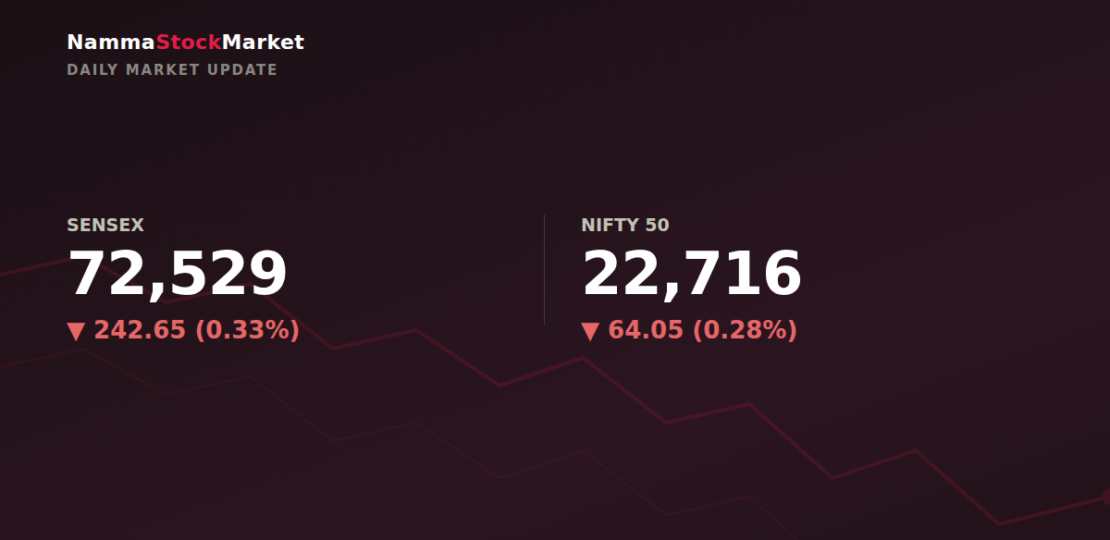
The Indian stock market fell for the second day in a row on Tuesday. The BSE Sensex closed at 72,529.07, down 242.65 points or 0.33%, while the NSE Nifty 50 ended at 22,716.20, down 64.05 points or 0.28%. It wasn’t a crash by any means, but it was a tired, nervous kind of session — the kind where the market opens weak, tries to recover, and then just about manages to claw back some of the day’s losses by the closing bell.
Two things drove the mood today. First, crude oil stayed expensive, with Brent crude climbing close to $107 a barrel on worries that Middle East tensions could disrupt oil supply routes like the Strait of Hormuz. Second, a big domestic story broke: Tata Trusts, the main shareholder of Tata Sons, proposed restructuring the group’s holding company to help it avoid a stock market listing that the Reserve Bank of India (RBI) has been pushing for. That news sent several Tata group stocks tumbling by up to 5%, and it was one of the most-talked-about stories on Dalal Street today. On top of that, it was also the monthly F&O (futures and options) expiry day, which usually adds some extra ups and downs to the last couple of hours of trade.
Market At A Glance
| Index | Close | Points Change | % Change |
|---|---|---|---|
| BSE Sensex | 72,529.07 | ▼ 242.65 | ▼ 0.33% |
| NSE Nifty 50 | 22,716.20 | ▼ 64.05 | ▼ 0.28% |
| Bank Nifty | 54,259.95 | ▼ 211.70 | ▼ 0.39% |
| Nifty Midcap 100 | — | — | ▼ 0.99% |
| Nifty Smallcap 100 | — | — | ▼ 0.81% |
| India VIX | 13.34 | ▼ 0.30 | ▼ 2.20% |
Note: exact closing levels for Nifty Midcap 100 and Nifty Smallcap 100 weren’t available from the sources checked at the time of writing, so only the percentage move is shown for those two rows.
Why The Market Moved
If you’re new to tracking the Indian share market, two numbers probably confused you today: crude oil prices and US bond yields. Here’s why they matter to your portfolio even though neither of them is an Indian stock.
India imports about 85% of the crude oil it uses. When oil prices go up, India’s oil import bill goes up too, and that’s bad news in two ways. It means the government and oil companies spend more dollars buying the same amount of oil, which puts pressure on the rupee (since we need to sell rupees to buy dollars to pay for that oil). A weaker rupee, in turn, makes everything we import more expensive — from petrol to electronics — and can add to inflation. Today, Brent crude (the international oil benchmark, priced in US dollars per barrel) rose close to 2% to around $107 a barrel on fears that tensions in the Middle East could choke off supply routes. That’s exactly the kind of move that makes both the stock market and the rupee nervous.
The second big factor was US bond yields. The yield on the US 10-year Treasury bond climbed above 5.27%, its highest level in nearly two decades. When US bonds pay more interest, some global money that was sitting in riskier markets like India tends to move back to the safety of US bonds. That’s a big reason why foreign investors (FIIs, explained more below) have been net sellers in Indian stocks for a while now, and it also adds pressure on the rupee.
Then there was the Tata Sons story, which is a purely domestic, company-specific trigger. Tata Trusts, which holds about 66% of Tata Sons and is chaired by Noel Tata, proposed merging two group companies — Tata Electronics Systems Solutions and Tata Consulting Engineers — into Tata Sons. Why does this matter? Because the RBI had classified Tata Sons as an “upper layer” non-banking financial company (NBFC), which under RBI rules would eventually force it to list on the stock exchange. Tata Sons wants to stay private, and this restructuring move is designed to bring its operating revenue mix below the threshold that triggers that listing requirement. The RBI had already rejected an earlier request from Tata Sons to exit this classification on September 11, so this new proposal is being watched closely. The uncertainty around what it means for shareholders sent Tata Teleservices (Maharashtra) and Tata Chemicals down about 5% each, Tata Motors Passenger Vehicles down 3% (hitting a 52-week low of ₹272.55), and stocks like Tata Technologies, Tata Communications, TCS, Tata Elxsi and Trent down 1-2%.
Which Sectors Held Up, And Which Didn’t
| Sector | % Change |
|---|---|
| Nifty Pharma | ▲ 1.00% |
| Nifty Metal | ▲ 0.78% |
| Nifty Bank | ▼ 0.39% |
| Nifty Auto | ▼ 1.10% |
| Nifty IT | ▼ 1.34% |
| Nifty Realty | ▼ 2.00% |
Pharma was the star of the day, and interestingly it wasn’t even about India directly — it was about a US tariff decision. The US brought in a 100% tariff on certain patented pharmaceutical products, but gave an exemption for qualifying speciality medicines coming from India, which is a big relief for Indian drugmakers who sell into the US market. That helped stocks like Dr. Reddy’s Laboratories and Sun Pharmaceutical push the Nifty Pharma index up by more than 1%, even as the broader market slipped. Metals also did well, helped along by Adani Enterprises, which jumped over 5% after the disposal of some SEBI (Securities and Exchange Board of India) proceedings against the group removed a bit of overhang.
On the other end, IT stocks continued their rough patch — the Nifty IT index has now fallen for eight straight sessions and is down around 11% for the month of September alone. Rising US bond yields hurt IT stocks specifically because a big chunk of their valuation depends on future earnings, which look less attractive when investors can get a safer, higher return by simply holding US bonds. Stocks like Infosys, Wipro and Tata Elxsi even touched fresh 52-week lows during the day’s trade, though Infosys managed to recover and close in the green. Realty was the single worst-performing sector, down a full 2%, with all its constituents ending in the red as high borrowing costs and general risk-aversion kept buyers away from real estate stocks. Auto and consumer durables were also under pressure, both falling more than 1%, while FMCG and chemical stocks (the latter dragged down by the Tata Chemicals news) also ended lower.
Today’s Top Movers
Adani group stocks led the gainers’ list by a wide margin. Adani Enterprises and Adani Ports and Special Economic Zone both jumped more than 4%, helped by the SEBI overhang clearing up. Pharma names Dr. Reddy’s and Sun Pharma rode the US tariff exemption story, and Infosys was the lone IT name to buck its sector’s trend and close higher.
Top 5 Gainers
| Stock | % Change |
|---|---|
| Adani Enterprises | ▲ 5.01% |
| Adani Ports & SEZ | ▲ 4.49% |
| Dr. Reddy’s Laboratories | ▲ 2.53% |
| Sun Pharmaceutical | ▲ 1.47% |
| Infosys | ▲ 1.22% |
Top 5 Losers
| Stock | % Change |
|---|---|
| Titan Company | ▼ 3.00% |
| Wipro | ▼ 2.95% |
| HCL Technologies | ▼ 2.44% |
| Apollo Hospitals Enterprise | ▼ 2.27% |
| Tech Mahindra | ▼ 2.06% |
On the losing side, it was almost entirely an IT and consumer-facing story. Titan Company was the biggest loser in the Nifty 50, falling 3% as investors booked profits after a strong run in jewellery and watch stocks. Wipro, HCL Technologies and Tech Mahindra all fell between 2% and 3% as the IT sector’s selling continued, and Apollo Hospitals also slipped. If you’re holding IT stocks right now, today was another tough day — but if you’re holding pharma or the Adani group names, you’d have had a much better time.
What FIIs and DIIs Were Doing
You’ll often see the terms FII and DII in market reports, so here’s a quick explainer if you’re newer to this. FII stands for Foreign Institutional Investor — big foreign funds and institutions that invest in Indian stocks from outside the country (this is sometimes also called FPI, or Foreign Portfolio Investor). DII stands for Domestic Institutional Investor — Indian mutual funds, insurance companies like LIC, and other local institutions that invest money on behalf of Indian savers, including the money that flows in every month through mutual fund SIPs (Systematic Investment Plans) from regular investors like you.
Today’s official FII/DII cash market figures for September 29 hadn’t been released at the time of writing — this data usually comes out after market hours, so check back tomorrow for today’s exact numbers. Here’s what the last five available trading days looked like in the cash segment:
| Date | FII Net (₹ Crore) | DII Net (₹ Crore) |
|---|---|---|
| Sep 22, 2026 | ▼ 3,809.99 | ▲ 4,120.07 |
| Sep 23, 2026 | ▲ 1,617.45 | ▲ 2,341.46 |
| Sep 24, 2026 | ▼ 5,027.36 | ▲ 4,301.18 |
| Sep 25, 2026 | ▼ 3,693.93 | ▲ 2,838.17 |
| Sep 28, 2026 | ▼ 5,353.20 | ▲ 5,189.00 |
Notice the pattern here: FIIs have been net sellers on four out of the last five days, pulling out roughly ₹3,700 crore to ₹5,350 crore on the heavier selling days. But DIIs have been buying just as consistently, and in almost the same size, which is exactly why the market hasn’t fallen much harder than it has. This is a trend that’s been playing out through most of September — foreign investors pulled out close to $3.7 billion from Indian markets this month amid the pressure from crude oil and US bond yields, but domestic mutual funds and insurance money, a lot of it coming in steadily through SIPs, has been quietly absorbing that selling. If you have a SIP running, this is exactly the kind of scenario where that discipline pays off — DII buying like this is, in a roundabout way, powered by ordinary investors continuing to invest every month regardless of the daily noise.
Oil, The Rupee, And Global Cues
Brent crude (the global benchmark for oil, always quoted in US dollars per barrel) ended the day near $107, up close to 2%, after touching even higher levels earlier in the session. The worry is straightforward: tensions in the Middle East have raised fears that oil supply through key routes could be disrupted, and reports that Saudi Arabia’s East-West pipeline had only partially resumed operations didn’t fully calm those nerves. For India, which imports the vast majority of its crude oil needs, a sustained rise in oil prices is never good news — it widens the oil import bill, adds pressure on the rupee, and can eventually feed into inflation at the petrol pump and beyond.
The rupee itself had a choppy day. It slipped to an intraday low of nearly 96.15 against the US dollar — its weakest level in about two months — as the double pressure of expensive oil and a strong US dollar took its toll. But it clawed back through the session, helped by hopes that the US and Iran could restart negotiations (which would ease some of the oil-supply worries) and by what traders described as RBI intervention defending the psychologically important 96-per-dollar level. By the close, the rupee had actually recovered to settle at 95.95 against the dollar, up 2 paise from the previous close of 95.97 — a flat day in the end, but with a lot of drama in between.
Global cues weren’t particularly friendly either. US Treasury yields kept climbing, with the 10-year yield crossing 5.27%, its highest level in around 19 years, as investors there priced in a tougher-for-longer interest rate environment from the US Federal Reserve. Higher US yields typically make emerging markets like India relatively less attractive to global money in the short term, which is part of why FIIs have been selling and why the rupee has been under pressure through the month.
What To Watch Tomorrow
The two big swing factors right now are the same ones that drove today’s session: crude oil and US bond yields. Any fresh headline on Middle East tensions, or on a potential US-Iran de-escalation, could move oil prices sharply in either direction, and the rupee and Nifty will likely follow that lead. Keep an eye on India VIX too — it eased to 13.34 today after touching a high of 14.77 during the session, but a number consistently above 13-14 usually means the market expects more volatility ahead, not less.
On the sector front, IT looks like the most exposed space right now given its eight-day losing streak and its sensitivity to US bond yields, so any further rise in US yields could extend that weakness. Pharma, on the other hand, looks relatively more resilient after today’s tariff-exemption news, though that’s obviously specific to companies with meaningful US speciality drug exposure. The Tata Sons restructuring story is also one to track closely over the next few days — further details or regulatory reactions to the Tata Trusts proposal could keep group stocks like Tata Chemicals, Tata Teleservices Maharashtra and Tata Motors Passenger Vehicles volatile. As always, this is general market information to help you follow what’s happening, not investment advice on what to buy or sell — that decision should factor in your own goals, whether you invest through direct stocks, mutual fund SIPs, or F&O, and your own risk appetite.
RELATED POSTS
View all

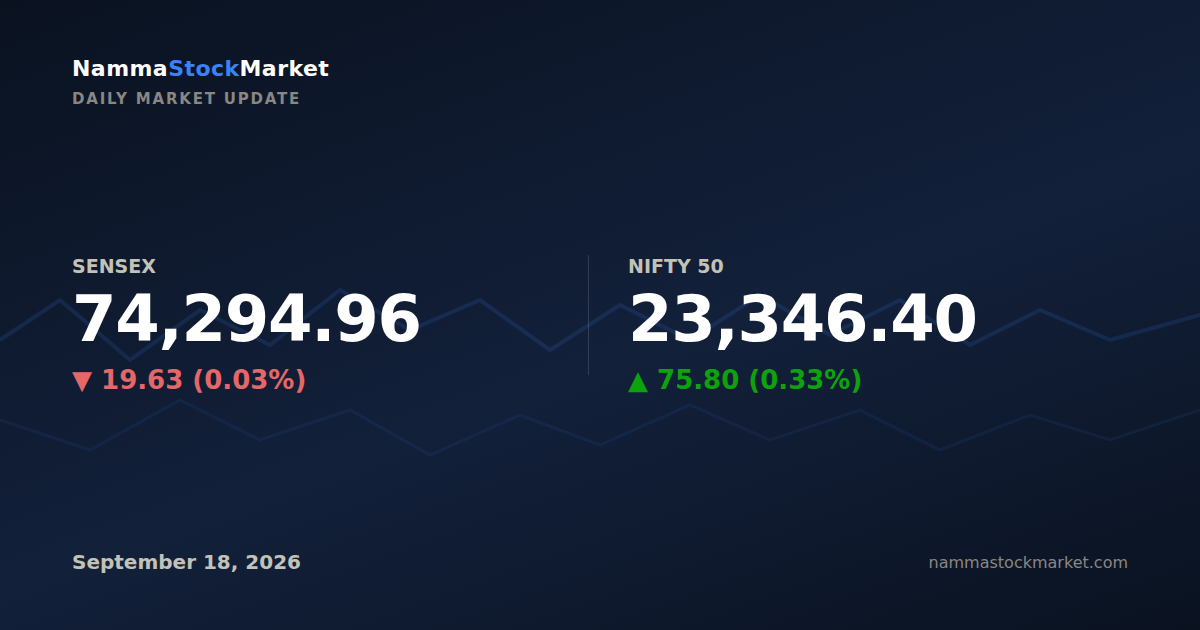
Nifty Ends Higher At 23,346 As Smallcaps Jump 1.7%, But TCS Crash Drags Sensex Into The Red
September 18, 2026 | by NammaStockMarket
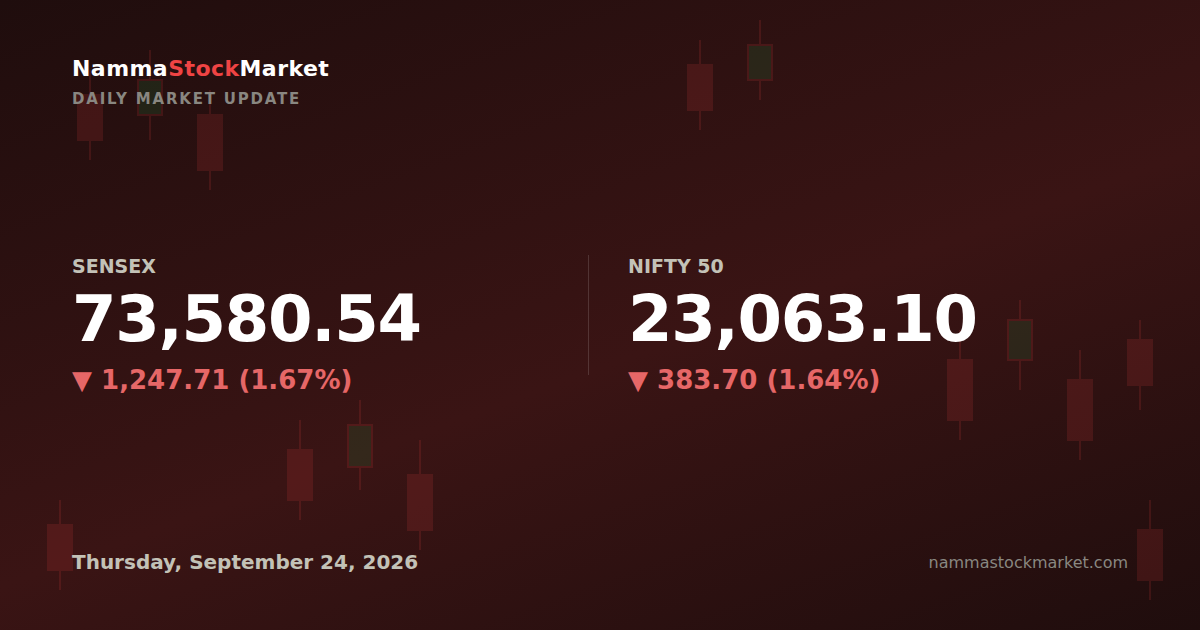
Sensex Crashes 1,247 Points, Nifty Slips Below 23,100 As Crude Oil Spikes And IRDAI Insurance Rules Hit Bank Stocks
September 24, 2026 | by NammaStockMarket
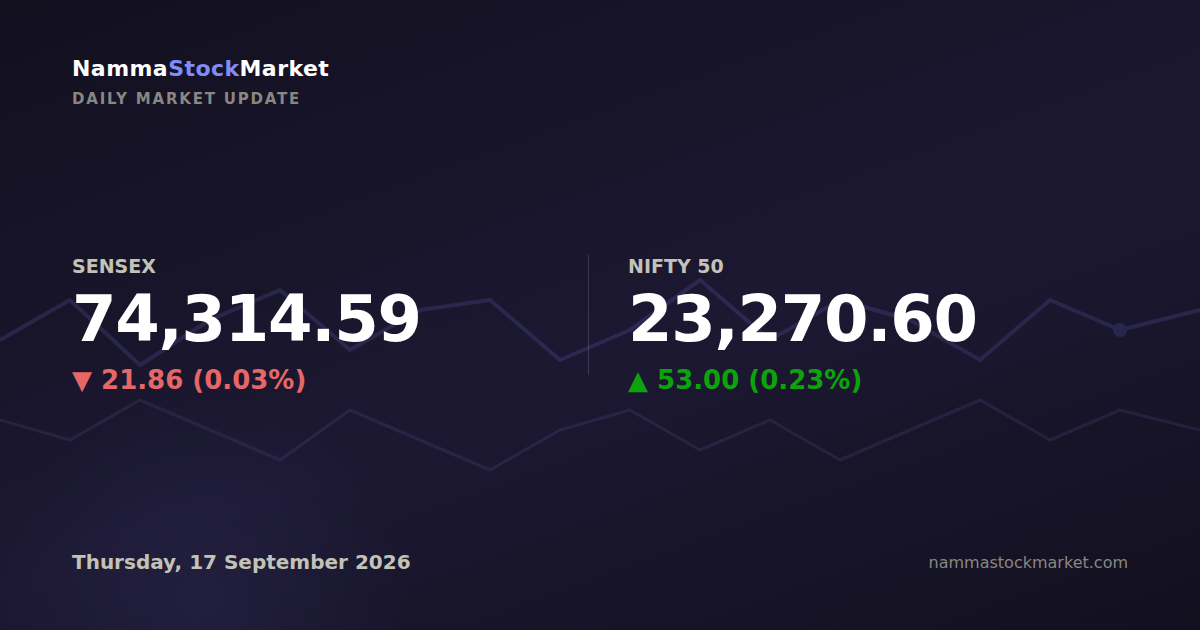
Sensex Ends Nearly Flat, Nifty Closes At 23,270 As Pharma, Realty Rally While Fed Rate Hike Hits IT And Bank Stocks
September 17, 2026 | by NammaStockMarket