

Economic Calendar India Today – Friday, 16 October 2026: RBI Forex Reserves Data
October 16, 2026 | by NammaStockMarket

Friday, 16 October 2026 (IST) | Last updated 5:50 PM IST
Welcome to today’s Economic Calendar India update. The one scheduled Indian data point for today is the Reserve Bank of India’s (RBI) weekly forex reserves figure, this time for the week ended 9 October 2026. The number is already out, so this page explains what it shows, how it compares with recent weeks, and why investors in the Indian stock market and the rupee keep an eye on it.
Economic Calendar India – Today’s Key Events
| Time (IST) | Economic Indicator | Reporting Period | Previous Data | Forecast | Why It Matters |
|---|---|---|---|---|---|
| Weekly Friday release (exact time not verified)† | India foreign exchange reserves. Released: $726.03 bn, down $8.58 bn | Week ended 9 Oct 2026 | $734.6 bn | Not available | Shows the RBI’s cushion to manage rupee volatility and external shocks |
† The RBI publishes forex reserves every week, normally on Friday. Data aggregators show different clock times for it, so we have not stated one. The previous reading is for the week ended 2 October 2026. No reliable consensus forecast was found, and none is shown.
Understanding Today’s Economic Indicators
Foreign Exchange Reserves
What it is. Forex reserves are the foreign assets held by the RBI. They include foreign currency assets (mainly US dollar securities and deposits), gold, Special Drawing Rights (SDRs, an international reserve asset issued by the IMF) and India’s reserve position with the IMF. The RBI releases the total every week, along with a breakdown.
Why it matters for India. India imports a large amount of crude oil, and foreign investors move money in and out of Indian stocks and bonds. Reserves give the RBI room to sell dollars when the rupee is under pressure, and they are one of the first things rating agencies and FIIs (foreign institutional investors) look at when judging external stability.
What the data shows (official figures, as reported). For the week ended 9 October 2026, total reserves were $726.03 billion, down $8.58 billion from $734.6 billion a week earlier. Foreign currency assets fell $7.14 billion to $597.61 billion. Gold reserves fell $1.32 billion to $105.09 billion. SDRs stood at $18.55 billion and the IMF reserve position at $4.78 billion. Compared with the end of March 2026, reserves are higher by $34.92 billion, and compared with a year earlier they are higher by $28.24 billion.
The recent trend. This is the fifth straight weekly fall. Reserves touched a record $785.7 billion in the week ended 4 September, so they are now about $59.7 billion lower than that peak. Business Standard reported that the previous week’s decline was linked to RBI dollar sales to support the rupee, with a stronger dollar and lower gold prices also reducing the dollar value of holdings. Changes in reserves reflect both RBI action and valuation effects, and weekly data does not separate the two.
Market expectations. None verified. We did not find a reliable consensus forecast for this release.
What to watch. The split between foreign currency assets and gold, the pace of further declines, the rupee’s movement against the dollar, and crude oil prices. Business Standard has noted that Brent crude was above $100 per barrel in the previous week, which raises India’s import bill.
Possible market implications. Falling reserves can raise questions about how much room the RBI has to defend the rupee. A weaker rupee can push up imported inflation, which the RBI weighs when setting the repo rate (the rate at which it lends short-term money to banks). Banking stocks, bond yields and rupee-sensitive sectors such as IT exporters and oil marketing companies are sometimes discussed in this context. These are possible links, not certain outcomes. Reserves remain large by historical standards.
Historical Data of India’s Forex Reserves
The table below uses the last seven weekly readings of total reserves in US$ billion. All are weekly figures reported by the RBI and carried by news agencies, and they can be revised in later RBI publications.
| Week Ended | Total Reserves (US$ bn) | Previous Week’s Value (US$ bn) | Interpretation |
|---|---|---|---|
| 28 Aug 2026 | 740.80 | Not verified | Starting point before the record jump |
| 4 Sep 2026 | 785.71 | 740.80 | Record weekly rise of $44.90 bn, taking reserves to an all-time high |
| 11 Sep 2026 | 780.78 | 785.71 | First fall after the record, down $4.92 bn |
| 18 Sep 2026 | 765.90 | 780.78 | Fall widened to $14.88 bn |
| 25 Sep 2026 | 747.56 | 765.90 | Largest weekly fall on record, about $18.3 bn |
| 2 Oct 2026 | 734.60 | 747.56 | Fall of $12.95 bn, fourth in a row |
| 9 Oct 2026 | 726.03 | 734.60 | Fall of $8.58 bn, fifth in a row, smaller than the three prior weeks |
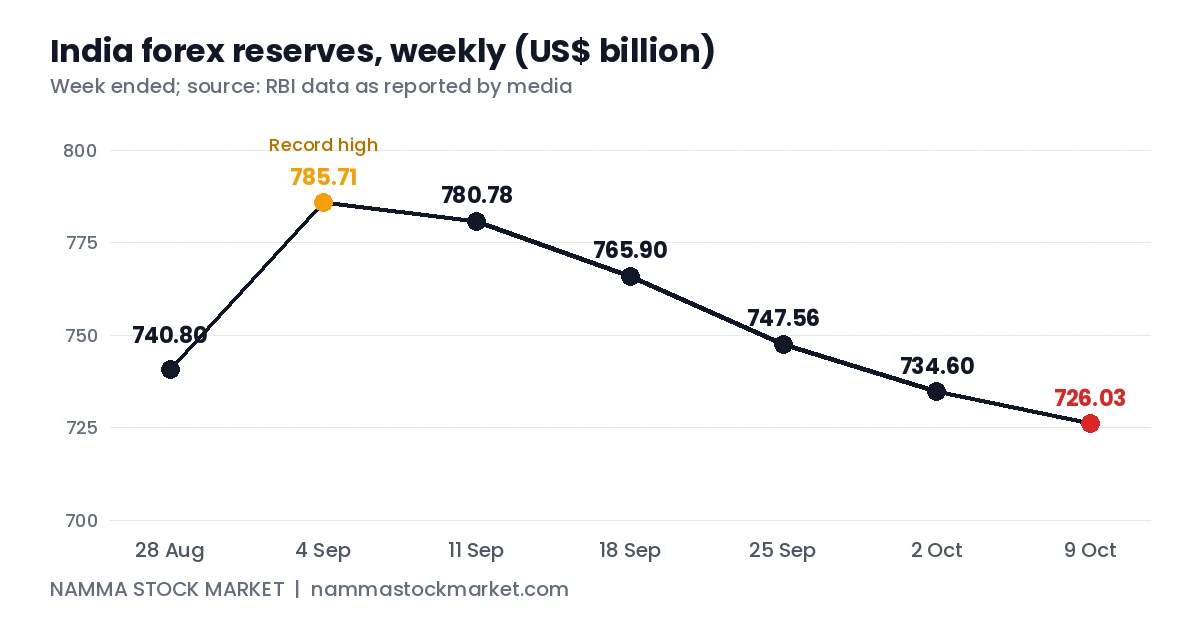
In simple words: reserves jumped to a record in early September, then fell every week since. The size of the weekly fall grew until the week ended 25 September and has narrowed in the last two weeks, but the direction has not yet reversed. All figures are in the same unit (US$ billion, weekly, not seasonally adjusted). Source: RBI weekly data as carried by Business Standard, The Wire and Punjab Kesari.
How Could Today’s Economic Data Affect the Indian Stock Market?
Forex reserves do not usually move the Nifty 50 or Sensex directly, but they feed into a few channels that investors watch.
- Rupee and imports. If the RBI sells dollars to steady the rupee, reserves fall. A weaker rupee raises the cost of imported crude and electronics.
- Inflation and interest rates. Higher imported costs can add to inflation, which can influence expectations on the RBI’s next repo rate decision and on bond yields. For the latest inflation reading, see our CPI inflation update for 12 October.
- Foreign flows. Reserves and the external balance are part of how FIIs judge India’s macro stability. Our trade data update for 15 October covers the other side of the external picture.
Markets react to many things at once, including global cues, crude oil and FII flows, so the effect of any single release can be small or short-lived. For today’s market setup, see our pre-market report for 16 October 2026.
What Should Indian Investors Watch Today?
- Whether weekly falls in reserves keep narrowing, as they did in the last two readings, or start widening again.
- How much of the decline comes from foreign currency assets versus gold, since gold moves with global prices.
- The rupee’s trend against the dollar and the direction of Brent crude.
- The next weekly reserves release on 23 October 2026, and the next RBI policy decision.
Frequently Asked Questions
What is the Economic Calendar India?
It is a schedule of important Indian data releases such as CPI, WPI, IIP, PMI, GDP, trade data, forex reserves and RBI policy decisions, along with the date, time and previous readings. Investors use it to know when new information about the economy is due.
Where can I check the India economic calendar today?
Official release calendars are published by MoSPI, the Office of the Economic Adviser (DPIIT), the Ministry of Commerce and the RBI release calendar. Our daily Economic Calendar India page also lists verified releases for the day.
What are India’s forex reserves?
They are the foreign currency assets, gold, SDRs and IMF reserve position held by the RBI. They help the central bank manage the rupee and pay for imports during shocks.
Which indicators matter most for the Indian stock market?
Retail inflation (CPI), RBI repo rate decisions, GDP growth, IIP, PMI, trade data and forex reserves are among the most closely followed. Which one matters most depends on the market situation at that time.
How can economic data affect Nifty 50 and Sensex?
Data can change expectations about interest rates, company earnings and the rupee, which in turn can influence share prices. Reactions vary and are never certain.
Conclusion
India’s forex reserves stood at $726.03 billion in the week ended 9 October 2026, down $8.58 billion on the week and the fifth straight weekly fall since the record $785.7 billion in early September. The pace of decline has slowed in the last two weeks, and reserves remain well above their level a year ago. Investors will want to track the rupee, crude oil and the next weekly release.
Data sources: weekly forex reserves as published by the RBI and reported by Business Standard, The Wire, Business Standard (11 Sep week), The Print and Punjab Kesari; schedule cross-checked with Trading Economics. The RBI’s own page for the 9 October week could not be separately accessed at the time of writing, and figures may be revised. Bank loan and deposit growth also appear on some aggregator calendars for today but could not be verified, so they are not covered here.
This article is for informational and educational purposes only and does not constitute investment advice. Please consult a SEBI-registered investment advisor before making any trading or investment decisions.
RELATED POSTS
View all

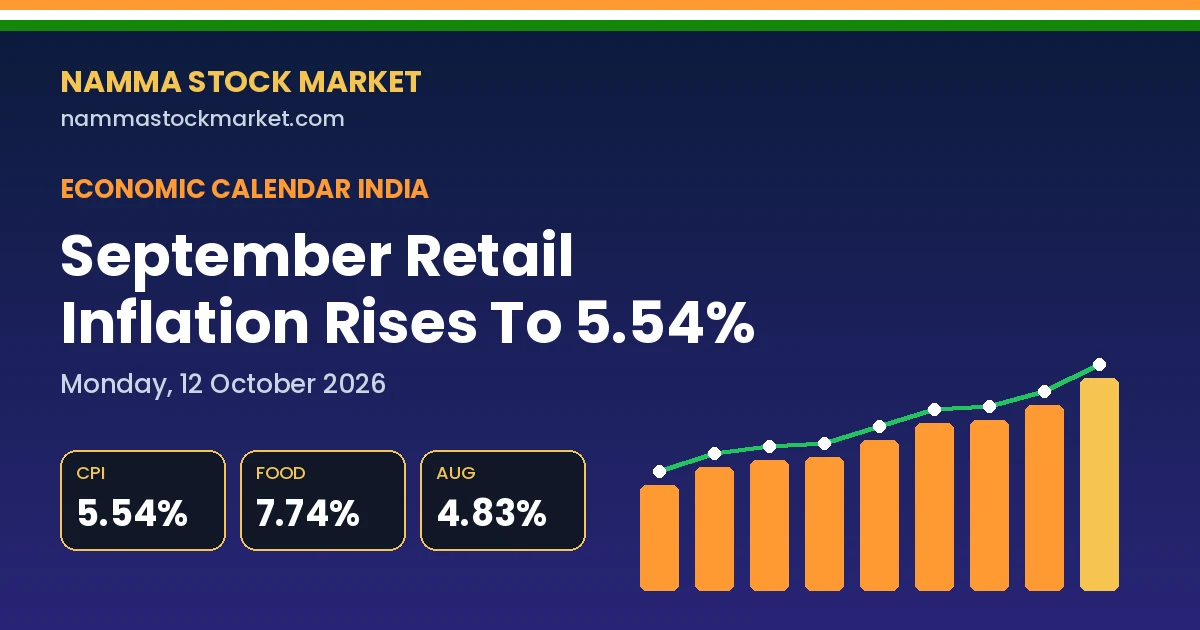
Economic Calendar India Today – Monday, 12 October 2026: CPI Inflation Data Released
October 12, 2026 | by NammaStockMarket
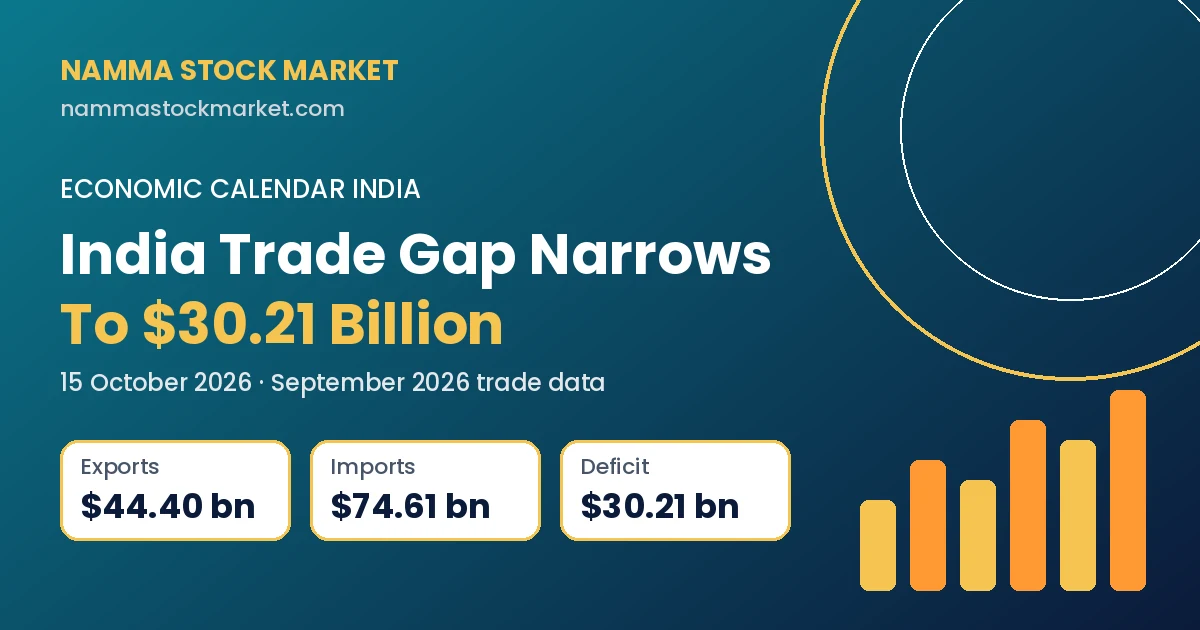
Economic Calendar India Today – Thursday, 15 October 2026: Trade Data Released
October 15, 2026 | by NammaStockMarket