

Sensex, Nifty End Flat As Banks Slide But Pharma, Realty, Media Shine; Tata Consumer Jumps 6.78%
October 27, 2026 | by NammaStockMarket
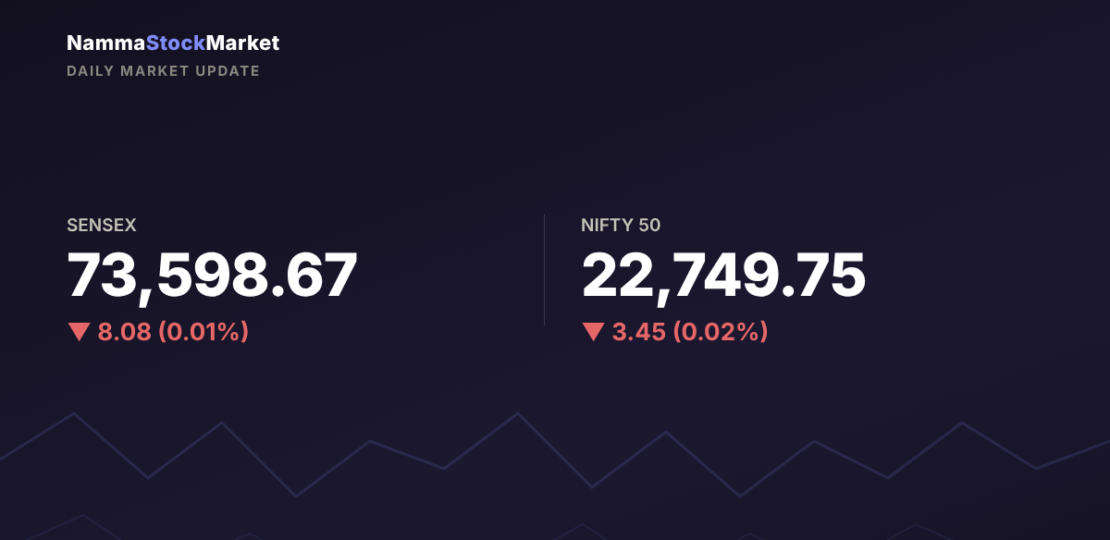
The Indian stock market ended almost exactly where it started today, but don’t let that “flat” headline number fool you — underneath the surface, it was anything but a boring day. The BSE Sensex closed at 73,598.67, down just 8.08 points, and the NSE Nifty 50 settled at 22,749.75, down a tiny 3.45 points. If you only looked at these two numbers, you’d think nothing happened. But if you were holding pharma, realty or media stocks, you had a genuinely good day. And if you were sitting in private banks, it was a different story — Bank Nifty fell 391.80 points, down 0.72%, as profit booking hit banking counters hard. The tug of war between a few hot sectors going up and heavyweight banks pulling the index down is exactly why Sensex and Nifty look unchanged while your own portfolio might have moved quite a bit either way.
The two big things on everyone’s mind today were crude oil and the US Federal Reserve. Brent crude oil stayed close to $115 a barrel, not far from a six-month high, after fresh attacks near Saudi Arabia raised fears that oil supply from the Middle East could get disrupted. On top of that, investors are staying cautious ahead of the US Fed’s interest rate decision, due out tomorrow, October 28. Nobody wants to take big fresh bets right before that kind of event, and that caution showed up as a flat, directionless Nifty and Sensex today.
| Index | Close | Points Change | % Change |
|---|---|---|---|
| BSE Sensex | 73,598.67 | ▼ 8.08 | ▼ 0.01% |
| NSE Nifty 50 | 22,749.75 | ▼ 3.45 | ▼ 0.02% |
| Bank Nifty | 53,974.90 | ▼ 391.80 | ▼ 0.72% |
| Nifty Midcap 100 | — | — | ▲ 1.00% |
| Nifty Smallcap 100 | — | — | ▲ 2.69% |
| India VIX | 16.35 | — | ▼ 4.72% |
Note: exact closing levels for Nifty Midcap 100 and Nifty Smallcap 100 were not available at the time of publishing, so only the percentage move is shown. India VIX reading is from late-afternoon trade, very close to the final close.
Why The Market Moved
If you’re newer to investing, India VIX is basically the market’s “fear gauge” — it tells you how nervous or calm traders are feeling about the next 30 days. A falling VIX, like today’s 4.72% drop to 16.35, usually means people are a little less panicked than before, even if the index itself didn’t move much.
The real story behind today’s caution is crude oil. India buys most of its oil from other countries, so when Brent crude stays elevated near $115 a barrel, it directly hits our import bill — we have to spend more precious dollars buying the same amount of oil. That weakens the rupee, makes imported goods costlier, and eventually shows up as inflation at home. This is why you’ll often hear market experts link “oil going up” with “rupee going down” with “RBI getting worried” — they’re all connected. Today’s attacks near Saudi Arabia added fresh worry about oil supply getting disrupted, even though there were also some hopes that tensions around Iran could cool off, which is why crude actually eased slightly during the day instead of spiking further.
The other big overhang is the US Federal Reserve’s policy decision, due tomorrow. When the Fed signals it will keep US interest rates high, it tends to make the dollar stronger and pulls money away from markets like India, because foreign investors can earn safer returns in the US itself. That is part of the reason FIIs (foreign institutional investors, the big overseas funds that invest in Indian shares) have continued to be net sellers this month, and why everyone is just waiting it out before making big moves.
Which Sectors Held Up, And Which Didn’t
This is where today’s real action was. If you’re holding pharma, realty or media stocks, today was a genuinely good day for you. If you’re sitting mostly in private banks or IT, it was a quiet drag on your portfolio even though the headline index barely moved.
| Sector | % Change |
|---|---|
| Nifty Media | ▲ 3.66% |
| Nifty Realty | ▲ 1.94% |
| Nifty Pharma | ▲ 1.91% |
| Nifty Auto | ▲ 1.48% |
| Nifty Consumer Durables | ▲ 1.19% |
| Nifty FMCG | ▲ 0.74% |
| Nifty Energy | ▲ 0.68% |
| Nifty Metal | ▲ 0.64% |
| Nifty IT | ▼ 0.26% |
| Nifty Financial Services | ▼ 0.62% |
| Nifty Bank | ▼ 0.72% |
Media stocks topped the charts today, up 3.66%, continuing a recent run of strength in that space. Realty and pharma weren’t far behind, both gaining close to 2%, while auto stocks added another 1.48% on steady demand expectations. On the other side, it was a rough day for banking. Private banks and the broader Nifty Bank index fell 0.72%, and Financial Services dropped 0.62%, as investors booked profits in some of the heavyweight names that have run up a lot this year. IT stocks also slipped slightly, down 0.26%, on lingering worries about how fast the sector can grow from here.
Today’s Top Movers
Tata Consumer Products was the standout stock of the day by a huge margin, jumping 6.78% to close at ₹1,000. Bharti Airtel, BSE Ltd, Trent and Power Grid Corporation rounded out the top five gainers, each adding between roughly 1.9% and 3.2%.
| Stock (Top Gainers) | % Change |
|---|---|
| Tata Consumer Products | ▲ 6.78% |
| Bharti Airtel | ▲ 3.20% |
| BSE Ltd | ▲ 2.44% |
| Trent | ▲ 2.42% |
| Power Grid Corporation | ▲ 1.92% |
| Stock (Top Losers) | % Change |
|---|---|
| Asian Paints | ▼ 1.94% |
| Coal India | ▼ 1.73% |
| Grasim Industries | ▼ 1.67% |
| State Bank of India | ▼ 1.63% |
| TCS | ▼ 1.50% |
Tata Consumer’s jump stood out as the day’s biggest individual mover by far, well ahead of anything else on the list, while the fall in SBI and TCS lines up with the broader weakness we saw in banking and IT. Asian Paints continued to struggle, extending its recent run of selling pressure as the paints business deals with soft demand and heavy competition.
What FIIs And DIIs Were Doing
You’ll see “FII” and “DII” mentioned in almost every market report, so here’s a quick explainer if you’re new to this. FIIs, or foreign institutional investors (sometimes also called FPIs, foreign portfolio investors), are big overseas funds that buy and sell Indian shares. DIIs, or domestic institutional investors, are Indian mutual funds, insurance companies and similar big local players — a lot of this money actually comes from your own SIP (systematic investment plan) contributions if you invest in mutual funds every month. Watching whether these two are buying or selling tells you a lot about the mood of “smart money” in the market.
Today’s (October 27) official FII/DII cash market figure was not out at the time of publishing — this data usually gets released after market hours. Here is the most recent confirmed data we have, covering the last few trading sessions:
| Date | FII Net (₹ Crore) | DII Net (₹ Crore) |
|---|---|---|
| 26 Oct 2026 | ▼ ₹1,462.49 crore | ▲ ₹2,609.57 crore |
| 23 Oct 2026 | ▲ ₹887.65 crore | ▲ ₹3,235.36 crore |
| 22 Oct 2026 | ▼ ₹3,458.70 crore | ▲ ₹2,891.32 crore |
| 21 Oct 2026 | ▲ ₹1,022.32 crore | ▲ ₹1,614.32 crore |
| 19 Oct 2026 | ▼ ₹1,148.64 crore | ▲ ₹3,201.19 crore |
Markets were shut for Dussehra on October 20 and for the weekend on October 24-25, so there is no data for those dates.
Notice the pattern here: in four of the last five sessions, FIIs have been net sellers, while DIIs have been net buyers on every single one of these days, and by a bigger amount each time. This is the “DIIs cushioning FII selling” story that has basically defined the Indian market for much of this year. October alone has seen FII outflows of roughly $4.75 billion, and FIIs have sold a record $32.56 billion worth of Indian shares so far this year (provisional figures). If you’re a long-term SIP investor, this is actually one reason your monthly contributions matter more than you think — that steady domestic flow is what has kept the market from falling much harder every time foreign money has pulled out.
Oil, The Rupee, And Global Cues
Brent crude eased slightly today to $115.02 a barrel, down about half a percent, but it’s still sitting close to a six-month high. The dip came on some hope that tensions between the US and Iran could cool off, but fresh attacks near Saudi Arabia kept alive the fear that oil supply from the Middle East could get disrupted again at any time. For India, this matters a lot more than it might seem at first glance. We import close to 85% of our crude oil needs, so every dollar increase in the price adds real pressure to our oil import bill, which in turn weakens the rupee and adds to inflation risk at home. This is why Indian markets watch Brent crude almost as closely as they watch our own Nifty.
The rupee itself actually closed marginally higher today, up 3 paise to settle at 95.12 against the US dollar, even with crude staying elevated. Traders pointed to likely intervention by the RBI (Reserve Bank of India) to support the currency, since the rupee had already lost about 77 paise over the previous three trading sessions. On global cues, all eyes are now on the US Federal Reserve’s policy decision due tomorrow, October 28. Dow Jones and Nasdaq traders in the US have been treading carefully ahead of this meeting too, and a hawkish tone from the Fed chief could push US bond yields and the dollar higher, which usually isn’t great news for emerging markets like India since it can pull more foreign money out of our market and add further pressure on the rupee.
What To Watch Tomorrow
The single biggest event on tomorrow’s calendar is the US Federal Reserve’s interest rate decision. If the Fed sounds more hawkish than expected, expect some pressure on Nifty and the rupee in early trade; a softer tone could give banks and IT a relief bounce after today’s weakness. Closer to home, Q2 FY27 earnings season is still in full swing, so expect more stock-specific action around individual results rather than one broad market move. Given today’s bounce in Nifty Midcap and Smallcap, which rose 1% and 2.69% respectively even as the headline indices stayed flat, it’s worth watching whether that broader market strength continues or whether it was just a one-day rotation out of large private banks. Crude oil and any further news from West Asia remain the wildcard that could move sentiment quickly in either direction. As always, this is general market information and not a buy or sell recommendation — please do your own research or speak with your financial advisor before making any investment decisions, especially if you’re investing through a demat and trading account for the first time.
RELATED POSTS
View all

Sensex Jumps 685 Points, Nifty Closes Above 22,750 As Markets Rally Ahead Of RBI Rate Decision
October 6, 2026 | by NammaStockMarket
Sensex Crashes 876 Points, Nifty Below 22,900 As Bank Earnings Disappoint And Crude Stays Hot
October 19, 2026 | by NammaStockMarket
Sensex Crashes 1,124 Points, Nifty Slips Below 22,800 As Brent Crude Tops $107 On Iran Standoff
September 28, 2026 | by NammaStockMarket