

Sensex Jumps 384 Points, Nifty Nears 24,000 For 5th Day As Media, Metal Stocks Rally; IT Stocks Alone Drag
November 4, 2026 | by NammaStockMarket
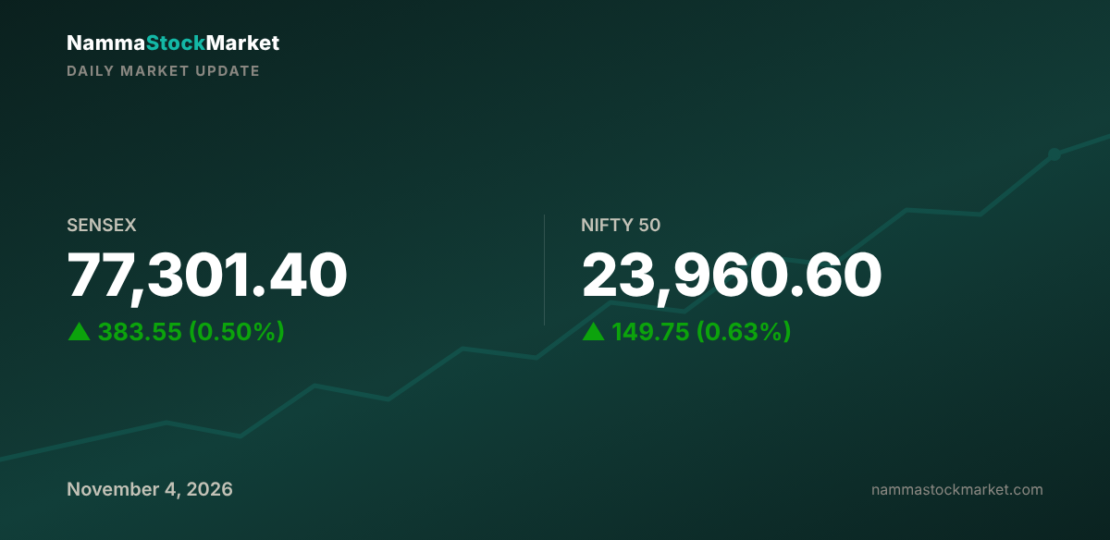
The Indian stock market closed higher on Wednesday for the fifth day in a row, and if you’ve been holding on through the recent ups and downs, today would have put a smile on your face. The BSE Sensex climbed 383.55 points, or 0.50%, to end at 77,301.40, while the NSE Nifty 50 added 149.75 points, or 0.63%, to close at 23,960.60 — its best closing level in about two months. Two things drove the rally: crude oil prices cooled off further on hopes that the wars in Ukraine and Iran might be nearing some kind of resolution, and foreign investors came back as strong buyers of Indian shares after a rough patch. The only sore spot in an otherwise green day was IT stocks, which fell as traders worried about what a change in the balance of power in the US Congress could mean for India’s technology exporters.
Small-cap and mid-cap stocks did even better than the main indices — the Nifty Smallcap 100 jumped about 2%, so if your portfolio leans toward smaller companies, today was a particularly good one. Media, metal and realty stocks led the charge on the NSE and BSE, while banking and financial stocks also chipped in with steady gains.
Market At A Glance
| Index | Close | Points Change | % Change |
|---|---|---|---|
| BSE Sensex | 77,301.40 | ▲ 383.55 | ▲ 0.50% |
| NSE Nifty 50 | 23,960.60 | ▲ 149.75 | ▲ 0.63% |
| Nifty Bank | 55,913.60 | ▲ 373.55 | ▲ 0.67% |
| Nifty Midcap 100 | 59,505.50 | ▲ 905.75 | ▲ 1.55% |
| Nifty Smallcap 100 | 19,026.40 | ▲ 373.07 | ▲ 2.00% |
| India VIX | 15.23 | ▼ 0.49 | ▼ 3.12% |
All figures are closing levels from the National Stock Exchange (NSE) and Bombay Stock Exchange (BSE) for Wednesday, November 4, 2026.
Why The Market Moved
If you’re newer to investing, you’ll often hear that “global cues” move the Indian share market, and today was a good example of why. Crude oil is the big one. India imports almost all the crude oil it needs, and we pay for it in US dollars. So when oil prices fall, India’s oil import bill gets smaller, which is good news for the rupee and for inflation at home — and that’s exactly what happened today. Brent crude, the international benchmark for oil prices, slipped further to around $102-103 a barrel, extending Tuesday’s near 1% drop to a four-week low of $103.60. The reason: growing hope that talks to end the wars in Ukraine and Iran could succeed, which would mean more oil supply reaching the market and less risk of disruption. Russia, Ukraine and the US are reportedly set to hold three-way talks in Abu Dhabi on November 10-11, and Qatar is mediating between Washington and Tehran separately. None of this is settled yet — an Iranian official told Reuters the two sides are still “a long way” from any deal — but even the possibility was enough to calm oil markets and, in turn, cheer Dalal Street (the nickname for Mumbai’s financial district, home to the BSE).
The second big driver was foreign money. Foreign Institutional Investors, or FIIs — these are big funds based outside India that invest in our markets — had been net sellers for a while, but they’ve now bought Indian shares for three sessions in a row, including a strong ₹6,836.81 crore worth of buying on Tuesday alone. When FIIs buy heavily, it usually means international money managers are feeling more confident about India, and that extra demand tends to push up stock prices, especially in large, liquid names.
There was a third factor too, a bit more mixed: the US midterm elections. Early results suggest the Democrats have won control of both the House and the Senate, which commentators are calling a setback for President Trump. For Indian markets, this cuts both ways. On one hand, it could complicate the India-US bilateral trade talks that have been in the works, and ongoing restrictions on H-1B work visas and student visas add a layer of uncertainty for Indian IT companies, many of whom send large numbers of employees to the US on these visas. That’s one reason IT stocks underperformed today even as the rest of the market rallied. On the other hand, some investors see a divided US government as reducing the chances of fresh aggressive tariff action, which is why the broader market still managed to rise.
Which Sectors Held Up, And Which Didn’t
| Sector | % Change |
|---|---|
| Nifty Media | ▲ 5.15% |
| Nifty Realty | ▲ 2.85% |
| Nifty Metal | ▲ 2.80% |
| Nifty Energy | ▲ 2.17% |
| Nifty Consumer Durables | ▲ 2.04% |
| Nifty FMCG | ▲ 1.50% |
| Nifty Auto | ▲ 1.16% |
| Nifty Financial Services | ▲ 0.88% |
| Nifty Pharma | ▲ 0.42% |
| Nifty IT | ▼ 1.50% |
Media stocks stole the show today, with the Nifty Media index surging over 5% — by far the strongest sectoral move of the day. Realty and metal stocks weren’t far behind, both up close to 2.8%, as easing crude prices and hopes of lower interest rates ahead made rate-sensitive sectors like real estate more attractive. Energy and consumer durables stocks also had a strong session. Banking stocks, tracked by the Nifty Bank index (Bank Nifty), rose a more modest 0.67% to close at 55,913.60 — healthy, but not the leader it sometimes is on days when the broader market rallies hard.
IT was the one sector that spoiled the party, falling 1.5% as the top drag on both the Sensex and the Nifty. If you’re holding IT stocks in your portfolio, today wasn’t a great day — the sector has been under pressure for a while now on worries about US client spending and visa policy, and the midterm election result gave traders one more reason to book profits in the space.
Today’s Top Movers
Top Gainers
| Stock | Close (₹) | % Change |
|---|---|---|
| Bharat Electronics (BEL) | 398.00 | ▲ 4.71% |
| Adani Enterprises | 2,709.20 | ▲ 4.47% |
| Titan Company | 4,754.40 | ▲ 4.22% |
| Jio Financial Services | 222.27 | ▲ 3.73% |
| Max Healthcare Institute | 927.15 | ▲ 3.53% |
Defence PSU Bharat Electronics led the gainers’ list today, up nearly 4.71%, a sign that the defence theme continues to find buyers on Dalal Street. Adani Enterprises and Titan Company both rallied over 4%, while two financial-services-linked names, Jio Financial Services and Max Healthcare, rounded out the top five with gains of around 3.5-3.7%.
Top Losers
| Stock | Close (₹) | % Change |
|---|---|---|
| Tata Consultancy Services (TCS) | 2,436.00 | ▼ 2.52% |
| HCL Technologies | 1,405.00 | ▼ 2.37% |
| Coal India | 399.65 | ▼ 2.05% |
| BSE Ltd | 3,601.50 | ▼ 1.75% |
| Infosys | 1,128.20 | ▼ 1.73% |
Unsurprisingly, given the sector’s weak day, the losers’ list was dominated by IT names. TCS, the country’s largest IT services company, slid 2.52% to ₹2,436, and HCL Technologies wasn’t far behind at a 2.37% fall. Infosys and BSE Ltd also ended in the red, while Coal India dropped over 2% on profit-booking after its recent run-up. If you hold any of these stocks for the long term, a single red day like this usually isn’t a reason to panic — but it’s worth keeping an eye on how IT earnings and US policy news develop over the next few weeks.
What FIIs And DIIs Were Doing
You’ll see FII and DII numbers mentioned in almost every market report, so here’s a quick refresher if you’re newer to this: FIIs (Foreign Institutional Investors, sometimes also called FPIs or Foreign Portfolio Investors) are large funds based outside India — pension funds, hedge funds, sovereign wealth funds and the like — that invest in Indian stocks. DIIs (Domestic Institutional Investors) are the Indian equivalent — mutual funds, insurance companies such as LIC, and banks that invest money pooled from Indian savers, including the SIP (systematic investment plan) contributions that millions of retail investors make every month. Watching the push and pull between these two big groups tells you a lot about where the “smart money” thinks the market is headed.
| Date | FII Net (₹ Cr) | DII Net (₹ Cr) |
|---|---|---|
| 28 Oct 2026 | ▲ 871.83 | ▲ 643.35 |
| 29 Oct 2026 | ▼ 943.60 | ▲ 1,924.41 |
| 30 Oct 2026 | ▲ 3,598.54 | ▼ 817.51 |
| 2 Nov 2026 | ▲ 3,114.68 | ▼ 392.20 |
| 3 Nov 2026 | ▲ 6,836.81 | ▼ 3,678.85 |
Figures are cash-segment net buy/sell data (provisional, as disclosed by the exchanges) in ₹ crore. Wednesday, November 4’s figure is not out yet — exchanges typically release same-day FII/DII numbers only after market hours or the following morning, so we’ll have that number in tomorrow’s update.
The pattern over the last week is an interesting one: FIIs have been consistent net buyers through most of this recent stretch, capped off by Tuesday’s big ₹6,836.81 crore of buying, while DIIs have actually been booking some profits on the big up-days, selling a net ₹3,678.85 crore on Tuesday. This is a bit of a reversal from the usual script, where DIIs often cushion the market when FIIs are selling. Here, it looks more like domestic mutual funds and insurers used the recent five-day rally to lock in some gains, even as foreign money flowed back in. Neither move is a red flag on its own — it’s fairly normal for DIIs to trim positions after a sharp run-up in prices, especially with the market near two-month highs.
Oil, The Rupee, And Global Cues
We touched on crude oil above, but to put a number on it: Brent crude was trading around $102-103 a barrel on Wednesday, extending Tuesday’s slide to a four-week low of $103.60 (Brent had lost about $1.17, or roughly 1%, in that single session). US crude (WTI) also eased, settling near $96 a barrel on Tuesday, its weakest close since mid-October. As we explained, cheaper oil is almost always good news for India because we’re a huge net importer — lower oil prices mean the government and oil companies spend fewer dollars on imports, which helps keep the rupee stable and eases pressure on retail fuel and transport costs down the line.
Speaking of the rupee: the Indian currency opened the day stronger at ₹94.56 to the US dollar, and after some give-and-take through the session, settled around ₹94.64 — still about 10 paise stronger than Tuesday’s close of ₹94.74. A weaker US dollar overseas, the fall in crude prices, and the return of FII buying into Indian equities all worked together to support the rupee today. A stronger rupee is a small but real tailwind for companies that import raw materials or have dollar-denominated debt, even if it can be a mild negative for IT and other export-driven businesses that earn in dollars and convert to rupees.
On Wall Street overnight (Tuesday, US time), the mood was mixed ahead of the midterm results: the Dow Jones Industrial Average slipped 0.38% to 51,786.72, while the S&P 500 rose 0.36% to 7,568.92 and the tech-heavy Nasdaq Composite gained 0.83% to 25,372.01, helped along by AI-related stocks. Asian markets were choppier this morning, with Japan’s Nikkei falling as traders digested the US election outcome, while European markets were mostly firmer. India’s own volatility gauge, the India VIX — think of it as the market’s “fear index,” since it rises when investors expect bigger swings ahead — eased about 3% to settle near 15.23, suggesting traders are feeling a little less nervous than they were a day earlier, even with the US political uncertainty in the backdrop.
What To Watch Tomorrow
Heading into Thursday, keep an eye on a few things. First, crude oil and the Ukraine-Iran peace talk headlines — any concrete progress (or setback) ahead of the planned Abu Dhabi talks on November 10-11 could move oil prices sharply, and Indian markets will likely take their cue from that. Second, the full picture on the US midterm results and what it means for the India-US trade negotiations and H-1B visa policy is still coming into focus; IT stocks in particular could stay volatile depending on how this develops. Third, with India VIX easing but still elevated by recent standards, don’t be surprised by some choppiness within an otherwise positive trend — a cooling-off period after a five-day rally wouldn’t be unusual. Markets will also be watching for the next batch of FII/DII cash-segment numbers, due out after Wednesday’s close, to see whether foreign buying continues or whether domestic funds keep trimming positions. And as always, this is general market information, not investment advice — if you’re deciding what to do with your own demat and trading account holdings, it’s worth checking with a qualified advisor who knows your specific goals and risk appetite.
RELATED POSTS
View all

Sensex Slips 330 Points, Nifty Snaps 4-Day Winning Streak To End At 23,329 As IT Stocks Drag
September 22, 2026 | by NammaStockMarket
Sensex Sinks 571 Points, Nifty Slips Below 22,450 As Crude Oil Tops $100 And US Bond Yields Spook D-Street
October 1, 2026 | by NammaStockMarket
Sensex Crashes 1,124 Points, Nifty Slips Below 22,800 As Brent Crude Tops $107 On Iran Standoff
September 28, 2026 | by NammaStockMarket