

Economic Calendar India Today – Wednesday, 4 November 2026: Services PMI for October
November 4, 2026 | by NammaStockMarket
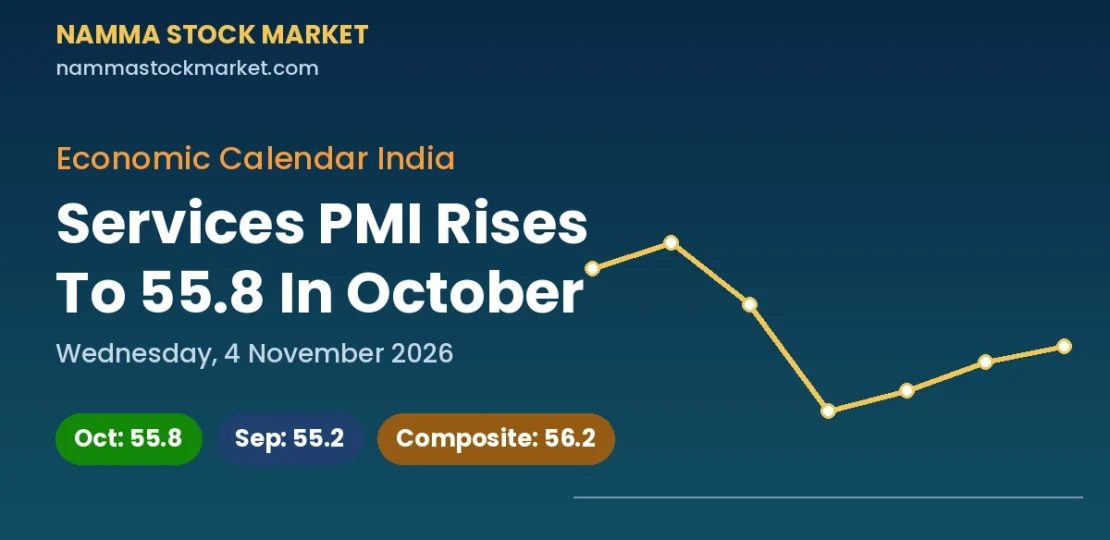
Date: Wednesday, 4 November 2026 (IST). Last updated: 5:45 PM IST.
Welcome to today’s Economic Calendar India update. Only one Indian data release was on the schedule today: the final HSBC India Services PMI for October 2026. It has already been published, so this page shows the actual figure, compares it with earlier months and explains, in simple words, why investors in the Indian stock market keep an eye on it.
Economic Calendar India – Today’s Key Events
| Time (IST) | Economic Indicator | Reporting Period | Previous Data | Forecast | Actual | Why It Matters |
|---|---|---|---|---|---|---|
| Released 4 Nov (exact time not verified) | HSBC India Services PMI (final) | October 2026 | 55.2 | Not available | 55.8 | Shows how fast services activity, the largest part of the economy, is growing |
Status: released. The earlier flash (preliminary) estimate for October, published on 23 October, was 56.2, so the final number came in slightly lower. A flash estimate is not the same as a market consensus forecast, and no reliable consensus figure could be verified for this page.
Understanding Today’s Economic Indicators
HSBC India Services PMI (October 2026)
What it is. PMI stands for Purchasing Managers’ Index. It is a monthly survey of private-sector service companies, compiled by S&P Global and sponsored by HSBC. Companies say whether their business activity rose or fell compared with the previous month. A reading above 50 means expansion; below 50 means contraction. Services include banking, IT, telecom, travel, retail and hospitality, which together make up the largest share of India’s economy.
What the data showed. According to Business Standard, the services PMI rose to 55.8 in October from 55.2 in September, the 63rd straight month above the 50 mark. The HSBC India Composite PMI Output Index, which combines services and manufacturing, rose to 56.2 from 55.9. HSBC’s Chief India Economist Pranjul Bhandari described it as the fastest rise in overall output in four months.
Details worth noticing. Reports on the survey say new export orders grew at the slowest pace since February 2023, and hiring growth was the weakest since June. Input cost inflation was reported to be at its lowest in more than six years. The final October manufacturing PMI, which we covered in our Economic Calendar India update for 2 November, was 54.7.
What to watch. Demand strength at home versus softer export orders, and whether job creation picks up again in the coming months.
Possible market implications. Steady services growth can support sectors such as banks, NBFCs, consumer-facing businesses, travel and IT services, because they depend on healthy demand. Slower input cost inflation can ease worries about price pressure, which may matter for RBI rate expectations. Softer export orders, on the other hand, are a point of caution for export-oriented businesses. These are possible relationships, not guaranteed market reactions; Nifty 50 and Sensex move on many factors at the same time.
Historical Data of HSBC India Services PMI
The table below shows final monthly readings of the HSBC India Services PMI Business Activity Index (seasonally adjusted, index points, where above 50 means expansion). Figures are as reported by S&P Global/HSBC and news and data providers; the March 2026 value is cited from a data-provider report that called it a 13-month low.
| Reporting Period | Actual Value | Previous Period’s Value | Interpretation |
|---|---|---|---|
| October 2026 | 55.8 | 55.2 | Slightly faster growth; four-month high |
| September 2026 | 55.2 | 54.1 | Growth picked up as demand strengthened |
| August 2026 | 54.1 | 53.3 | Modest recovery from July |
| July 2026 | 53.3 | 57.4 | Sharp slowdown from June |
| June 2026 | 57.4 | 59.8 | Eased from May, still firmly expanding |
| May 2026 | 59.8 | 58.8 | Strongest reading in this period |
| April 2026 | 58.8 | 57.5 | Improved from March’s 13-month low |
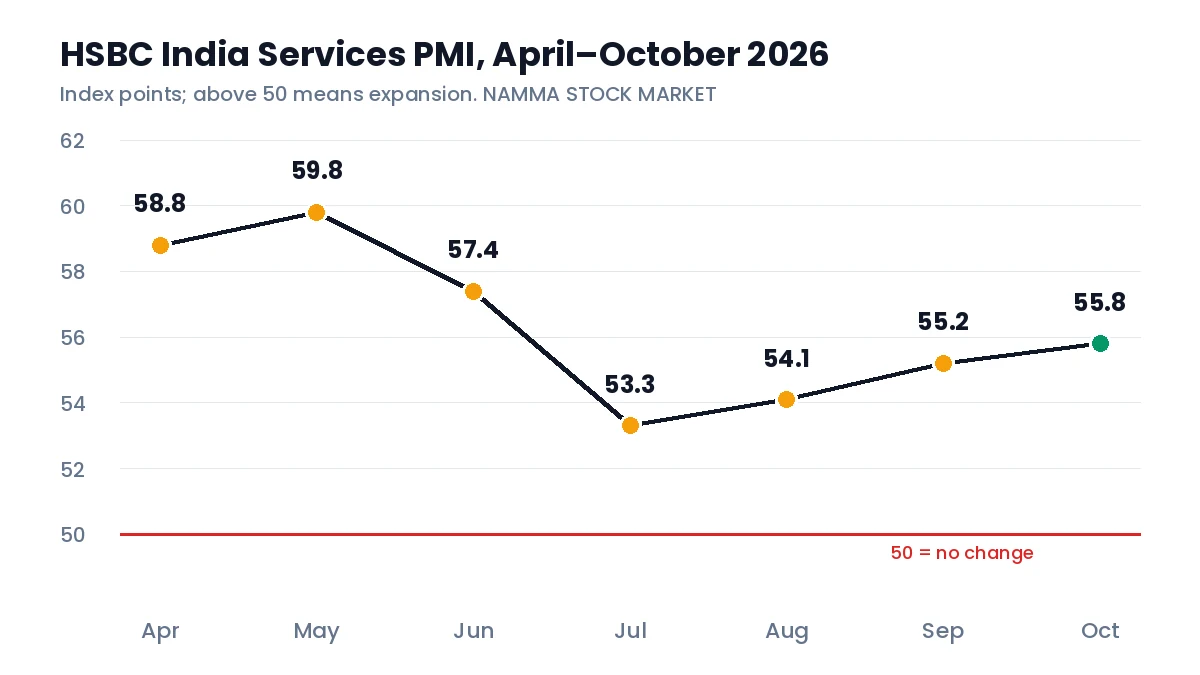
Reading the trend. Services activity stayed in expansion territory in every month shown. It peaked at 59.8 in May, dropped sharply to 53.3 in July, and has been climbing back for three months in a row. The October reading is still below the highs of April–May, so the recovery is steady rather than spectacular. Please note that all values are final readings, but S&P Global can revise seasonal adjustments in later releases.
Source: HSBC/S&P Global PMI data as reported by Trading Economics and Business Standard; official releases are on S&P Global PMI.
How Could Today’s Economic Data Affect the Indian Stock Market?
Economic data does not move markets on its own. It changes how investors think about growth, inflation, interest rates and company earnings. Some possible links are:
- Inflation and rates. CPI and WPI inflation influence what investors expect from the RBI on the repo rate (the rate at which RBI lends to banks). Lower input costs reported in PMI surveys can feed into these expectations over time.
- Growth and activity. PMI, IIP (Index of Industrial Production) and GDP give different views of how fast the economy is moving. A rising services PMI points to healthy demand, which can matter for company earnings.
- Borrowing costs. RBI policy decisions affect loan rates and bond yields, which in turn matter for banks and rate-sensitive sectors.
- External sector. Trade data and export orders show how global demand is affecting India and can influence the rupee.
What Should Indian Investors Watch Today?
- The services PMI is above 50 for the 63rd month in a row, so the long-run direction remains one of expansion.
- The October reading (55.8) is above September (55.2) but below the 56.2 flash estimate, a reminder that final numbers can differ from early ones.
- Export orders growing at the slowest pace since February 2023 is the weak spot in an otherwise healthy survey.
- RBI forex reserves data for the week ended 30 October is scheduled for Friday, 6 November, according to Business Standard’s weekly preview.
- For the broader market picture, see our pre-market report for 4 November 2026.
Frequently Asked Questions
What is the Economic Calendar India?
It is a schedule of important Indian economic data releases and policy events, such as CPI inflation, WPI, IIP, PMI, GDP, trade data and RBI decisions, along with their release dates and previous readings.
Where can I check India’s economic calendar today?
Official sources include the RBI, MoSPI, the Office of the Economic Adviser (DPIIT) and PIB. PMI dates are published by S&P Global. This page also summarises each day’s verified releases.
Which indicators matter most for the Indian stock market?
CPI inflation, GDP growth, IIP, PMI surveys, trade data and RBI policy announcements are widely followed, since they relate to growth, inflation and interest rates.
What is the difference between CPI and WPI?
CPI (Consumer Price Index) tracks the prices households pay for goods and services. WPI (Wholesale Price Index) tracks prices at the wholesale level, before goods reach consumers.
How can economic data affect Nifty 50 and Sensex?
Data can change expectations about growth, inflation and interest rates, which may influence how investors value companies. The reaction is never fixed and depends on how the data compares with expectations and on other global and domestic factors.
Conclusion
The only scheduled Indian release today was the final HSBC India Services PMI for October 2026, which came in at 55.8, up from 55.2 in September. Services activity continues to expand, though export orders and hiring were softer. We will keep tracking each new release on this Economic Calendar India page.
Data sources: Business Standard, Business Standard weekly policy watch, S&P Global PMI, Trading Economics – India Services PMI. Release time and consensus forecast could not be verified from official sources.
This article is for informational and educational purposes only and does not constitute investment advice. Please consult a SEBI-registered investment advisor before making any trading or investment decisions.
RELATED POSTS
View all

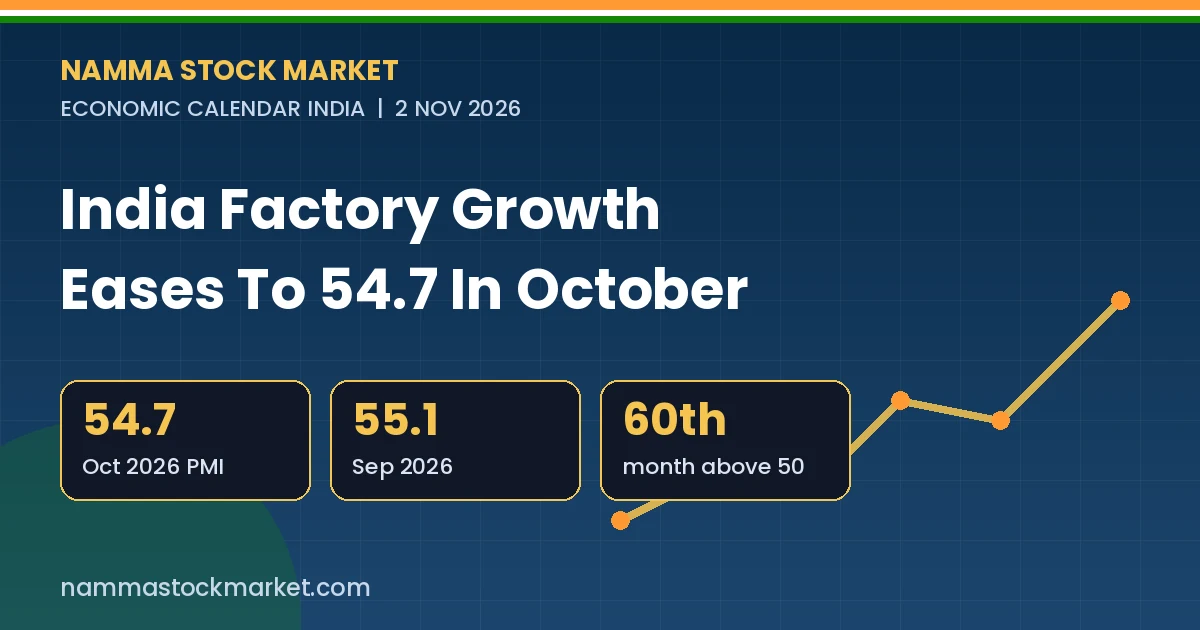
Economic Calendar India Today – Monday, 2 November 2026: Manufacturing PMI for October
November 2, 2026 | by NammaStockMarket
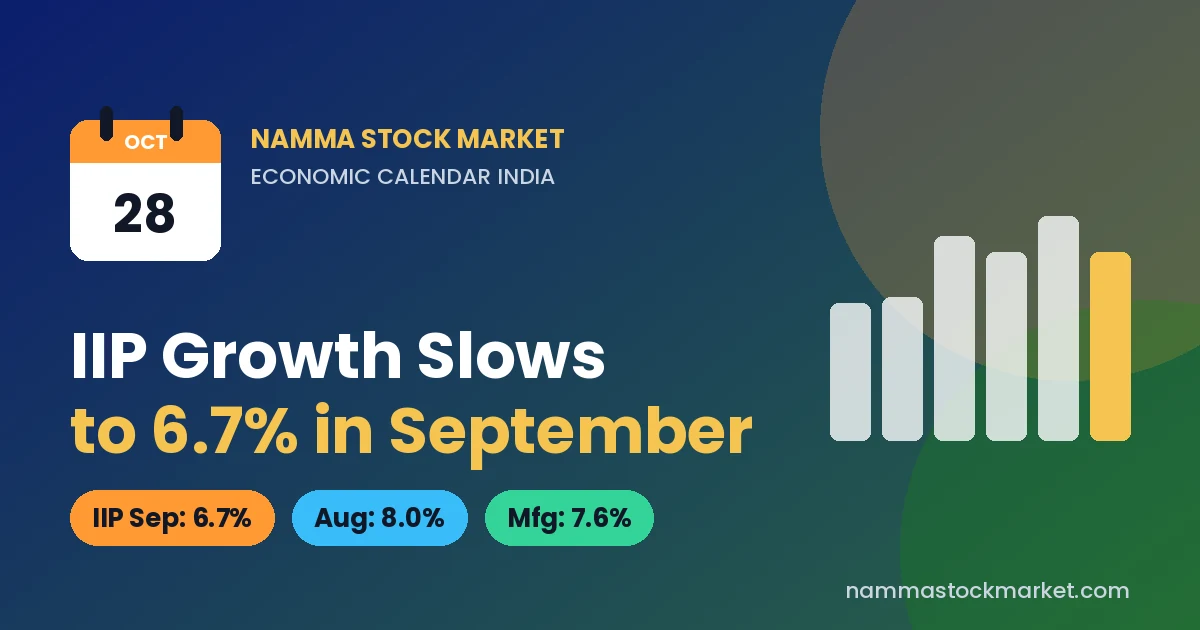
Economic Calendar India Today – Wednesday, 28 October 2026: IIP Data for September Released
October 28, 2026 | by NammaStockMarket
Economic Calendar India Today – Thursday, 15 October 2026: Trade Data Released
October 15, 2026 | by NammaStockMarket