

Nifty Next Week: 13 Things to Check as Q2 Results Begin (12-16 Oct)
October 11, 2026 | by NammaStockMarket
Last week felt like a breath of fresh air on D-Street. After eight straight weeks of falling, the NSE Nifty 50 and BSE Sensex finally turned green, and IT stocks did the heavy lifting on Friday. But before you get too comfortable, this coming week (12-16 October 2026) brings its own test: Q2 FY27 results season opens in full force, two new IPOs hit the market, and traders are still digesting the RBI’s surprise repo rate hike. If you have a demat account and trading account on NSE or BSE, or you simply run a SIP in mutual funds, here is your simple Nifty next week checklist so you are ready before Monday’s opening bell.
We have pulled together everything you need to check on NSE and BSE this week, in plain language, with no jargon left unexplained. Let’s get into it.
Last week on NSE and BSE: a quick recap
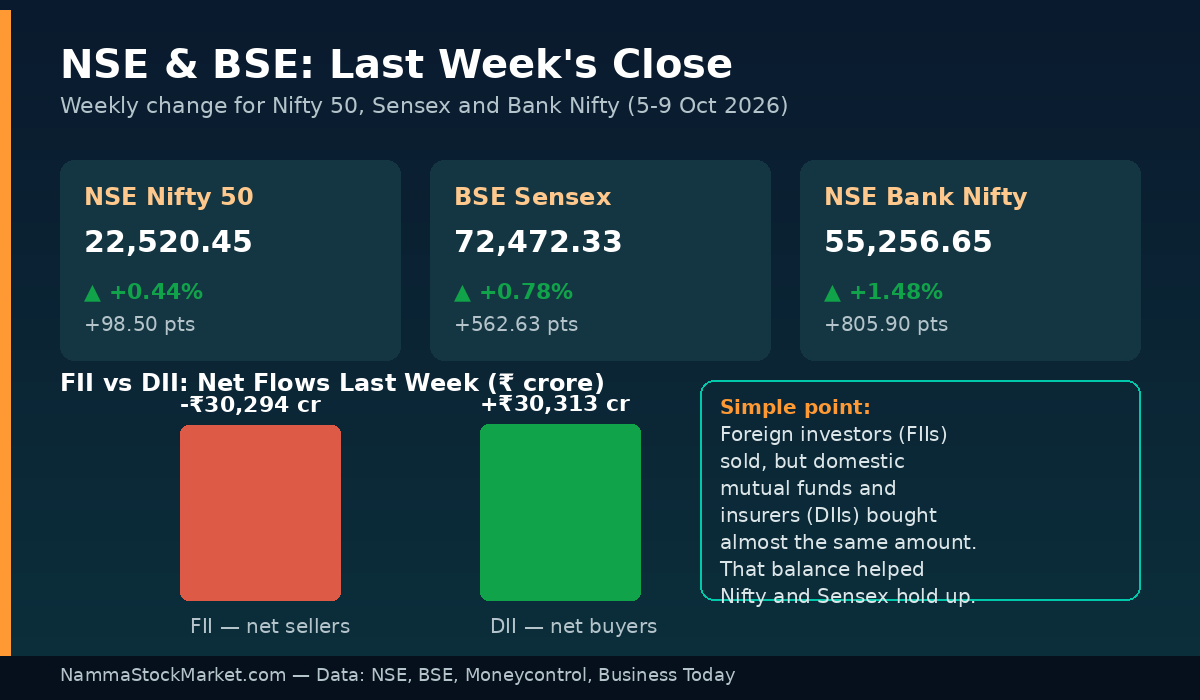
Here is how the Indian stock market closed last week (5-9 October 2026), and how it moved from the previous Friday.
| Index | Close (9 Oct 2026) | Weekly change |
|---|---|---|
| NSE Nifty 50 | 22,520.45 | +98.50 points (+0.44%) |
| BSE Sensex | 72,472.33 | +562.63 points (+0.78%) |
| NSE Bank Nifty | 55,256.65 | +805.90 points (+1.48%) |
The bounce was led by a sharp Friday rally (Sensex up 879 points, Nifty up nearly 289 points) after HCL Technologies and TCS’s Q2 numbers lifted IT stocks. Nifty Midcap and Smallcap indices also joined the party. That rebound came right after a shaky start to the month, when the RBI’s rate hike and $104 crude oil had spooked the market earlier in the week. If you missed how we previewed that last week, you can read our Nifty next week guide before the RBI policy for context. Now, let’s go point by point through what matters most for Nifty next week and the wider Indian share market.
1. GIFT Nifty and global cues before Monday’s opening
Before NSE and BSE open at 9:15 AM IST on Monday, check GIFT Nifty (the Nifty futures contract traded in Gujarat’s GIFT City). It gives the first hint of how our market may open. Also glance at how the Dow, Nasdaq and other global cues closed over the weekend, along with Asian markets like Nikkei and Hang Seng on Monday morning. A positive GIFT Nifty usually means a gap-up opening for the Nifty 50, though the first 30 minutes of trade can still swing either way.
2. India VIX: has the fear cooled off?
India VIX is often called the “fear gauge” of the Indian stock market. It tells you how much swing traders expect in the Nifty over the next 30 days. India VIX cooled to around the 14-14.4 level on 9 October, down sharply from its highs earlier in the week when the market was falling. A lower VIX generally means calmer, more range-bound trading, while a sudden spike can signal more volatile sessions ahead. Keep an eye on this number every morning this week.
3. FII selling met DII buying, almost rupee for rupee
Here’s a simple point that decided last week’s direction: Foreign Institutional Investors (FIIs/FPIs) were net sellers of about ₹30,294 crore in the cash market last week, pulling money out of Indian equities. But Domestic Institutional Investors (DIIs) — your mutual funds, insurance companies and pension funds — stepped in as net buyers of almost the exact same amount, about ₹30,313 crore. This tug of war between FII and DII flows is one of the biggest reasons Nifty and Sensex held their ground instead of falling further. Watch the daily FII DII data this week on the NSE and BSE provisional figures to see if domestic buying keeps absorbing foreign selling.
4. Rupee vs dollar: still near record-low territory
The rupee closed near ₹96.73 per US dollar on Friday, not far from its record low of ₹96.97 touched in May 2026. A weak rupee makes imports (like crude oil) costlier for India, which can add to inflation worries, but it also helps IT and export-focused companies that earn in US dollars. Keep half an eye on this number — a sharp rupee fall can sometimes spook the broader Indian share market.
5. Crude oil and gold: the usual suspects
Brent crude oil swung between roughly US$102 and US$106 a barrel last week on Middle East tension headlines, before easing a bit towards the weekend. India imports most of its oil, so costlier crude is bad news for the rupee, for inflation, and for companies that use oil as a raw material (paints, tyres, airlines). Gold, on the other hand, has stayed a safe-haven favourite this year. If crude spikes again this week, expect it to weigh on Nifty and Sensex sentiment.
6. Q2 FY27 results season gets busy this week
This is probably the single biggest driver for the Indian stock market this week. Quarterly results (for the July-September 2026 quarter, called Q2 of FY27 in the Indian financial year that runs April to March) start flowing in thick and fast.
| Date | Key companies reporting Q2 FY27 results |
|---|---|
| 12 Oct (Mon) | HCL Technologies, RBL Bank, Swaraj Engines |
| 13 Oct (Tue) | Tata Elxsi, Transformers & Rectifiers |
| 14 Oct (Wed) | BHEL, ICICI Lombard, HDB Financial Services, MRPL, Tata Technologies, CEAT |
| 15 Oct (Thu) | Nestle India, Wipro, Tech Mahindra, HDFC Life, HDFC AMC, L&T Finance, Angel One |
| 16 Oct (Fri) | Federal Bank, Bajaj Housing Finance |
Big private banks like ICICI Bank, HDFC Bank and Axis Bank report the following week, so IT and select financials will set the mood this week. A good set of numbers from HCL Tech or Wipro can lift the whole Nifty IT index, while a miss can drag it down fast.
7. Nifty and Bank Nifty: support and resistance to watch
If you track charts, here are the broad zones that analysts are watching this week. On the Nifty 50, immediate support sits near 22,350-22,200, with a bigger cushion at 22,000 and 21,800. On the upside, resistance is seen around 22,600-22,700, and a move past 22,800 could open the door towards 23,000-23,200. For Bank Nifty, support is placed near 55,000-54,800, while resistance comes in around 55,400-55,500, with 55,800-56,000 as the next hurdle if that breaks. Remember, these are not predictions — they are simply the levels where buying or selling pressure has shown up before, so treat them as reference points, not guarantees.
8. F&O expiry, open interest and PCR this week
In the futures and options (F&O) segment, NSE’s weekly Nifty options now expire on Tuesday, while BSE’s weekly Sensex options expire on Thursday, after the exchanges revised their weekly expiry days. Expiry sessions can bring extra volatility, especially in the last hour of trade, because of unwinding positions. Two more things worth a quick look each morning: open interest (OI), which shows how many contracts are still active at a given strike price, and the put-call ratio (PCR), a simple way to gauge whether options traders are leaning bullish or bearish. If your broker’s app shows an F&O ban list, check it too — stocks on that list have hit their futures market-wide position limit and come with extra restrictions.
9. New IPOs opening, closing and listing this week
The primary market stays busy. Here is what’s lined up on NSE and BSE for 12-16 October 2026.
| IPO | Type | Price band | Open – Close | Lot size |
|---|---|---|---|---|
| HD Fire Protect (mainboard) | Mainboard, NSE & BSE | ₹258-271 | 13 Oct – 15 Oct | 55 shares (≈₹14,905) |
| Fusion CX (mainboard) | Mainboard, NSE & BSE | ₹275-289 | 14 Oct – 16 Oct | 51 shares (≈₹14,739) |
| Ravita Engineering Services (SME) | SME, NSE Emerge | ₹105-112 | Opens 13 Oct | To be confirmed |
| Vaibhav Vyapaar (SME) | SME IPO | To be confirmed | Opens 13 Oct | To be confirmed |
HD Fire Protect allots shares on 16 October and is expected to list on 21 October, while Fusion CX allots on 19 October and lists on 22 October. Both are offer-for-sale heavy issues, so check the red herring prospectus for details before you apply. The grey market premium (GMP), an unofficial indicator of listing-day demand quoted by dealers outside the exchanges, was positive for both issues as of our research, but GMP can swing quickly and should never be the only reason to apply for an IPO. Also keep an eye on headlines around Jio Platforms, whose much-awaited IPO continues to be discussed in the market, though its price band was not officially confirmed at the time of writing.
10. RBI’s rate hike: what it means for you
The Reserve Bank of India (RBI) raised the repo rate (the rate at which RBI lends to banks) by 25 basis points to 5.50% on 7 October, its first hike in nearly four years, and signalled a shift towards calibrated tightening going forward. For the stock market, higher rates can mean costlier borrowing for companies and investors, which is why banking and rate-sensitive sectors reacted sharply that week. For you personally, it can also mean slightly higher EMIs on floating-rate home and auto loans over time. There is no separate RBI MPC (Monetary Policy Committee) meeting this week, but expect commentary from RBI officials and economists through the week as markets digest the policy shift.
11. Dividends, rights issue and stock splits to track
Corporate actions matter if you hold these stocks in your demat account. Vedanta and TCS are both set to go ex-dividend next week, meaning you need to hold the shares before the record date to be eligible for the dividend. Ola Electric’s rights issue has its record date on 13 October — if you hold the stock, check your email and broker app for details on how to apply. A couple of stock splits are also due during the week; if you own those stocks, don’t be alarmed if your holding quantity changes and the price adjusts proportionately — that’s normal with a split.
12. Sector watch: IT and FMCG lead, Pharma lags
Sector trends from last week give a hint of where money is rotating. Nifty IT led the charge, helped by strong Q2 numbers and hopes around AI-related revenue, while Nifty FMCG also did well. On the other hand, Nifty Pharma was the lone laggard among major sectors. Nifty Auto, Nifty Metal and Nifty Realty posted modest gains too. As more Q2 results roll in this week from IT, banking and consumption companies, watch whether this rotation towards IT and FMCG continues, or whether banks and autos take the lead once results season picks up pace.
13. No NSE or BSE holiday this week — but one is coming
Good news for active traders: there is no NSE or BSE market holiday in the 12-16 October 2026 week, so it’s a full five-day trading week. However, mark your calendar for 20 October (Dussehra), which falls on a Tuesday the following week and is a trading holiday on both exchanges. If you run a weekly SIP (Systematic Investment Plan) in mutual funds or have EMI-linked investments, this is also a good time to do a quick demat account and trading account safety check: make sure your KYC is updated, your nominee details are filled in, and you are not sharing your login or OTP with anyone claiming to be a broker representative.
Nifty next week: quick checklist for Monday morning
- Check GIFT Nifty and global cues (Dow, Nasdaq, Asian markets) before 9:15 AM IST.
- Note India VIX — is it rising or falling from Friday’s close?
- Look at FII and DII provisional data from Friday’s session.
- Check the rupee vs US dollar rate and Brent crude price.
- See which Q2 results are due that day and whether any of your holdings report.
- Glance at Nifty and Bank Nifty support/resistance levels and the F&O ban list.
- If applying for an IPO, confirm the price band, lot size and closing date.
- Confirm there’s no surprise exchange circular or market holiday.
Frequently asked questions
What time does NSE and BSE open on Monday?
Both NSE and BSE follow the same trading hours: the normal market session runs from 9:15 AM to 3:30 PM IST, Monday to Friday. There’s a pre-open session from 9:00 AM to 9:15 AM IST where opening prices are discovered.
Is there any market holiday next week on NSE and BSE?
No. The week of 12-16 October 2026 is a full trading week on both NSE and BSE. The next holiday is Dussehra on 20 October 2026 (Tuesday), in the following week.
Which sectors to watch in the Indian share market next week?
IT and FMCG led last week’s gains and have more Q2 results due this week, so they stay in focus. Pharma was the one sector that lagged, so watch whether it recovers as more companies report earnings.
What is GIFT Nifty and why does it matter for Monday’s opening?
GIFT Nifty is the Nifty 50 futures contract traded out of GIFT City in Gujarat, which trades almost round the clock. Since it reflects overnight global cues, traders use it as an early signal for how Nifty might open when NSE begins trading at 9:15 AM IST.
How do I check FII and DII data for the day?
NSE and BSE, along with financial news sites like Moneycontrol and Business Standard, publish provisional FII and DII cash market data every evening after the market closes, usually by 6-7 PM IST, showing net buying or selling in ₹ crore.
That’s your full Nifty next week checklist for 12-16 October 2026. The Indian stock market just snapped a long losing streak, but with Q2 results, two fresh IPOs and the RBI’s rate move still playing out, this week needs a cool head rather than quick decisions. Bookmark this page, come back through the week, and follow NammaStockMarket for daily NSE and BSE updates, FII DII numbers and simple explainers like this one.
This article is for learning and information only. It is not investment advice. Please do your own research or talk to a SEBI registered advisor before you invest.
RELATED POSTS
View all

Nifty Next Week: 13 Things to Check Before RBI Policy (5-9 Oct)
October 4, 2026 | by NammaStockMarket
Nifty Next Week: 12 Things to Check After 7 Falls (28 Sep-2 Oct)
September 27, 2026 | by NammaStockMarket

Nifty Sensex Next Week: 12 Must-Check Things After 6 Falls (21-25 Sep)
September 20, 2026 | by NammaStockMarket