

Nifty Next Week: 13 Things to Check Before RBI Policy (5-9 Oct)
October 4, 2026 | by NammaStockMarket

Eight weeks in a row. That is how long the NSE Nifty 50 and BSE Sensex have now fallen, and this coming week throws a big test straight at the market: the RBI MPC rate decision lands on Wednesday, 7 October, and TCS opens the Q2 results season the very next day. If you are trying to plan for Nifty next week, you are not alone — this is one of the busiest weeks of the year for the Indian stock market, and a lot of readers are asking the same question this weekend: will the RBI policy verdict finally turn the mood around, or is there more pain coming before Monday’s open on NSE and BSE?
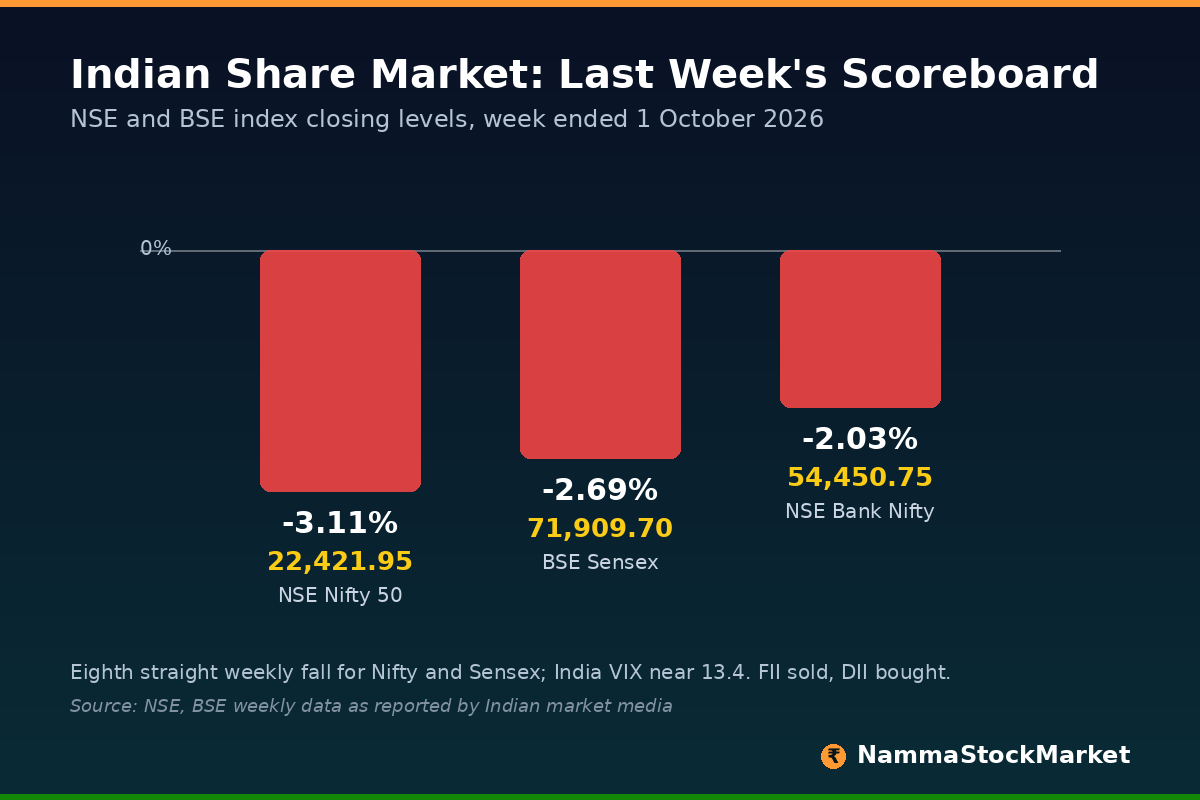
Let’s see what actually happened last week first. On Thursday, 1 October 2026 (NSE and BSE were shut on Friday for Gandhi Jayanti), the NSE Nifty 50 closed at 22,421.95, down 198.50 points on the day, and the BSE Sensex ended at 71,909.70, down 570.59 points. For the week, Nifty fell about 3.11% and Sensex about 2.69% — the eighth straight weekly fall for both indices, reportedly the longest such losing run in about 25 years, as elevated crude oil prices, rising US bond yields and steady FII selling kept weighing on the Indian share market even as domestic institutions kept buying the dip. We covered Thursday’s full close in detail here, and last week’s preview is available here if you want the full picture of how we got to eight weeks.
Now we move into a full five-day trading week on NSE and BSE (5 to 9 October 2026) with the RBI’s rate call, a Nifty weekly expiry, fresh IPOs and the start of Q2 FY27 earnings all packed in. You can also catch Thursday’s detailed pre-market setup in our 1 October pre-market report. Here are the 13 things worth checking before you place your first trade on Monday.
1. Nifty next week: levels after an eighth weekly fall
Simple point first: know where the market stands before you do anything else. NSE Nifty 50 closed the week at 22,421.95 and BSE Sensex at 71,909.70. Both indices have now fallen for eight straight weeks, and Nifty is not far from its six-month low. A market that has fallen this much, this consistently, tends to see sharp bounces on any good news — so don’t be surprised by volatile swings in either direction next week.
| Index | Close (1 Oct 2026) | Weekly Change |
|---|---|---|
| NSE Nifty 50 | 22,421.95 | -3.11% (8th weekly fall) |
| BSE Sensex | 71,909.70 | -2.69% |
| NSE Bank Nifty | 54,450.75 | -2.03% |
| India VIX | ~13.41 | Eased slightly, still worth watching |
2. The big one: RBI MPC policy verdict on 7 October
This is easily the biggest trigger for the Indian stock market next week. The RBI’s Monetary Policy Committee (MPC) — the six-member panel that decides the repo rate (the rate at which RBI lends to banks, which influences your home loan EMI and FD returns) — meets from 5 to 7 October 2026, with the decision due around 10:00 AM IST on Wednesday, 7 October. The repo rate has been unchanged at 5.25% for a while now, and this time economists are genuinely split: a good number expect the RBI to raise rates for the first time since February 2023, given sticky inflation worries and global bond-yield pressure, while others expect another pause. Keep an eye on this: a rate hike (or even hawkish language from the Governor) can hit rate-sensitive sectors like NSE Bank Nifty, auto and realty hard, while a pause with a soft tone could spark a relief rally.
3. TCS Q2 FY27 results kick off earnings season
Tata Consultancy Services (TCS) holds its board meeting on Thursday, 8 October 2026, to approve Q2 FY27 (July–September 2026) results and consider a second interim dividend. TCS reporting first effectively opens the Q2 results season for the Indian IT sector, and its commentary on client spending, deal wins and margins usually sets the tone for the whole NSE IT index for the next few weeks. Watch this one closely if you hold IT stocks or IT mutual funds.
4. FII and DII flows: who sold, who bought
Here is a simple point that trips up a lot of new investors: FII (Foreign Institutional Investors, also called FPI) and DII (Domestic Institutional Investors like mutual funds and insurance companies) flows tell you who is driving the market. Last week, FIIs net sold around ₹33,882 crore of Indian equities while DIIs net bought around ₹33,455 crore — almost a mirror image. This is the pattern that has held through most of the eight-week fall: foreign money is leaving, and domestic SIP and mutual fund money is absorbing the selling. If FII selling eases even a little next week, it could support the market more than any single piece of good news.
5. India VIX: the market’s fear gauge
India VIX measures how much volatility traders expect over the next 30 days — think of it as the market’s “nervousness meter.” It was near 13.41 as last week ended, which is not alarmingly high, but with the RBI decision and TCS results both landing mid-week, don’t be surprised if VIX spikes a bit on Tuesday or Wednesday. A rising VIX usually means wider swings on both sides, so keep your position sizes sensible.
6. Rupee vs dollar: pressure from a strong greenback
The rupee slipped to around ₹96.3 per US dollar last week, its weakest level in about two months, as a strong US dollar, elevated crude prices and FII outflows all pulled on it together. A weak rupee is a mixed bag for India: it helps IT and pharma exporters who earn in dollars, but it makes imports (oil, in particular) costlier and tends to nudge inflation up — one more reason the RBI’s rate call on Wednesday matters so much.
7. Crude oil: back above US$ 98-100 a barrel
Brent crude has climbed back above the US$ 98-100 a barrel mark, driven by global supply worries and firm demand. India imports most of its oil, so costlier crude means a bigger import bill, more pressure on the rupee, and higher input costs for paints, tyres, airlines and logistics companies. Keep half an eye on crude headlines through the week — a sharp spike or fall can move Nifty within minutes of the open.
8. Bank Nifty and the weekly F&O expiry calendar
Since NSE shifted index derivative expiries in 2025, the NSE Nifty weekly expiry now falls on Tuesday, while the BSE Sensex weekly expiry falls on Thursday. That means this week has a Nifty options expiry on Tuesday, 6 October — right in the middle of the RBI meeting — and a Sensex expiry on Thursday, 8 October, the same day as the TCS results. If you trade F&O (futures and options), watch the open interest (OI) build-up and the PCR (put-call ratio) around the 22,200-22,800 zone on Nifty; that is roughly the support-resistance band technical analysts are flagging after last week’s fall. Bank Nifty itself fell 2.03% for the week to 54,450.75, with support seen near 53,700-54,000 and resistance near 55,400-56,000.
9. Sector watch: IT holds up, autos and metals lag
Not every sector fell equally last week. NSE IT was the only major sector index to end the week in the green, helped by a weaker rupee and defensive buying ahead of results season. On the other hand, NSE Auto, Nifty Metal, Nifty FMCG, Nifty Realty and Nifty Media were among the weakest performers, each down between 2-3% for the week, while NSE Pharma, PSU Bank and Oil & Gas also slipped over 1%. With TCS results and the RBI decision both due this week, IT and rate-sensitive sectors (banks, autos, realty) are the ones to track most closely.
10. IPOs closing and listing this week
Two mainboard IPOs — Nityas Gems & Jewellery and Vishal Nirmiti — close for subscription on Monday, 5 October 2026, with listing expected around Wednesday, 8 October. If you have applied, check your IPO allotment status on the registrar’s website or through your demat account, and remember: GMP (grey market premium) is an unofficial, informal indicator and can change quickly, so don’t treat it as a guarantee of listing gains.
| IPO | Type | Price Band | Closes |
|---|---|---|---|
| Nityas Gems & Jewellery | Mainboard | ₹70-₹75 | 5 Oct 2026 |
| Vishal Nirmiti | Mainboard | ₹208-₹220 | 5 Oct 2026 |
A few SME IPOs on NSE Emerge and BSE SME are also likely to open through the week; SME IPOs carry higher risk and lower liquidity than mainboard issues, so read the prospectus (RHP) carefully and size your bets accordingly.
11. NSE and BSE holiday check: no holiday this week
Good news for traders who like a full week: there is no NSE or BSE trading holiday between 5 and 9 October 2026. Markets will be open all five days, 9:15 AM to 3:30 PM IST, Monday to Friday. The next scheduled market holiday is Dussehra on 20 October 2026, so plan any time-sensitive trades with that date in mind. Last week, remember, was a shorter four-day week because of the Gandhi Jayanti holiday on 2 October.
12. GIFT Nifty and global cues to track at the open
Before the NSE and BSE opening bell, check GIFT Nifty (the Singapore-based gauge that hints at how Nifty may open) for early direction, especially on Monday and Wednesday morning. Global cues matter more than usual this week: US bond yields have been climbing to multi-decade highs, and any sharp move in the Dow, Nasdaq or US Federal Reserve commentary tends to flow straight into GIFT Nifty and then into our own NSE Nifty 50 and BSE Sensex at the open. Think of global cues as the “mood” Indian markets wake up to, before local news like the RBI decision takes over for the rest of the day.
13. A simple reminder for SIP investors and demat account safety
If you are a long-term investor running a mutual fund SIP, weeks like this one are exactly why SIPs exist — you keep investing a fixed amount regardless of the noise, and eight weeks of falling prices actually mean your SIP is buying more units at lower prices. Stay invested in your mutual funds, PPF, ELSS or NPS as per your own financial plan rather than reacting to every headline. Separately, with markets volatile and IPO season active, double-check your demat account and trading account security this week: don’t share your login, OTP or PIN with anyone, enable two-factor authentication, and only use apps and websites registered with SEBI.
So, in one line: for Nifty next week, the RBI policy verdict and TCS results are the two events that matter most, with F&O expiry, IPOs and global cues adding to the volatility. Here is a quick checklist to keep handy before Monday’s open.
Quick checklist for Monday morning
- Check GIFT Nifty and global cues (Dow, Nasdaq, crude, US yields) before 9:15 AM IST.
- Note the RBI MPC decision time on Wednesday, 7 October, around 10:00 AM IST.
- Mark Tuesday’s Nifty weekly expiry and Thursday’s Sensex weekly expiry on your calendar.
- Watch TCS results and the Q2 FY27 season kicking off on Thursday, 8 October.
- Track FII/DII cash figures daily on the NSE and BSE websites or financial news sites.
- If you applied for Nityas Gems & Jewellery or Vishal Nirmiti IPOs, check allotment status.
- Keep position sizes sensible given India VIX and expiry-week volatility.
- Don’t skip your SIP instalment just because the market has fallen for eight weeks.
Frequently asked questions
What time does NSE and BSE open on Monday?
Normal trading hours on NSE and BSE are 9:15 AM to 3:30 PM IST, Monday to Friday. There is a pre-open session from 9:00 AM to 9:15 AM where the opening price is discovered.
Is there any market holiday next week on NSE and BSE?
No. NSE and BSE will be open all five trading days from 5 to 9 October 2026. The next holiday on the calendar is Dussehra on 20 October 2026.
Which sectors to watch in the Indian share market next week?
NSE IT and NSE Bank Nifty are in focus because of TCS results and the RBI rate decision respectively. Rate-sensitive sectors like auto, realty and NBFCs could also see sharp moves depending on what the RBI decides on Wednesday.
Will the RBI raise interest rates in October 2026?
Nobody can say for sure before the announcement. Economist opinion is divided between a 25 basis point hike (which would be the first since February 2023) and another pause at 5.25%. The decision is expected around 10:00 AM IST on Wednesday, 7 October 2026.
How can I check my IPO allotment status?
You can check IPO allotment status on the registrar’s website (such as Link Intime or KFin Technologies), on the NSE or BSE website, or directly through your demat account or broker app, usually a day or two after the IPO closes.
What is the single biggest thing to track for Nifty next week?
If you only track one thing, make it the RBI MPC policy verdict on Wednesday, 7 October. It will likely decide the direction for Nifty and Sensex for the rest of the week, more than any other single event on the calendar.
That’s our checklist for the week ahead. Markets are choppy right now, and big events like an RBI policy call and the start of results season can swing Nifty and Sensex sharply in either direction, so stay informed, stay patient, and don’t let one volatile week change your long-term plan. If you found this useful, follow NammaStockMarket for daily market updates and next Sunday’s preview for the week after.
This article is for learning and information only. It is not investment advice. Please do your own research or talk to a SEBI registered advisor before you invest.
RELATED POSTS
View all


Nifty Sensex Next Week: 12 Must-Check Things After 6 Falls (21-25 Sep)
September 20, 2026 | by NammaStockMarket

Nifty Next Week: 12 Things to Check After 7 Falls (28 Sep-2 Oct)
September 27, 2026 | by NammaStockMarket