

Sensex Climbs 390 Points, Nifty Nears 25,900 As IT Stocks Rally 3.66% — But Banks And Rupee Slip Today
November 26, 2026 | by NammaStockMarket
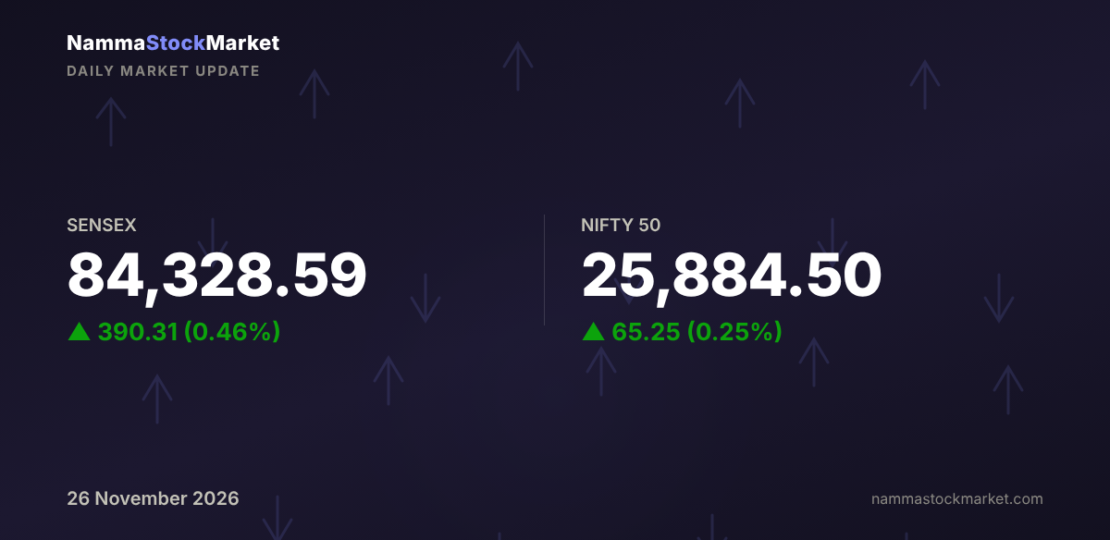
The Indian stock market closed higher on Thursday, with the BSE Sensex climbing 390 points and the NSE Nifty 50 ending back above the 25,850 mark. But don’t let those green numbers fool you into thinking it was a one-way day. This was really a story of two markets within one market: IT stocks had a terrific session, up more than 3.6%, while bank and NBFC (non-banking financial company) stocks dragged, and the rupee had a rough day against the US dollar. If you’re holding IT stocks like HCL Tech, Infosys or TCS, today was a good day for your portfolio. If you’re sitting in banking or financial stocks, it probably didn’t feel like one.
Sensex ended at 84,328.59, up 390.31 points or 0.46%. Nifty 50 closed at 25,884.50, up 65.25 points or 0.25%. Both indices had actually opened with bigger gains in the morning — Nifty touched a high of 25,974 — but gave up a chunk of that as the day went on, a pattern traders call “fading” or “paring gains.” Bank Nifty, which tracks the big banking stocks, actually ended in the red, down 0.26%, which is the main reason Nifty’s gain looks modest even though some individual stocks had a cracking day.
Market At A Glance
| Index | Close | Points Change | % Change |
|---|---|---|---|
| BSE Sensex | 84,328.59 | ▲ 390.31 | ▲ 0.46% |
| NSE Nifty 50 | 25,884.50 | ▲ 65.25 | ▲ 0.25% |
| Bank Nifty | 63,535.30 | ▼ 167.95 | ▼ 0.26% |
| Nifty Midcap 100 | 61,782.50 | ▲ 196.75 | ▲ 0.32% |
| Nifty Smallcap 100 | 19,362.05 | ▲ 132.72 | ▲ 0.69% |
| India VIX | 16.86 | ▼ 0.81 | ▼ 4.58% |
Points change for Nifty Midcap 100, Nifty Smallcap 100 and India VIX has been worked out from today’s closing level and the day’s percentage move, since exact point figures weren’t published alongside them.
Why The Market Moved
The single biggest reason the Sensex and Nifty managed to close higher today is the IT sector. Nifty IT jumped 3.66%, its best day in a while, after strong GDP (Gross Domestic Product, a measure of how fast an economy is growing) data out of the US raised hopes that American companies will spend more money on technology and software next year. Since IT is one of the biggest export-earning sectors for India — companies like TCS, Infosys, HCL Tech and Wipro earn most of their revenue in dollars from US and European clients — any sign that tech spending abroad is picking up is good news for these stocks, and in turn for the Sensex, where IT stocks carry a heavier weight than they do in the Nifty 50.
That’s actually why Sensex (up 0.46%) outperformed Nifty (up 0.25%) today — the Sensex has only 30 stocks, so a strong move in a few heavyweight IT names moves the index more. The Nifty 50, with its broader base of 50 stocks, had to deal with the drag from banks and NBFCs weighing it down at the same time.
On the other side, bank and NBFC stocks had a tough day. Bajaj Finance, Shriram Finance and a few private banks slipped on profit booking — basically, investors who had made money in the recent rally decided to cash in some gains. There’s also a bigger worry hanging over the market: the US has proposed fresh tariffs (import taxes) of up to 25% on goods from India and 13 other trading partners, with a provision to cap it at 17% if India and the US can finalise a trade deal before a hearing scheduled for January 25. This kind of news makes investors in rate-sensitive sectors like banking and consumer finance a bit nervous, since tariffs can slow down economic growth and company earnings over time.
Rising crude oil prices added to the cautious mood. Oil matters a lot for India because we import more than 80% of the crude oil we use — so every dollar increase in the price of oil makes India’s oil import bill bigger, which widens the trade deficit and puts pressure on the rupee. We’ll get into the details of oil and the rupee further down.
Which Sectors Held Up, And Which Didn’t
| Sector | % Change |
|---|---|
| Nifty IT | ▲ 3.66% |
| Nifty Realty | ▲ 3.27% |
| Nifty Metal | ▲ 1.17% |
| Nifty Energy | ▲ 0.56% |
| Nifty Pharma | ▲ 0.43% |
| Nifty Financial Services | ▼ 0.17% |
| Nifty Media | ▼ 0.62% |
| Nifty PSU Bank | ▼ 0.68% |
| Nifty Auto | ▼ 0.69% |
| Nifty FMCG | ▼ 0.94% |
| Nifty Consumer Durables | ▼ 1.33% |
IT and Realty (real estate) were clearly the stars of the day, both up more than 3%, while Metal stocks also bounced back after a rough Wednesday. On the losing side, Consumer Durables was the weakest sector, down 1.33%, followed by FMCG (Fast-Moving Consumer Goods — everyday products like soap, biscuits and packaged food) stocks, which cooled off after a big rally the previous day. Auto, PSU (Public Sector Undertaking, meaning government-owned) banks and Media stocks also ended lower. Basically, if your portfolio is tilted toward technology and real estate, you had a nice day. If it’s tilted toward autos, FMCG or consumer durables, today gave back some of what you made earlier this week.
Today’s Top Movers
The gains in IT were led by HCL Technologies, which jumped nearly 6% to become the top performer in the Nifty 50 today, with the rest of the IT pack — Infosys, TCS and Wipro — not far behind. Metals producer Hindalco also made the top-5 gainers list, riding the broader recovery in metal stocks.
| Stock | Close (₹) | % Change |
|---|---|---|
| HCL Technologies | 1,462.60 | ▲ 5.99% |
| Infosys | 1,181.20 | ▲ 4.53% |
| Tata Consultancy Services (TCS) | 2,625.00 | ▲ 4.28% |
| Wipro | 196.60 | ▲ 3.99% |
| Hindalco Industries | 917.50 | ▲ 3.10% |
On the losing side, paint maker Asian Paints led the fall, followed closely by NBFC majors Shriram Finance and Bajaj Finance, both hit by profit booking after a strong run. FMCG names Nestle India and Tata Consumer Products also featured among the top losers as that sector’s rally from earlier in the week cooled off.
| Stock | Close (₹) | % Change |
|---|---|---|
| Asian Paints | 2,550.20 | ▼ 2.71% |
| Shriram Finance | 963.60 | ▼ 2.66% |
| Bajaj Finance | 1,102.00 | ▼ 2.59% |
| Nestle India | 1,326.50 | ▼ 2.36% |
| Tata Consumer Products | 1,160.50 | ▼ 2.13% |
What FIIs and DIIs Were Doing
Two of the biggest forces moving Indian stock prices every day are FIIs (Foreign Institutional Investors — big foreign funds that invest in Indian shares) and DIIs (Domestic Institutional Investors — Indian mutual funds, insurance companies like LIC, and similar big domestic players). When you hear “FII buying” or “DII selling” on the news, this is what it means — and tracking the two side by side tells you a lot about who’s driving a rally or a sell-off. Exchanges usually release this cash-segment data with a one-day lag, so today’s (26 November) exact FII/DII figures weren’t out at the time of writing. Here’s the most recent five trading sessions we do have, with dates:
| Date | FII Net (Cash) | DII Net (Cash) |
|---|---|---|
| 25 Nov 2026 (Wed) | +₹4,479.08 cr | +₹4,018.72 cr |
| 23 Nov 2026 (Mon) | +₹5,672.99 cr | -₹2,760.12 cr |
| 20 Nov 2026 (Fri) | +₹10,308.42 cr | -₹4,859.80 cr |
| 19 Nov 2026 (Thu) | +₹7,411.41 cr | -₹1,356.57 cr |
| 18 Nov 2026 (Wed) | +₹5,866.78 cr | -₹3,159.90 cr |
The pattern over the last few sessions is worth noting: FIIs have been net buyers on every one of these days, and in a fairly large way — including a single-day inflow of over ₹10,300 crore on November 20. DIIs, on the other hand, have mostly been net sellers over this stretch, which usually happens when domestic mutual funds book some profits into a rally that FIIs are pushing up. This is a bit of a reversal from the usual script, where DIIs are the ones cushioning the market when foreign money leaves — right now it’s foreign money doing the heavy lifting. If you have a mutual fund SIP (Systematic Investment Plan — where you invest a fixed amount every month rather than a lump sum) running, this kind of FII-led rally is exactly the sort of broad-based strength that tends to show up in your fund’s NAV (Net Asset Value, the price of one unit of a mutual fund) over time.
Oil, The Rupee, And Global Cues
Brent crude (the international benchmark price for crude oil, quoted in US dollars per barrel since oil is a globally dollar-priced commodity) had a choppy day. It climbed above $95 a barrel earlier in the session before cooling off to settle around $93.80, down about 0.86% for the day. The back-and-forth is being driven by two opposite forces: on one hand, reports of fresh Houthi attacks on Saudi Arabian oil facilities and shipping routes near the Strait of Hormuz keep raising fears that Middle East oil supply could get disrupted. On the other hand, agencies like the IEA (International Energy Agency) and OPEC (the oil producers’ group) have been flagging a potential global oil supply surplus heading into next year, which is capping how high prices can climb.
For India, crude oil prices aren’t just an abstract number — they hit your wallet directly. India imports the vast majority of its oil, so when crude gets expensive, the government and oil companies end up paying more dollars for the same amount of oil. That widens India’s oil import bill, puts pressure on the rupee (since we need more dollars to pay for it), and can eventually feed into inflation at the petrol pump and in transport costs.
That rupee pressure showed up clearly today. The rupee weakened 24 paise to close at 92.44 against the US dollar (provisional), down from Wednesday’s close of 92.20, which had been its strongest level this financial year after a sharp 65-paise rally. The rupee had actually recovered close to 5% from its record low of 96.88 hit back on October 8, so today’s dip is really just a pause in that recovery rather than a new worry. The main reasons for today’s fall were the elevated crude oil prices discussed above and the fresh US tariff threat on Indian exports. A stronger US dollar index, which rose 0.09% to 103.70, added a bit more pressure. What kept the fall from being worse was continued FII buying into Indian equities and the fact that local stocks themselves closed higher — both of which support demand for the rupee.
Globally, cues were mixed. US markets were shut on Thursday for the Thanksgiving holiday, so there was no fresh overnight lead from Wall Street — the Dow, S&P 500 and Nasdaq will resume with a shortened half-day session on Friday. Asian markets rebounded strongly, with South Korea’s Kospi up 1.43% and Japan’s Nikkei 225 up 0.71%, as investors there went bargain-hunting in technology stocks after weeks of a correction driven by worries over how much money big tech companies are pouring into AI (Artificial Intelligence) infrastructure. That same revival in global tech sentiment is very likely part of why Indian IT stocks had such a strong day too — it’s a connected story across markets.
What To Watch Tomorrow
In the F&O (futures and options — contracts that let traders bet on or hedge against where a stock or index is headed, without owning the underlying shares) segment, data for the near-term weekly expiry on December 1 showed the heaviest Call open interest (OI, the total number of outstanding option contracts) built up around the 26,000 and 27,000 levels, while the heaviest Put OI sits near 25,000. That broadly suggests traders see 25,000 as a strong support zone and 26,000-27,000 as resistance for the Nifty in the near term. The PCR (Put-Call Ratio, a popular gauge of market mood — a rising PCR generally means more hedging or bullishness, a falling one means more caution) for this expiry rose to 1.03 from 0.91 earlier in the day, while the ratio for the monthly expiry on December 29 edged up to 1.18. Both moves suggest a slightly more constructive mood building up in the options market by the end of the session, even with the late-day pullback in the cash market.
Looking ahead, keep an eye on three things: first, how Friday’s shortened, half-day US trading session behaves once Wall Street reopens after Thanksgiving, since that will set the tone for Monday’s Indian market open through GIFT Nifty. Second, crude oil prices and any further news on the Saudi Arabia situation — a bigger supply disruption could push Brent higher and add fresh pressure on the rupee and on oil-import-heavy sectors. Third, the Reserve Bank of India’s (RBI) next Monetary Policy Committee (MPC) meeting, where the central bank decides on the repo rate (the interest rate at which the RBI lends to banks, which influences loan and FD rates across the economy), is coming up on December 4, and commentary in the run-up to it could start moving banking and rate-sensitive stocks either way. IT stocks look like the sector with the most momentum heading into Friday, while banks, NBFCs and consumer-facing sectors may need a few calmer sessions to find their footing again. As always, this is a read of where things stand, not a recommendation to buy or sell anything — do your own homework, or speak to a qualified advisor, before making any investment decisions.
RELATED POSTS
View all

Sensex Crashes 1,124 Points, Nifty Slips Below 22,800 As Brent Crude Tops $107 On Iran Standoff
September 28, 2026 | by NammaStockMarket
Sensex Falls 460 Points, Nifty Below 22,700 As Crude Oil Jumps Past $112 On Middle East Tensions
October 22, 2026 | by NammaStockMarket
Sensex Falls 252 Points, Nifty Slips Below 22,650 As Crude Oil And FII Selling Hit D-Street; IT, FMCG Cushion The Fall
October 14, 2026 | by NammaStockMarket