

Sensex Falls 252 Points, Nifty Slips Below 22,650 As Crude Oil And FII Selling Hit D-Street; IT, FMCG Cushion The Fall
October 14, 2026 | by NammaStockMarket
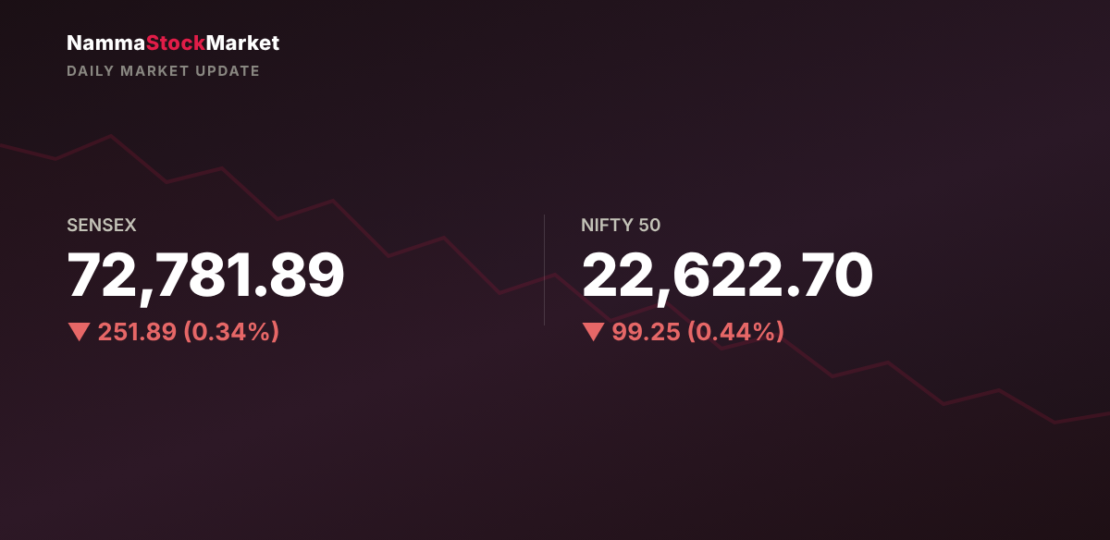
The Indian stock market gave back a chunk of Tuesday’s big IT-led rally today. The BSE Sensex closed at 72,781.89, down 251.89 points or 0.34%, while the NSE Nifty 50 ended at 22,622.70, down 99.25 points or 0.44%, slipping back below the 22,650 mark. Two things did most of the damage: crude oil prices climbing toward ₹107 a barrel (Brent) on fresh Middle East tensions, and Foreign Institutional Investors (FIIs) continuing to sell Indian shares for what is now well over a week straight. A hot wholesale inflation (WPI) print added to the worry, pushing bond yields higher and spooking rate-sensitive stocks like banks, auto and financials.
If you were holding IT or FMCG stocks today, you had a decent day — both sectors held up well and even added to Tuesday’s gains. But if your portfolio leans towards pharma, financials, auto or metals, today probably hurt a bit. This is exactly the kind of day where knowing what’s driving the market, instead of just watching the number go red, actually helps you make sense of your own portfolio’s movement.
Market At A Glance
| Index | Close | Points Change | % Change |
|---|---|---|---|
| BSE Sensex | 72,781.89 | ▼ 251.89 | ▼ 0.34% |
| NSE Nifty 50 | 22,622.70 | ▼ 99.25 | ▼ 0.44% |
| Nifty Midcap 100 | — | — | ▼ 0.08% |
| Nifty Smallcap 100 | — | — | ▼ 0.32% |
| India VIX | 14.64 | ▲ 0.48 | ▲ 3.40% |
Bank Nifty’s official closing level wasn’t available from verified sources at the time of writing, so it has been left out of the table above; sectoral Financial Services and private banking data below gives a good sense of how bank stocks performed today.
Why The Market Moved
Two big forces were at play today, and both of them matter a lot for the Indian economy, not just the stock market.
First, crude oil. Brent crude (the global benchmark, priced in US dollars per barrel) rose toward $107 a barrel after reports of an attack near a Saudi Aramco facility in Dhahran, Saudi Arabia, caused a fire, on top of ongoing tensions linked to Houthi activity near shipping lanes in the Middle East. Here’s why this matters for you even if you’ve never bought a barrel of oil in your life: India imports more than 80% of the crude oil it uses. When oil gets costlier in dollar terms, India’s oil import bill goes up, which puts pressure on the rupee and adds to inflation at home — pricier petrol, diesel, and everything that depends on transport. That’s a big reason oil marketing companies, aviation stocks and auto makers (who need fuel-efficient demand to stay strong) come under pressure on days like today.
Second, FIIs — Foreign Institutional Investors, the big global funds that invest in Indian shares from outside the country — kept selling. This has now been going on for more than a week straight, and FII outflows for October alone have crossed ₹39,000 crore. When FIIs sell in large numbers, it adds supply pressure on stocks and also means more dollars are leaving India, which is another reason the rupee feels the heat. The one thing cushioning all of this has been DIIs (Domestic Institutional Investors — Indian mutual funds, insurance companies and the like, who invest money collected from retail investors like you, including through SIPs). DIIs have been net buyers on every single day this week, soaking up a good chunk of what FIIs are selling. If you run a mutual fund SIP, this is quite literally your money and other Indian retail investors’ money helping stabilise the market on days when foreign money is running for the exit.
On top of this, India’s wholesale inflation (WPI) for September came in hot at 11.39%, sharply higher than August’s 9.92%, driven by costlier fuel, food and manufactured goods. Higher inflation readings tend to push bond yields up, and when yields rise, it makes borrowing costlier and squeezes margins for rate-sensitive sectors like banks, NBFCs (non-banking financial companies) and auto — which is exactly where we saw the selling concentrated today.
Which Sectors Held Up, And Which Didn’t
| Sector Index | % Change |
|---|---|
| Nifty IT | ▲ 1.14% |
| Nifty Oil & Gas | ▲ 1.32% |
| Nifty FMCG | ▲ 1.05% |
| Nifty Media | ▲ 0.55% |
| Nifty Metal | ▼ 0.49% |
| Nifty Auto | ▼ 0.53% |
| Nifty Financial Services | ▼ 0.96% |
| Nifty Pharma | ▼ 1.34% |
IT was clearly the story of the week continuing into today — the sector extended its sharp Tuesday rally (when it had jumped over 5% on the back of a strong HCL Technologies earnings beat) with another gain, as TCS, Infosys, HCL Tech and Tech Mahindra all found buyers. Oil & gas and FMCG also managed to close in the green, helped by resilient consumer demand stocks like Nestle and Tata Consumer Products. On the other side, pharma was the weakest sector of the day by some distance, dragged down by names like Sun Pharma and Dr Reddy’s, with the broader healthcare space following it lower. Financial services, auto and metal all slipped too, as the hot WPI print and rising bond yields made investors nervous about anything rate-sensitive. Real estate (realty) stocks also faced selling pressure through the session, though a precise closing percentage for the sector wasn’t available from verified sources at publish time.
Today’s Top Movers
Here’s a look at the Nifty 50 stocks that moved the most today, in either direction.
| Stock | % Change |
|---|---|
| Nestle India | ▲ 3.69% |
| Tata Consumer Products | ▲ 2.91% |
| Infosys | ▲ 2.44% |
| Coal India | ▲ 2.07% |
| Tech Mahindra | ▲ 2.05% |
Nestle India led the gainers’ table comfortably, with FMCG demand names and IT majors like Infosys rounding out the top five. Coal India also had a strong day, riding higher energy and commodity prices.
| Stock | % Change |
|---|---|
| Shriram Finance | ▼ 3.85% |
| HDFC Life Insurance | ▼ 2.85% |
| Bajaj Finance | ▼ 2.62% |
| Bajaj Finserv | ▼ 2.59% |
| Mahindra & Mahindra | ▼ 2.47% |
The losers’ list was dominated by NBFCs and insurance names. Shriram Finance was the biggest loser in the Nifty 50 today, falling nearly 4%, while HDFC Life, Bajaj Finance and Bajaj Finserv all fell over 2.5% as rising bond yields hurt sentiment around lenders and insurers. Mahindra & Mahindra also featured among the top losers as auto stocks came under pressure.
What FIIs and DIIs Were Doing
Quick explainer if you’re newer to this: FIIs (Foreign Institutional Investors, sometimes also called FPIs — Foreign Portfolio Investors) are large global funds investing in Indian markets from abroad. DIIs (Domestic Institutional Investors) are Indian institutions — mutual funds, insurance companies, pension funds — investing money pooled from retail investors, including your mutual fund SIPs. Tracking what each group is doing in the cash segment (regular buying and selling of shares, as opposed to F&O or derivatives) gives you a sense of who’s driving the market’s mood.
Today’s (14 October 2026) FII/DII cash market figures were not yet available from exchanges at the time of publishing — these numbers are usually released after market hours and can take a few hours to show up. Here’s the data for the most recent sessions we could verify, with dates clearly marked:
| Date | FII/FPI Net (₹ Crore) | DII Net (₹ Crore) |
|---|---|---|
| 13 Oct 2026 | ▼ 1,305 | ▲ 2,439 |
| 12 Oct 2026 | ▼ 1,708 | ▲ 3,045 |
| 09 Oct 2026 | ▼ 3,569 | ▲ 4,743 |
| 08 Oct 2026 | ▼ 12,944 | ▲ 10,703 |
| 07 Oct 2026 | ▼ 6,121 | ▲ 4,597 |
The pattern over the last few sessions is clear: FIIs have been net sellers every single day, while DIIs have stepped in as net buyers every single day, cushioning the market from a much sharper fall. Over the last eight weeks, FIIs have net sold more than ₹39,000 crore just in October so far, while DIIs have bought roughly ₹40,000 crore over the same period — almost a rupee-for-rupee offset. This tug of war between foreign selling and domestic buying has been the single biggest theme driving Nifty and Sensex over the past couple of months, and today was no exception.
Oil, The Rupee, And Global Cues
Brent crude oil climbed toward $107 per barrel today, its highest level in a while, driven by reports of an attack near a Saudi Aramco facility in Dhahran and continuing tensions linked to the Houthis in the Middle East. As explained above, this matters hugely for India because of our heavy dependence on imported crude — every dollar increase in oil prices adds to the import bill, puts pressure on the rupee, and can eventually show up as higher fuel and transport costs for all of us.
Despite the crude oil pressure, the rupee actually managed to strengthen today, closing around 95.17 against the US dollar, up about 19 paise from the previous close. This was mainly due to the Reserve Bank of India (RBI) stepping in with measures to curb speculative dollar bets and ease near-term dollar demand — essentially the RBI using its forex reserves and policy tools to stop the rupee from falling too fast. A slightly weaker US dollar overseas and easing US bond yields also helped, though continued FII outflows and elevated crude prices kept a lid on how much the rupee could gain.
On the global cues front, Wall Street had a mixed session overnight — the Dow and Nasdaq both ended lower, dragged by a selloff in semiconductor stocks (Micron fell over 3%, Applied Materials nearly 7%) and disappointing earnings from some big US banks like Citigroup and Wells Fargo. Asian markets were mostly higher today, with Japan’s Nikkei and South Korea’s Kospi both up over 1%, which gave some support to Indian markets through the morning before crude oil and FII selling took over the narrative in the afternoon session.
What To Watch Tomorrow
Nifty has now been consolidating in a tight range for 11 straight sessions and remains below its 20-day and 50-day moving averages — a sign that the market hasn’t yet picked a clear direction. Analysts are watching support around 22,480-22,500 on the downside (a break below that could open the door to 22,330), while resistance sits around 22,770-22,800 (a decisive move above that could push the index toward 22,950).
Key things to track going into tomorrow’s session: crude oil prices, since any further escalation in the Middle East could keep pressuring oil and the rupee; US inflation (CPI) data due shortly, which could influence how aggressive the US Federal Reserve is seen to be and in turn affect FII flows into emerging markets like India; and whether today’s FII/DII cash figures, once released, show any change in the selling pattern that has persisted through October. There’s also some market chatter around a possible review of LTCG (Long Term Capital Gains tax) and STT (Securities Transaction Tax), which investors will be watching for any official word on. None of this is a buy or sell signal — just the key things that could move the needle on your portfolio tomorrow, so you know what to watch out for.
RELATED POSTS
View all

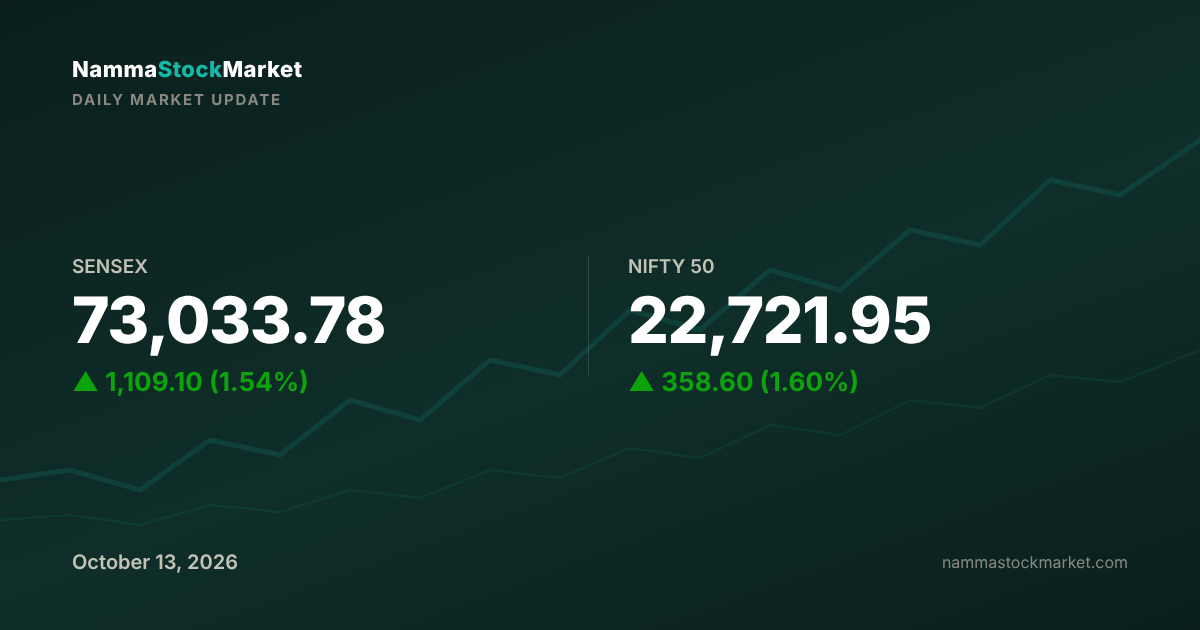
Sensex Jumps 1,109 Points To 73,034, Nifty Tops 22,700 As IT Stocks Stage Stunning Comeback
October 13, 2026 | by NammaStockMarket
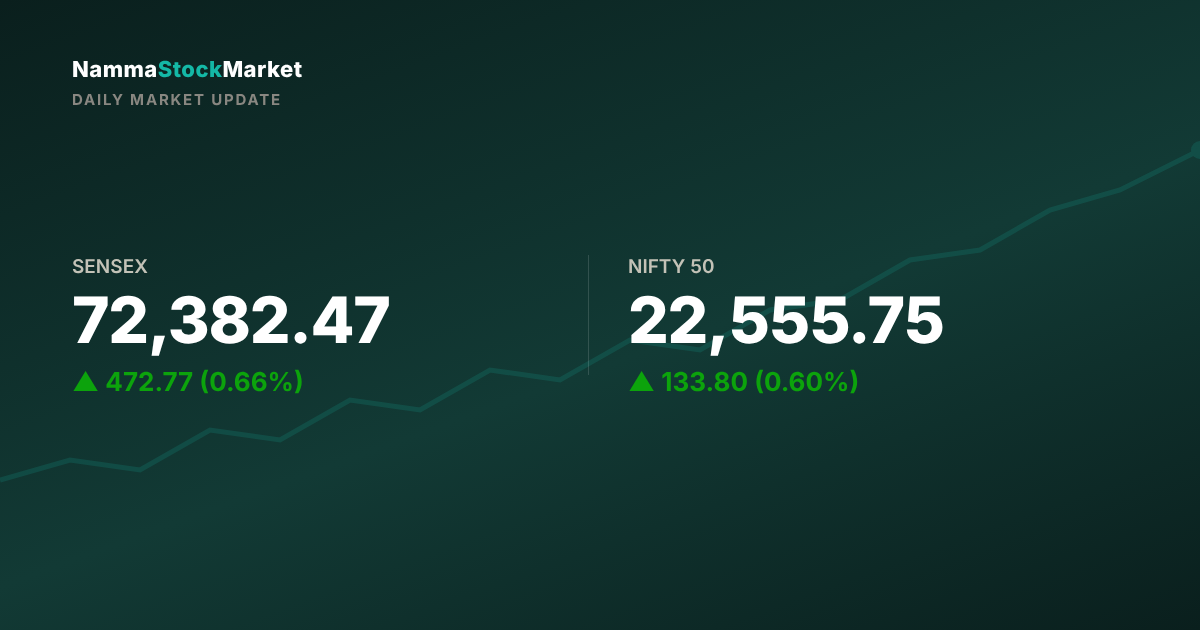
Sensex Jumps 472 Points To 72,382, Nifty Ends At 22,556 As ITC Rallies 5% And Crude Oil Eases
October 5, 2026 | by NammaStockMarket
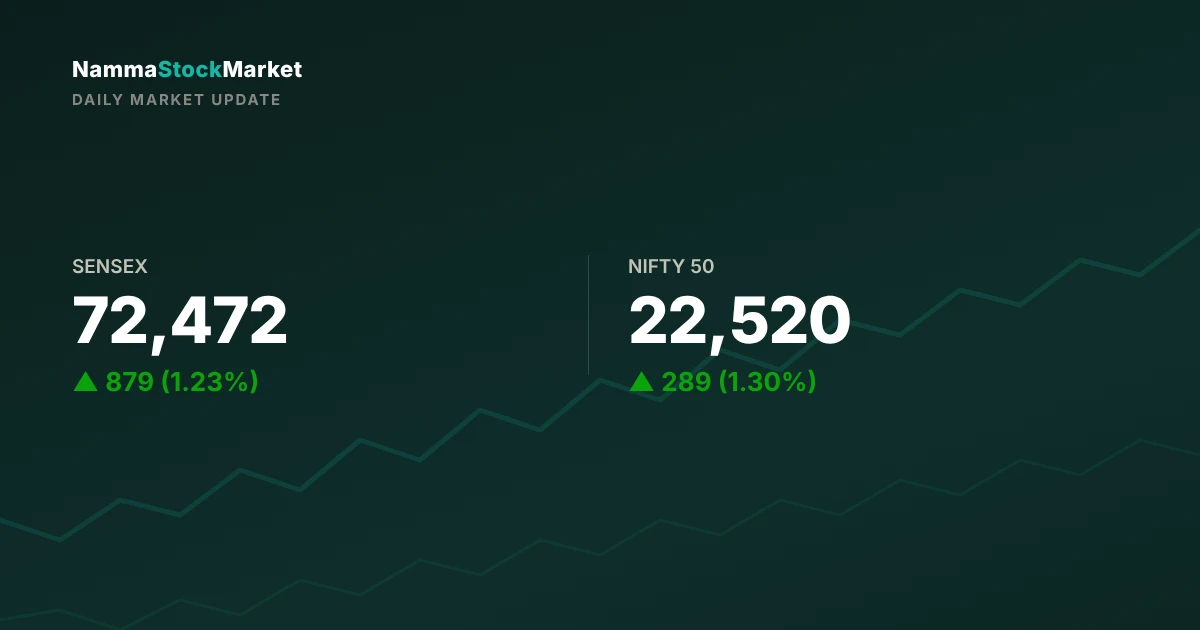
Sensex Jumps 879 Points, Nifty Reclaims 22,500: IT Stocks Lead Rebound After 8-Week Losing Run
October 9, 2026 | by NammaStockMarket