

Sensex Falls 319 Points, Nifty Slips Below 25,150 As Inflation And Crude Oil Spike End 10-Day Rally
November 13, 2026 | by NammaStockMarket
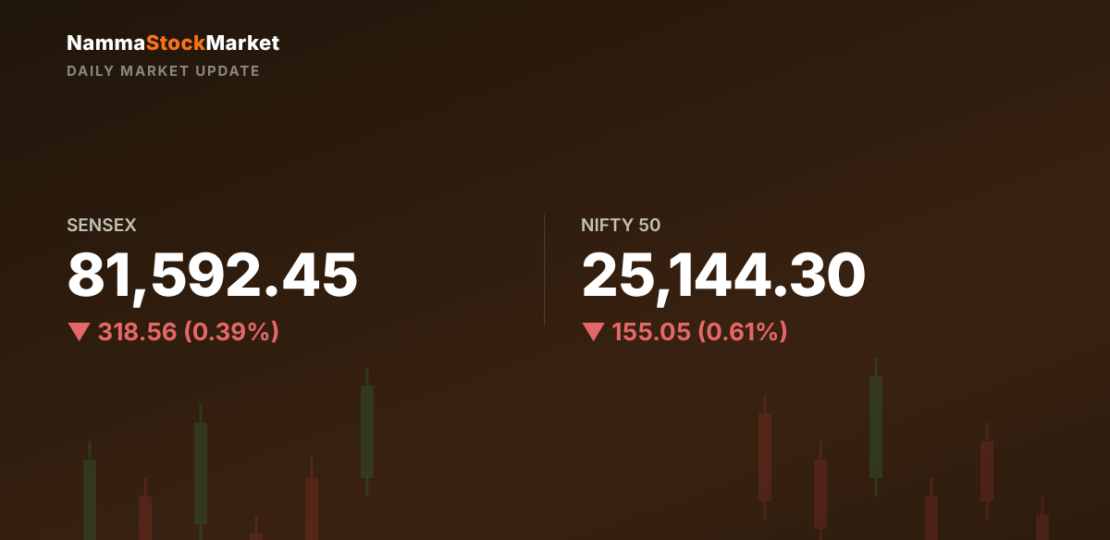
The Indian share market’s winning run finally hit a wall today. The BSE Sensex (the 30-stock index of the Bombay Stock Exchange) closed down 318.56 points at 81,592.45, a fall of 0.39%, while the NSE Nifty 50 (the 50-stock index of the National Stock Exchange) slipped 155.05 points to end at 25,144.30, down 0.61%. This snapped a run of roughly ten straight winning sessions for Dalal Street — the nickname for Mumbai’s financial district, where the BSE is actually located, and a word you’ll see used as shorthand for the Indian stock market in general. Two things did the damage today: October’s retail inflation number came in hotter than expected at 6.09%, breaching the Reserve Bank of India’s (RBI) upper comfort band of 6% for the first time in about two years, and crude oil prices jumped sharply overnight on fresh Middle East tensions. If you were holding auto, metal or realty stocks today, it probably wasn’t a fun day to check your demat account (the account that holds your shares, the way a bank account holds your money) — those were the sectors that took the biggest hit.
Market At A Glance
| Index | Close | Points Change | % Change |
|---|---|---|---|
| BSE Sensex | 81,592.45 | ▼ 318.56 | ▼ 0.39% |
| NSE Nifty 50 | 25,144.30 | ▼ 155.05 | ▼ 0.61% |
| Nifty Bank (Bank Nifty)* | NA | NA | ▼ ~0.8% |
| Nifty Midcap 100 | 61,889.50 | ▼ 149.50 | ▼ 0.24% |
| Nifty Smallcap 100 | 19,656.45 | ▼ 51.30 | ▼ 0.26% |
| India VIX | 15.55 | ▼ 1.07 | ▼ 6.45% |
*Bank Nifty’s exact closing level wasn’t confirmed across our sources at the time of publishing. Sector trackers put private bank and financial services stocks down roughly 0.76-0.8% on the day, which is the figure used above. Interestingly, India VIX — the “fear gauge” that measures how much volatility traders expect over the next 30 days — actually fell today even as the market dropped, which tells you the move wasn’t driven by panic selling.
Why The Market Moved
The headline reason today was inflation. India’s retail inflation (CPI, or Consumer Price Index — basically how much costlier everyday goods have become compared to a year ago) for October came in at 6.09%, up from September’s 5.54%, and food inflation jumped to 8.94% from 7.74%. That 6.09% print matters a lot because it pokes above the RBI’s own comfort zone of 2-6%, something that hasn’t happened in close to two years. When inflation runs hot, the RBI’s rate-setting committee (called the MPC, or Monetary Policy Committee) has less room to cut the repo rate — the rate at which the RBI lends to banks, which eventually decides how expensive your home loan or car loan is. Higher-for-longer rates squeeze companies that depend on borrowed money, which is exactly why banks, auto and real estate stocks — all of them rate-sensitive — led today’s fall.
The second big push came from crude oil. Brent crude (the global benchmark price for oil, quoted in US dollars) jumped to around $95.50-96 a barrel in today’s session, up nearly 4% from Thursday’s close near $92, after reports of fresh attacks on Saudi energy infrastructure and worries about shipping disruptions through the Strait of Hormuz — the narrow sea route a huge chunk of the world’s oil passes through. For India, which imports more than 80% of the crude oil it uses, a sudden jump in oil prices is never good news: it makes India’s oil import bill bigger, which widens the trade deficit and puts pressure on the rupee, which in turn makes imported goods (including more oil) even costlier. It’s a bit of a vicious circle, and today the market was pricing that in.
Which Sectors Held Up, And Which Didn’t
It really was a broad-based fall today, with almost every sector ending in the red. FMCG (Fast-Moving Consumer Goods — think soaps, biscuits, packaged food, the stuff that sells regardless of the economic mood) was the only pocket that managed to stay in positive territory, even if just barely, which makes sense: people don’t stop buying toothpaste because inflation is high. Pharma held up relatively well too. On the other end, realty and auto stocks took the hardest knocks, exactly the kind of sectors that get hurt most when interest rate worries creep back in.
| Sector (Nifty Index) | % Change |
|---|---|
| Pharma | ▼ 0.50% |
| Financial Services | ▼ 0.70% |
| IT | ▼ 0.72% |
| Private Bank | ▼ 0.76% |
| Metal | ▼ 0.98% |
| Auto | ▼ 1.07% |
| Realty | ▼ 1.39% |
Today’s Top Movers
Eicher Motors was the standout gainer in the Nifty 50 today, bucking the weakness in the rest of the auto pack. Bharti Airtel and Nestle India also held up well. On the losing side, NBFC (Non-Banking Financial Company — a lender that isn’t technically a bank but does similar lending business) stock Shriram Finance and Tata Motors’ passenger vehicle business were the worst hit, both down over 3%. Grasim Industries fell after reporting a consolidated net loss of ₹234 crore for the September quarter, against a profit of ₹595 crore a year ago — a reminder that stock-specific news can override the broader market mood on any given day.
| Top Gainers (Nifty 50) | % Change |
|---|---|
| Eicher Motors | ▲ 1.34% |
| Bharti Airtel | ▲ 1.12% |
| Nestle India | ▲ 0.66% |
| ONGC | ▲ 0.47% |
| Asian Paints | ▲ 0.45% |
| Top Losers (Nifty 50) | % Change |
|---|---|
| Shriram Finance | ▼ 3.37% |
| Tata Motors (PV) | ▼ 3.31% |
| Grasim Industries | ▼ 2.60% |
| Hindalco Industries | ▼ 2.12% |
| Adani Enterprises | ▼ 1.95% |
Away from the top and bottom five, the overall mood was weak: on the NSE, about 1,446 stocks advanced while 2,179 declined. Still, 102 stocks hit fresh 52-week highs even on a red day, and 108 stocks hit their upper circuit (the maximum a stock is allowed to rise in a session, a safety rule exchanges use to curb wild single-day swings) against 96 that hit their lower circuit — so it wasn’t a one-way, panic-everywhere kind of session, more a broad, steady grind lower.
What FIIs And DIIs Were Doing
You’ll see “FII” and “DII” in almost every market report, so here’s the quick version: FIIs are Foreign Institutional Investors — big foreign funds and pension funds investing in Indian stocks from abroad (also often called FPIs, or Foreign Portfolio Investors). DIIs are Domestic Institutional Investors — Indian mutual funds, insurance companies like LIC, and similar big local players. Tracking who’s buying and who’s selling tells you a lot about where the smart, big money thinks the market is headed.
The twist in the past couple of weeks has actually been the opposite of the usual script. Normally you hear about DIIs “cushioning” the market when FIIs sell — but recently it’s been FIIs doing sustained buying while DIIs have been net sellers, likely booking some profits after the market’s recent run-up. Friday’s own cash-segment figures weren’t out by the time of writing — FII/DII numbers for the day’s session are usually released by the exchanges after market hours or the next morning — so here are the last five sessions we do have, cash segment, in ₹ crore:
| Date | FII Net (₹ Crore) | DII Net (₹ Crore) |
|---|---|---|
| 5 Nov 2026 | ▲ ₹14,974.68 cr | ▼ ₹10,444.54 cr |
| 6 Nov 2026 | ▲ ₹13,749.82 cr | ▼ ₹5,968.70 cr |
| 9 Nov 2026 | ▲ ₹7,212.22 cr | ▼ ₹7,172.53 cr |
| 11 Nov 2026 | ▲ ₹12,563.33 cr | ▼ ₹8,434.53 cr |
| 12 Nov 2026 | ▲ ₹7,830.60 cr | ▼ ₹6,331.17 cr |
Friday, November 13’s FII/DII cash-segment figures hadn’t been released at the time of publishing. We’ll carry them in tomorrow’s update once the exchanges put out the provisional data.
This is actually a pretty reassuring pattern if you think about it — despite a hot inflation print and rising oil, foreign money hasn’t been running for the exit. If anything, FIIs have been steady buyers through most of this stretch, which is one reason the Nifty and Sensex were still up for the week overall (around 0.5% and 0.7% respectively) even after today’s fall.
Oil, The Rupee, And Global Cues
The rupee weakened 21 paise today to close near ₹94.24 against the US dollar, from Thursday’s close of ₹94.03, as the jump in crude oil and firmer US bond yields outweighed the support from all that FII buying. As we mentioned earlier, a weaker rupee and costlier oil feed into each other: India pays for most of its oil in dollars, so when the rupee falls, the same barrel of crude costs more in rupee terms, which widens the oil import bill further. This eventually shows up in costlier fuel, costlier transport, and a bit more pressure on overall inflation — which, ironically, is the very problem that kicked off today’s sell-off in the first place.
On global cues: Wall Street had a weak Thursday night, with the Dow, S&P 500 and Nasdaq all closing lower after Nvidia shares tumbled on reports that CEO Jensen Huang was stepping down. Elevated US Treasury yields didn’t help either, since higher US returns can pull some foreign money away from markets like India’s. Asian markets were mixed on Friday — Japan’s Nikkei was a rare gainer, up 0.44%, while Hong Kong’s Hang Seng and South Korea’s Kospi both fell around 1-1.8%.
What To Watch Tomorrow
With October’s CPI print now in, all eyes shift to how sticky this inflation turns out to be and what it means for the RBI’s next move on the repo rate — the central bank will be watching the same food-price data closely before its next MPC meeting. Crude oil is the other big swing factor: if the Middle East tensions escalate further, expect more pressure on oil-import-heavy sectors and the rupee; if they cool off, the relief could be just as quick, the way we’ve seen oil whipsaw up and down through this month already. Rate-sensitive pockets — banks, autos, and real estate — look the most exposed to any further bad news on either inflation or oil, while IT and pharma, which earn a lot of their revenue in dollars, could actually benefit somewhat from a weaker rupee. For retail investors, it’s worth remembering that one red day after a ten-session winning run isn’t unusual — if you’re investing through a mutual fund SIP (Systematic Investment Plan, where you put in a fixed amount regularly instead of a lump sum), days like today are exactly the kind of volatility that long-term SIPs are designed to ride out rather than react to. This is market information for you to stay informed, not investment advice — always think through your own goals and risk appetite, or talk to a qualified advisor, before making any changes to your portfolio.
RELATED POSTS
View all

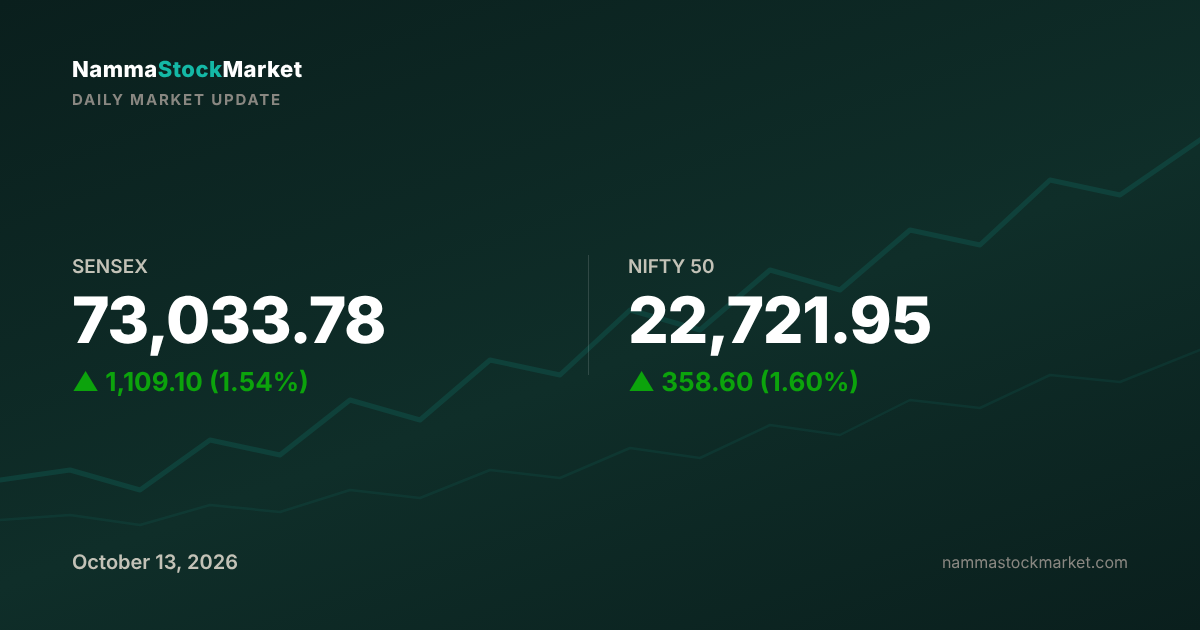
Sensex Jumps 1,109 Points To 73,034, Nifty Tops 22,700 As IT Stocks Stage Stunning Comeback
October 13, 2026 | by NammaStockMarket
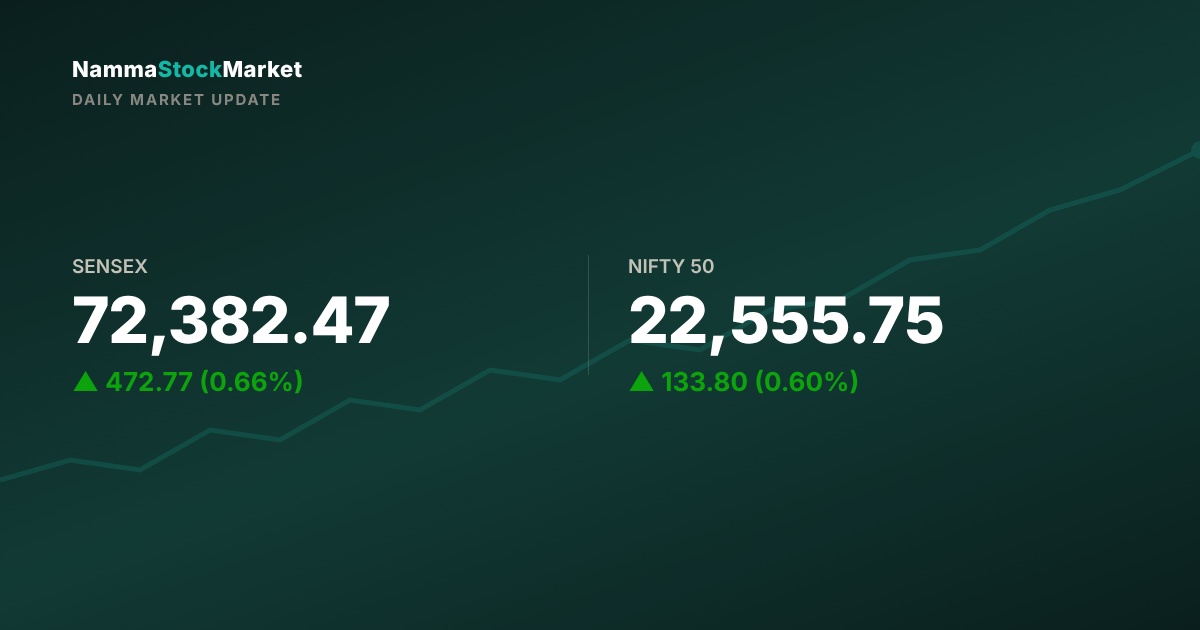
Sensex Jumps 472 Points To 72,382, Nifty Ends At 22,556 As ITC Rallies 5% And Crude Oil Eases
October 5, 2026 | by NammaStockMarket
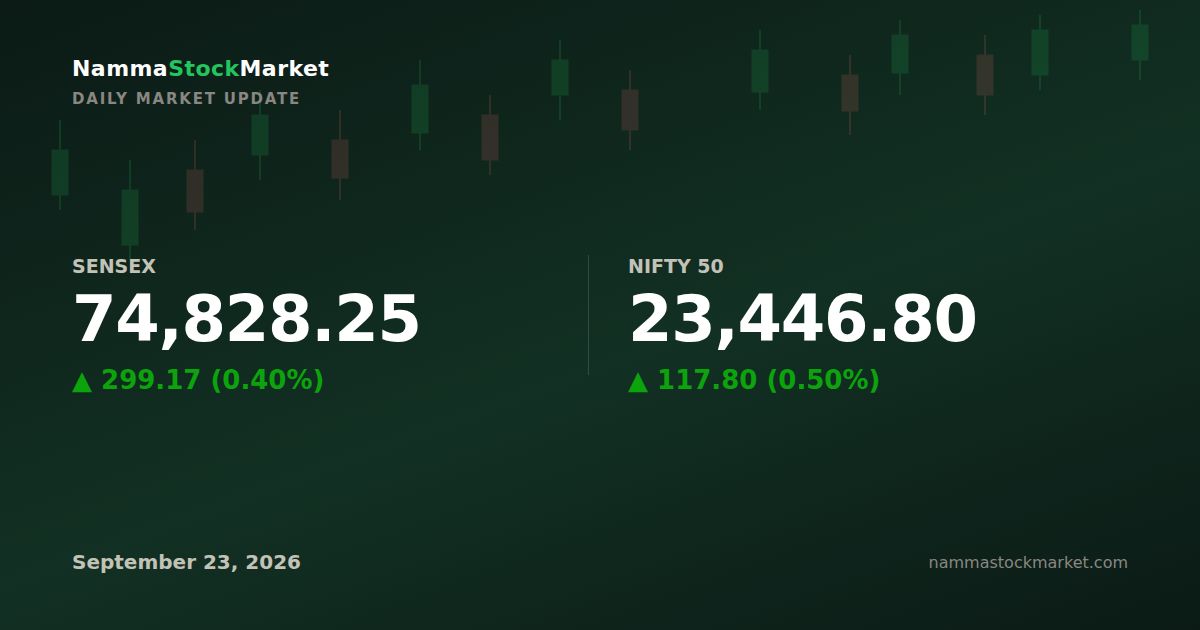
Sensex Gains 299 Points, Nifty Ends Above 23,400 As Crude Oil Drops Below $100; Metal Stocks Jump 2.4%, IT Slips
September 23, 2026 | by NammaStockMarket