

Sensex Jumps 898 Points, Nifty Ends Near 25,800 As Bank Nifty Hits Record High Past 64,500
November 20, 2026 | by NammaStockMarket
If you were watching your portfolio today, you probably saw a lot of red in the morning and a lot of green by the afternoon — and that’s exactly what happened on Dalal Street. The Indian stock market opened sharply lower on Friday, tracking a scary overnight sell-off in US and Asian tech stocks over fears that AI companies are overvalued. Japan’s Nikkei and South Korea’s Kospi both crashed over 4%, and the Nasdaq in the US fell more than 2% a day earlier. The NSE Nifty 50 opened nearly 70 points down and the BSE Sensex slipped close to 250 points in the first few minutes of trade.
But here’s the good part: Indian investors didn’t panic along with the rest of the world. Banking and IT stocks came in with strong buying through the day, foreign investors kept pumping in money, and by the closing bell, the BSE Sensex and the NSE Nifty 50 had completely erased the morning’s losses and finished near their highs of the day. This was the second straight day of gains for both indices, and Bank Nifty — the index of the 12 biggest bank stocks — raced to a fresh all-time high, crossing the 64,500 mark for the first time ever.
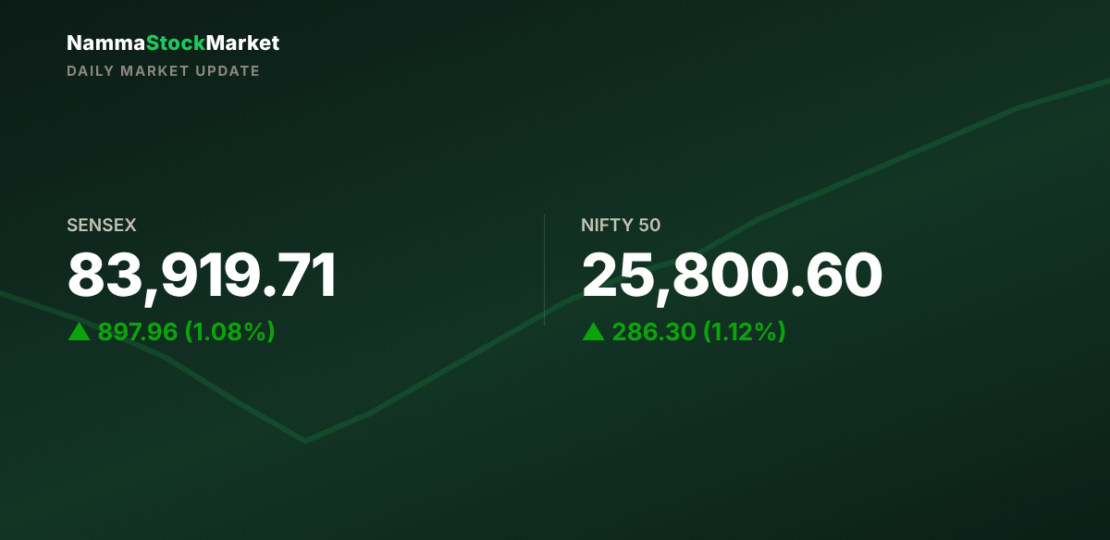
The Sensex closed at 83,919.71, up 897.96 points or 1.08%. The Nifty 50 ended at 25,800.60, up 286.30 points or 1.12%. If you’re holding banking or IT stocks in your portfolio, today was a genuinely good day for you.
Market At A Glance
| Index | Close | Points Change | % Change |
|---|---|---|---|
| BSE Sensex | 83,919.71 | ▲ 897.96 | ▲ 1.08% |
| NSE Nifty 50 | 25,800.60 | ▲ 286.30 | ▲ 1.12% |
| Nifty Bank (Bank Nifty) | 64,500+ (record high) | — | ▲ 2.49% |
| Nifty Midcap 100 | 62,031.00 | ▲ 406.60 | ▲ 0.66% |
| Nifty Smallcap 100 | 19,443.60 | ▼ 24.80 | ▼ 0.13% |
| India VIX | 17.32 | ▲ 1.21 | ▲ 7.51% |
Note: Nifty Bank’s exact closing level wasn’t confirmed at publish time, but it closed above the 64,500 mark for the first time ever, up 2.49% for the day — its third fresh record high in a week.
Why The Market Moved
The simplest way to think about today is: bad global mood, good local buying. Overnight in the US, the Dow Jones fell 2.19%, the S&P 500 fell 2.02% and the Nasdaq fell 2.25%, as investors got nervous that big AI companies have run up too fast and valuations don’t make sense anymore. That nervousness spread to Asia first thing in the morning — Japan’s Nikkei and South Korea’s Kospi both tumbled more than 4%, which is a massive one-day move for any market.
Normally, when global markets fall this hard, India falls too. And for the first hour or so, it did. But Indian banking stocks had a different story to tell. Foreign institutional investors (FIIs) — big global funds that invest in Indian shares — have been on a buying spree all month, and that buying continued today, mostly into banks and financial stocks. On top of that, India VIX, which is sometimes called the market’s “fear gauge” because it measures how much volatility traders are expecting, jumped 7.51% to 17.32. That tells you there was real nervousness and big swings happening during the day, even though the market ended up in the green. A rising VIX on a day when the market still closes higher usually means the session was a rollercoaster, not a smooth ride — which is exactly what happened today.
There’s also a rupee and oil angle that doesn’t get talked about enough. When foreign money pours into India the way it has this month, it also makes the rupee stronger, because those dollars need to be converted into rupees to buy Indian shares. A stronger rupee is good news for India’s oil import bill, since we import almost all our crude oil in dollars — when the rupee is weak, the same barrel of oil costs us more rupees, which pushes up fuel prices and inflation back home. We’ll get into the exact numbers on oil and the rupee further down, but just remember: the two are directly connected to what you pay at the petrol pump and, eventually, to retail inflation.
Which Sectors Held Up, And Which Didn’t
| Sector Index | % Change |
|---|---|
| Nifty Bank | ▲ 2.49% |
| Nifty IT | ▲ 1.30% |
| Nifty Metal | ▼ 0.23% |
Banking was clearly the star performer, with the Nifty Bank index up 2.49% and Bank Nifty hitting a fresh record high. IT stocks also did well, up 1.30%, recovering from the overnight AI-led sell-off in US tech names rather than following it down — a sign that Indian IT investors are reading the AI valuation worries as more of a US problem than an India problem, at least for now. On the other side, metal stocks were the one clear loser among the sectors we could confirm, with Nifty Metal down 0.23%, dragged by Tata Steel.
Beyond these three, the stock-level moves tell a broader story. Financial services and realty names also saw healthy buying alongside the banks, which is why names like Axis Bank and Jio Financial Services both made news today (one as a gainer, one as a laggard — more on that below). Healthcare and auto stocks had a strong day too, led by Apollo Hospitals, Max Healthcare and Maruti Suzuki. FMCG and power stocks were the soft spots outside of metals, with Hindustan Unilever and NTPC both ending lower, suggesting some profit booking in the more defensive, already-expensive pockets of the market while money rotated into banks and autos.
Today’s Top Movers
Here’s a look at which Nifty 50 stocks moved the most, in either direction.
Top Gainers
| Stock | % Change |
|---|---|
| Apollo Hospitals Enterprise | ▲ 5.29% |
| Axis Bank | ▲ 4.72% |
| Max Healthcare Institute | ▲ 3.88% |
| Maruti Suzuki India | ▲ 3.11% |
| UltraTech Cement | ▲ 3.02% |
Apollo Hospitals Enterprise topped the gainers’ list and even touched a record high today, which analysts are reading as defensive buying — when global markets get nervous about AI and tech, investors often rotate into healthcare and other steady, India-focused businesses that don’t depend on global tech sentiment. Axis Bank’s near-5% jump added real weight to the Bank Nifty’s record-breaking run, while Maruti Suzuki’s gain shows auto stocks are holding up well heading into the year-end festive and wedding season demand.
Top Losers
| Stock | % Change |
|---|---|
| Titan Company | ▼ 1.70% |
| Tata Steel | ▼ 1.60% |
| NTPC | ▼ 1.08% |
| Hindustan Unilever (HUL) | ▼ 1.05% |
| Jio Financial Services | ▼ 0.81% |
Titan Company and Tata Steel led the losers, both giving back some of their recent gains. Hindustan Unilever’s fall is part of a broader theme we’ve seen through November — FMCG stocks have been out of favour while money chases banks, IT and autos instead. NTPC and Jio Financial Services rounding out the losers’ list suggests some profit booking in power and new-age financial names rather than any specific bad news about either company.
What FIIs And DIIs Were Doing
If you’re newer to investing, here’s a quick explainer: FIIs, or Foreign Institutional Investors (sometimes also called FPIs, Foreign Portfolio Investors), are big global funds — from places like the US, Europe, Singapore and the Gulf — that invest in Indian shares from abroad. DIIs, or Domestic Institutional Investors, are India’s own big money managers, mainly mutual funds (the same mutual funds your SIP, or Systematic Investment Plan, goes into every month), insurance companies like LIC, and banks. Tracking what these two big groups are doing with their money each day is one of the best ways to understand who is really driving the market.
Today’s exact FII and DII numbers for the cash segment (where shares are bought and sold for actual delivery, not for trading) weren’t out at the time of publishing — this data usually comes out after market hours and is confirmed by the exchanges the next evening. Here’s what we know from the last five trading days for which confirmed, dated figures are available:
| Date | FII Net (₹ Crore) | DII Net (₹ Crore) |
|---|---|---|
| 13 Nov 2026 | ▲ ₹5,736.55 Cr (Buy) | ▼ ₹2,253.58 Cr (Sell) |
| 16 Nov 2026 | ▲ ₹4,864.68 Cr (Buy) | ▼ ₹3,519.05 Cr (Sell) |
| 17 Nov 2026 | ▲ ₹4,195.38 Cr (Buy) | ▲ ₹196.93 Cr (Buy) |
| 18 Nov 2026 | ▲ ₹5,866.78 Cr (Buy) | ▼ ₹3,159.90 Cr (Sell) |
| 19 Nov 2026 | ▲ ₹7,411.41 Cr (Buy) | ▼ ₹1,356.57 Cr (Sell) |
The pattern over the last several sessions has been clear and consistent: FIIs have been big, consistent net buyers of Indian shares almost every single day this month, while DIIs have mostly been net sellers, likely booking some profits and rebalancing after the market’s strong run-up in November. The one exception was 17 November, when both FIIs and DIIs bought. This FII-buying, DII-selling pattern is actually a healthy sign for the market — it means foreign money is genuinely convinced on India’s growth story, while domestic funds are simply taking some chips off the table after a good run, not running for the exits. Separately, foreign investors have pumped in more than $12 billion into Indian stocks this month alone, which market reports are calling one of the biggest monthly FPI inflows on record.
Oil, The Rupee, And Global Cues
Brent crude, the international oil benchmark priced in US dollars per barrel, had a volatile day itself. It had opened near $92.6 a barrel in the morning on fresh worries about a possible attack on Saudi Arabia and disruptions to tanker traffic through the Strait of Hormuz — the narrow waterway that a big chunk of the world’s oil supply passes through. As the day went on and those fears eased a bit, Brent slipped back to around $90.35 a barrel by the afternoon, a pullback of roughly 2.4% from the morning’s level.
This matters hugely for India because we import close to 85% of the crude oil we use, and we pay for nearly all of it in US dollars. When oil prices cool off like this, it’s genuinely good news for India — it means a smaller oil import bill, less pressure on the rupee, and less chance of petrol, diesel and LPG prices going up at home. It also helps keep retail inflation in check, which in turn gives the Reserve Bank of India (RBI) more room on interest rates.
The rupee had a strong day too, extending its gaining streak to a fifth straight session against the US dollar — its best run since April. It strengthened to around 92.9–93 per dollar, compared with Thursday’s close near 93.3, helped directly by all that foreign money flowing into Indian stocks (which we talked about in the FII/DII section above) and by money moving out of expensive Asian tech markets into India instead. A stronger rupee is good news if you’re planning any dollar expenses — from a foreign trip to your child’s overseas education — and it also means imported goods, including that oil we just talked about, cost less in rupee terms.
On the global cues front, the overnight mood in the US was clearly risk-off, with the Dow, S&P 500 and Nasdaq all falling more than 2% on AI valuation worries, and reports suggesting even Anthropic’s valuation came under pressure in after-hours trading. Closer home in Asia, Japan’s Nikkei and South Korea’s Kospi both sank more than 4%. The fact that Indian markets shrugged off such a rough global backdrop and still closed higher is being seen by many market watchers as a sign of underlying strength in domestic flows right now.
What To Watch Tomorrow
A quick heads-up for your calendar: the Indian stock market will be shut on Tuesday, 24 November, for Guru Nanak Jayanti. Monday, 23 November is a normal trading day, and the market reopens as usual on Wednesday, 25 November. Note that 24 November is also a settlement holiday, which could affect when fund credits or withdrawals from your demat account and trading account actually show up, so plan accordingly if you have any pending transactions.
Beyond the holiday, there are a few things worth keeping an eye on. First, whether the FII buying spree continues — if foreign money keeps flowing in at this pace, banking stocks could keep making fresh highs, but any pause could trigger quick profit booking given how much the Bank Nifty has already run up this month. Second, keep watching global AI-stock sentiment; if US tech shares stabilise, India VIX could cool off again, but another rough night on Wall Street could easily spill over into a volatile opening here too. Third, crude oil and the rupee are worth tracking together — if Middle East tensions around the Strait of Hormuz flare up again, oil could spike back up and put some pressure back on the rupee and on oil marketing companies. None of this is a buy or sell call — just the key things that could move your portfolio over the next few sessions, so you can stay informed rather than react to headlines in the moment.
RELATED POSTS
View all

Sensex Jumps 384 Points, Nifty Nears 24,000 For 5th Day As Media, Metal Stocks Rally; IT Stocks Alone Drag
November 4, 2026 | by NammaStockMarket
Sensex Jumps 773 Points, Nifty Reclaims 25,255 As Bank Nifty Nears Record High After Diwali Break
November 11, 2026 | by NammaStockMarket
Sensex Sinks 571 Points, Nifty Slips Below 22,450 As Crude Oil Tops $100 And US Bond Yields Spook D-Street
October 1, 2026 | by NammaStockMarket