

Nifty Next Week: 13 Things to Check as CPI, Crude Bite (16-20 Nov)
November 15, 2026 | by NammaStockMarket

The Indian share market just had a reminder that no rally runs forever. After ten straight winning sessions, the NSE Nifty 50 and BSE Sensex hit a wall on Friday, 13 November, as a hotter-than-expected inflation number and a sudden jump in crude oil prices spoiled the party. So if you’re trying to figure out what’s coming in the Indian share market next week, you’re not the only one. Heading into the week of 16-20 November, here are 13 simple things worth checking before you place your first trade on Monday morning.
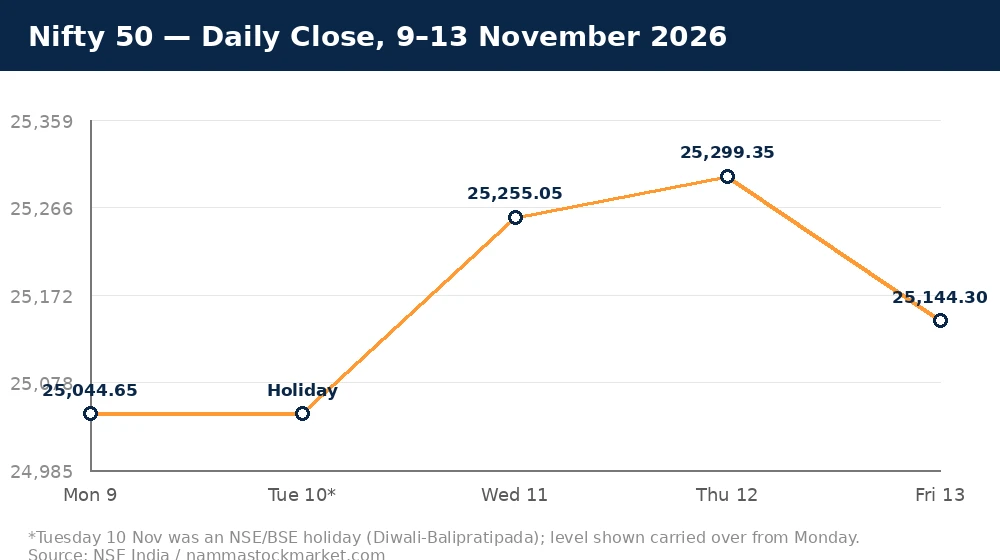
Let’s set the scene first. The Sensex ended last week at 81,592.45, and the Nifty 50 closed at 25,144.30. That’s still roughly 0.7% and 0.5% higher than where they started the week, even after Friday’s wobble — so the bigger trend is still intact, even if the last day felt bumpy. Here’s everything you should have on your radar for Nifty next week and the broader Indian share market next week.
Last Week’s NSE & BSE Snapshot (9-13 November)
| Index | Close (13 Nov) | Weekly Change |
|---|---|---|
| BSE Sensex | 81,592.45 | ▲ 564.43 (+0.70%) |
| NSE Nifty 50 | 25,144.30 | ▲ 113.95 (+0.46%) |
| Nifty Bank (Bank Nifty) | ~61,500 (Thu close) | ▲ ~1.2% (Thu session) |
| Nifty Midcap 100 | 61,889.50 | ▼ 0.24% (Fri session) |
| Nifty Smallcap 100 | 19,656.45 | ▼ 0.26% (Fri session) |
| India VIX | 15.55 | ▼ 6.45% (Fri session) |
Bank Nifty’s exact Friday close wasn’t confirmed across our sources at the time of writing, so we’ve used Thursday’s level. Sources: NSE India, BSE India and our own Friday market report.
1. Where Nifty and Sensex Open on Monday
The first thing every trader checks before the opening bell is the GIFT Nifty (the Nifty futures contract that trades at Gift City, Gujarat, even before NSE and BSE open at 9:15 AM IST). It gives an early hint of whether Monday will open flat, higher or lower. Keep an eye on it over the weekend news flow — a weak GIFT Nifty on Monday morning usually means global worries (crude, US tech stocks, or bond yields) have carried over from Friday.
2. India VIX: The Market’s “Fear Gauge”
India VIX measures how much swing traders expect in the Nifty over the next 30 days. It actually fell to 15.55 on Friday even as the index dropped — which usually means the sell-off wasn’t driven by panic, just steady profit-booking. Simple point: a rising VIX next week would be the bigger worry sign than a red Nifty candle on its own.
3. FII and DII Flows in ₹ Crore
FIIs (Foreign Institutional Investors, big foreign funds) and DIIs (Domestic Institutional Investors — Indian mutual funds, insurers like LIC, and similar big local players) move prices with their daily buying and selling. The twist this month has been the opposite of the usual script: FIIs have been the steady buyers while DIIs have been booking profits.
| Date | FII Net (₹ Crore) | DII Net (₹ Crore) |
|---|---|---|
| 5 Nov | ▲ ₹14,974.68 cr | ▼ ₹10,444.54 cr |
| 6 Nov | ▲ ₹13,749.82 cr | ▼ ₹5,968.70 cr |
| 9 Nov | ▲ ₹7,212.22 cr | ▼ ₹7,172.53 cr |
| 11 Nov | ▲ ₹12,563.33 cr | ▼ ₹8,434.53 cr |
| 12 Nov | ▲ ₹7,830.60 cr | ▼ ₹6,331.17 cr |
Cash-segment figures as reported by the exchanges. Friday 13 November’s figures weren’t out at the time of writing.
4. Rupee vs US Dollar
The rupee weakened 21 paise on Friday to close near ₹94.24 per US dollar, from Thursday’s ₹94.03. A weaker rupee makes imported crude oil costlier in rupee terms, which is exactly the kind of thing that can feed back into inflation — so this is one to track alongside point 5 and point 6 below.
5. Crude Oil and the Middle East Angle
Brent crude (the global oil-price benchmark, quoted in US dollars) jumped to around $95.50-96 a barrel on Friday, up nearly 4% from Thursday’s close near $92, on reports of fresh attacks on Saudi energy infrastructure and shipping worries through the Strait of Hormuz. India imports more than 80% of its crude, so a sharp jump is never good news for the rupee or for inflation. If tensions cool off over the weekend, expect some relief; if they escalate, rate-sensitive sectors could feel it again.
6. CPI Inflation and RBI’s 6% Line
October’s retail inflation (CPI) came in at 6.09%, up from September’s 5.54%, with food inflation jumping to 8.94% from 7.74%. That’s the first time in roughly two years that CPI has poked above the RBI’s upper comfort band of 6%. Higher inflation gives the RBI’s rate-setting panel, the MPC (Monetary Policy Committee), less room to cut rates — which is why banks, autos and real estate stocks, all rate-sensitive, led Friday’s fall. The next MPC meeting is scheduled for 2-4 December (per the RBI’s own press release), so this week is about how markets digest the data, not a policy decision itself.
7. RBI’s Forex Reserves Cushion
A quieter but useful number: India’s foreign exchange reserves rose to about $719.55 billion for the week ended 6 November, up roughly $2.49 billion from the week before and snapping two straight weekly falls. Comfortable reserves give the RBI more room to smooth out sharp rupee moves — worth checking in our Economic Calendar India update if the rupee keeps wobbling next week.
8. Bank Nifty and the F&O Weekly Expiry Days
Since the exchanges split weekly options expiry across two days, Nifty 50 weekly options now expire every Tuesday on the NSE, and Sensex weekly options expire every Thursday on the BSE. For this week, that means Tuesday, 17 November for Nifty expiry and Thursday, 19 November for Sensex expiry. Expiry days usually bring higher open interest (OI) unwinding and can swing the index more than a normal session — something F&O traders tracking lot size, PCR (put-call ratio) and OI data should flag on their calendar.
9. Sector Rotation: Who Got Hurt, Who Held Up
Friday’s fall was broad-based, but not every sector moved the same way. FMCG (fast-moving consumer goods — soaps, biscuits, packaged food) was the only Nifty sectoral index that stayed positive, while Realty, Auto and Metal — all sensitive to interest-rate worries — took the biggest hits after a strong run earlier in the week (Nifty Realty had actually surged 4.5% on Thursday). IT and pharma, which earn a large share of revenue in dollars, could get some support from a weaker rupee even if the broader market stays choppy.
10. IPOs and New Listings to Track
The IPO (Initial Public Offering) calendar has been fairly active through October and early November on both the mainboard and the SME (small and medium enterprise) platforms of NSE Emerge and BSE SME. We couldn’t confirm a specific mainboard or SME issue opening in the 16-20 November window from two reliable sources at the time of writing, so rather than guess, we’d suggest checking the live IPO list on the NSE India or BSE India website, or your broker’s app, for the latest price band, GMP (grey market premium) and allotment dates before the week begins.
11. Mark Your Calendar: The Next NSE & BSE Holiday
There’s no trading holiday in the 16-20 November week itself — all five sessions, Monday to Friday, are regular trading days from 9:15 AM to 3:30 PM IST. But pencil in Tuesday, 24 November, when NSE and BSE will be shut for Guru Nanak Jayanti. That holiday also pushes the Nifty’s monthly F&O expiry for that week to Monday, so it’s worth remembering a little in advance if you’re planning positions that stretch into late November.
12. Global Cues: Wall Street and Nvidia
US markets had a rough Thursday night, with the Dow, S&P 500 and Nasdaq all closing lower after Nvidia shares tumbled on reports — later acknowledged in part by the company — around a board review of CEO Jensen Huang. Elevated US bond yields added to the pressure, since higher US returns can pull some foreign money away from markets like India’s. Asian markets were mixed on Friday, with Japan’s Nikkei bucking the trend while Hong Kong and South Korea fell. US-listed tech weakness has a way of showing up in NSE IT stocks the next session, so it’s worth a quick check before Monday’s open.
13. A Reminder for SIP Investors and Demat Account Safety
If you invest through a mutual fund SIP (Systematic Investment Plan — putting in a fixed amount regularly instead of a lump sum), a volatile week like this is exactly the kind of thing SIPs are built to ride out rather than react to. Separately, it’s always a good time to check your demat account (the account that holds your shares) and trading account for any unfamiliar login alerts, and to make sure your two-factor authentication is switched on — a small five-minute habit that protects you far more than trying to time the market.
Quick Checklist for Monday Morning
- Check GIFT Nifty and global cues before 9:15 AM IST
- Note India VIX — rising sharply is the bigger red flag, not a single red candle
- Glance at the latest FII/DII ₹ crore numbers
- Check ₹ vs US dollar and Brent crude levels
- Mark Tuesday (Nifty expiry) and Thursday (Sensex expiry) on your calendar
- Don’t react to one day’s move if you’re investing through SIPs
FAQ: Nifty Next Week and Share Market Next Week
What time does NSE and BSE open on Monday?
Regular trading on both NSE and BSE runs from 9:15 AM to 3:30 PM IST, Monday to Friday, with a pre-open session from 9:00 AM to 9:15 AM IST. There’s no change to these timings for the week of 16-20 November.
Is there a market holiday next week on NSE and BSE?
No. All five sessions from 16 to 20 November are regular trading days. The next NSE and BSE holiday is Tuesday, 24 November, for Guru Nanak Jayanti.
Which sectors to watch in the Indian share market next week?
Rate-sensitive sectors — banks, auto and realty — are worth watching closely given the hot CPI print, while IT and pharma could see some support from a weaker rupee. FMCG has looked relatively defensive in recent sessions.
What is the Nifty weekly F&O expiry day now?
Nifty 50 weekly options expire every Tuesday on the NSE. Sensex weekly options expire every Thursday on the BSE. For this week, that’s 17 November and 19 November respectively.
Why did Nifty and Sensex fall on Friday?
Two things: October’s CPI inflation came in at 6.09%, breaching the RBI’s upper comfort band of 6% for the first time in about two years, and Brent crude jumped nearly 4% on fresh Middle East tensions. Both raised concerns about rate-sensitive sectors and the rupee.
That’s our checklist for Nifty next week and the Indian share market next week. We’ll be back with our usual daily pre-market reports every trading morning — do follow NammaStockMarket and check back through the week for updates on GIFT Nifty, FII/DII data and more.
This article is for learning and information only. It is not investment advice. Please do your own research or talk to a SEBI registered advisor before you invest.
RELATED POSTS
View all


Nifty Next Week: 13 Things to Check as FII Buying Returns (2-6 Nov)
November 1, 2026 | by NammaStockMarket

Nifty Sensex Next Week: 12 Must-Check Things After 6 Falls (21-25 Sep)
September 20, 2026 | by NammaStockMarket

Nifty Next Week: 13 Things to Check Before Jio IPO (19-23 Oct)
October 18, 2026 | by NammaStockMarket