

Nifty Next Week: 13 Things to Check as FII Buying Returns (2-6 Nov)
November 1, 2026 | by NammaStockMarket

Last week ended on a much better note than it started. After ten straight weeks of foreign investors pulling money out, FIIs (foreign institutional investors — overseas funds that invest in Indian shares) turned net buyers, and IT and pharma stocks pulled the NSE Nifty 50 and BSE Sensex back toward their highs. If you are planning your trades, your SIP, or just want to understand what moved the Indian share market last week, this Nifty next week checklist will help you walk into Monday, 2 November 2026, prepared instead of guessing. There is a fresh IPO calendar, SBI’s Q2 results, and a weekly F&O expiry to track too, so let’s get into it. (If you want last week’s prep list for comparison, here’s our Share Market Next Week checklist for 26-30 October.)
1. Nifty Next Week Starts Here: How NSE and BSE Performed Last Week (26-30 October)
Here’s a quick recap before we look ahead. The NSE Nifty 50 and BSE Sensex both climbed through the week as IT and pharma stocks rallied — we covered Friday’s close in detail in our report on Sensex jumping 308 points as Nifty reclaimed 23,000. The broader market did not join the party fully — midcaps and smallcaps actually slipped, which tells you this rally was led by a handful of large stocks. If you missed any single day’s closing numbers, our pre-market report from Friday, 30 October has the full pre-open picture.
| Index | Close (30 Oct 2026) | Weekly Change |
|---|---|---|
| NSE Nifty 50 | 23,053.10 | Up about 2% for the week |
| BSE Sensex | 74,459.53 | Up about 1.8% for the week |
| NSE Bank Nifty | Underperformed | Down about 0.5% on Friday alone as banking counters saw profit booking |
| India VIX | Around 15.5-16 | Volatility rising through the week |
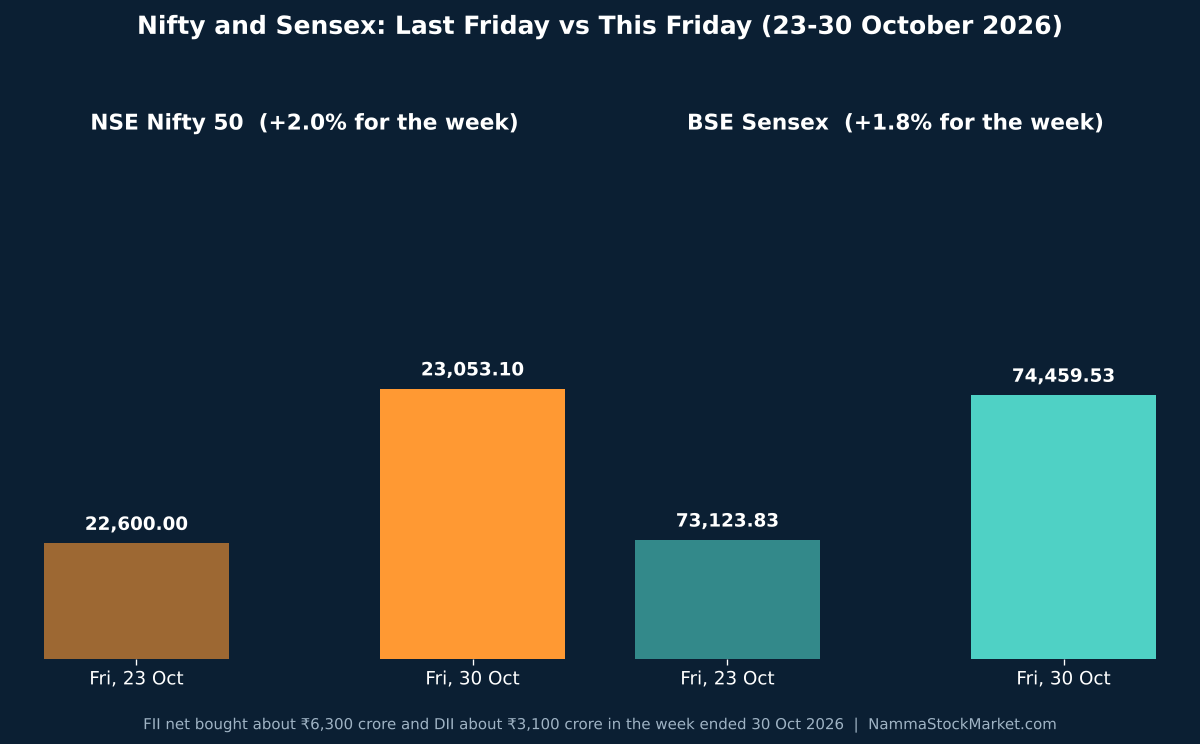
Nifty Midcap 100 fell about 0.8-0.9% and Nifty Smallcap 100 fell close to 2% for the week, even as the main indices rose. Nifty IT was the star performer, up more than 2% on Friday alone as Wipro, Coforge and Infosys all jumped, while Nifty Pharma also gained. On the other side, Nifty Metal, Nifty Realty, Nifty Bank, Nifty Auto and Nifty FMCG all ended lower on Friday, according to Business Standard and HDFC Sky market reports.
2. GIFT Nifty and Global Cues for Monday Morning
Simple point: before the Indian share market opens at 9:15 AM IST, look at GIFT Nifty (the Nifty futures contract that trades out of Gujarat’s GIFT City almost 24 hours a day). It gives you the first hint of how Nifty 50 and Sensex might open on Monday. Also check how Friday’s US markets (Dow, Nasdaq) closed and any fresh comments from the US Fed, since global cues often set the mood for Dalal Street’s opening bell. Brent crude oil was trading near $116 a barrel on Friday, so watch if that cools off or climbs further over the weekend.
3. FII and DII Flows: Foreign Investors Turn Buyers Again
This is the biggest story of the week. FIIs (foreign institutional investors) net bought around ₹6,300 crore worth of Indian shares in the week ended 30 October, after being net sellers for roughly ten weeks in a row. DIIs (domestic institutional investors — mainly mutual funds and insurance companies) also stayed net buyers, adding around ₹3,100 crore. For the full month of October, FIIs were still net sellers of about ₹45,162 crore, while DIIs net bought about ₹62,220 crore, which is the main reason the market held up despite the foreign outflows. Keep an eye on the daily FII/DII numbers on the NSE India and BSE India websites each evening — if FII buying continues into this week, it would be a genuine trend change, not just a one-week bounce. This is exactly the kind of number to track for your Nifty next week planning, since sustained FII buying usually supports the broader market.
4. India VIX: The Fear Gauge Is Ticking Higher
India VIX is often called the market’s “fear gauge” — it tells you how much volatility traders expect in the next 30 days. It rose through last week to around 15.5-16, up roughly 3% from levels near 15 earlier in the week. A rising VIX along with a rising Nifty is a bit unusual and suggests traders are buying some protection even while the market goes up. If you trade options, this is worth watching, since a jump in VIX usually means wider price swings ahead.
5. Bank Nifty and Tuesday’s Nifty Weekly F&O Expiry
NSE’s Nifty weekly options now expire on Tuesdays, so this week’s weekly expiry falls on Tuesday, 3 November 2026. Bank Nifty actually lagged the broader market last week, ending lower even on days Nifty and Sensex gained, as some investors booked profits in banking stocks ahead of more Q2 results. Before you take any F&O (futures and options) positions this week, check the open interest (OI) build-up and the PCR (put-call ratio) on the NSE option chain — a PCR below 1 generally means more call writing (bearish bias), while above 1 suggests more put writing (bullish bias). Also check the F&O ban list on the NSE website each morning before trading in stock futures and options; stocks that cross a certain open interest limit get added there and intraday behaviour can get choppy.
6. BSE Sensex Expiry and Lot Size Reminder
Alongside Nifty’s Tuesday expiry, the BSE Sensex weekly contract expires on Thursday, 5 November 2026. If you trade both NSE and BSE derivatives, mark both days on your calendar, since expiry days often bring sharp, fast moves in the last hour of trade. A quick reminder for newer traders: always check the current lot size before placing an order, since exchanges revise lot sizes from time to time, and a wrong lot size assumption can throw off your whole trade.
7. Rupee vs US Dollar and Brent Crude Oil
The rupee (₹) has been trading in a fairly tight band against the US dollar, closing around ₹95.2-95.5 per US dollar in the days leading into the weekend, with RBI intervention and crude oil prices being the two big swing factors traders are watching. Brent crude, meanwhile, has climbed back above $113-116 a barrel on Middle East supply worries. A weaker rupee and costlier crude together usually pressure import-heavy sectors like paints, tyres and aviation, so if you hold stocks in these sectors, keep half an eye on both numbers this week.
8. Gold Price Check for Your Portfolio
Gold has stayed firm, with 24-karat gold trading near ₹1,42,800-₹1,43,200 per 10 grams in major Indian cities toward the end of October (prices before GST and making charges). If you hold gold ETFs or sovereign gold bonds as part of your portfolio, this is a good week to check how that allocation is doing relative to your equity holdings, especially with so much happening in global markets right now. Gold is one of the simplest hedges to track as part of your Nifty next week portfolio review.
9. Sector Watch: IT and Pharma Lead, Bank and Metal Lag
Let’s see which sectors are in focus. Nifty IT and Nifty Pharma were clearly the strongest performers last week, helped by a weaker rupee (which helps IT exporters) and steady pharma demand. Nifty Metal, Nifty Realty, Nifty Bank, Nifty Auto and Nifty FMCG all cooled off. If this pattern continues into the new week, it is worth tracking whether the rally broadens out to banks and autos, or whether it stays concentrated in IT and pharma names alone — that difference matters a lot for how healthy the rally really is.
10. Q2 FY27 Results: SBI Leads a Busy Earnings Week
Quarterly results season (July-September quarter, called Q2 FY27 in the Indian financial year that runs April to March) is still in full swing. State Bank of India (SBI) is set to announce its Q2 and half-year results on Tuesday, 3 November 2026, with its board meeting in Mumbai that day. Several other companies across sectors are also due to report through the week. Results day moves can be sharp in either direction, so if you hold any of these stocks, it is worth checking the exact announcement date rather than assuming it will fall on a particular day.
11. Mainboard IPOs Listing This Week (2-6 November)
The primary market stays busy this week with five mainboard IPOs set to list on NSE and BSE. Here’s the quick table:
| Company | Price Band (₹) | Lot Size | Listing Date |
|---|---|---|---|
| EAAA India Alternatives | ₹1,585-1,665 | 9 shares (~₹14,985) | Monday, 2 Nov |
| BLS Polymers | ₹142-150 | 100 shares (~₹15,000) | Tuesday, 3 Nov |
| SFC Environmental Technologies | ₹313-330 | 45 shares (~₹14,850) | Tuesday, 3 Nov |
| M.K.Sons Fine Jewels | ₹153-162 | 91 shares (~₹14,742) | Wednesday, 4 Nov |
| Bombay Coated and Special Steels | ₹78-82 | 182 shares (~₹14,924) | Thursday, 5 Nov (allotment 3 Nov) |
If you applied for any of these, check your IPO allotment status on the registrar’s website or your demat account app, and watch the IPO GMP (grey market premium — an unofficial indicator of likely listing gains or losses) only as a rough guide, never as a guarantee of listing day performance.
12. SME IPO to Watch on NSE Emerge and BSE SME
On the smaller end of the primary market, Vedant Poly Fabs is opening its SME IPO on Monday, 2 November and closing on Wednesday, 4 November, looking to raise about ₹56.68 crore. SME IPOs (small and medium enterprise IPOs, listed on NSE Emerge or BSE SME) carry higher risk and lower liquidity than mainboard issues, so if you are new to SME investing, read the offer document carefully and never invest more than you can afford to lock in for a while.
13. NSE/BSE Holiday Check and a SIP/Demat Safety Reminder
Good news for traders: there is no NSE or BSE trading holiday between 2 and 6 November 2026, so markets stay open all five days. The next holiday is Diwali Balipratipada on Monday, 9 November, with the special one-hour Diwali Muhurat trading session expected on Sunday evening, 8 November (exact timing is announced by the exchanges closer to the date). If you invest through a mutual fund SIP (systematic investment plan), there is no need to pause it for a volatile week — SIPs work exactly because you keep investing a fixed amount regardless of the market’s mood. This is also a good week for a quick demat account safety check: confirm your mobile number and email on your demat and trading account are up to date, turn on two-factor authentication if you have not already, and never share your OTP, password or PIN with anyone promising “guaranteed returns.”
Quick Nifty Next Week Checklist for Monday Morning
- Check GIFT Nifty before 9:00 AM IST for the likely opening direction.
- Look at Friday’s US markets close and weekend Fed commentary.
- Note Tuesday, 3 November as Nifty’s weekly F&O expiry, and Thursday, 5 November for Sensex.
- Track SBI’s Q2 results reaction on Tuesday.
- Watch Brent crude oil and the rupee-dollar level.
- Check daily FII and DII numbers on the NSE and BSE websites each evening.
- If you applied for an IPO this week, check your allotment status before the listing date.
Frequently Asked Questions
What time does NSE and BSE open on Monday?
Both NSE and BSE open at 9:15 AM IST and close at 3:30 PM IST, Monday to Friday. There is a pre-open session from 9:00 AM to 9:15 AM IST where opening prices are discovered.
Is there any market holiday next week on NSE and BSE?
No. There is no trading holiday between 2 and 6 November 2026. The next holiday is Diwali Balipratipada on Monday, 9 November, with Muhurat trading expected on the evening of Sunday, 8 November.
Which sectors to watch in the Indian share market next week?
Nifty IT and Nifty Pharma were last week’s leaders and are worth tracking for follow-through. Nifty Bank, Nifty Metal, Nifty Realty and Nifty Auto cooled off and are worth watching for any signs of a turnaround.
When is the Nifty weekly F&O expiry this week?
Nifty’s weekly options expire on Tuesday, 3 November 2026, since NSE moved the weekly expiry day to Tuesday. The BSE Sensex weekly contract expires on Thursday, 5 November 2026.
Why did FII buying matter so much last week?
FIIs had been net sellers for about ten straight weeks before turning net buyers of around ₹6,300 crore in the week ended 30 October. Combined with continued DII buying, this helped the Nifty and Sensex rally, though one week of buying is not yet confirmation of a longer trend.
That’s your Nifty next week checklist for 2-6 November 2026. Markets can change quickly, so treat all levels and dates here as a guide, and always confirm with live data before you act. Keep following NammaStockMarket through the week for daily Nifty and Sensex updates, FII/DII numbers, and IPO news as it happens.
This article is for learning and information only. It is not investment advice. Please do your own research or talk to a SEBI registered advisor before you invest.
RELATED POSTS
View all


Share Market Next Week: 13 Things to Check as Jio Lists (26-30 Oct)
October 25, 2026 | by NammaStockMarket

Nifty Next Week: 12 Things to Check After 7 Falls (28 Sep-2 Oct)
September 27, 2026 | by NammaStockMarket

Nifty Next Week: 13 Things to Check as Q2 Results Begin (12-16 Oct)
October 11, 2026 | by NammaStockMarket