

Nifty Next Week: 14 Things to Check After 9-Month High (23-27 Nov)
November 22, 2026 | by NammaStockMarket

Last week felt like a party on Dalal Street. The NSE Nifty 50 and BSE Sensex both closed at their highest levels in nine months, Bank Nifty hit a fresh record, and foreign investors poured in money like never before this month. If you are wondering what matters for Nifty next week, or you are a trader, an investor, or someone who just opened a demat account and trading account and is trying to make sense of the Indian stock market, this is your simple, no-jargon guide to the week starting Monday, 23 November 2026.
Let’s see how we got here, and what you should keep an eye on before the opening bell. (If you missed it, catch up on Friday’s closing report and our checklist for last week.)
How Last Week Went on NSE and BSE
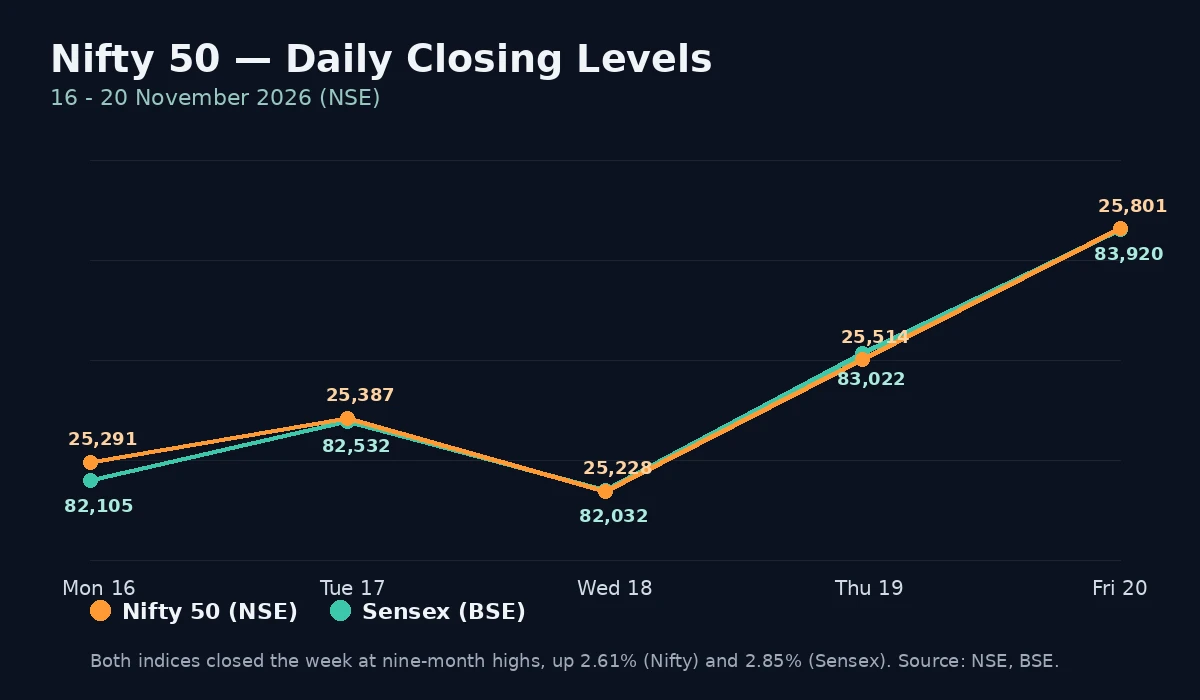
The Nifty 50 gained 656.30 points, or 2.61%, to close at 25,800.60. The Sensex did even better in points terms, jumping 2,327.26 points, or 2.85%, to settle at 83,919.71. This was the fourth straight weekly gain for both indices, and they ended at their best levels since February 2026. Bank Nifty was the real hero of the week, surging 5.90% to 64,635.20 and touching a fresh all-time intraday high of 64,680.80 on Friday.
| Index | Close (20 Nov) | Weekly Change | Weekly % |
|---|---|---|---|
| NSE Nifty 50 | 25,800.60 | +656.30 | +2.61% |
| BSE Sensex | 83,919.71 | +2,327.26 | +2.85% |
| NSE Bank Nifty | 64,635.20 | +3,601.10 | +5.90% |
Now that you know how we got here, let’s get into the 14 things to check for Nifty next week before the Indian share market opens on Monday.
1. Nifty Next Week: Can the Rally at 9-Month Highs Reach 26,000?
The Nifty 50 broke out of its recent range and closed the week at its highest point, 25,800.60. If it can hold above Friday’s high of 25,808 in the coming sessions, the next big psychological level to watch is 26,000 on the Nifty. But if the index slips and closes below Friday’s low of 25,345, it could pull back towards the 25,132-25,185 zone. Simple point: as long as Nifty stays above the 25,300-25,400 band, the mood stays positive.
2. Bank Nifty’s 5.9% Surge Was the Real Engine
Bank Nifty (the index of NSE’s top banking stocks) rose nearly 6% in a single week and touched a lifetime high of 64,680.80. PNB, Axis Bank, SBI, HDFC Bank and ICICI Bank were among the names that gained between 3% and 8%. Analysts point to renewed foreign buying, improving loan growth, better asset quality, and new foreign-currency deposits that gave banks more funds to lend. Keep an eye on this: if banks keep leading, the broader market usually follows.
3. FII Buying Crosses ₹1.11 Lakh Crore for November
FII stands for Foreign Institutional Investor — big foreign funds that buy and sell Indian shares. They bought a net ₹32,646 crore worth of Indian equities in the cash market during 16-20 November alone, taking their buying for the whole month of November to a massive ₹1,11,949 crore (that’s over ₹1.11 lakh crore). Friday, 20 November, alone saw net FII buying of ₹10,308.42 crore, the single biggest day of buying in the week. This wave of foreign money is one of the main reasons behind the rally.
4. DII Selling Is the Other Side of the Trade
DII means Domestic Institutional Investor — Indian mutual funds, insurance companies and similar large local investors. While FIIs were buying heavily, DIIs sold a net ₹12,698 crore worth of shares during the week, taking their selling for November so far to ₹61,787 crore. In simple terms, foreign money is driving this rally while domestic funds are booking some profit. This tug of war is worth tracking, because if FII buying slows down even a little, DII selling could start to matter more.
5. Sector Check: Banks, FMCG and Auto Lead; Metals and IT Lag
Not every sector had a good week. Financial Services and FMCG (fast-moving consumer goods, like soaps, biscuits and daily-use products) both rose about 3.6%, and Auto added around 3.0%. On the other hand, Metals fell nearly 2.9% and IT (information technology) stocks slipped about 1.9%, along with capital market-related stocks. Simple point: this rally has been led by banks and consumption-linked sectors, not by the whole market equally, so check which sector your stocks belong to before assuming they will move the same way as the Nifty.
6. India VIX Stayed Calm — What That Means for You
India VIX is NSE’s “fear index” — it tells you how much volatility (ups and downs) traders expect in the next 30 days. Through the week, India VIX moved in a fairly calm 15-16 range, well below the highly volatile levels seen earlier in the year. A calm VIX usually means traders expect smoother moves ahead, but it can also mean the market has become a bit complacent — so don’t let a quiet VIX make you ignore risk management completely.
7. Monthly F&O Expiry Moves to Monday, 23 November
Normally, the November F&O (futures and options) contracts on NSE would expire later in the month, but because Tuesday, 24 November is a market holiday, the monthly expiry has been preponed to Monday, 23 November. Expiry days often see extra volatility, especially in index options and the stocks with high open interest (OI — the total number of outstanding derivative contracts). If you trade F&O, mark Monday as a day to watch your positions closely, since it is both expiry day and the first trading day of the week.
8. NSE and BSE Shut on Tuesday, 24 November
Both the NSE and BSE will remain closed on Tuesday, 24 November 2026, for Guru Nanak Jayanti. This makes it a shorter trading week — just four sessions (Monday, Wednesday, Thursday and Friday) instead of five. Plan your trades, SIP dates and any pending transactions around this holiday.
9. Two Mainboard IPOs Plus an SME IPO Open This Week
The primary market (where new companies raise money through an IPO, or initial public offering) stays busy. Integris Medtech, a medical devices company backed by PE firm Everstone Capital, is expected to open its ₹600 crore+ IPO (fresh issue plus an offer for sale, or OFS, of 1.08 crore shares) later in the week. Foodlink F&B Holdings, which runs luxury food services and catering businesses, is set to announce its price band and open its ₹192 crore fresh issue plus OFS of up to 88,35,382 shares soon after. On the SME IPO side (SME IPOs are smaller company listings on NSE Emerge or BSE SME), Shree Siddhivinayak Greentech Industries opens its ₹93.66 crore issue on 25 November and closes on 27 November, with a price band of ₹130 to ₹142 per share and a lot size of 1,000 shares.
| IPO / Listing | Price Band | Key Date This Week |
|---|---|---|
| Shree Siddhivinayak Greentech (SME IPO) | ₹130 – ₹142 | Opens 25 Nov, closes 27 Nov |
| Crystal Crop Protection | ₹259 – ₹272 | Lists NSE & BSE, 26 Nov |
| Mahanadi Coalfields | ₹129 – ₹136 | Lists NSE & BSE, 27 Nov |
| Integris Medtech (mainboard) | To be announced | Opens around 27 Nov |
10. Mahanadi Coalfields and Crystal Crop Protection List This Week
Listing day is when a company’s shares start trading on the stock exchanges for the first time. Crystal Crop Protection, an agri-inputs company, lists on NSE and BSE on Thursday, 26 November, with its IPO priced between ₹259 and ₹272 per share. Mahanadi Coalfields, a wholly owned subsidiary of Coal India and one of the largest single coal-producing companies in the country, lists on Friday, 27 November, after an ₹8,981.12 crore offer for sale priced between ₹129 and ₹136 per share. Both listings will be watched closely for their IPO GMP (grey market premium, an unofficial indicator of likely listing gains) trends and Day 1 price action.
11. Crude Oil’s Third Straight Weekly Fall Is Good News for India
Brent crude, the global oil benchmark, fell for a third consecutive week, with the January contract settling near $92.57 a barrel, down 3.4% for the week. Lower crude matters a lot for India since we import most of our oil — cheaper crude usually means less pressure on the rupee and lower inflation, both of which are good for the Indian share market. That said, attacks on energy infrastructure in Saudi Arabia, tanker incidents near the Strait of Hormuz, and damage to Russian refineries remain risks that could push prices back up suddenly.
12. Rupee Holds Firm Near 93.3-93.4 Against the Dollar
The rupee (₹) strengthened through the week, helped by the heavy FII inflows and softer crude oil prices, moving in the 93.3 to 93.4 per US dollar zone by Thursday’s close. A stronger rupee is generally good news for companies that import raw materials or have dollar debt, while it can be a mild headwind for IT and pharma exporters who earn in dollars.
13. Global Cues: US PCE Data, GDP Numbers and a Short US Week
Globally, the Dow, Nasdaq and the US Fed’s policy signals continue to be watched as “global cues” that affect Indian markets, even though the Indian stock market moves on its own fundamentals too. In the coming week, the US releases its second estimate of Q3 GDP and the PCE inflation reading (the Fed’s preferred inflation gauge) on Wednesday, 25 November, with markets expecting PCE inflation around 3.8% year-on-year. US markets will also be shut on Thursday, 26 November, for Thanksgiving, and will close early on Friday, 27 November — so expect somewhat thinner global trading volumes towards the end of our week too. On the domestic side, India’s flash manufacturing, services and composite PMI (Purchasing Managers’ Index, a gauge of business activity) numbers are due on Monday, 23 November.
14. GIFT Nifty and Market Breadth — a Quiet Early Signal
GIFT Nifty (the Nifty contract traded at Gujarat’s international exchange, used as an early indicator of how NSE and BSE might open) will be the first thing worth checking every morning this week — our daily pre-market reports track this every day. Alongside that, market breadth — the share of Nifty stocks trading above their key moving averages — improved to 86% by Friday, up from 84% a week earlier, which is a healthy sign, though most of the strength so far has been concentrated in large-cap stocks rather than spread evenly across midcaps and smallcaps.
Key Dates to Mark This Week
| Date | Event |
|---|---|
| Mon, 23 Nov | November F&O monthly expiry (moved up); India flash PMI data |
| Tue, 24 Nov | NSE and BSE closed — Guru Nanak Jayanti |
| Wed, 25 Nov | US Q3 GDP (2nd estimate) and PCE inflation data; Shree Siddhivinayak Greentech SME IPO opens |
| Thu, 26 Nov | Crystal Crop Protection lists on NSE & BSE; US markets closed for Thanksgiving |
| Fri, 27 Nov | Mahanadi Coalfields lists on NSE & BSE; weekly Nifty/Bank Nifty options expiry; US markets close early |
Quick Checklist for Monday Morning
- Check GIFT Nifty before 9:15 AM IST to get a sense of how NSE and BSE may open.
- Remember Monday is also the November F&O monthly expiry — expect extra volatility in options.
- Mark Tuesday, 24 November as a market holiday — no trading on NSE or BSE.
- Watch Bank Nifty — it led last week’s rally and is close to its record high.
- Track daily FII and DII data every evening on NSE’s website to see if the foreign buying streak continues.
- If you run a mutual fund SIP (systematic investment plan), remember your SIP date is unaffected by market holidays — it simply processes on the next working day.
- Double-check your demat account and trading account logins, and never share your password or OTP with anyone claiming to help you “activate” your account.
Frequently Asked Questions
What time does NSE and BSE open on Monday?
Both the NSE and BSE open at 9:15 AM IST and close at 3:30 PM IST, Monday to Friday, with a pre-market session from 9:00 to 9:15 AM IST. This applies on Monday, 23 November, since it is a trading day — only Tuesday, 24 November is a holiday this week.
Is there any market holiday next week on NSE and BSE?
Yes. NSE and BSE will be closed on Tuesday, 24 November 2026, for Guru Nanak Jayanti. All other weekdays — Monday, Wednesday, Thursday and Friday — are regular trading days.
Which sectors should I watch in the Indian share market next week?
Based on last week’s trend, Banking, Financial Services, FMCG and Auto were the strongest sectors, while Metals and IT lagged. Keep an eye on whether banks can hold their gains, since Bank Nifty has been the main driver of this rally.
Why did FIIs buy so much in November?
A mix of factors helped: easing crude oil prices, a stronger rupee, improving corporate earnings, attractive valuations after earlier selling, and some global investors rotating money away from expensive overseas technology stocks and into Indian banks and consumption names.
What should a new investor do in a week like this?
There is no need to chase the rally. If you invest through a mutual fund SIP, simply continue it as usual. For direct stock investors, it helps to review your portfolio, check which sectors you are overweight or underweight in, and avoid taking large fresh positions purely based on recent gains.
Before You Go
That’s our full Nifty next week checklist for 23-27 November 2026 — a short trading week with a monthly F&O expiry, a market holiday, two new IPOs, two big listings, and a market sitting at nine-month highs. Keep following NammaStockMarket for daily pre-market reports and more easy-to-understand updates on the Indian stock market through the week.
This article is for learning and information only. It is not investment advice. Please do your own research or talk to a SEBI registered advisor before you invest.
RELATED POSTS
View all

Nifty Next Week: 13 Things to Check as FII Buying Returns (2-6 Nov)
November 1, 2026 | by NammaStockMarket
Nifty & Sensex Next Week: 12 Things to Check After FII Rally (9-13 Nov)
November 8, 2026 | by NammaStockMarket

Nifty Sensex Next Week: 12 Must-Check Things After 6 Falls (21-25 Sep)
September 20, 2026 | by NammaStockMarket